
Introduction
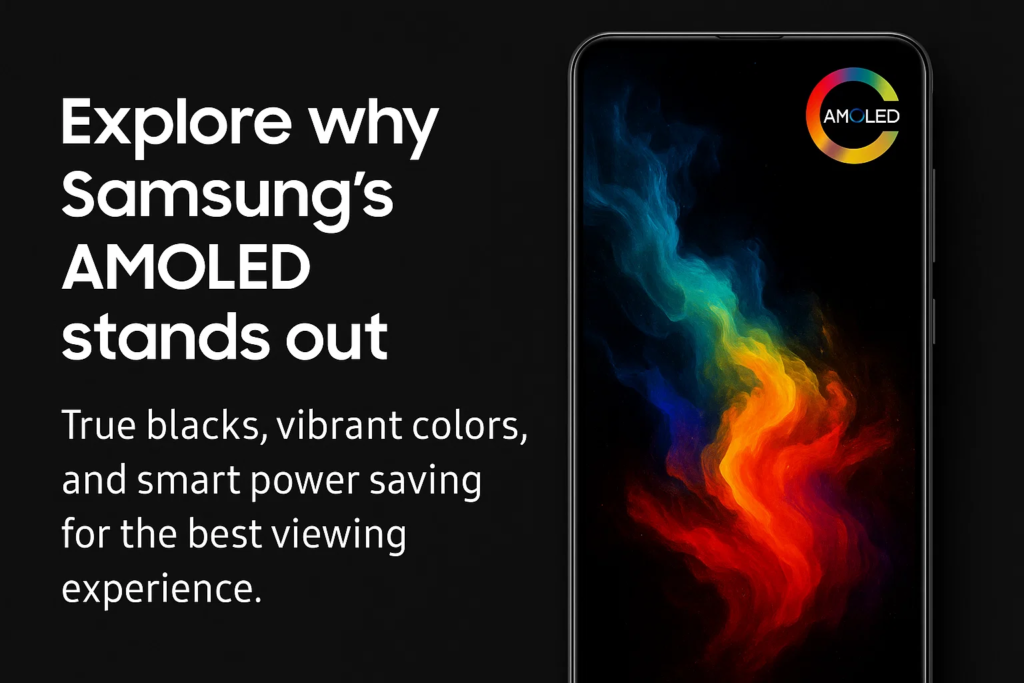
When you pick up a Samsung smartphone, the first thing that grabs your attention is the display. The colors pop, blacks look impossibly deep, and the brightness dazzles even under harsh sunlight. Behind this magic lies Samsung’s AMOLED technology, a display innovation that has not only redefined how we see our devices but also set an industry-wide benchmark.
Understanding AMOLED Technology
What is AMOLED?
AMOLED stands for Active Matrix Organic Light-Emitting Diode. Unlike traditional LCD panels that require a backlight, AMOLED pixels generate their own light. This means every pixel acts like a tiny bulb, switching on and off independently.
How it Differs from LCD
LCDs rely on a uniform backlight shining through a layer of liquid crystals. The result? Blacks are never truly black, and power efficiency suffers. AMOLED removes that limitation, creating images with superior contrast and sharper depth.
Independent Pixel Lighting Explained
Each pixel in an AMOLED display can shut off entirely when displaying black, producing true blacks and saving power simultaneously. It’s like turning off individual light switches in a room instead of keeping all lights on.
Core Working Principle
Pixel-Level Self-Emission
Because each pixel lights up on its own, AMOLED screens provide precise control over brightness and color on a microscopic level.
Achieving True Blacks and Infinite Contrast
When a pixel turns off, it emits no light—meaning the contrast ratio is virtually infinite. This is why watching movies or playing games on an AMOLED feels cinematic.
Energy Efficiency Through Selective Lighting
By only powering the pixels that are in use, AMOLED displays naturally save energy compared to backlit LCDs. This makes them perfect for modern smartphones that demand both performance and efficiency.
Key Advantages of Samsung AMOLED
Dynamic AMOLED 2X
Samsung’s premium display branding, Dynamic AMOLED 2X, brings cutting-edge visual performance.
HDR10+ Support
High Dynamic Range ensures richer details in shadows and highlights, making videos breathtakingly realistic.
High Peak Brightness for Outdoor Visibility
Even in direct sunlight, Samsung AMOLED displays maintain clarity thanks to peak brightness levels that rival professional monitors.
LTPO Technology
Adaptive Refresh Rate (1Hz–120Hz)
From scrolling through feeds to playing high-frame-rate games, LTPO makes the display ultra-responsive. At the same time, it can drop to 1Hz for static images to save battery.
Power-Saving in Static Content
Reading an article? The screen conserves power by slowing refresh rates—without compromising clarity.
Smoothness in Scrolling and Gaming
Gamers especially love LTPO AMOLED, as it combines speed with efficiency, giving the best of both worlds.
Color Accuracy
Factory Calibration
Each Samsung AMOLED screen undergoes precise factory calibration, ensuring that colors look exactly as intended.
Wide DCI-P3 Coverage
Covering more of the DCI-P3 color spectrum means content creators, photographers, and videographers get reliable, professional-grade visuals.
Benefits for Content Creators
For designers and editors, accurate color reproduction means they can trust what they see on-screen will match the final product.
Why Samsung Sets the Industry Standard
Samsung Display as a Global Supplier
Samsung Display doesn’t just make screens for its own smartphones. It supplies AMOLED panels to some of the biggest brands in the world, including Apple, Google, and OnePlus.
Adoption in Flagship Devices by Other Brands
The fact that competitors rely on Samsung’s AMOLED panels is proof enough of their superior quality.
Years of R&D Investment
Samsung has poured billions into display research, staying years ahead of rivals and setting trends that others follow.
Comparisons with Other Display Technologies
AMOLED vs LCD
- LCD: backlight, washed-out blacks, lower efficiency.
- AMOLED: self-lighting pixels, true blacks, superior energy use.
AMOLED vs OLED from Competitors
While other brands offer OLED panels, Samsung’s AMOLED leads with better brightness, longer lifespan, and superior calibration.
Advantages in Durability and Innovation
Samsung constantly improves screen durability, whether through Gorilla Glass integration or foldable display engineering.
Future of AMOLED
Next-Gen Foldable Displays
Samsung is pioneering foldable AMOLED panels, redefining what smartphones and tablets can look like.
Micro-Lens Array and Energy Efficiency
Emerging tech like micro-lens arrays promise even brighter screens with reduced power consumption.
Integration with Under-Display Sensors
Future AMOLED screens will seamlessly hide cameras and fingerprint sensors beneath the panel, creating uninterrupted all-screen designs.
Conclusion
Samsung’s AMOLED displays aren’t just screens—they’re the gold standard of mobile visual technology. With innovations like Dynamic AMOLED 2X, LTPO adaptive refresh rates, and unrivaled color accuracy, Samsung has built displays that others aspire to match. Whether you’re a gamer, a movie lover, or a professional creator, AMOLED ensures the experience is nothing short of stunning.
FAQs
What makes AMOLED better than LCD?
AMOLED provides true blacks, higher contrast, and better energy efficiency compared to backlit LCD screens.
Does AMOLED consume more battery?
Not necessarily. Since black pixels turn off completely, AMOLED can actually save battery in dark-mode usage.
Why is Samsung considered the leader in display tech?
Samsung invests heavily in R&D and supplies AMOLED panels to top smartphone brands worldwide.
What is LTPO in AMOLED screens?
LTPO (Low-Temperature Polycrystalline Oxide) enables adaptive refresh rates, balancing smoothness and power efficiency.
Will AMOLED still dominate in the future?
Yes. With foldable designs, micro-lens arrays, and under-display tech, AMOLED is evolving to stay ahead.



