Introduction: The Legacy of the Galaxy S Series
Since its dramatic debut in 2010, the Samsung Galaxy S series has stood as a benchmark in the world of Android smartphones. More than just a product line, the Galaxy S series represents Samsung’s relentless pursuit of technological excellence while simultaneously delivering designs that captivate the human eye. It’s not just about speed or specs—it’s about creating a symphony where hardware, software, and user experience harmonize seamlessly.
The Dawn of a New Era (2010-2014)
Galaxy S (2010): The Pioneer
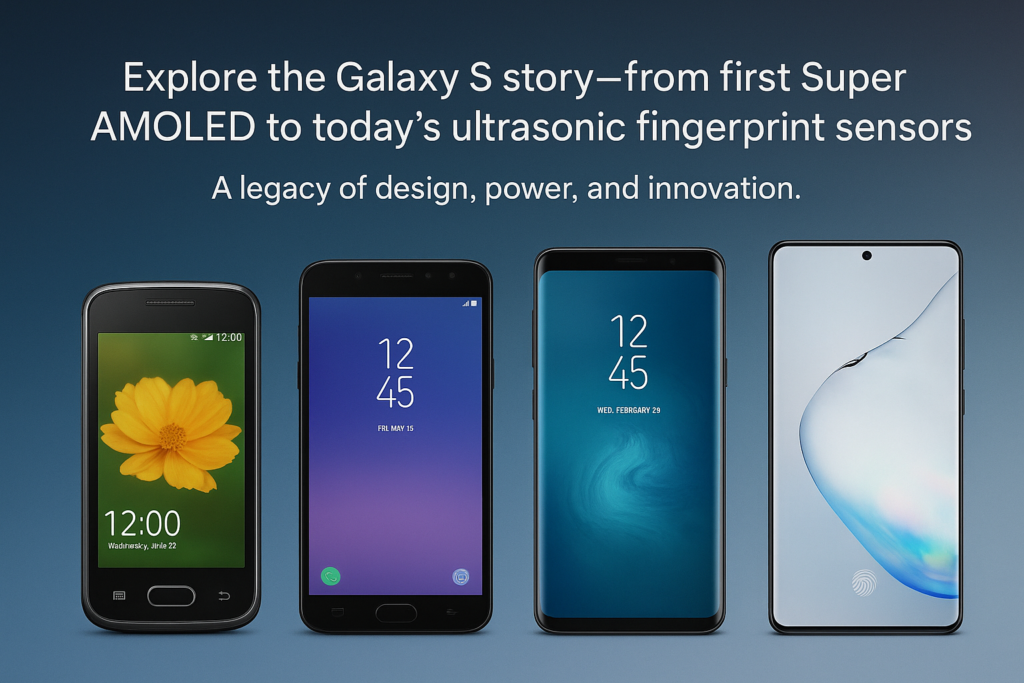
The original Samsung Galaxy S (i9000) marked a bold step into the smartphone arena. With its 4-inch Super AMOLED screen, powered by the Hummingbird processor, it redefined what Android could be. For its time, the display was groundbreaking—vivid colors, deep blacks, and energy efficiency that blew away LCD rivals.
Fingerprint recognition? Not yet. At this stage, biometrics hadn’t entered the mobile mainstream. But the Galaxy S had laid the foundation for what was to come.
Galaxy S5 (2014): Introducing Fingerprint Security
By 2014, Samsung was ready to make biometrics part of everyday life. The Galaxy S5 introduced swipe-based fingerprint scanning on its Home key. It was innovative, but far from perfect—accuracy and speed left much to be desired. Still, it was the spark that ignited Samsung’s journey into fingerprint tech. Alongside that, the S5 brought IP67 water resistance and a heart-rate sensor, signaling Samsung’s vision of smartphones as health companions, not just communication tools.
Design Evolution and Fingerprint Advancements (2015-2017)
Galaxy S6 & S6 Edge: Glass, Metal, and Edge Innovation
2015 was the year of transformation. The Galaxy S6 series abandoned plastic for glass-and-metal bodies, setting a new premium standard. More importantly, the S6 Edge unveiled the dual curved display, an aesthetic revolution that also introduced new interactive functions.
Fingerprint scanning evolved, too. The S6 ditched the clumsy swipe method and adopted press-based capacitive sensors. Finally, unlocking your phone became smooth, fast, and reliable.
Galaxy S8 & S8+: The Birth of the Infinity Display
2017’s Galaxy S8 delivered a design language that defined the future: the Infinity Display. Nearly bezel-less with curved edges, it achieved breathtaking immersion. But this beauty came with a compromise—the Home key was gone, and fingerprint recognition moved awkwardly to the back, near the camera. Many users complained about smudging the lens, but the innovation of full-screen design made it a necessary step.
Full-Screen Innovation and Beyond (2019-2022)
Galaxy S10: The Ultrasonic Fingerprint Revolution
The Galaxy S10 (2019) marked a turning point with the world’s first ultrasonic in-display fingerprint sensor. Unlike optical sensors that relied on light, ultrasonic tech used sound waves to map the ridges of your fingerprint in 3D. The result? Faster, more secure, and resistant to dirt or moisture. It was a glimpse of biometric perfection.
Galaxy S22 Ultra: Merging the Note Legacy
By 2022, the S22 Ultra was more than a smartphone—it was a productivity powerhouse. It integrated the S Pen from the discontinued Note series, appealing to power users and creators alike. Its Dynamic AMOLED 2X display with adaptive refresh rates up to 120Hz represented the pinnacle of screen technology. The fingerprint sensor? A highly optimized version of Qualcomm’s ultrasonic solution, faster and more accurate than ever before.
Towards the Future: Minimalism and Integration (2023-Present)
Galaxy S23 Ultra: Refined Power and Durability
The Galaxy S23 Ultra (2023) cemented its dominance with a custom Snapdragon 8 Gen 2 “for Galaxy.” Not just powerful—it was efficient, cool, and stable, even under heavy gaming loads. The display was shielded by Gorilla Glass Victus 2, making it as durable as it was beautiful.
The fingerprint experience? Samsung doubled down on Qualcomm’s 3D Sonic Sensor Gen 2, expanding the recognition area and speeding up authentication. At this point, unlocking felt almost invisible—an act that blended seamlessly with natural interaction.
The Evolution of Display Technology
From Super AMOLED in 2010 to Dynamic AMOLED 2X today, Samsung has consistently set industry standards. HDR10+, higher brightness, adaptive refresh rates, and blue-light reduction all contribute to making Galaxy displays the gold standard of smartphone screens.
The Fingerprint Journey
- Swipe Scanners (S5): Innovative but clunky.
- Press-to-Unlock (S6/S7): Practical and polished.
- Rear-Mounted (S8/S9): Controversial, but transitional.
- Ultrasonic In-Display (S10 and beyond): Secure, sleek, and futuristic.
Samsung turned fingerprints from a gimmick into an invisible, seamless layer of trust.
Performance Over the Years
From the Hummingbird processor in 2010 to the Snapdragon 8 Gen 2 (for Galaxy) in 2023, performance has skyrocketed. Each generation refined speed, multitasking, and energy efficiency, making Galaxy S devices capable of replacing PCs for many users.
The Role of Galaxy S in Shaping Smartphone Design
The Galaxy S didn’t just follow trends—it set them. The Edge Display, the Infinity Screen, and the move to gesture navigation all began here. Competitors followed, but Samsung often led.
Integration with Lifestyle and Productivity
Features like Samsung DeX transformed smartphones into desktop-like machines, while the S Pen in S22 Ultra elevated productivity and creativity. The Galaxy S became more than a phone; it became a digital hub for work, play, and expression.
Global Impact of the Galaxy S Series
Over the years, the Galaxy S series has not just competed with Apple’s iPhone but has shaped the entire Android ecosystem. Every innovation—from displays to biometrics—echoes across the industry, inspiring rivals and raising consumer expectations.
Key Milestones Recap Table
(Already provided in detail in the original table above—summarizing screen types, fingerprint placement, and navigation evolution.)
Terminology Explained
- Super AMOLED: Slimmer, brighter, and more vivid than AMOLED.
- Dynamic AMOLED: Enhanced with HDR10+ support, higher brightness, and less blue light.
- Navigation Evolution: From physical buttons to capacitive keys, then to virtual pressure-sensitive zones, and finally gesture-only systems.
The Philosophy Behind the Galaxy S Series
If the Galaxy S series were a symphony, the instruments would be processors, screens, and sensors. Each generation refines the melody, balancing aesthetics and technology in perfect rhythm. Samsung’s philosophy is simple: push the boundaries, then make innovation invisible.
Conclusion
The Samsung Galaxy S series isn’t just a product line—it’s a chronicle of mobile evolution. From early experiments with swipe-based fingerprints to today’s near-instant ultrasonic unlocking, from Super AMOLED breakthroughs to adaptive Dynamic AMOLED 2X displays, the S series reflects how far smartphones have come.
It’s not just technology—it’s an experience, a story of how beauty and function can coexist in perfect harmony. Truly, the Galaxy S is a symphony of technology and aesthetics.
5 Unique FAQs
Q1: What was the first Galaxy S phone with a fingerprint sensor?
A1: The Galaxy S5 in 2014 introduced swipe-based fingerprint scanning.
Q2: Which Galaxy S phone first used an ultrasonic fingerprint sensor?
A2: The Galaxy S10 (2019) was the first to feature ultrasonic in-display fingerprint technology.
Q3: Why was the Galaxy S8 fingerprint placement criticized?
A3: It was located near the rear camera, leading to frequent smudges and awkward access.
Q4: How has the Galaxy S display evolved over time?
A4: From Super AMOLED to Dynamic AMOLED 2X with HDR10+ and adaptive refresh rates, Samsung consistently leads in display innovation.
Q5: What makes the Galaxy S22 Ultra special compared to earlier models?
A5: It merged the Note series DNA with an integrated S Pen, creating the ultimate blend of productivity and performance.