Smartphone screens have quietly become the soul of our daily digital lives. We scroll, watch, read, game, and work through them for hours every day. Yet when people talk about “good screens,” the conversation often stops at resolution or refresh rate. In reality, display tuning—the invisible hand behind color, brightness, and comfort—matters just as much, if not more.
So how do Apple, Samsung, Huawei, and Xiaomi differ in their screen tuning philosophies? And more importantly, how do those differences actually feel in real-world use? Let’s break it down in plain English.
Why Smartphone Display Tuning Matters More Than Ever
The Shift from Hardware Specs to Visual Experience
Back in the day, a sharper resolution meant a better screen. Simple. Today, nearly all flagship phones offer OLED panels, high refresh rates, and HDR support. Hardware parity is the new normal.
What sets brands apart now is how they tune those displays. Think of it like cooking: the ingredients are similar, but the flavor depends on the chef.
“Good Screen” — Objective Data vs Subjective Feel
A display can score perfectly in lab tests yet still feel “off” to your eyes. That’s because humans don’t watch spreadsheets—we watch movies, photos, and text. A great screen balances objective accuracy with subjective comfort.
Key Metrics That Define Display Quality
Color Accuracy and Color Gamut
Color accuracy determines how close on-screen colors are to real life, while color gamut defines how many colors a screen can show.
sRGB vs DCI-P3 Explained Simply
- sRGB: Natural, realistic, ideal for photos and web content
- DCI-P3: Wider, more vibrant, commonly used in movies
Most flagships support both, but tuning decides which one dominates by default.
Peak Brightness and HDR Performance
Peak brightness affects outdoor visibility and HDR punch. Numbers matter, but consistency and tone mapping matter more.
Eye Comfort Technologies
PWM Dimming
PWM controls brightness by flickering pixels rapidly. Low-frequency PWM can cause eye strain for sensitive users.
DC-like Dimming and Software Optimization
DC-like dimming reduces flicker at low brightness, often combined with smart software tuning to minimize color shift.
Apple iPhone Display Tuning Philosophy
True Tone and Color Consistency
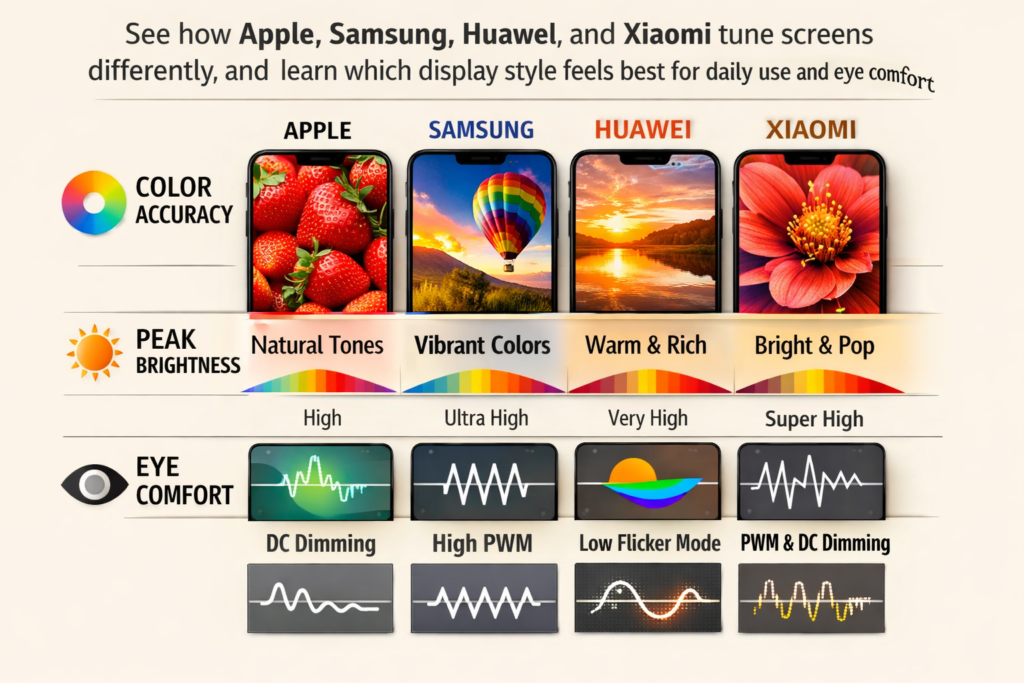
Apple’s displays aim for one thing: consistency. True Tone dynamically adjusts white balance based on ambient light, making the screen feel paper-like rather than glowing.
Brightness Strategy and Outdoor Visibility
While Apple doesn’t always win spec wars, its brightness control is smooth and predictable. HDR highlights are controlled, not flashy.
Apple’s Approach to Eye Protection
Apple avoids aggressive PWM and focuses on natural color temperature shifts. It’s subtle but effective for long sessions.
Real-World Viewing Experience
iPhone screens rarely “wow” in a showroom—but they age gracefully. After hours of use, your eyes feel less tired, which is the real win.
Samsung Galaxy Display Tuning Philosophy
Saturation vs Accuracy
Samsung loves vibrant colors. Blues pop, reds shine, and everything looks Instagram-ready. Accuracy modes exist, but vivid is the default.
Industry-Leading Peak Brightness
Samsung consistently leads in peak brightness, making outdoor visibility excellent and HDR content visually striking.
PWM Dimming and User Sensitivity
Lower PWM frequencies can affect sensitive users, especially at night. Samsung has improved here, but it’s still not for everyone.
Who Loves Samsung Screens the Most
If you love bold visuals, gaming, and cinematic contrast, Samsung screens feel exciting and energetic.
Huawei Display Tuning Philosophy
Balanced Color and Professional Calibration
Huawei sits between Apple and Samsung. Colors are rich but restrained, often calibrated closer to professional standards.
HDR and Contrast Optimization
Huawei focuses on depth rather than brightness alone. Shadows retain detail, highlights feel controlled.
Eye Comfort and PWM Frequency
Higher PWM frequencies and solid eye comfort modes make Huawei screens easier on the eyes over time.
Practical Daily Use Experience
Huawei displays feel calm and premium, especially for reading, browsing, and mixed usage.
Xiaomi Display Tuning Philosophy
Spec-Driven Display Strategy
Xiaomi loves numbers: high brightness, high refresh rate, wide gamut. On paper, it’s impressive.
Custom Color Modes and User Control
Users can tweak color space, temperature, and contrast. It’s great for enthusiasts but overwhelming for casual users.
High-Frequency PWM and DC-like Dimming
Recent Xiaomi flagships shine here, offering strong eye protection options.
Value for Money Perspective
You get a lot of screen for the price, though default tuning may need adjustment for perfectionists.
Side-by-Side Comparison: What Really Feels Different
Color Perception Differences
- Apple: Natural and neutral
- Samsung: Bold and dramatic
- Huawei: Balanced and refined
- Xiaomi: Flexible and customizable
Brightness in Real Life, Not Just Numbers
Samsung wins outdoors, Apple feels consistent indoors, Huawei balances both, Xiaomi impresses for the price.
Long-Term Eye Comfort
Apple and Huawei generally feel easier on the eyes, especially for reading-heavy users.
Choosing the Right Screen for Your Needs
For Photographers and Designers
Apple and Huawei offer the most reliable color accuracy out of the box.
For Gamers and Video Lovers
Samsung’s contrast and brightness deliver maximum visual impact.
For Night Readers and Sensitive Eyes
Huawei and Xiaomi, with high-frequency PWM and DC-like dimming, are strong choices.
The Future of Smartphone Display Tuning
LTPO, AI Calibration, and Adaptive Displays
Displays are becoming smarter, adjusting not just brightness but color and contrast in real time.
From “Wow” to “Comfort First”
The industry is slowly shifting from showroom shock to long-term comfort—and that’s a good thing.
Conclusion
A “good screen” isn’t just about specs—it’s about how it feels after hours of use. Apple prioritizes consistency, Samsung chases visual impact, Huawei seeks balance, and Xiaomi empowers users with choice. Understanding these philosophies helps you choose not just a better phone, but a better daily experience.
FAQs
1. Which brand has the most accurate smartphone display?
Apple and Huawei generally offer the best out-of-the-box color accuracy.
2. Are brighter screens always better?
Not necessarily. Controlled brightness often feels more comfortable than extreme peaks.
3. What is PWM dimming, and should I worry?
Sensitive users may experience eye strain with low-frequency PWM, especially at night.
4. Is AMOLED always better than LCD?
For contrast and efficiency, yes—but tuning still matters more than panel type.
5. Can software updates change display quality?
Absolutely. Display tuning is largely software-driven and can improve over time.