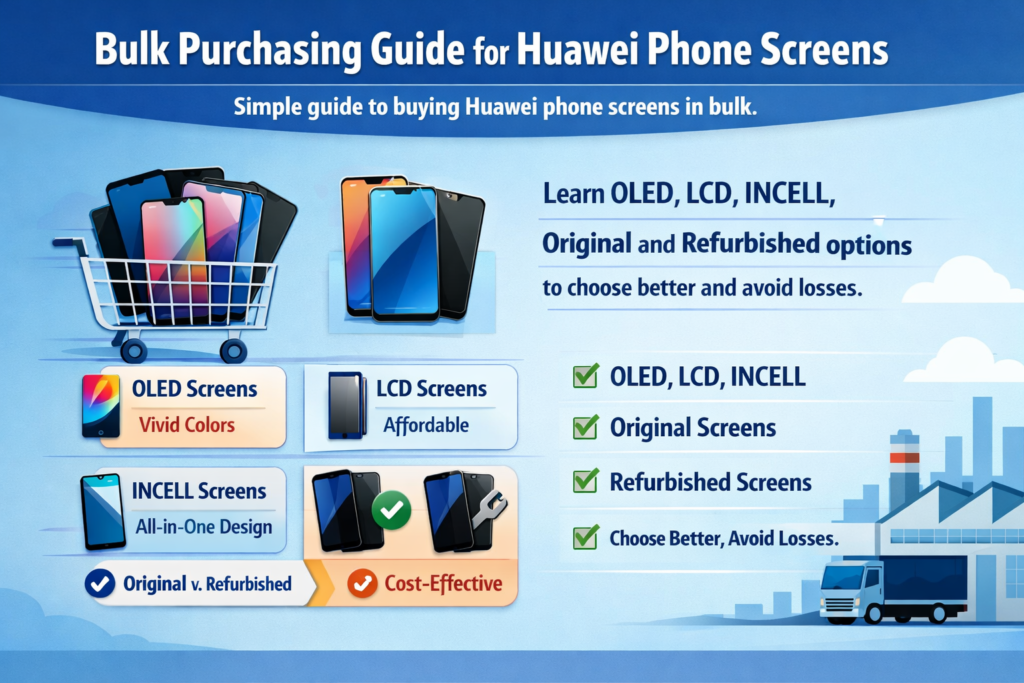
Introduction to Huawei Screen Procurement
If you run a phone repair shop, a wholesale business, or an online accessories store, Huawei phone screens are probably on your regular purchasing list. But have you ever felt confused by all the different terms like OLED, LCD, INCELL, Original, and Refurbished? You’re not alone.
Buying Huawei phone screens in bulk is not as simple as just choosing the cheapest option. Every screen type has different technology, quality level, and price range. Making the wrong choice can lead to unhappy customers, high return rates, and lost profit.
This guide will help you clearly understand Huawei screen specifications from multiple dimensions and make smarter purchasing decisions.
Why Screen Specifications Matter
The screen is the most important part of any smartphone. It directly affects:
- Display quality
- Touch sensitivity
- User experience
- Repair cost
- Customer satisfaction
When you purchase in bulk, understanding these specifications is like having a map before a journey. Without it, you may easily get lost.
Common Problems Faced by Bulk Buyers
Many buyers struggle with questions such as:
- Should I buy OLED or LCD?
- What does INCELL really mean?
- Are refurbished screens safe to use?
- Is “original” always the best option?
Let’s break everything down step by step.
Understanding Screen Specifications by Different Dimensions
Huawei phone screen specifications can be classified into three major dimensions:
- Display Technology
- Touch Technology
- Source and Condition
Understanding these categories is the key to professional purchasing.
Display Technology Dimension: OLED vs TFT/LCD
This is the first and most important classification.
What Is OLED Technology?
OLED stands for Organic Light Emitting Diode. In simple words, every pixel on an OLED screen can light up by itself.
Main features of OLED screens:
- Extremely high contrast
- Bright and vivid colors
- Deep pure blacks
- Thinner and more flexible
- Supports features like Always-On Display
Most high-end Huawei models such as the Pura series, Mate series, and nova high-end versions use OLED screens.
However, OLED screens are more expensive and may have a slight risk of flicker for sensitive users.
What Is TFT/LCD Technology?
TFT/LCD screens rely on a backlight layer to display images.
Key characteristics:
- More natural and softer colors
- No flicker, more eye-friendly
- Thicker structure
- Lower cost
LCD screens are usually used in entry-level or older Huawei models like Enjoy series.
For buyers targeting budget repairs, LCD screens are often the first choice.
Touch Technology Dimension: INCELL
Many buyers misunderstand INCELL as a screen type. Actually, it is not.
How INCELL Works
INCELL is a touch technology used in LCD screens. It integrates the touch layer directly into the LCD panel instead of adding it as a separate layer.
Think of it like combining two layers of a cake into one. The result is a thinner and lighter screen.
Advantages of INCELL LCD
Compared with traditional LCD:
- Thinner body
- Better transparency
- Faster touch response
- More stable performance
INCELL was widely used in some mid-range Huawei models in the past. Today, OLED has become more mainstream, but INCELL LCD is still relevant for specific models.
Source and Condition Dimension: Original vs Refurbished
This classification has nothing to do with technology. It refers to where the screen comes from.
What Is an Original Screen?
An original screen is:
- Produced by the official manufacturer
- Brand new
- Never used
- Comes with full official quality standards
It offers:
- Best display effect
- Perfect touch performance
- Strong durability
- Official warranty
Original screens are ideal for customers who demand top quality.
What Is a Refurbished Screen?
Refurbished screens are recycled from used phones. The display panel is still original, but the outer glass is replaced.
Advantages:
- Much lower price
- Core display quality close to original
Disadvantages:
- Quality varies
- No official warranty
- Depends heavily on refurbishment process
For budget-focused markets, refurbished screens are a common choice.
Core Specification Comparison Table
| Specification Type | Technical Principle | Main Display Features | Suitable Models/Scenarios | Price Range |
|---|---|---|---|---|
| OLED | Self-lighting organic pixels | High contrast, vivid colors, thin, supports AOD | Huawei high-end models like Mate, Pura, nova Pro | High |
| TFT/LCD | Requires backlight | Natural colors, eye-friendly, thicker | Entry-level models like Enjoy series | Low to Medium |
| INCELL | Touch layer embedded in LCD | Thinner than normal LCD | Some older mid-range models | Medium |
| Original | Official brand-new screen | Best quality and warranty | Official repair channels | Highest |
| Refurbished | Recycled original panel | Lower cost, unstable quality | Third-party repair market | Lower |
How to Choose the Right Screen for Bulk Purchasing
Choosing the right screen is all about matching products with customer needs.
Choosing Based on Customer Type
Ask yourself:
- Are your customers high-end users?
- Are they budget repair clients?
- Do they care more about price or quality?
For premium customers → choose Original OLED
For normal users → choose INCELL LCD or quality refurbished
For budget repairs → choose LCD refurbished
Choosing Based on Budget
Your budget strategy determines your product mix.
- High budget → focus on original screens
- Medium budget → mix of original and refurbished
- Low budget → mainly refurbished LCD
A smart bulk buyer always keeps a balanced inventory.
Choosing Based on Model Compatibility
Not every screen fits every phone.
Before purchasing, always confirm:
- Exact Huawei model
- Screen size
- Connector version
- Frame compatibility
Never assume that similar models use the same screen.
Quality Inspection Tips for Bulk Buyers
Buying in bulk without inspection is like buying fruit without tasting it.
Visual Inspection
Check for:
- Scratches
- Dead pixels
- Light leakage
- Color uniformity
A quick visual test can already filter out many problems.
Functional Testing
Always test:
- Touch sensitivity
- Multi-touch
- Brightness adjustment
- Face recognition area
- Fingerprint area (for OLED models)
Supplier Verification
Work only with suppliers who can provide:
- Real photos
- Test reports
- Warranty terms
- Stable after-sales service
A reliable supplier is more valuable than a cheap price.
Pricing Strategies in Screen Procurement
Different markets require different strategies.
High-End Market Strategy
Focus on:
- Original OLED screens
- Premium packaging
- Longer warranty
Profit comes from quality, not quantity.
Mid-Range Market Strategy
A mix of:
- Original LCD
- High-quality refurbished
- INCELL options
This is the most balanced segment.
Budget Market Strategy
Mainly:
- Refurbished LCD screens
- Strict cost control
- Fast turnover
Great for developing countries and price-sensitive customers.
Risks to Avoid When Buying Huawei Screens
Avoiding Non-Original Compatible Screens
The market is full of “compatible screens” that claim to be original.
Problems include:
- Poor brightness
- Bad touch response
- Short lifespan
Always verify authenticity before ordering.
Warranty and After-Sales Risks
Cheap screens without warranty can become very expensive later.
Consider:
- Return policies
- Replacement terms
- Technical support
Saving a few dollars today may cost you hundreds tomorrow.
Working With Reliable Suppliers
Good suppliers should offer:
- Stable stock
- Transparent grading
- Clear communication
- Fast logistics
Building long-term partnerships is the real secret of successful bulk purchasing.
Conclusion
Bulk purchasing Huawei phone screens is both an art and a science. By understanding the three key dimensions—display technology, touch technology, and source condition—you can make confident and profitable decisions.
Whether you choose OLED, LCD, INCELL, original, or refurbished screens depends entirely on your target market and business model.
Remember: the cheapest screen is not always the most profitable one. The right screen for the right customer is.
FAQs
1. Is OLED always better than LCD?
Not necessarily. OLED has better display quality, but LCD is more eye-friendly and cheaper. The best choice depends on customer needs.
2. Are refurbished Huawei screens reliable?
They can be, if sourced from a trustworthy supplier with proper testing procedures.
3. What does INCELL mean exactly?
INCELL is a touch integration technology used in LCD screens, not a separate display type.
4. Should I always buy original screens?
If your customers demand top quality and warranty, yes. For budget markets, refurbished may be more practical.
5. How can I avoid low-quality screens?
Always test samples, verify suppliers, and avoid prices that seem too good to be true.