Perché le specifiche dello schermo dello smartphone sono più importanti che mai 2026 Le specifiche dello schermo contano più che mai 2026
Se ci pensi, IL schermo è l'anima di uno smartphone. È l'unica parte che tocchi centinaia di volte ogni giorno. Leggi i messaggi su di esso, guarda i video su di esso, scorri i social media su di esso, modificare le foto su di esso, e forse anche lavorare da esso. Non importa quanto sia potente il processore o quanti megapixel offra la fotocamera, se lo schermo risulta opaco, offuscato, o scomodo da guardare, l'intera esperienza del telefono sembra più debole. Ecco perché comprendere le specifiche del display dello smartphone è più importante di quanto molte persone credano.
In 2026, la tecnologia dei display continua a evolversi velocemente. I telefoni premium ora arrivano regolarmente 3,000+ luminosità delle lendini, Mentre 120Frequenze di aggiornamento adattative Hz sono diventati comuni tra i dispositivi di fascia medio-alta. Dimmer PWM ad alta frequenza sopra 2,160Hz sta anche diventando più popolare, soprattutto nel comfort di punta OLEDe. citaturn0search0turn0search2
La parte difficile? La maggior parte delle schede tecniche ti lanciano numeri senza spiegare cosa significano effettivamente. PPI, rapporto di contrasto, frequenza di aggiornamento, gamma di colori: può sembrare di leggere un'altra lingua. Questa guida analizza tutto in un inglese semplice, quindi se stai acquistando un nuovo telefono, confronto tra LCD e OLED, o semplicemente curioso della tecnologia di visualizzazione, saprai esattamente cosa cercare.
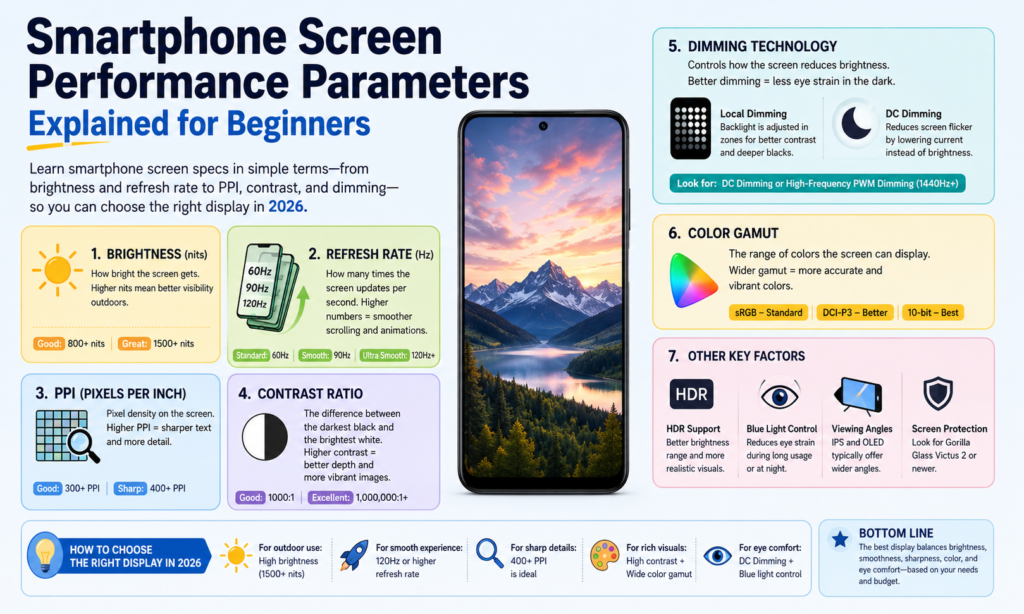
Tecnologia di oscuramento
Che cos'è l'attenuazione CC?
Oscuramento CC regola la luminosità modificando direttamente la corrente elettrica fornita al display. Immaginatelo come abbassare lentamente la manopola di un rubinetto: l'acqua continua a scorrere, solo con meno forza. La luce rimane continua, ma la luminosità diminuisce.
Per Schermi LCD, la luminosità proviene principalmente dalla retroilluminazione, quindi riducendo la tensione o la corrente si riduce la luminosità. Per Schermi OLED, ogni pixel emette la propria luce, quindi la luminosità cambia riducendo la corrente inviata a quei singoli pixel.
Molti utenti preferiscono l'attenuazione DC perché sembra visivamente stabile. Poiché la luce non si accende e si spegne rapidamente, può essere più facile per gli occhi sensibili. Ciò è particolarmente importante per le persone che trascorrono ore a guardare il proprio telefono in ambienti bui.
Il compromesso è che l’attenuazione DC a volte può influenzare l’uniformità del colore a luminosità molto bassa sui pannelli OLED. I neri possono rimanere eccellenti, ma la calibrazione del colore può variare leggermente a seconda del design del pannello. I produttori spesso cercano di bilanciare il comfort visivo e la precisione del colore in questo caso.
Che cos'è l'attenuazione PWM?
PWM sta per Modulazione della larghezza dell'impulso. Invece di ridurre continuamente la potenza, il display passa rapidamente da uno all'altro acceso → spento → acceso → spento ad alta velocità.
Immagina di azionare l'interruttore della luce centinaia o migliaia di volte al secondo. I tuoi occhi di solito non riescono a rilevare direttamente lo sfarfallio, quindi appare più fioco anziché lampeggiante.
La quantità di tempo in cui la luce rimane accesa durante ciascun ciclo determina la luminosità:
- Tempo di accensione più lungo = schermo più luminoso
- Tempo di accensione più breve = schermo più scuro
Il PWM è estremamente comune sugli smartphone OLED.
In 2026, I telefoni Android di punta pubblicizzano sempre più 2,160Dimmerazione PWM da Hz a 3.840 Hz, che è molto più alto rispetto alle vecchie implementazioni da 240 Hz a 480 Hz. Utenti tendany PWM a frequenza più alta. citaturn0search8turn0search6
Quale è migliore per il comfort degli occhi?
Non esiste una risposta universale perché gli occhi umani sono meravigliosamente complicati.
Alcuni utenti non notano nemmeno lo sfarfallio del PWM. Altri avvertono mal di testa dopo 10 minuti.
Generalmente:
| Tecnologia | Vantaggio principale | Principale svantaggio |
|---|---|---|
| Oscuramento CC | Sfarfallio meno visibile, spesso più facile per gli occhi | Può influire leggermente sulle prestazioni cromatiche dell'OLED |
| Dimmerazione PWM | Migliore controllo della luminosità e consistenza del colore | Può causare affaticamento agli occhi per gli utenti sensibili |
Se sei sensibile allo sfarfallio dello schermo, Oscuramento CC O PWM ad alta frequenza vale la pena dare priorità.
Prestazioni cromatiche
Saturazione
Saturazione descrive quanto appare ricco o puro un colore.
I colori altamente saturi risultano vividi e incisivi. La bassa saturazione appare attenuata o sbiadita.
Pensa a una fragola rossa matura rispetto a una maglietta rosa sbiadita lasciata al sole troppo a lungo. Stessa famiglia di colori, intensità molto diversa.
I pannelli OLED spesso sembrano più saturi perché ogni pixel emette la propria luce in modo indipendente.
Alcune persone adorano quell'effetto "wow".. Altri preferiscono colori più naturali per la modifica delle foto.
Gamma di colori
Gamma di colori si riferisce alla gamma totale di colori che uno schermo può visualizzare.
Una gamma più ampia significa che il display può riprodurre più sfumature.
Gli standard comuni includono:
- sRGB
- DCI-P3
- AdobeRGB
- BT.2020
Negli smartphone, DCI-P3 è ora molto comune nei display premium.
Gli ultimi concetti di display Samsung mostrati alla SID Display Week 2026 dimostrato fino a 96% Copertura BT.2020, tutto viene visualizzato. citaturn0news16turn0news17
Precisione del colore
Precisione del colore misura quanto il colore visualizzato è vicino al colore originale previsto.
Questo conta molto per:
- fotografi
- montatori video
- progettisti
- venditori online che mostrano i colori dei prodotti
Se un'immagine bianca appare giallastra o la foto di un prodotto rosso appare arancione, la precisione del colore è scarsa.
Una misura comune qui è Delta E.
Delta E inferiore = riproduzione del colore più accurata.
Scala di grigi
La scala di grigi si riferisce ai livelli di luminosità tra bianco e nero.
Buone prestazioni in scala di grigi significano transizioni fluide.
Una scala di grigi scarsa crea bande visibili o ombreggiature irregolari.
Ciò diventa molto evidente quando si guardano film scuri o si visualizzano foto in condizioni di scarsa illuminazione.
Luminosità e contrasto
La spiegazione della luminosità
La luminosità viene misurata lendini.
Nits più alti = display più luminoso.
Perché è importante?
Perché esiste la luce del sole.
Un telefono può sembrare perfetto all’interno ma diventare illeggibile all’esterno.
Smartphone di punta in 2026 comunemente raggiungono 3,000–Luminosità di picco di 3.500 nit. Per esempio, l'OnePlus 15 viene riportato in giro 3,500 lendini, mentre Pixe è in giro 3,300 lendini. citaturn0search2
Spiegazione del rapporto di contrasto
Il rapporto di contrasto è la differenza tra:
bianco più brillante ÷ nero più scuro
Crea un contrasto più elevato:
- neri più profondi
- evidenziazioni più forti
- migliore HDR
- profondità dell'immagine più ricca
L'OLED domina qui perché i pixel possono spegnersi completamente.
Questo crea il vero nero.
Il display LCD non può disattivare completamente la retroilluminazione allo stesso modo.
Ecco perché i neri OLED spesso hanno la sensazione di guardare il cielo notturno.
Chiarezza e nitidezza
Risoluzione (DPI)
La risoluzione si riferisce a quanti pixel esistono orizzontalmente e verticalmente.
Esempi:
- 1080 × 2400
- 1440 × 3200
Più pixel = più dettagli.
Anche se oltre un certo punto, la differenza diventa più difficile da notare alla normale distanza di visione.
Densità dei pixel (PPI)
PPI significa pixel per pollice.
Ti dice quanto sono fitti i pixel.
PPI più alto = testo più nitido e bordi più puliti.
Esempi:
| Tipo di visualizzazione | PPI tipico |
|---|---|
| LCD economico | 300–400 |
| OLED di fascia media | 400–460 |
| OLED di punta | 450–550+ |
Sopra più o meno 450 PPI, il testo di solito appare estremamente nitido.
Passo pixel
Il passo dei pixel è la distanza tra i pixel vicini.
Passo dei pixel più piccolo = maggiore nitidezza.
Gli spazi più piccoli tra i pixel rendono le immagini più fluide e raffinate.
Movimento e reattività
Tempo di risposta
Il tempo di risposta misura la velocità con cui un pixel passa da uno stato all'altro.
Spesso descritto come:
Nero → Bianco → Nero
Un tempo di risposta inferiore aiuta a ridurre:
- fantasma
- sfocatura
- sbavatura
Particolarmente evidente durante i giochi o la riproduzione video veloce.
Frequenza di aggiornamento
Frequenza di aggiornamento = quante volte il display si aggiorna ogni secondo.
Misurato in Hz.
Esempi:
- 60Hz
- 90Hz
- 120Hz
- 144Hz
UN 120Visualizzazione Hz si aggiorna due volte più spesso di 60Hz.
Ciò rende lo scorrimento più fluido e le animazioni più fluide.
Una volta utilizzati regolarmente 120 Hz, tornare a 60Hz può sembrare di camminare sulla sabbia bagnata.
Altri importanti fattori di visualizzazione
Angolo di visione
L'angolo di visione indica quanto bene puoi ancora vedere il display lateralmente.
Si mantengono buoni angoli di visione:
- luminosità
- colore
- contrasto
In questo caso l'OLED di solito funziona meglio dell'LCD.
Consumo energetico
I display consumano gran parte della durata della batteria dello smartphone.
L'OLED può essere più efficiente con la modalità oscura perché i pixel neri possono spegnersi completamente.
La retroilluminazione del display LCD rimane accesa continuamente.
Questo è il motivo per cui la modalità oscura può risparmiare batteria sui dispositivi OLED.
Radiazione elettromagnetica
I display emettono energia attraverso campi elettrici e magnetici, nonché luce visibile e calore.
Per il normale utilizzo dello smartphone, ciò rientra negli standard di sicurezza dell'elettronica di consumo.
Ciò che gli utenti di solito notano più praticamente è:
- esposizione alla luce blu
- affaticamento degli occhi
- generazione di calore
piuttosto che la radiazione elettromagnetica stessa.
Come scegliere lo schermo dello smartphone giusto in base alle tue esigenze
Scegliere il display di uno smartphone è come scegliere un paio di occhiali. Quello “migliore” dipende da te.
Se ci tieni di più guardare film, dare la priorità:
- OLED
- contrasto elevato
- HDR
- alta luminosità
Se sei un giocatore mobile, concentrarsi su:
- 120Hz+
- tempi di risposta rapidi
- campionamento ad alto tocco
Se sei sensibile all'affaticamento degli occhi:
- Oscuramento CC
- PWM ad alta frequenza
- impostazioni per il comfort degli occhi
Se la batteria conta di più:
- LTPO SEI
- frequenza di aggiornamento adattiva
- gestione efficiente della luminosità
Non inseguire ogni numero.
Cerca i numeri che corrispondono al modo in cui usi effettivamente il tuo telefono.
Conclusione
I display degli smartphone non sono più solo rettangoli che si illuminano. Sono la porta d’ingresso della tua intera vita digitale.
Comprensione Oscuramento CC, PWM, saturazione, rapporto di contrasto, risoluzione, PPI, frequenza di aggiornamento, tempo di risposta, gamma di colori, E consumo di energia ti aiuta a leggere oltre il marketing.
Uno schermo più luminoso non è sempre migliore.
Una frequenza di aggiornamento più elevata non è sempre necessaria.
Una gamma di colori più ampia non è utile se la precisione del colore è scarsa.
Il miglior schermo per smartphone è quello che risulta semplice ogni volta che sblocchi il telefono.
E una volta che sai cosa significano veramente queste specifiche, scegliere quella schermata diventa molto più semplice.
FAQ
1. Che è meglio per gli occhi: Dimmerazione DC o dimmerazione PWM?
Per molti utenti sensibili allo sfarfallio, Oscuramento CC si sente più a suo agio. Anche il PWM ad alta frequenza può essere comodo a seconda della sensibilità.
2. Un PPI più alto è sempre meglio?
Non sempre. Oltre circa 450–500 PPI, le differenze diventano più difficili da notare durante il normale utilizzo.
3. L'OLED è migliore dell'LCD?
L'OLED solitamente offre un contrasto migliore, neri più profondi, e colore più ricco. L'LCD può comunque offrire un'eccellente luminosità e spesso evita i problemi di sfarfallio dell'OLED.
4. Ne vale la pena 120Hz su uno smartphone?
Sì, soprattutto se giochi o scorri frequentemente. Il movimento più fluido è molto evidente.
5. Quali specifiche dello schermo sono più importanti?
Non c’è una sola risposta. Per la maggior parte delle persone, da cui proviene il maggiore impatto quotidiano:
- luminosità
- frequenza di aggiornamento
- contrasto
- conforto degli occhi