Introduction — Why Smartphone Screens Are More Complex Than You Think
You tap, swipe, scroll, and binge-watch every day. But have you ever stopped to ask yourself: what’s actually happening beneath that smooth piece of glass? A smartphone screen isn’t just a display — it’s a masterpiece of engineering, chemistry, physics, and global collaboration.
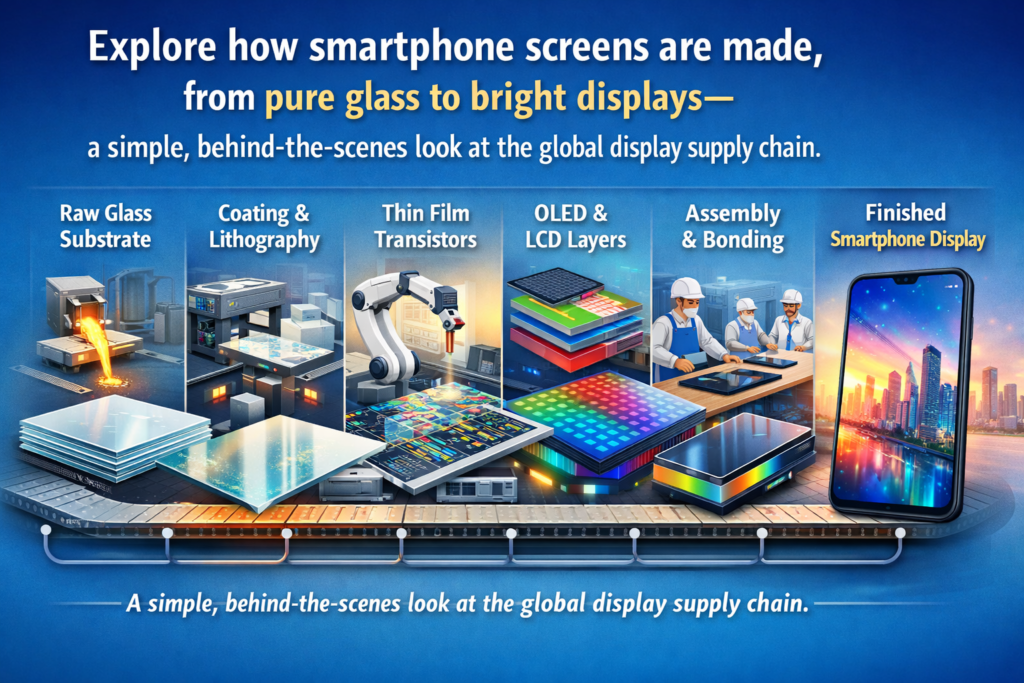
In this article, we’re pulling back the curtain on the smartphone display supply chain. From raw glass substrates to the perfectly calibrated screen lighting up your device, we’ll walk through every major manufacturing step. Think of it as a behind-the-scenes factory tour — no safety helmet required.
The Foundation of It All — Glass Substrates
What Is a Glass Substrate?
Everything starts with glass. Not the kind in your windows, but ultra-pure, ultra-flat glass substrates manufactured specifically for displays. These substrates act as the physical foundation for building millions of microscopic components.
Without a flawless substrate, everything that comes after is compromised. It’s like building a skyscraper on uneven ground — impossible to get right.
Types of Glass Used in LCD Manufacturing
Most LCD panels rely on alkali-free glass. Why? Because alkali ions can interfere with electrical performance. Display glass must withstand high temperatures, chemical exposure, and extreme precision processes without warping.
Alkali-Free Glass and Why It Matters
Alkali-free glass ensures electrical stability, higher yields, and longer panel lifespan. It’s invisible to users, but absolutely critical to performance.
Array Process — Building the Brain of the Display
Thin Film Transistors (TFT) Explained
If the screen were a city, TFTs would be traffic lights. Each pixel has at least one TFT controlling when and how much light it lets through. Millions of transistors are deposited onto the glass using advanced thin-film technology.
Photolithography and Patterning
This step borrows techniques from semiconductor manufacturing. Light, masks, and chemicals are used to etch precise circuit patterns at microscopic scales. Accuracy here determines resolution, refresh rate, and power efficiency.
How Pixels Are Individually Controlled
Each pixel must respond instantly and independently. The array layer ensures precise voltage control so images stay sharp, smooth, and flicker-free.
Color Comes to Life — The Color Filter Process
RGB Sub-Pixels and Color Accuracy
Colors aren’t magic — they’re math. Red, green, and blue sub-pixels combine in different intensities to create millions of colors. The color filter layer ensures each pixel displays the right hue.
Black Matrix and Contrast Control
The black matrix prevents light leakage between pixels, improving contrast and clarity. It’s the unsung hero behind deep blacks and crisp text.
Cell Process (Cell Assembly) — When Two Glasses Become One
Liquid Crystal Injection
Here’s where LCD truly becomes LCD. Liquid crystal material is injected between the TFT glass and the color filter glass. These crystals twist and align to control light passage.
Cell Gap Precision and Alignment
The gap between the two glass layers is measured in microns. Too wide or too narrow, and image quality suffers.
Why Micron-Level Accuracy Is Critical
Even tiny variations can cause brightness inconsistency or color shifts. Precision here separates premium displays from average ones.
Polarizers — Controlling Light Direction
How Polarizers Work
Polarizers act like traffic cops for light, allowing only specific light waves to pass. LCDs rely on two polarizers to function properly.
Impact on Brightness and Viewing Angles
High-quality polarizers improve outdoor visibility, color stability, and viewing angles — all things users notice instantly.
The Role of Optical Adhesives
OCA vs LOCA Explained
Optical Clear Adhesive (OCA) and Liquid Optical Clear Adhesive (LOCA) bond layers together without distorting light. Think of them as invisible glue with superhero clarity.
Optical Clarity and Durability
Good adhesives prevent bubbles, yellowing, and delamination over time, especially under heat and UV exposure.
Driver IC — The Command Center of the Screen
What a Driver IC Does
The driver IC translates digital signals into electrical commands that control every pixel. No driver IC, no image.
Timing, Voltage, and Signal Control
Perfect synchronization ensures smooth scrolling, accurate colors, and stable refresh rates.
COF, COG, and COP Packaging Technologies
These packaging methods define how the driver IC connects to the panel, balancing cost, durability, and performance.
Backlight Unit (BLU) — Lighting Up the Display
LED Light Sources
LCDs don’t emit light themselves. LEDs provide the illumination needed to make images visible.
Light Guide Plates and Diffusion Films
These components distribute light evenly, avoiding bright spots and shadows. Uniform brightness is harder to achieve than it looks.
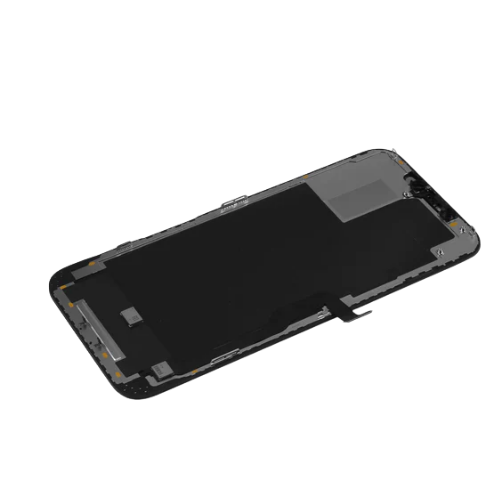
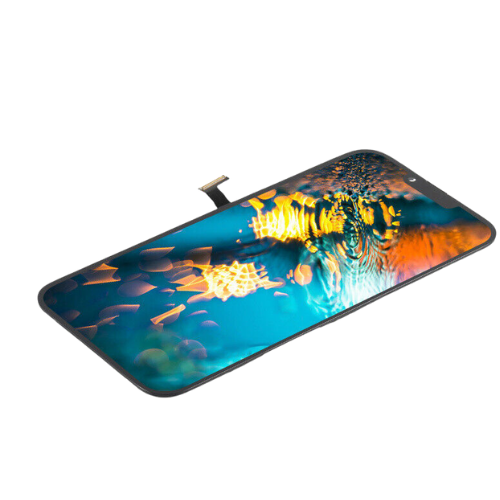
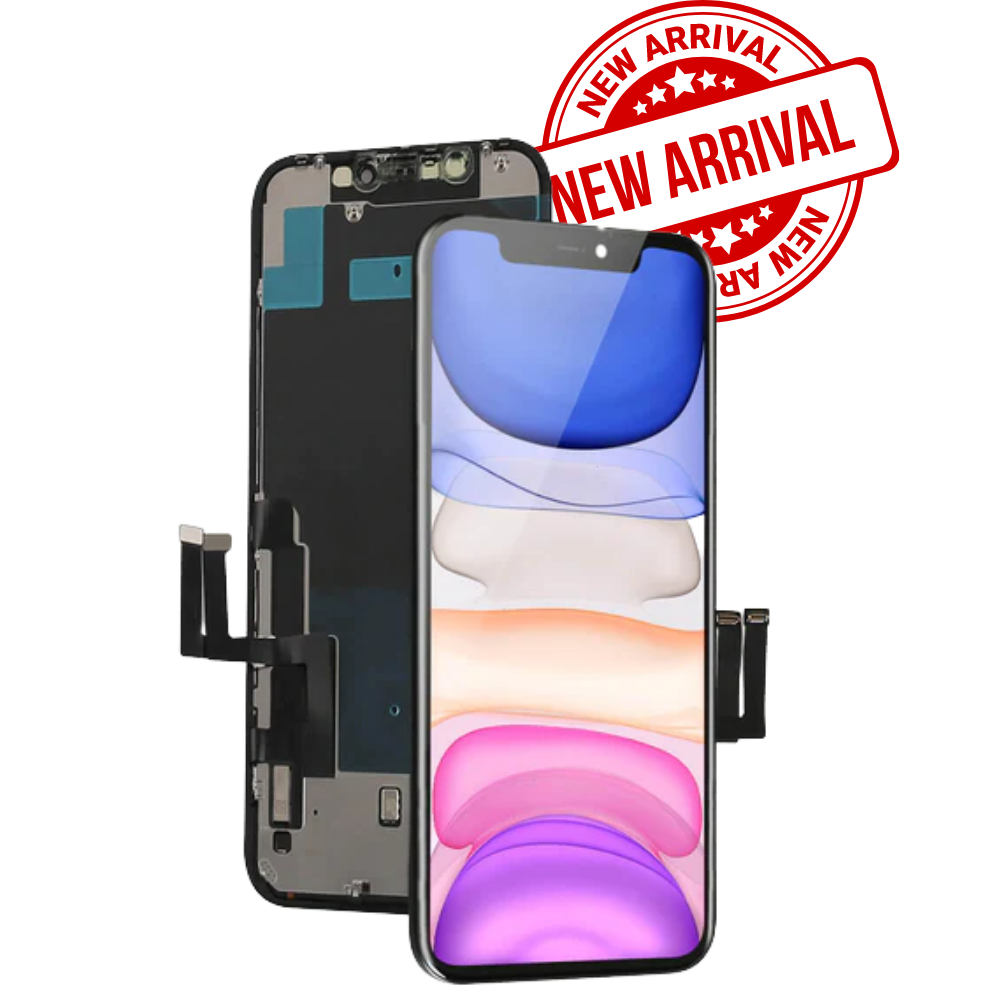
Module Assembly — Turning Panels into Usable Screens
Combining LCD, BLU, and Touch Layers
Once all components are ready, they’re assembled into a complete display module. This is where screens finally look like screens.
Frame Bonding and Reinforcement
Mechanical strength is added to survive drops, pressure, and daily abuse.
Touch Integration — Making Screens Interactive
In-Cell, On-Cell, and Out-Cell Touch Technologies
Touch sensors can be integrated at different layers, each with trade-offs in thickness, cost, and performance.
Sensitivity and Responsiveness Factors
Good touch response depends on sensor design, firmware, and material quality.
Quality Control and Testing
Optical Inspections
Screens are checked for mura, dead pixels, color inconsistency, and brightness issues.
Electrical and Reliability Tests
Voltage stability, temperature resistance, and lifespan are all tested.
Common Defects and How They’re Detected
Issues like flicker, spots, and uneven backlight are identified before shipping.
The Global Supply Chain Behind One Screen
Specialized Suppliers for Each Component
Glass from one country, ICs from another, polarizers from a third — display manufacturing is truly global.
Why Screen Manufacturing Is Globally Distributed
No single company masters every step. Specialization drives innovation and efficiency.
Innovation Trends in Display Manufacturing
Thinner, Brighter, More Efficient Screens
Manufacturers constantly push limits to improve power efficiency and visual quality.
Mini-LED, Micro-LED, and Beyond
The future promises even better contrast, longer lifespan, and lower energy consumption.
Why Understanding Screen Manufacturing Matters
For Buyers, Engineers, and Consumers
Knowing how screens are made helps buyers choose better products and suppliers avoid costly mistakes.
Appreciating the Technology in Your Pocket
That screen isn’t just glass — it’s decades of innovation packed into your hand.
Conclusion — A Tiny Screen, A Massive Engineering Marvel
The next time you unlock your phone, remember this: behind that vibrant display lies a breathtaking journey from raw glass to precision-engineered perfection. Smartphone screens are proof that even the smallest components can carry the biggest technological weight. Understanding their manufacturing isn’t just educational — it’s eye-opening.
FAQs
1. Why is smartphone screen manufacturing so complex?
Because it combines electronics, optics, chemistry, and precision mechanics at microscopic scales.
2. What is the most critical step in LCD manufacturing?
The array and cell processes, where pixel control and liquid crystal alignment are defined.
3. Why are driver ICs so important?
They control timing, voltage, and image accuracy — without them, displays can’t function.
4. How does quality control affect screen pricing?
Stricter QC reduces defects but increases cost, leading to higher-quality displays.
5. Will LCD screens still matter in the future?
Yes. Despite OLED growth, LCDs remain cost-effective and widely used globally.