Por qué es importante comprender las pantallas LCD
Cuando la gente compra un teléfono inteligente, Suelen prestar atención al procesador., cámara, batería, o capacidad de almacenamiento. Asombrosamente, Uno de los componentes más importantes, la pantalla, a menudo se pasa por alto.. Sin embargo, la pantalla es la parte con la que interactúas todos los días.. Ya sea que estés leyendo correos electrónicos, viendo vídeos, navegando por las redes sociales, o jugando juegos, su pantalla determina qué tan agradable y cómoda será su experiencia.
Aunque las pantallas OLED se han vuelto cada vez más populares en los teléfonos inteligentes emblemáticos, Las pantallas LCD siguen dominando muchos dispositivos asequibles y de gama media porque proporcionan un rendimiento confiable, menores costos de fabricación, y excelente durabilidad. Los analistas de la industria informan que OLED ha superado 60% de envíos de teléfonos inteligentes, Pero los teléfonos económicos de LCn y el mercado mundial de reparación..
exploremos 10 Datos fascinantes sobre las pantallas LCD de los teléfonos inteligentes. que todo usuario debe saber.
Hecho #1 – La pantalla LCD no produce luz por sí sola
Mucha gente cree que las imágenes coloridas de una pantalla LCD provienen directamente de los propios píxeles.. De hecho, eso no es cierto.
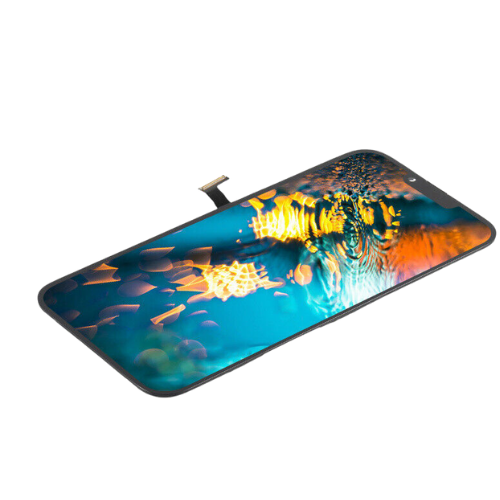
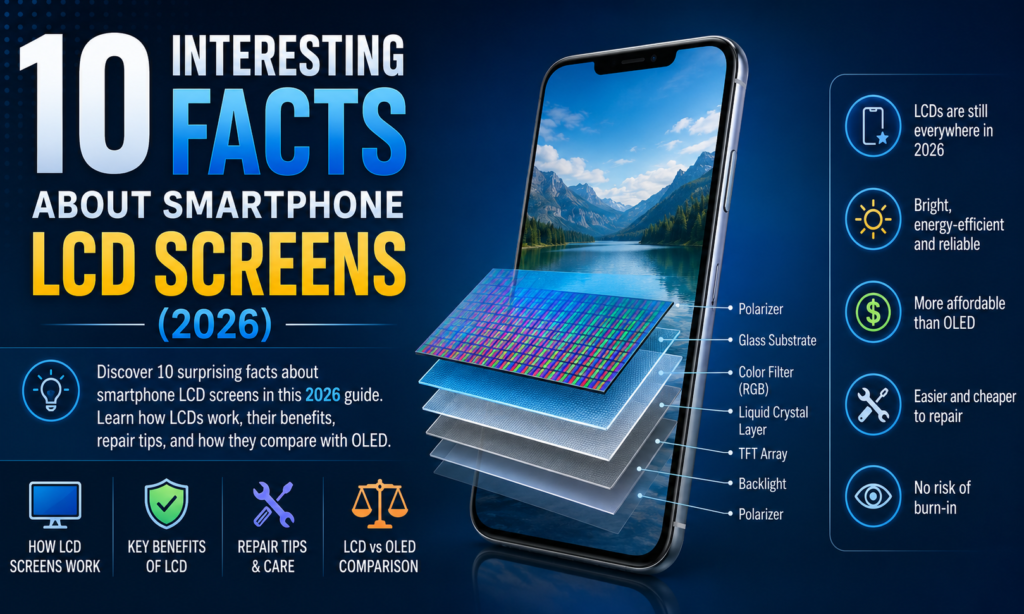
LCD significa Pantalla de cristal líquido. A diferencia de la tecnología OLED, Los píxeles de la pantalla LCD no pueden emitir luz de forma independiente. En cambio, Una potente retroiluminación LED se encuentra detrás de la pantalla y brilla a través de millones de células de cristal líquido.. Estos cristales giran y giran para controlar cuánta luz pasa a través de cada píxel., creando las imágenes que ves.
Cómo funciona la luz de fondo
Piense en la pantalla LCD como una ventana con persianas ajustables.. La luz de fondo actúa como la luz del sol en el exterior., mientras que los cristales líquidos funcionan como pequeñas persianas que se abren y cierran para controlar el brillo y el color..
Porque la pantalla LCD siempre depende de una luz de fondo, las áreas negras nunca son completamente negras. Esta es una de las razones por las que OLED ofrece un brillo profundo y menores costos de producción..
Hecho #2 – La pantalla LCD IPS es mucho mejor que la pantalla LCD TFT tradicional
No todas las pantallas LCD son iguales.
Los teléfonos inteligentes más antiguos de uso común LCD TFT paneles, que eran económicos pero tenían ángulos de visión estrechos y colores descoloridos. Los teléfonos inteligentes modernos suelen utilizar LCD IPS (Conmutación en el plano) tecnología, lo que mejora drásticamente la calidad de la imagen.
Ángulos de visión y precisión del color
Los paneles LCD IPS permiten a los usuarios ver la pantalla desde casi cualquier ángulo sin una distorsión significativa del color.. También proporcionan una reproducción del color más precisa., haciendo fotos, vídeos, y los sitios web parecen mucho más naturales.
Hoy, IPS LCD se ha convertido en la tecnología LCD estándar para teléfonos inteligentes, y asequibilidad extremadamente bien.
Hecho #3 – Una resolución más alta no siempre significa una mejor visualización
Muchos compradores asumen automáticamente que una resolución más alta equivale a una pantalla mejor..
Mientras que Full HD+, 2k, e incluso las resoluciones 4K suenan impresionantes, densidad de píxeles (IPP) A menudo importa más que la resolución bruta.. Una vez que un teléfono inteligente alcanza aproximadamente 400–500 píxeles por pulgada, Los píxeles individuales se vuelven casi imposibles de distinguir para el ojo humano durante el uso normal..
En lugar de perseguir la resolución más alta, Los consumidores también deben evaluar:
| Característica | Por qué es importante |
|---|---|
| Brillo | Mejor visibilidad al aire libre |
| Precisión del color | Imágenes más naturales |
| Contraste | Experiencia de visualización mejorada |
| Frecuencia de actualización | Desplazamiento más suave |
| Respuesta táctil | Mejor experiencia de juego |
Una pantalla equilibrada ofrece una experiencia que simplemente tener más píxeles. citarturn0search5turn0search2
Hecho #4 – El brillo es más importante de lo que mucha gente cree
¿Alguna vez has tenido dificultades para leer tu teléfono bajo la luz del sol??
El problema muchas veces no es la resolución, sino brillo de la pantalla.
Entendiendo las liendres
El brillo se mide en liendres.
Generalmente:
- 400–500 liendres = aceptable en interiores
- 500–700 liendres = buena visibilidad exterior
- 800+ liendres = excelente rendimiento ante la luz solar
Las modernas pantallas LCD IPS pueden alcanzar un brillo sostenido impresionante, haciéndolos particularmente prácticos para los trabajadores al aire libre, El repartidor utiliza con frecuencia su teléfono bajo la luz solar directa..
Hecho #5 – Las pantallas LCD no experimentan quemaduras permanentes
Una de las mayores ventajas de la pantalla LCD es su resistencia a quemado de pantalla.
El quemado se produce cuando las imágenes estáticas permanecen visibles después de mostrarse durante largos períodos.. Porque los píxeles de la pantalla LCD dependen de una luz de fondo compartida en lugar de una luz autoemisora, el quemado permanente es extremadamente raro.
Esto hace que las pantallas LCD sean una excelente opción para los usuarios que visualizan con frecuencia:
- Navegación GPS
- Paneles estáticos
- Aplicaciones empresariales
- Monitoreo de seguridad
- Sistemas de punto de venta
Las pantallas OLED proporcionan una retención de imagen más rica en determinadas condiciones.
Hecho #6 – Un cristal roto no siempre significa que la pantalla LCD esté rota
Muchos propietarios de teléfonos inteligentes entran en pánico después de dejarlos caer.
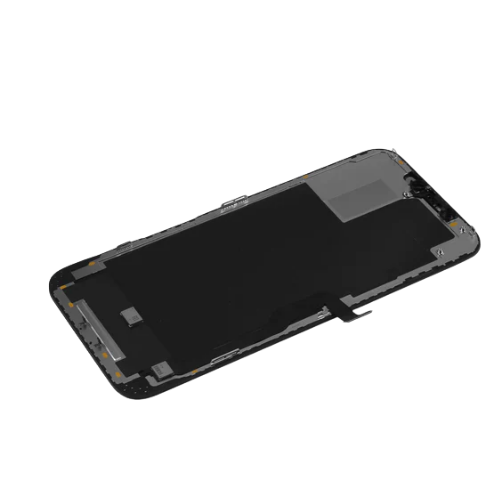
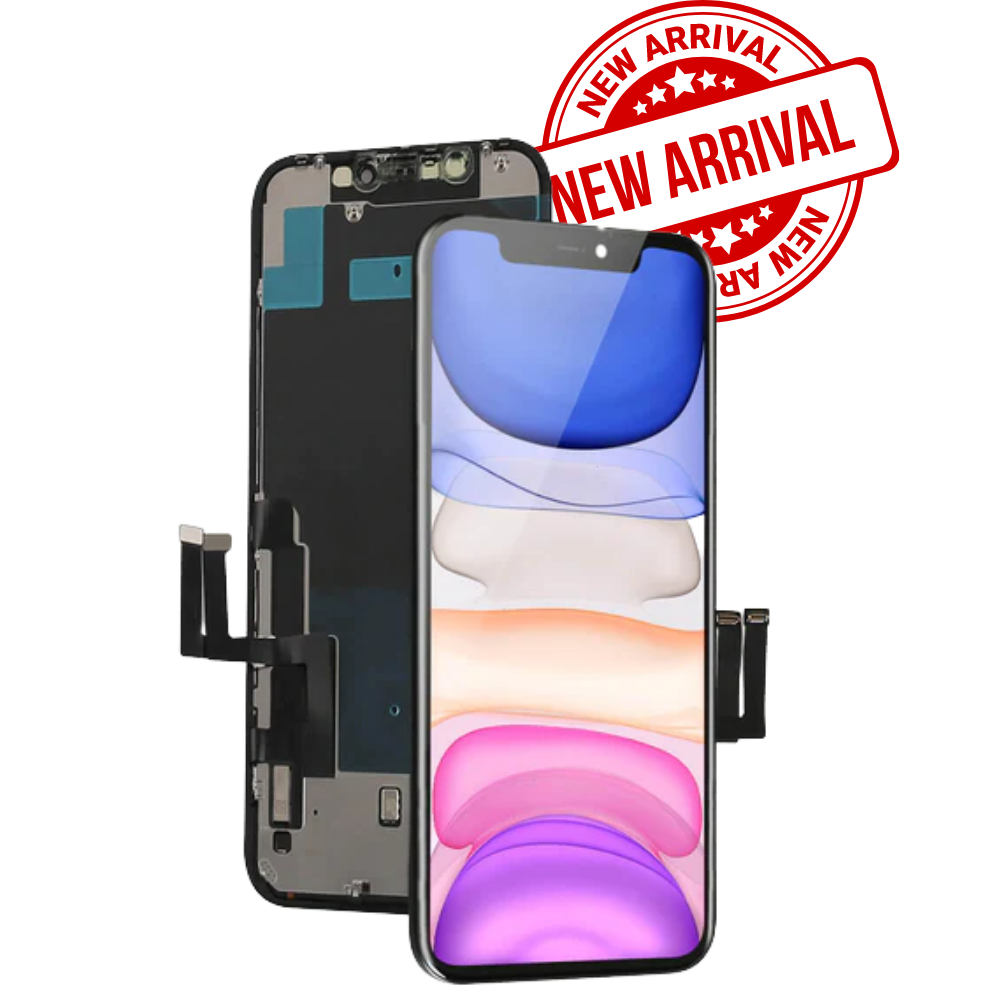
Afortunadamente, el cristal frontal, digitalizador táctil, y el panel LCD son componentes diferentes.
Vidrio versus LCD versus panel táctil
Un teléfono dañado puede tener:
| Componente | Síntomas |
|---|---|
| Vidrio frontal | Solo grietas |
| Digitalizador táctil | El toque deja de funcionar |
| Panel LCD | puntos negros, lineas de colores, sin pantalla |
Si solo el vidrio está roto mientras la pantalla y el tacto permanecen normales, las reparaciones pueden costar significativamente menos que reemplazar el conjunto completo de la pantalla.
Los técnicos profesionales siempre diagnostican qué capa ha fallado antes de recomendar reparaciones..
Hecho #7 – Las pantallas LCD de repuesto económicas pueden diferir mucho en calidad
No todas las pantallas de repuesto ofrecen el mismo rendimiento.
Las pantallas de posventa de bajo costo pueden sufrir:
- Brillo más bajo
- Mala calibración del color
- Respuesta táctil más lenta
- Mayor consumo de energía
- Vida útil más corta
Las pantallas de repuesto de primera calidad o del mercado de accesorios generalmente ofrecen una mayor durabilidad y una experiencia de usuario mucho más cercana a la pantalla original.. Los profesionales de la reparación recomiendan constantemente centrarse únicamente en el precio..
Hecho #8 – Es posible que los daños causados por el agua no acaben con una pantalla LCD inmediatamente
Muchos usuarios creen que si un teléfono sigue funcionando después de mojarse, todo está bien.
De hecho, la humedad puede corroer lentamente los conectores de la pantalla, circuitos integrados, y componentes de retroiluminación durante días o incluso semanas.
Las señales de advertencia comunes incluyen:
- Pantalla parpadeante
- Puntos negros aleatorios
- Líneas verticales
- Brillo desigual
- Fallo táctil
El secado inmediato y la inspección profesional aumentan en gran medida las posibilidades de prevenir daños permanentes..
Hecho #9 – Los protectores de pantalla evitan principalmente arañazos
Un protector de vidrio templado es extremadamente útil, pero tiene limitaciones.
Protege contra:
- Llaves
- monedas
- Partículas de arena
- Arañazos cotidianos
Sin embargo, él no puede garantizar la protección contra impactos fuertes. Una caída fuerte aún puede romper el panel LCD interno incluso si el protector de pantalla permanece intacto..
La mejor protección se combina:
- vidrio templado
- Funda de teléfono resistente a los golpes
- Manejo cuidadoso
Hecho #10 – Los buenos hábitos diarios pueden prolongar la vida útil de la pantalla LCD
Las pantallas LCD son sorprendentemente duraderas cuando se mantienen adecuadamente.
Los hábitos simples incluyen:
- Evite exponer el teléfono a calor extremo.
- Mantenga seco el puerto de carga.
- Limpiar la pantalla con un paño de microfibra..
- Evite sentarse al teléfono.
- Utilice cargadores de calidad para evitar la inestabilidad eléctrica.
- Guarde el dispositivo en una funda protectora..
Estos pequeños hábitos pueden reducir significativamente los daños accidentales y prolongar la vida útil de la pantalla de su teléfono inteligente..
LCD frente a OLED: Comparación rápida
| Característica | LCD IPS | Oleado |
|---|---|---|
| Fuente de luz | Retroiluminación LED | Píxeles autoemisores |
| Nivel de negro | Bien | Excelente |
| Brillo exterior | Excelente | Excelente |
| Riesgo de quemado | Ninguno | Posible |
| Costo de reparación | Más bajo | Más alto |
| Costo de fabricación | Más bajo | Más alto |
| Eficiencia de la batería | Estable | Depende del contenido |
| Espesor | más grueso | Disolvente |
Mientras OLED domina los teléfonos inteligentes premium, IPS LCD sigue siendo un rendimiento diario excepcional y confiable. citarturn0search0turn0search1turn0search3
Conclusión
La tecnología LCD de los teléfonos inteligentes ha evolucionado drásticamente en las últimas dos décadas. Las pantallas LCD IPS actuales ofrecen colores vibrantes, amplios ángulos de visión, excelente brillo, y rendimiento confiable que satisface a millones de usuarios en todo el mundo. Aunque OLED continúa expandiéndose a dispositivos emblemáticos, La pantalla LCD sigue siendo una tecnología esencial para los teléfonos inteligentes económicos, dispositivos educativos, equipo de negocios, y la industria mundial de reparación.
Comprender estos diez hechos ayuda a los consumidores a tomar decisiones de compra más inteligentes, Elija pantallas de repuesto de mayor calidad, y proteger mejor sus dispositivos. Ya sea que estés comprando un teléfono nuevo o reparando uno viejo, saber cómo funciona la tecnología LCD le permite equilibrar el rendimiento, durabilidad, y cueste con confianza.
Preguntas frecuentes
1. ¿Es la pantalla LCD IPS mejor que la pantalla LCD TFT??
Sí. LCD IPS proporciona ángulos de visión más amplios, mejor precisión del color, y calidad de imagen mejorada en comparación con el LCD TFT tradicional.
2. ¿Pueden las pantallas LCD sufrir quemaduras??
El desgaste permanente es extremadamente poco común en las pantallas LCD porque utilizan una luz de fondo separada en lugar de píxeles autoemisores..
3. ¿Por qué las pantallas de repuesto LCD son más baratas que las OLED??
La fabricación de LCD es más madura y menos costosa, haciendo que las reparaciones sean significativamente más asequibles.
4. ¿Puede una pantalla rota todavía tener una pantalla LCD que funcione??
Sí. A veces solo se rompe el cristal frontal mientras la pantalla LCD y las funciones táctiles permanecen en pleno funcionamiento.
5. ¿Cómo puedo hacer que mi pantalla LCD dure más??
Utilice una funda de teléfono de calidad, instalar protección de vidrio templado, Evite la exposición al agua y temperaturas extremas., y limpie la pantalla regularmente con un paño de microfibra.