Pourquoi comprendre les écrans LCD est important
Quand les gens achètent un smartphone, ils font généralement attention au processeur, caméra, batterie, ou capacité de stockage. Étonnamment, l'un des composants les plus importants, l'écran, est souvent négligé. Pourtant, l’écran est la partie avec laquelle vous interagissez chaque jour. Que vous lisiez des e-mails, regarder des vidéos, naviguer sur les réseaux sociaux, ou jouer à des jeux, votre écran détermine à quel point votre expérience sera agréable et confortable.
Bien que les écrans OLED soient devenus de plus en plus populaires dans les smartphones phares, Les écrans LCD continuent de dominer de nombreux appareils abordables et milieu de gamme parce qu'ils offrent des performances fiables, coûts de fabrication inférieurs, et une excellente durabilité. Les analystes du secteur rapportent que l'OLED a dépassé 60% des expéditions de smartphones, mais les téléphones économiques LCn et le marché mondial de la réparation.
Explorons 10 faits fascinants sur les écrans LCD des smartphones que tout utilisateur devrait savoir.
Fait #1 - L'écran LCD ne produit pas de lumière tout seul
Beaucoup de gens pensent que les images colorées sur un écran LCD proviennent directement des pixels eux-mêmes.. En fait, ce n'est pas vrai.
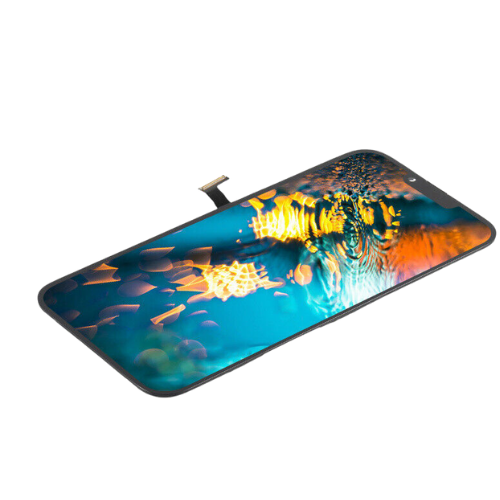
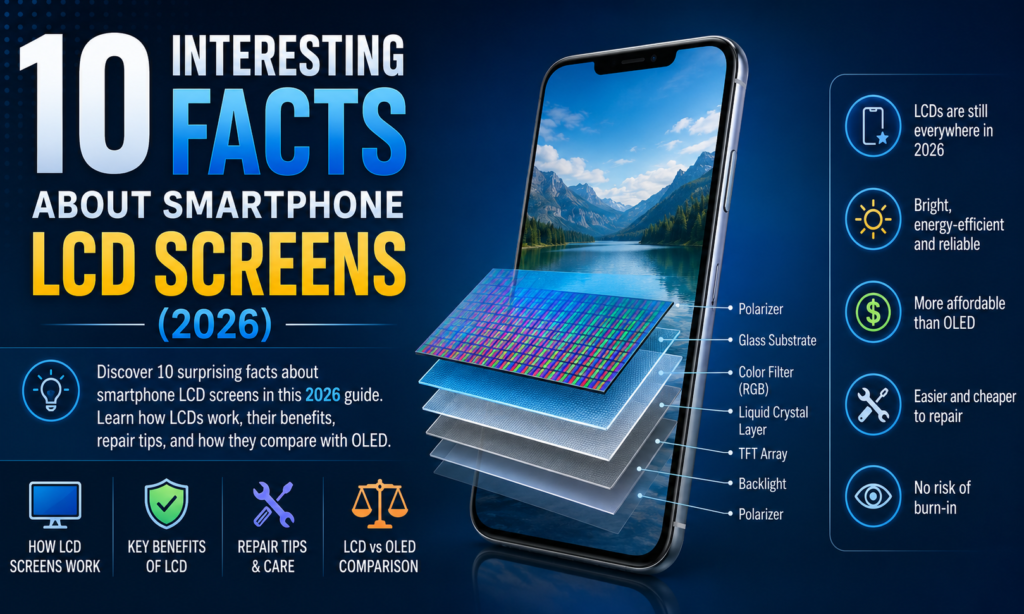
LCD représente Affichage à cristaux liquides. Contrairement à la technologie OLED, Les pixels LCD ne peuvent pas émettre de lumière indépendamment. Plutôt, un puissant rétroéclairage LED se trouve derrière l'écran et brille à travers des millions de cellules à cristaux liquides. Ces cristaux se tordent et tournent pour contrôler la quantité de lumière qui traverse chaque pixel., créer les images que vous voyez.
Comment fonctionne le rétroéclairage
Considérez l'écran LCD comme une fenêtre avec des stores réglables. Le rétroéclairage agit comme la lumière du soleil à l'extérieur, tandis que les cristaux liquides fonctionnent comme de minuscules stores qui s'ouvrent et se ferment pour contrôler la luminosité et la couleur..
Parce que l'écran LCD repose toujours sur un rétroéclairage, les zones noires ne sont jamais complètement noires. C'est l'une des raisons pour lesquelles l'OLED offre une luminosité profonde et des coûts de production réduits..
Fait #2 - L'écran LCD IPS est bien meilleur que l'écran LCD TFT traditionnel
Tous les écrans LCD ne sont pas égaux.
Les smartphones plus anciens sont couramment utilisés Écran LCD TFT panneaux, qui étaient peu coûteux mais souffraient d'angles de vision étroits et de couleurs délavées. Les smartphones modernes utilisent généralement Écran LCD IPS (Commutation dans le plan) technologie, ce qui améliore considérablement la qualité de l'image.
Angles de vision et précision des couleurs
Les panneaux LCD IPS permettent aux utilisateurs de visualiser l'écran sous presque n'importe quel angle sans distorsion significative des couleurs. Ils offrent également une reproduction des couleurs plus précise, faire des photos, vidéos, et les sites Web semblent beaucoup plus naturels.
Aujourd'hui, IPS LCD est devenu la technologie LCD standard pour la fiabilité des smartphones, et un prix abordable extrêmement bien.
Fait #3 – Une résolution plus élevée ne signifie pas toujours un meilleur affichage
De nombreux acheteurs supposent automatiquement qu’une résolution plus élevée équivaut à un meilleur écran.
Tandis que le Full HD+, 2K, et même les résolutions 4K semblent impressionnantes, densité de pixels (IPP) compte souvent plus que la résolution brute. Une fois qu'un smartphone atteint environ 400–500 pixels par pouce, les pixels individuels deviennent presque impossibles à distinguer pour l'œil humain lors d'une utilisation normale.
Au lieu de rechercher la plus haute résolution, les consommateurs devraient également évaluer:
| Fonctionnalité | Pourquoi c'est important |
|---|---|
| Luminosité | Meilleure visibilité extérieure |
| Précision des couleurs | Des images plus naturelles |
| Contraste | Expérience visuelle améliorée |
| Taux de rafraîchissement | Défilement plus fluide |
| Réponse tactile | Meilleure expérience de jeu |
Une expérience d'affichage équilibrée plutôt que simplement avoir plus de pixels. citeturn0search5turn0search2
Fait #4 – La luminosité est plus importante que beaucoup de gens ne le pensent
Avez-vous déjà eu du mal à lire votre téléphone en plein soleil?
Souvent, le problème n’est pas la résolution, c’est luminosité de l'écran.
Comprendre les lentes
La luminosité est mesurée en lentes.
En général:
- 400–500 nits = acceptable à l'intérieur
- 500–700 nits = bonne visibilité extérieure
- 800+ lentes = excellente performance solaire
Les écrans LCD IPS modernes peuvent atteindre une luminosité soutenue impressionnante, ce qui les rend particulièrement pratiques pour les travailleurs en extérieur, le livreur utilise fréquemment son téléphone en plein soleil.
Fait #5 – Les écrans LCD ne subissent pas de brûlure permanente
L’un des plus grands avantages du LCD est sa résistance aux brûlure d'écran.
Le burn-in se produit lorsque des images statiques restent visibles après avoir été affichées pendant de longues périodes. Parce que les pixels LCD reposent sur un rétroéclairage partagé plutôt que sur une lumière auto-émettrice, le burn-in permanent est extrêmement rare.
Cela fait des écrans LCD un excellent choix pour les utilisateurs qui affichent fréquemment:
- Navigation GPS
- Tableaux de bord statiques
- Applications métiers
- Surveillance de la sécurité
- Systèmes de point de vente
Les écrans OLED offrent une rétention d'image plus riche dans certaines conditions.
Fait #6 – Un verre brisé ne signifie pas toujours que l’écran LCD est cassé
De nombreux propriétaires de smartphones paniquent après avoir laissé tomber leur téléphone.
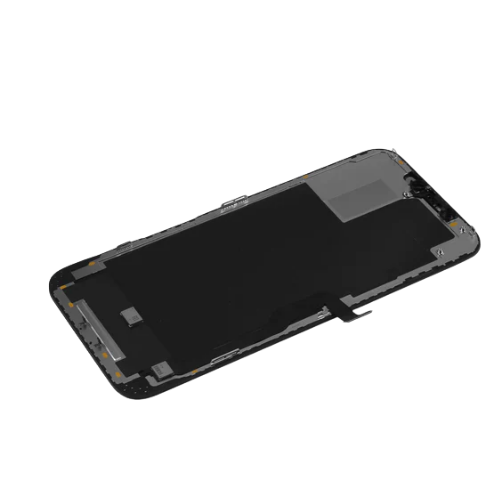
Heureusement, la vitre avant, numériseur tactile, et le panneau LCD sont des composants différents.
Verre vs LCD vs écran tactile
Un téléphone endommagé peut avoir:
| Composant | Symptômes |
|---|---|
| Verre avant | Fissures uniquement |
| Numériseur tactile | Le toucher ne fonctionne plus |
| Panneau LCD | Points noirs, lignes colorées, pas d'affichage |
Si seulement le verre est fissuré alors que l'affichage et le toucher restent normaux, les réparations peuvent coûter beaucoup moins cher que le remplacement de l'ensemble d'affichage complet.
Les techniciens professionnels diagnostiquent toujours quelle couche est défaillante avant de recommander des réparations.
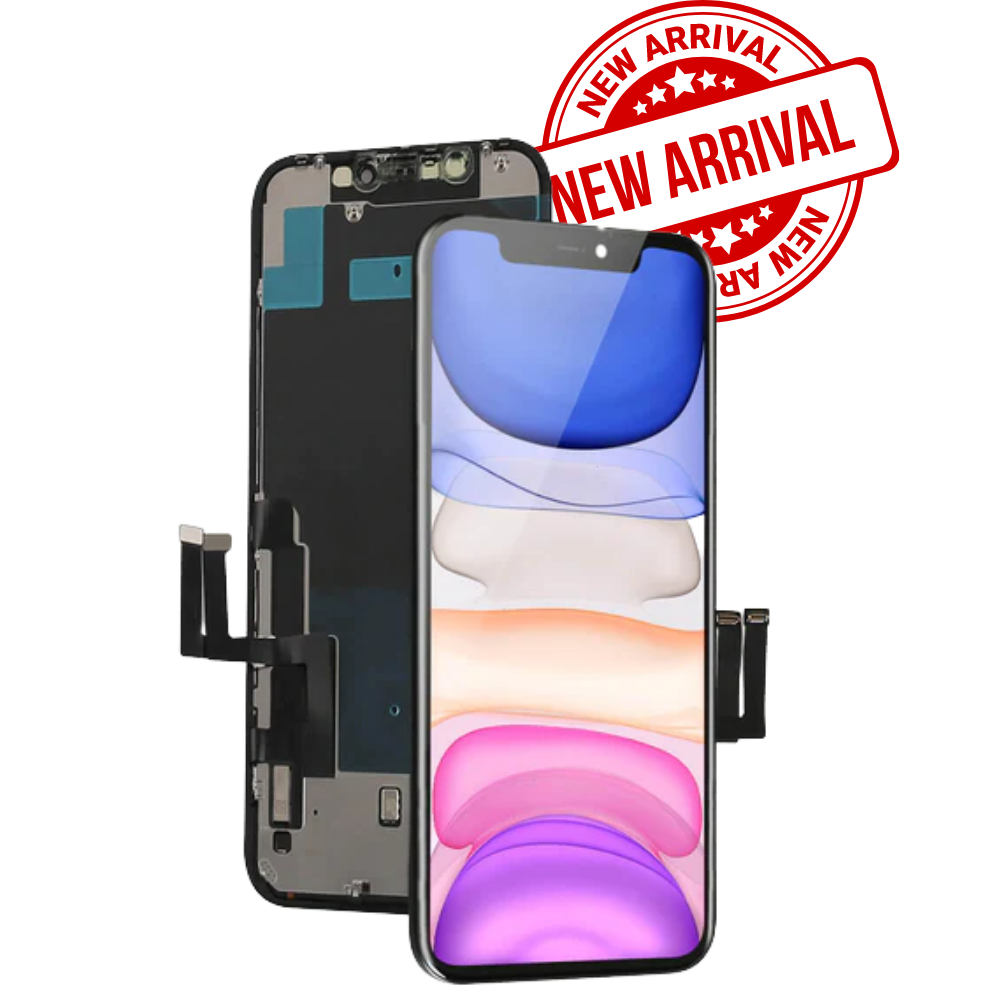
Fait #7 – Les écrans LCD de remplacement bon marché peuvent différer considérablement en qualité
Tous les écrans de remplacement n'offrent pas les mêmes performances.
Les écrans du marché secondaire à faible coût peuvent souffrir de:
- Luminosité inférieure
- Mauvais calibrage des couleurs
- Réponse tactile plus lente
- Consommation d'énergie plus élevée
- Durée de vie plus courte
Les écrans de remplacement de qualité supérieure ou de qualité OEM offrent généralement une meilleure durabilité et une expérience utilisateur beaucoup plus proche de l'écran d'origine.. Les professionnels de la réparation recommandent systématiquement de se concentrer uniquement sur le prix.
Fait #8 – Les dégâts d’eau peuvent ne pas tuer un écran LCD immédiatement
De nombreux utilisateurs pensent que si un téléphone fonctionne toujours après avoir été mouillé, tout va bien.
En fait, l'humidité peut lentement corroder les connecteurs d'écran, circuits intégrés, et les composants de rétroéclairage sur des jours, voire des semaines.
Les signes d’avertissement courants incluent:
- Affichage scintillant
- Points noirs aléatoires
- Lignes verticales
- Luminosité inégale
- Échec tactile
Un séchage immédiat et une inspection professionnelle augmentent considérablement les chances de prévenir des dommages permanents.
Fait #9 – Les protecteurs d’écran empêchent principalement les rayures
Un protecteur en verre trempé est extrêmement utile, mais il a ses limites.
Il protège contre:
- Clés
- Pièces
- Particules de sable
- Les rayures du quotidien
Cependant, il ne peut pas garantir une protection contre les chocs violents. Une chute importante peut toujours fissurer le panneau LCD interne même si le protecteur d'écran reste intact.
La meilleure protection combine:
- Verre trempé
- Coque de téléphone résistante aux chocs
- Manipulation prudente
Fait #10 – De bonnes habitudes quotidiennes peuvent prolonger la durée de vie des écrans LCD
Les écrans LCD sont étonnamment durables lorsqu'ils sont correctement entretenus.
Les habitudes simples incluent:
- Évitez d'exposer le téléphone à une chaleur extrême.
- Gardez le port de chargement au sec.
- Nettoyez l'écran avec un chiffon en microfibre.
- Évitez de rester assis au téléphone.
- Utilisez des chargeurs de qualité pour éviter l’instabilité électrique.
- Rangez l'appareil dans un étui de protection.
Ces petites habitudes peuvent réduire considérablement les dommages accidentels et prolonger la durée de vie de l'écran de votre smartphone..
LCD contre OLED: Comparaison rapide
| Fonctionnalité | Écran LCD IPS | Oled |
|---|---|---|
| Source de lumière | Rétroéclairage LED | Pixels auto-émetteurs |
| Niveau de noir | Bien | Excellent |
| Luminosité extérieure | Excellent | Excellent |
| Risque de brûlure | Aucun | Possible |
| Coût de réparation | Inférieur | Plus haut |
| Coût de fabrication | Inférieur | Plus haut |
| Efficacité de la batterie | Écurie | Dépend du contenu |
| Épaisseur | Plus épais | Diluant |
Alors que l'OLED domine les smartphones premium, IPS LCD reste une performance exceptionnelle et fiable au quotidien. citeturn0search0turn0search1turn0search3
Conclusion
La technologie LCD des smartphones a considérablement évolué au cours des deux dernières décennies. Les écrans LCD IPS d'aujourd'hui offrent des couleurs éclatantes, angles de vision larges, excellente luminosité, et des performances fiables qui satisfont des millions d'utilisateurs dans le monde. Bien que l'OLED continue de se développer dans les appareils phares, L'écran LCD reste une technologie essentielle pour les smartphones économiques, appareils éducatifs, équipement professionnel, et l'industrie mondiale de la réparation.
Comprendre ces dix faits aide les consommateurs à prendre des décisions d'achat plus judicieuses, choisissez des écrans de remplacement de meilleure qualité, et mieux protéger leurs appareils. Que vous achetiez un nouveau téléphone ou répariez un ancien, savoir comment fonctionne la technologie LCD vous permet d'équilibrer les performances, durabilité, et évaluez en toute confiance.
Foire aux questions
1. L'écran LCD IPS est-il meilleur que l'écran LCD TFT?
Oui. L'écran LCD IPS offre des angles de vision plus larges, meilleure précision des couleurs, et une qualité d'image améliorée par rapport à l'écran LCD TFT traditionnel.
2. Les écrans LCD peuvent-ils souffrir de brûlures?
Le burn-in permanent est extrêmement rare sur les écrans LCD car ils utilisent un rétroéclairage séparé au lieu de pixels auto-émetteurs..
3. Pourquoi les écrans de remplacement LCD sont-ils moins chers que les écrans OLED?
La fabrication d'écrans LCD est plus mature et moins chère, rendant les réparations beaucoup plus abordables.
4. Un écran fissuré peut-il toujours avoir un écran LCD fonctionnel?
Oui. Parfois, seule la vitre avant se brise alors que les fonctions LCD et tactiles restent pleinement opérationnelles.
5. Comment puis-je prolonger la durée de vie de mon écran LCD?
Utilisez une coque de téléphone de qualité, installer une protection en verre trempé, éviter l’exposition à l’eau et aux températures extrêmes, et nettoyez régulièrement l'écran avec un chiffon en microfibre.