Les écrans des smartphones comptent parmi les composants les plus fréquemment endommagés des appareils mobiles modernes.. Si un téléphone tombe accidentellement, écrasé sous pression, ou endommagé par un impact, l'écran est souvent la première partie à souffrir. Des rapports récents de l'industrie montrent que le remplacement d'écran reste le segment le plus important du marché de la réparation mobile, représentant plus de 30% du chiffre d'affaires des réparations dans le monde. En même temps, les propriétaires de smartphones conservent leurs appareils plus longtemps qu'avant, rendre les réparations de haute qualité de plus en plus importantes.
Choisir le bon écran de remplacement n'est plus aussi simple que de sélectionner l'option la moins chère disponible en ligne. Les smartphones d’aujourd’hui utilisent un large éventail de technologies d’affichage, y compris LCD, Oled, Amoufré, LTPO VOUS ÊTES, et panneaux OLED flexibles. Un remplacement de mauvaise qualité peut entraîner une réduction de la luminosité, couleurs imprécises, mauvaise réponse au toucher, décharge de la batterie, voire des problèmes de compatibilité. C'est pourquoi comprendre comment sélectionner le bon type d'écran peut permettre d'économiser de l'argent., améliorer les performances de l'appareil, et augmenter la satisfaction client.
Ce guide explore dix conseils pratiques que les techniciens de réparation, grossistes, ateliers de réparation, et les utilisateurs de smartphones peuvent l'utiliser lors de l'achat d'écrans de remplacement.
Pourquoi la sélection d'écran est plus importante que jamais
Le secteur de la réparation de smartphones continue de croître alors que les consommateurs choisissent la réparation plutôt que le remplacement.. Des recherches industrielles indiquent que le marché mondial des services de réparation de smartphones était évalué à environ $7.55 milliards en 2025 et devrait continuer à croître régulièrement au cours de la prochaine décennie.. Le remplacement de l'écran reste le service de réparation le plus demandé car les dommages à l'écran sont l'une des pannes les plus courantes des smartphones..
En même temps, la technologie d’affichage devient de plus en plus sophistiquée. Les écrans OLED dominent désormais les smartphones haut de gamme, et les analystes du secteur estiment que plus que 60% des smartphones expédiés 2025 technologie OLED utilisée. Ce changement signifie que les professionnels de la réparation doivent comprendre les différentes catégories d'écrans et leurs caractéristiques de performance avant de prendre des décisions d'achat..
Un écran de remplacement affecte directement l’expérience utilisateur. L'écran est l'interface principale entre l'utilisateur et l'appareil. Si les couleurs semblent délavées, la sensibilité tactile est mauvaise, ou la luminosité est incohérente, les utilisateurs remarquent immédiatement la différence. La sélection de l'écran approprié permet de conserver les performances d'origine tout en minimisant les problèmes de réparation futurs.
Comprendre les types d'écran de smartphone
Avant de discuter des conseils, il est important de comprendre les principales catégories d’écrans disponibles sur le marché de la réparation actuel.
Écrans LCD expliqués
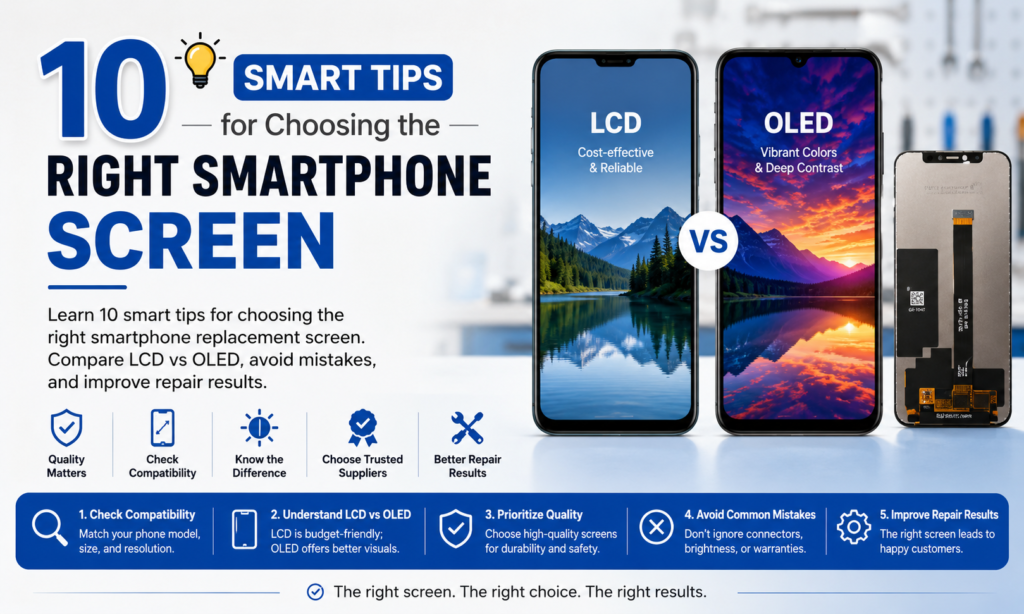
LCD (Affichage à cristaux liquides) la technologie reste largement utilisée dans les smartphones économiques et milieu de gamme. Les écrans LCD s'appuient sur un rétroéclairage pour éclairer les pixels. Ils offrent généralement une bonne durabilité, coûts de fabrication inférieurs, et un prix de remplacement abordable.
Les écrans LCD IPS modernes offrent d'excellents angles de vision et une précision des couleurs améliorée par rapport aux anciennes technologies LCD.. De nombreux techniciens de réparation apprécient les panneaux LCD car ils sont généralement moins chers et souvent plus faciles à trouver.. Pour les clients qui privilégient l’abordabilité plutôt que la qualité d’image premium, Le remplacement des écrans LCD reste une solution pratique.
Écrans OLED et AMOLED expliqués
Les écrans OLED génèrent de la lumière au niveau des pixels, éliminant le besoin d'un rétroéclairage. Cela permet d'obtenir des noirs plus profonds, taux de contraste plus élevés, efficacité énergétique améliorée, et des conceptions d'appareils plus fines.
La technologie AMOLED représente une implémentation OLED avancée couramment utilisée par Samsung, Xiaomi, Google-Pixels, OnePlus, et d'autres marques phares de smartphones. Les écrans OLED flexibles sont devenus de plus en plus courants en raison de leur capacité à prendre en charge des bords incurvés et des profils d'appareils plus fins.. Les données du secteur suggèrent que l'adoption de l'OLED continue de croître rapidement sur le marché des smartphones..
Original, OEM, et écrans de rechange
Les écrans de remplacement se répartissent généralement en trois catégories:
| Type d'écran | Qualité | Prix | Fiabilité |
|---|---|---|---|
| Original/Original OEM | Le plus haut | Le plus haut | Excellent |
| Équivalent OEM | Très bien | Modéré | Bien |
| Marché secondaire | Variable | Le plus bas | Dépend du fournisseur |
Comprendre ces différences aide les acheteurs à prendre des décisions éclairées en fonction des exigences de budget et de performances..
Conseil #1 – Vérifiez toujours la technologie d’affichage d’origine
L'une des erreurs les plus courantes lors de la réparation d'un smartphone consiste à remplacer un écran OLED par une alternative LCD peu coûteuse sans tenir compte des différences de performances.. Bien que cette approche puisse réduire les coûts de réparation, cela peut modifier considérablement l’expérience utilisateur.
Par exemple, de nombreux appareils phares sont conçus autour de la technologie OLED. Leur logiciel, systèmes de gestion de l'énergie, et l'étalonnage de l'affichage sont optimisés spécifiquement pour les panneaux OLED. L'installation d'un écran LCD de remplacement peut entraîner des assemblages plus épais, luminosité réduite, performances du capteur d'empreintes digitales plus lentes, et une qualité d'affichage globale inférieure.
Avant d'acheter un écran de remplacement, vérifier la technologie d'affichage d'origine utilisée par le fabricant de l'appareil. Correspondre aux spécifications d'origine fournit généralement le meilleur résultat de réparation et minimise les problèmes de compatibilité.
Conseil #2 – Vérifiez la compatibilité avec votre modèle de téléphone
Tous les écrans qui semblent identiques ne sont pas réellement compatibles. Les fabricants de smartphones proposent fréquemment plusieurs versions du même modèle pour différents marchés.. Connecteurs internes, pilotes d'affichage, et les circuits intégrés tactiles peuvent varier selon les versions.
Les professionnels de la réparation doivent toujours vérifier:
- Numéro de modèle
- Version régionale
- Type de connecteur
- Compatibilité des cadres
- Intégration du capteur d'empreintes digitales
L'achat d'un écran incompatible peut entraîner une perte de temps, frais de retour, et des clients mécontents. Une vérification minutieuse avant de commander réduit considérablement ces risques.
Conseil #3 – Comprendre la différence entre les écrans OEM et Aftermarket
De nombreux acheteurs supposent que tous les écrans de remplacement sont fabriqués selon des normes identiques. En réalité, la qualité varie considérablement.
Les écrans OEM sont généralement produits selon des spécifications très proches des normes du fabricant d'origine.. Ces écrans offrent généralement une luminosité supérieure, cohérence des couleurs, réponse tactile, et durabilité.
Les écrans de rechange peuvent varier d'excellente à mauvaise qualité selon le fournisseur. Certains écrans de rechange de haute qualité fonctionnent presque de la même manière que les versions OEM., tandis que d'autres souffrent de problèmes tels que des pixels morts, rétroéclairage inégal, adhésifs faibles, ou une reproduction des couleurs inexacte.
L’option la moins chère n’est pas toujours le choix le plus économique. A slightly higher upfront investment in a better-quality screen often reduces warranty claims and customer complaints.
Conseil #4 – Evaluate Display Quality Before Buying
Display quality directly impacts user satisfaction. Two screens may look identical in product photos but perform very differently in real-world use.
Luminosité et précision des couleurs
A high-quality replacement should closely match the original display’s brightness levels and color reproduction. Poor-quality screens often appear dim outdoors and may display inaccurate color tones.
Lors de l'évaluation des fournisseurs, request detailed specifications, y compris:
- Brightness ratings
- Couverture de la gamme de couleurs
- Resolution specifications
- Refresh rate support
These technical details provide valuable insight into actual screen performance.
Touch Sensitivity Performance
Touch response is equally important. Un écran avec une faible sensibilité tactile peut rendre un appareil lent même lorsque le matériel interne du téléphone fonctionne parfaitement..
Les techniciens de réparation expérimentés testent souvent la précision tactile sur toute la surface de l'écran avant d'effectuer les réparations.. Une réactivité constante contribue à garantir une expérience utilisateur fluide et à réduire les plaintes après réparation.
Conseil #5 – Tenez compte de la durabilité de l’écran
La durabilité ne doit jamais être négligée. Les smartphones sont transportés partout et exposés aux impacts quotidiens, gouttes, et la pression.
Des écrans de remplacement de haute qualité comportent souvent:
- Verre renforcé
- Meilleure liaison adhésive
- Structures de châssis plus solides
- Résistance aux chocs améliorée
Un écran durable réduit le risque de réparations répétées et améliore la satisfaction client à long terme. Pour les ateliers de réparation, moins de réclamations au titre de la garantie se traduisent directement par une rentabilité plus élevée.
Conseil #6 – Examiner la garantie et les politiques de retour
La politique de garantie d’un fournisseur révèle souvent une confiance dans la qualité des produits. Les fournisseurs fiables proposent généralement des conditions de garantie claires couvrant les défauts de fabrication et les problèmes de qualité..
Avant d'acheter, vérifier:
- Durée de la garantie
- Politique relative aux pixels morts
- Procédures de retour
- Disponibilité du support technique
- Délais de traitement de remplacement
Une garantie solide peut réduire considérablement les risques lors de l'achat de grandes quantités d'écrans de remplacement pour les entreprises de réparation..
Conseil #7 – Comparez le prix par rapport à la valeur à long terme
Le prix compte, mais se concentrer uniquement sur le coût peut s'avérer coûteux à long terme.
Imaginez acheter un écran très bon marché qui tombe en panne après plusieurs mois. L'atelier de réparation devra peut-être fournir un remplacement, couvrir les frais de main d'œuvre, et potentiellement perdre un client. Ce qui semblait initialement être une décision permettant de réduire les coûts pourrait finalement réduire la rentabilité..
Une approche équilibrée évalue à la fois le prix et les performances attendues. Les écrans de haute qualité offrent généralement une meilleure fiabilité, conduisant à des coûts de garantie inférieurs et à une confiance plus forte des clients.
Conseil #8 – Faites attention aux options de cadre et d’assemblage
Les écrans de remplacement sont souvent disponibles en deux formats:
- Écran uniquement
- Écran avec assemblage de cadre
Un écran avec un cadre préinstallé simplifie généralement l'installation et réduit le temps de réparation. Il minimise également le risque de dommages lors de l'assemblage.
Les options avec écran uniquement peuvent coûter moins cher au départ, mais nécessitent souvent une main d'œuvre supplémentaire et un équipement spécialisé.. Les ateliers de réparation doivent tenir compte de l'expérience des techniciens et de l'efficacité du flux de travail lorsqu'ils choisissent entre ces options.
Conseil #9 – Achetez uniquement auprès de fournisseurs de confiance
La sélection du fournisseur peut être le facteur le plus important dans l'achat d'écrans.
Les fournisseurs de confiance fournissent généralement:
- Contrôle de qualité cohérent
- Spécifications détaillées du produit
- Assistance garantie
- Assistance technique
- Disponibilité stable des stocks
La demande croissante de réparations de smartphones a encouragé de nombreux nouveaux fournisseurs de pièces détachées à entrer sur le marché.. Les rapports de l'industrie indiquent une demande croissante de composants de remplacement d'écran alors que le cycle de vie des smartphones continue de s'étendre au-delà de quatre ans..
Travailler avec des fournisseurs réputés permet de garantir la cohérence des produits et de protéger la réputation de l'entreprise..
Conseil #10 – Pensez aux réparations futures et à la valeur de revente
Un remplacement d'écran de qualité peut aider à préserver la valeur globale d'un smartphone. Les appareils réparés avec des composants de haute qualité sont plus attractifs pour les futurs acheteurs et coûtent souvent plus cher à la revente..
Ceci est particulièrement important pour les smartphones premium d'Apple, Samsung, Google, et Xiaomi. Les clients considèrent de plus en plus les smartphones comme des investissements à long terme plutôt que comme des produits jetables.. Les initiatives croissantes en faveur du droit à la réparation dans le monde encouragent également les consommateurs à réparer leurs appareils plutôt que de les remplacer..
Choisir aujourd'hui un écran de qualité peut donc apporter des avantages bien au-delà de la réparation immédiate..
Erreurs courantes à éviter lors de l'achat d'écrans de remplacement
Plusieurs erreurs récurrentes continuent de créer des problèmes aux réparateurs et aux consommateurs:
| Erreur | Conséquence potentielle |
| Acheter uniquement en fonction du prix | Qualité réduite et taux d’échec plus élevés |
| Ignorer les contrôles de compatibilité | Échecs d'installation |
| Choisir des fournisseurs inconnus | Augmentation des demandes de garantie |
| Ignorer les tests de qualité | Plaintes des clients |
| Utilisation d’une technologie d’affichage incorrecte | Performances réduites de l'appareil |
Éviter ces erreurs améliore considérablement les taux de réussite des réparations et la satisfaction des clients..
Tableau de comparaison des types d'écran
| Fonctionnalité | LCD | Oled | Amoufré |
| Coût | Faible | Moyen | Haut |
| Contraste | Bien | Excellent | Excellent |
| Efficacité énergétique | Modéré | Haut | Très élevé |
| Niveaux de noir | Moyenne | Parfait | Parfait |
| Épaisseur | Plus épais | Mince | Très mince |
| Coût de réparation | Inférieur | Plus haut | Plus haut |
| Visibilité extérieure | Bien | Excellent | Excellent |
Cette comparaison aide les acheteurs à identifier rapidement quel type d'écran correspond le mieux à leurs objectifs de réparation et à leur budget..
Conclusion
Choisir le bon écran de remplacement est l'une des décisions les plus importantes en matière de réparation de smartphone.. Alors que la technologie d’affichage continue d’évoluer et que l’adoption de l’OLED se développe dans l’ensemble du secteur, comprendre les types d’écran devient de plus en plus précieux. Une étude de l'industrie montre que le remplacement d'écran reste le segment le plus important des services de réparation de smartphones., soulignant l’importance de prendre des décisions d’achat éclairées.
En vérifiant la compatibilité, comprendre la technologie d'affichage, évaluer la réputation des fournisseurs, et se concentrer sur la valeur à long terme plutôt que sur le seul prix, les professionnels de la réparation et les consommateurs peuvent obtenir des résultats de réparation nettement meilleurs. Un écran de qualité restaure non seulement les fonctionnalités mais préserve également les performances de l'appareil, satisfaction du client, et valeur de revente.
FAQ
1. Un remplacement OLED est-il toujours meilleur qu'un remplacement LCD?
Pas nécessairement. OLED offre généralement un meilleur contraste et une meilleure qualité de couleur, mais un écran LCD de haute qualité peut toujours offrir d'excellentes performances à moindre coût.
2. Quelle est la différence entre les écrans OEM et aftermarket?
Les écrans OEM suivent de près les spécifications du fabricant d'origine, tandis que la qualité des écrans de rechange varie en fonction du fournisseur.
3. Comment puis-je identifier un écran de remplacement de haute qualité?
Vérifier les spécifications de luminosité, réactivité au toucher, couverture de garantie, réputation du fournisseur, et avis clients.
4. Les assemblages de moustiquaires avec cadres valent-ils le coût supplémentaire?
Pour de nombreuses réparations, Oui. Ils réduisent le temps d'installation, simplifier l'assemblage, et réduire le risque de dommages accidentels.
5. Pourquoi les écrans de remplacement OLED sont-ils plus chers?
La fabrication OLED est plus complexe, et ces écrans offrent un contraste supérieur, dessins plus fins, et une meilleure efficacité énergétique par rapport aux panneaux LCD traditionnels.