1. Overview of the Global Smartphone Market in 2026
The global mobile phone industry continues to be one of the most competitive sectors in consumer electronics. Cada año, established manufacturers introduce new smartphones, improve camera systems, develop advanced display technologies and compete for customers in different price segments. From premium flagship devices to affordable entry-level Android phones, consumers have more choices than ever before. Sin embargo, 2026 has presented significant challenges for smartphone manufacturers, including rising component prices, memory shortages, changing consumer purchasing habits and increasingly intense competition. These factors have made the global smartphone market particularly interesting, as some established brands have strengthened their positions while others have experienced substantial shipment declines.
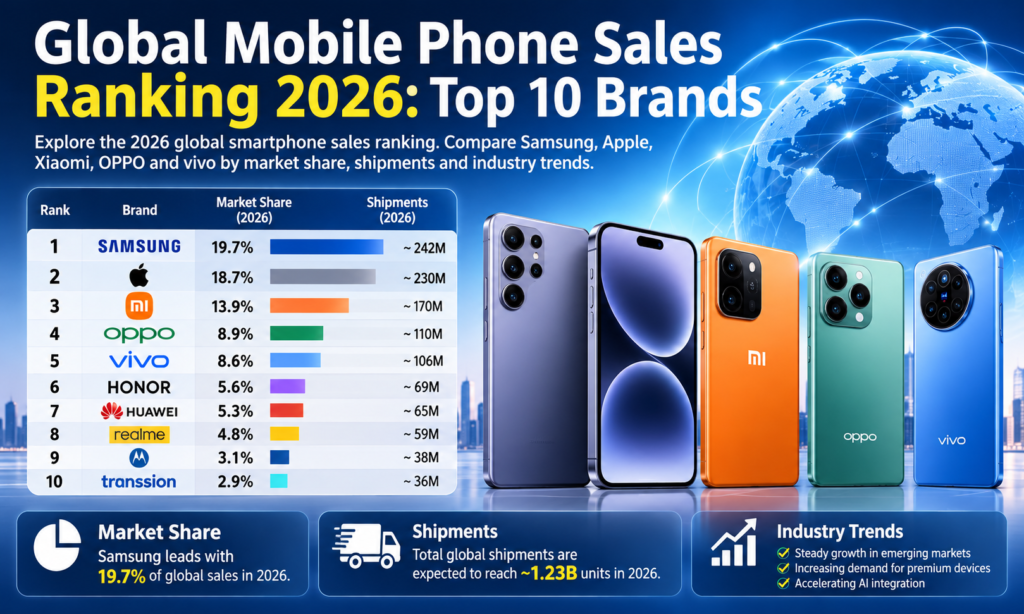
According to market research published during 2026, the global smartphone industry experienced considerable pressure during the third quarter. Omdia reported that worldwide smartphone shipments reached approximately 254.7 millones de unidades en el tercer trimestre 2026, representando un 20% year-over-year decline. Samsung maintained its leadership position, while Apple remained a close competitor. Xiaomi, OPPO and vivo continued to occupy important positions in the global market, although their shipment volumes were affected by higher component costs and weaker demand in price-sensitive markets. Omdia+1
It is important to understand that the ranking of smartphone manufacturers is not determined by brand popularity alone. Market share, shipment volume, regional distribution, product pricing and consumer demand all influence a company’s position. A manufacturer may sell fewer devices but generate higher revenue because its products are concentrated in the premium segment. Another manufacturer may ship millions of affordable smartphones while achieving a relatively low average selling price.
Para distribuidores, mayoristas, mobile phone repair businesses and replacement-parts suppliers, understanding these rankings provides valuable information. It helps identify which smartphone brands have the largest installed customer bases, which models are likely to generate replacement-part demand and which markets offer promising business opportunities.
1.1 Smartphone Shipments vs. Actual Retail Sales
Before examining the rankings, we need to clarify an important distinction between smartphone shipments and actual sales. Industry research companies such as IDC, Omdia and Counterpoint Research regularly publish smartphone shipment statistics. These figures generally represent devices delivered by manufacturers into distribution channels, rather than every individual smartphone purchased by an end consumer.
Retail sales, por otro lado, refer to devices actually purchased by consumers through online platforms, mobile phone retailers, telecommunications operators and other sales channels. The two measurements are closely related, but they are not identical. Por ejemplo, a manufacturer might ship a large quantity of smartphones to distributors in preparation for a major shopping season, while consumers purchase those products over several following weeks or months.
For this article, shipment rankings are used as the main reference because they provide a consistent and widely recognized way to compare smartphone manufacturers internationally. The figures should not be interpreted as a complete record of individual consumer purchases.
2. Arriba 10 Global Smartphone Brands in 2026
A partir de noviembre 20, 2026, complete calendar-year 2026 sales statistics are not yet available. Por lo tanto, the following analysis uses the latest available third-quarter shipment figures and published January–September market estimates. The ranking focuses on major global manufacturers rather than every regional smartphone brand.
2.1 Global Smartphone Shipment Ranking
The following table presents the top five manufacturers according to IDC’s preliminary Q3 2026 shipment figures, followed by other significant manufacturers in the global smartphone industry.
| Ranking | Smartphone Brand | Q3 2026 Shipments | Global Market Share |
|---|---|---|---|
| 1 | Samsung | 57.8 millón | 22.6% |
| 2 | Manzana | 57.3 millón | 22.4% |
| 3 | Xiaomi | 30.7 millón | 12.0% |
| 4 | Opto | 25.6 millón | 10.0% |
| 5 | vivo | 19.1 millón | 7.5% |
| 6 | Other manufacturers | 64.8 million combined | 25.4% |
Source: IDC Worldwide Quarterly Mobile Phone Tracker, preliminary Q3 2026 resultados, as reported in the October 2026 market data. aVenture Research+1
The table demonstrates an interesting development: Samsung and Apple have established a substantial lead over other manufacturers. Juntos, they accounted for approximately 45% of worldwide smartphone shipments in Q3 2026. Xiaomi, OPPO and vivo remain important competitors, but their combined shipment performance was considerably weaker during the same period.
The remaining market includes manufacturers such as HONOR, Huawei, Lenovo-owned Motorola, Transsion brands and several smaller regional players. Their individual positions vary depending on the research methodology, geographic coverage and whether related brands are consolidated under their parent companies. Como consecuencia, it would be misleading to assign precise sixth-to-tenth positions without a consistent manufacturer-level dataset.
Another important consideration is that the figures represent quarterly performance, not final annual rankings. Seasonal product launches and holiday shopping can significantly influence the final results.
3. Detailed Analysis of the Top Five Smartphone Brands
3.1 Samsung – The World’s Leading Smartphone Manufacturer
Samsung flagship and foldable smartphone portfolio
Rank #1 – Q3 2026
Samsung remains the world’s largest smartphone manufacturer by shipment volume in Q3 2026. According to IDC’s preliminary figures, Samsung shipped approximately 57.8 million smartphones during the quarter, representing a global market share of 22.6%. Although shipments declined by around 5.8% compared with the previous year, Samsung maintained a narrow lead over Apple. This achievement reflects the company’s extensive product portfolio, established global distribution network and ability to serve customers across different price categories.
One of Samsung’s greatest competitive advantages is its product diversity. The Galaxy S series targets consumers looking for premium performance, advanced cameras and sophisticated display technology. Mientras tanto, the Galaxy Z Fold and Z Flip series have strengthened Samsung’s position in the foldable smartphone segment. The Galaxy A series serves a much broader audience by offering practical features at more accessible prices. This combination allows Samsung to compete in markets with very different purchasing power and consumer expectations.
Display technology is another important part of Samsung’s competitive strategy. The company has extensive experience in AMOLED and OLED display development, providing high brightness, rich colors, deep blacks and improved power efficiency. These technologies are particularly important in flagship devices, where display quality can influence purchasing decisions. As consumers increasingly use smartphones for gaming, transmisión, photography and productivity, screen performance has become a major selling point.
For mobile phone LCD screen wholesalers and replacement-parts distributors, Samsung represents an important product category. Its large installed customer base creates ongoing demand for replacement displays, pantallas táctiles, baterias, charging connectors and other components. Repair businesses should pay particular attention to popular Galaxy A and Galaxy S models because different price segments generate different types of replacement demand.
3.2 Apple – The Strongest Competitor in the Premium Smartphone Market
Apple iPhone premium smartphone portfolio
Rank #2 – Q3 2026
Manzana continues to be one of the most influential companies in the global smartphone industry. In Q3 2026, Apple shipped approximately 57.3 million iPhones according to IDC’s preliminary estimates, dándole un 22.4% cuota de mercado. This placed Apple very close to Samsung, with a difference of only around 500,000 unidades. Although Apple did not take the first position during the quarter, its performance demonstrated the continued strength of its premium smartphone business.
Apple’s competitive advantage is built around its integrated ecosystem. The iPhone works closely with products and services such as the iPad, Mac, Apple Watch, AirPods and iCloud. This creates a connected user experience that encourages customer loyalty. Many existing iPhone users prefer upgrading to another iPhone rather than switching to an Android device, even when competing smartphones offer attractive hardware specifications.
El iPhone 18 Pro and iPhone 18 Pro Max also contributed to Apple’s premium positioning during the 2026 product cycle. Apple’s focus on high-end models allows the company to generate substantial revenue even when overall smartphone demand is weak. Counterpoint Research reported that Apple captured approximately 50% of global smartphone revenue in Q3 2026, despite accounting for around one-fifth of worldwide shipments. This demonstrates the considerable difference between shipment leadership and revenue leadership. Counterpoint Research+1
Apple also plays an important role in the mobile phone replacement-parts market. Conjuntos de pantalla OLED, baterias, charging components, cameras and other iPhone replacement parts are widely required by independent repair shops. Because iPhones have a relatively long product life cycle, demand for replacement components can continue for years after a particular model is released.
Para mayoristas, it is useful to monitor the popularity of different iPhone generations, particularly models with large user bases. Screen quality, compatibilidad, sensibilidad al tacto, brillo, color accuracy and installation reliability are important factors when selecting replacement displays.
3.3 Xiaomi – A Major Player in the Affordable and Mid-Range Smartphone Market
Xiaomi, Redmi and POCO smartphone product portfolio
Rank #3 – Q3 2026
Xiaomi remains one of the world’s most important smartphone manufacturers. The company has built its reputation by offering competitive hardware specifications, attractive designs and relatively accessible prices. Its portfolio includes Xiaomi flagship smartphones, Redmi budget and mid-range devices, and POCO performance-oriented products. This multi-brand approach enables Xiaomi to serve different consumer groups without relying entirely on a single product category.
According to IDC’s preliminary Q3 2026 figures, Xiaomi shipped approximately 30.7 million smartphones, contabilidad de 12% del mercado global. Sin embargo, shipments declined by around 29.2% año tras año. This was one of the more significant contractions among the leading manufacturers. Rising memory costs, weaker demand in emerging markets and adjustments to the company’s lower-priced product strategy contributed to the decline. aVenture Research+1
Xiaomi’s international expansion has been an important part of its business development. The company has established a strong presence in India, Sudeste Asiático, Europa, Latin America and other regions. Its Redmi series is particularly competitive in markets where consumers are sensitive to smartphone prices. Mientras tanto, premium Xiaomi models are designed to compete with established flagship manufacturers through advanced cameras, high-performance processors and improved displays.
The company’s product strategy is attractive to independent repair businesses because Xiaomi has a broad range of models across different price levels. Redmi and POCO devices often serve customers who prefer repairing their existing smartphones instead of purchasing new premium models. This creates opportunities for replacement LCD screens, Conjuntos OLED, baterias, charging ports and other mobile phone accessories.
Para proveedores de pantallas, accurate model identification is essential. Similar-looking Xiaomi, Redmi and POCO devices may use different display specifications, connectors or frame structures. Buyers should verify screen compatibility and quality before placing bulk orders.
3.4 OPPO – Strong Design and Camera Technology
OPPO flagship and Reno smartphone series
Rank #4 – Q3 2026
Opto has developed a strong position in the global smartphone market through attractive industrial design, camera innovation and charging technology. The company offers products across multiple price categories, including its Find flagship series, Reno mid-range devices and A series smartphones. These products are designed to appeal to customers who value appearance, fotografía, battery performance and convenient everyday functionality.
IDC’s preliminary Q3 2026 figures placed OPPO fourth globally, con aproximadamente 25.6 million shipments and a 10% cuota de mercado. Shipments declined by approximately 34.5% año tras año, reflecting significant pressure in several important smartphone markets. Rising component prices and weaker purchasing power have made it increasingly difficult for manufacturers with substantial exposure to mid-range and entry-level products.
OPPO’s competitive position is also connected to its related brands. In some market research reports, OnePlus and realme are consolidated under OPPO’s parent-company grouping. In others, the brands may be presented separately. This distinction matters when comparing rankings because different reporting methods can produce different shipment totals and market shares.
For the mobile phone repair industry, OPPO offers a considerable range of replacement-parts opportunities. Its popular Reno and A series models can generate demand for display assemblies, paneles táctiles, baterias, cameras and charging components. Repair shops serving Asian, Middle Eastern, African and European markets may find that local OPPO model popularity differs considerably from global averages.
When sourcing OPPO replacement screens, wholesalers should check model numbers, resoluciones de pantalla, connector positions and frame compatibility. A product that appears visually similar may not necessarily be interchangeable with another model.
3.5 vivo – A Strong Competitor in Photography and Emerging Markets
vivo flagship, camera-focused and Y series smartphones
Rank #5 – Q3 2026
vivo completes the top five global smartphone manufacturers in the Q3 2026 IDC ranking. The company shipped approximately 19.1 million smartphones, representando un 7.5% cuota de mercado. Shipments declined by approximately 31.5% compared with the same period in 2025, reflecting challenging conditions across several emerging smartphone markets.
vivo has developed its brand identity through camera technology, stylish designs and strong regional distribution. Its X series targets premium consumers who prioritize photography and advanced hardware. The V series focuses on camera-oriented mid-range smartphones, while the Y series offers more affordable devices for everyday use. This portfolio gives vivo access to consumers with different budgets and purchasing preferences.
India and Southeast Asia remain important markets for vivo. The company has invested in retail distribution, marketing and localized product strategies to compete with Samsung, Xiaomi and other Android manufacturers. Its ability to establish relationships with local retailers and distributors has helped it develop a recognizable position in these regions.
From a replacement-parts perspective, vivo’s growing international user base creates opportunities for mobile phone screen suppliers and repair businesses. Display assemblies, baterias, charging flex cables and camera components are among the commonly required replacement categories. Since many vivo smartphones occupy the affordable and mid-range segments, customers may prefer replacing damaged screens rather than purchasing an entirely new phone.
Para mayoristas internacionales, the most useful strategy is to identify the vivo models with the highest local repair demand rather than purchasing every available model. This helps improve inventory turnover and reduce the risk of holding slow-moving replacement components.
4. Other Important Smartphone Manufacturers
Although Samsung, Manzana, Xiaomi, OPPO and vivo dominate the leading shipment rankings, several other manufacturers remain important competitors. Their combined market share represents a substantial part of the global smartphone industry. Some specialize in particular countries or regions, while others focus on premium products, budget devices or specialized consumer groups.
4.1 Huawei, HONOR, Lenovo and Transsion
Huawei remains an important smartphone manufacturer, particularmente en china. The company has developed its own hardware and software ecosystem and continues to invest in imaging, operating systems and domestic supply chains. Its strong brand recognition and loyal customer base support its position in the Chinese market.
HONOR has expanded its international presence through flagship, mid-range and affordable smartphones. Its Magic series targets premium customers, while the HONOR X series competes in more accessible price segments. International expansion and product localization have become important elements of its growth strategy.
Motorola, owned by Lenovo, has a long history in mobile communications. Its Edge and Moto G series target different price categories, with particularly relevant distribution networks in North and Latin America. The company also participates in the foldable smartphone segment through its Razr product family.
Participaciones en transición operates several popular smartphone brands, incluido TECNO, Infinix and itel. These brands have established strong positions in Africa and other emerging markets by offering affordable devices, baterías grandes, practical camera features and competitive specifications. Their products are especially important in regions where consumers have limited budgets but increasingly rely on smartphones for communication, education and digital payments.
For repair-parts wholesalers, these manufacturers should not be overlooked. Although their global shipment positions may be lower than those of Samsung and Apple, their strong regional presence can create substantial local demand for replacement screens and mobile phone accessories.
5. Major Factors Influencing Smartphone Sales in 2026
The global smartphone market is influenced by several factors, y 2026 has highlighted how quickly market conditions can change. Manufacturers are no longer competing only through processor performance, camera megapixels or screen size. Supply chain management, component availability, production costs, software support and consumer purchasing power are equally important. Understanding these factors helps explain why some manufacturers have maintained their market positions while others have experienced declining shipments.
1. Memory chip shortages and rising component costs
One of the most significant challenges in 2026 has been the rising cost and limited availability of memory components. Smartphones require DRAM and NAND flash memory for multitasking, aplicaciones, fotografía, video storage and operating system performance. When memory prices increase, manufacturers must decide whether to absorb additional costs, raise retail prices or adjust hardware configurations. IDC reported in August 2026 that memory costs had increased substantially, putting particular pressure on entry-level smartphone manufacturers. This situation has made it more difficult for brands competing primarily through low prices to maintain their previous shipment volumes. Smartphone Market Share+1
2. Increasing demand for premium smartphones
Consumers are keeping their smartphones longer, but when they eventually upgrade, many prefer devices with better cameras, muestra, processors and battery performance. This has supported premium-focused brands, particularly Apple and Samsung. High-end smartphones also provide manufacturers with better opportunities to protect profit margins when production costs rise. Sin embargo, premiumization does not mean that affordable smartphones are becoming irrelevant. Millions of consumers still depend on entry-level and mid-range devices, particularly in developing economies.
3. Artificial intelligence and smart features
Artificial intelligence has become an increasingly important selling point in the smartphone industry. Manufacturers are introducing AI-powered photography, real-time translation, asistentes de voz, intelligent search, productivity tools and personalized software experiences. These features are changing how consumers evaluate smartphones. A device is no longer judged only by its hardware specifications; its software capabilities and ability to integrate AI into daily activities are also becoming important purchasing considerations.
4. Battery performance and charging technology
Battery life remains one of the most practical considerations for smartphone buyers. Consumers want devices that can comfortably operate throughout the day, even when using navigation, redes sociales, video streaming and demanding applications. Carga rápida, improved battery chemistry and more efficient processors are therefore important areas of competition. Manufacturers that provide a good balance between battery capacity, charging speed and long-term battery health can strengthen their product appeal.
5. Display quality and durability
The display is one of the most frequently interacted-with smartphone components. Consumers expect high resolution, smooth refresh rates, accurate colors and good outdoor visibility. OLED and AMOLED technology have become increasingly common in premium and mid-range devices, while LCD technology continues to serve important affordable product categories. Manufacturers are also improving glass protection, screen durability and foldable display structures. These developments influence both new smartphone purchases and the replacement-parts market.
6. Trade-in programs and longer software support
Another factor influencing smartphone sales is the availability of trade-in programs and extended software updates. When manufacturers offer attractive upgrade discounts, consumers may replace older devices earlier. Al mismo tiempo, longer software support encourages people to keep their smartphones for more years. Both trends influence replacement demand, inventory planning and the timing of new product purchases.
6. Regional Smartphone Market Trends
Global smartphone rankings provide an overall picture, but they do not fully explain regional differences. A brand that performs extremely well in China may have a smaller presence in North America. Similarmente, manufacturers with strong positions in Africa and Southeast Asia may not appear among the leading brands in Western Europe. Regional market conditions, income levels, retail networks, telecommunications infrastructure and consumer preferences all contribute to these differences.
América del norte
North America is one of the most important premium smartphone markets. Apple has a particularly strong position in the United States, supported by its ecosystem, brand recognition, carrier partnerships and customer loyalty. Samsung is also a major competitor through its Galaxy S, Galaxy Z and Galaxy A product families.
Consumers in this region often purchase smartphones through telecommunications operators, installment plans and trade-in programs. These purchasing methods make expensive flagship devices more accessible. Como consecuencia, premium smartphone manufacturers can maintain stronger demand even when retail prices increase.
For replacement-parts suppliers, Apple and Samsung models are particularly important categories to monitor. Repair shops need reliable display assemblies, baterias, charging components and other frequently replaced parts for popular models.
Europa
Europe is a mature smartphone market with strong competition among Apple, Samsung and Chinese manufacturers. Consumers often consider design, rendimiento de la cámara, duración de la batería, software updates and long-term product reliability when purchasing smartphones. Xiaomi, HONOR, Motorola and other Android brands compete by offering a balance between specifications and price.
Environmental awareness and repairability are also becoming increasingly relevant in European markets. Consumers may choose to repair existing devices rather than replace them, particularly when the cost of a replacement screen or battery is significantly lower than purchasing a new smartphone.
This creates opportunities for professional repair businesses and suppliers that can provide consistent-quality replacement components.
Porcelana
China is one of the world’s most competitive smartphone markets. Domestic manufacturers such as Huawei, Xiaomi, vivo, OPPO and HONOR compete aggressively with Apple. Consumers have access to a wide range of smartphones, from affordable Android devices to sophisticated flagship products.
Local brand loyalty, technological innovation and retail promotions strongly influence purchasing decisions. Huawei’s continued development of its domestic smartphone ecosystem has also increased competitive pressure on other manufacturers.
China is particularly important for the mobile phone components industry because of its extensive electronics manufacturing and supply chain infrastructure. Many display modules, baterias, connectors and other smartphone components are manufactured or assembled within the broader Chinese electronics ecosystem.
India and Southeast Asia
India and Southeast Asia are important markets for affordable and mid-range smartphones. Samsung, Xiaomi, vivo, Opto, realme and Transsion brands compete for consumers who want reliable devices at reasonable prices.
Smartphones in these regions are frequently used for mobile payments, compras en línea, social networking, education and entertainment. Como resultado, duración de la batería, calidad de la pantalla, camera performance and overall value are important purchasing considerations.
The large installed base of affordable smartphones also creates demand for repair services. When an LCD or OLED screen is damaged, many customers prefer replacing the screen instead of buying a new device. This makes India and Southeast Asia attractive markets for mobile phone LCD screen wholesalers and replacement-parts distributors.
África, Latin America and the Middle East
These regions offer considerable opportunities for manufacturers that can provide affordable smartphones and reliable distribution. Marcas de transición, Samsung, Xiaomi and other Android manufacturers have developed strong regional positions.
Sin embargo, currency fluctuations, import duties, inflation and limited consumer purchasing power can influence smartphone demand. In these markets, price competitiveness is often as important as technical specifications.
For international suppliers, understanding regional demand is essential. A replacement screen that sells quickly in one country may have limited demand in another. Successful wholesalers therefore need to combine global market information with local repair-shop purchasing patterns.
7. Smartphone Display Technology and Replacement Parts Demand
The growth of the smartphone industry has created a large market for replacement screens and mobile phone accessories. Although smartphone manufacturers continuously introduce new models, millions of older devices remain in daily use. Screens can be damaged by accidental drops, presión, rayones, liquid exposure and other forms of physical impact. In many situations, replacing the display is considerably more economical than purchasing a new smartphone.
Different Types of Smartphone Display Technology
Understanding display technology is important when selecting replacement screens. Different smartphone models use different display structures, and buyers should not assume that all screens are interchangeable.
| Tecnología de visualización | Main Characteristics | Aplicaciones comunes |
|---|---|---|
| LCD TFT | Asequible, mature and widely used | Entry-level smartphones |
| LCD IPS | Good viewing angles and color consistency | Budget and mid-range devices |
| Oleado | Self-emissive pixels and high contrast | Teléfonos inteligentes premium |
| Amolado | Active-matrix OLED with fast response | Mid-range and flagship devices |
| LTPO ERES | Adaptive refresh rates and improved power efficiency | Premium flagship smartphones |
LCD TFT technology remains relevant because of its relatively affordable manufacturing cost. It is commonly found in entry-level smartphones and some budget replacement-screen products. Although it cannot match the contrast performance of OLED, it remains a practical solution for cost-conscious customers.
LCD IPS improves viewing angles and color consistency compared with traditional basic LCD panels. It has been widely used in smartphones because it offers a reasonable balance between performance and production cost.
OLED y AMOLED displays provide deeper blacks, stronger contrast and excellent color reproduction. Because individual pixels generate their own light, these displays can also support more flexible screen designs and power-saving features. They are widely used in modern premium smartphones.
LTPO ERES is an advanced display technology that allows the refresh rate to adjust dynamically according to displayed content. This can help improve energy efficiency while maintaining a smooth visual experience. It is particularly relevant to high-end smartphones.
Why Replacement LCD and OLED Screens Remain in Demand
Even though manufacturers continue to improve screen protection, accidental damage remains common. A smartphone may continue working perfectly while its screen is cracked, unresponsive or displaying abnormal colors. In such cases, replacing the display module is often the most practical repair solution.
The global installed base of Samsung, Manzana, Xiaomi, OPPO and vivo devices provides a continuing market for replacement screens. Older models can remain commercially relevant for several years because many consumers do not upgrade every time a new generation is released.
Para mayoristas, the most important factors when purchasing replacement displays include compatibility, brillo, resolución, sensibilidad al tacto, reproducción del color, durability and production consistency. El precio es importante, but the cheapest screen is not necessarily the most profitable choice if it generates a high return rate or customer complaints.
Suppliers should also clearly distinguish between different replacement-screen grades and configurations. Original service-pack screens, pantallas originales restauradas, aftermarket OLED screens and aftermarket LCD assemblies may have different characteristics and prices. Transparent product specifications help distributors make informed purchasing decisions.
Business Opportunities for Mobile Phone Parts Wholesalers
The smartphone market ranking can provide useful guidance for replacement-parts inventory planning. Manufacturers with large installed user bases are natural candidates for wholesalers looking to establish stable product lines.
Samsung and Apple are important because of their large global customer bases and extensive model portfolios. Xiaomi, OPPO and vivo offer opportunities in affordable and mid-range replacement screens, particularly in emerging markets. HONOR, Huawei, Motorola and Transsion brands can provide additional opportunities depending on the destination market.
A successful wholesale strategy should consider three important factors. Primero, identify the most popular smartphone models in the target country. Segundo, compare the availability and quality of compatible replacement screens. Tercero, evaluate the actual purchasing behavior of local repair shops rather than relying exclusively on global shipment rankings.
A reliable supplier should also provide accurate compatibility information, stable quality control, protective packaging and responsive after-sales service. These factors help international distributors build long-term customer relationships.
8. Global Smartphone Market Outlook for 2027
Mirando hacia adelante, the global smartphone industry is likely to remain highly competitive. The market challenges experienced in 2026 may influence manufacturers’ product strategies, production plans and retail pricing throughout 2027. According to Omdia’s October 2026 analysis, global smartphone shipments were expected to decline by approximately 12% for the full year 2026, with further pressure from memory shortages and rising component costs. Omdía
Sin embargo, a decline in new smartphone shipments does not necessarily mean that the entire mobile phone industry will experience weaker business opportunities. Consumers who delay purchasing new smartphones may continue using their existing devices for longer. A medida que los teléfonos inteligentes envejecen, the need for screen replacements, battery replacements and other repairs can remain significant.
Several trends are likely to influence the market in 2027.
Artificial intelligence integration: Smartphone manufacturers will continue improving on-device AI capabilities. Better AI photography, intelligent assistants, language translation and productivity tools may encourage consumers to upgrade older smartphones.
Foldable smartphone development: Foldable phones may gradually become more accessible as manufacturers improve hinge durability, display technology and production efficiency. This could create new opportunities for specialized replacement display modules and repair services.
Tecnología OLED avanzada: OLED and LTPO OLED displays are expected to remain important in premium smartphones. Improvements in brightness, eficiencia energética, thinness and durability will influence future product development.
Longer smartphone replacement cycles: Higher device prices may encourage consumers to keep their smartphones for longer. This could support demand for replacement batteries, screens and other repair components.
Greater competition in emerging markets: Manufacturers will continue developing affordable smartphones for India, África, Southeast Asia and Latin America. Regional distribution, local pricing and reliable after-sales support will remain important competitive advantages.
For mobile phone parts wholesalers, 2027 should be approached with a balanced inventory strategy. Maintaining popular Samsung and Apple replacement screens while expanding carefully into Xiaomi, Opto, vivo, HONOR and other regional brands can help reduce dependence on a single manufacturer.
Al final, the smartphone market is evolving rather than disappearing. Even when new-device sales slow down, the need to maintain and repair existing smartphones remains part of the industry’s long-term business ecosystem.
Conclusión
El 2026 global mobile phone sales ranking highlights the competitive nature of the smartphone industry. Samsung currently holds the leading position in worldwide Q3 shipments, with Apple following closely behind. Xiaomi, OPPO and vivo remain major competitors, while Huawei, HONOR, Motorola and Transsion continue to strengthen their positions in different regional markets.
One of the most important findings from 2026 is that shipment volume and profitability do not always move together. Samsung leads in smartphone shipments, while Apple dominates global smartphone revenue. This difference demonstrates how product positioning, brand loyalty and average selling prices influence manufacturers’ business performance.
For international mobile phone distributors, wholesalers and repair businesses, these rankings provide valuable insights into future sourcing opportunities. The growing installed base of smartphones creates continuing demand for replacement LCD screens, pantallas OLED, baterias, charging components and other mobile phone accessories.
Choosing the right supplier is equally important. Product compatibility, calidad constante, competitive wholesale pricing, reliable delivery and professional customer service all contribute to successful long-term cooperation.
As the smartphone industry moves toward 2027, businesses that understand global brand trends and respond quickly to changing replacement-parts demand will be better positioned to capture new opportunities.
Looking for a reliable supplier of mobile phone LCD screens and accessories?
If you are a mobile phone wholesaler, distribuidor, importer or repair-parts retailer looking for quality replacement screens and mobile phone accessories, we welcome your inquiries. We are happy to discuss your product requirements and explore potential business cooperation.
Mobile Phone LCD Screens & Accessories – Business Contact
Contact Person: Manager Loly Jiang
Correo electrónico: Mophoneparts@outlook.com
WhatsApp: +86 137 1130 8199
Feel free to contact us for product inquiries, wholesale pricing and business cooperation.
Preguntas frecuentes (Preguntas frecuentes)
1. Which is the No. 1 mobile phone brand in the world in 2026?
Samsung ranked No. 1 globally by smartphone shipments in Q3 2026, con aproximadamente 57.8 million units shipped and a 22.6% market share according to IDC’s preliminary data. Apple ranked second, con aproximadamente 57.3 millones de unidades. The two companies remain extremely close competitors.
2. Which smartphone brand has the largest global market share in 2026?
Samsung holds the largest global smartphone shipment share in the Q3 2026 IDC ranking, at approximately 22.6%. Sin embargo, market shares change between quarters, and Apple remains a close competitor. Rankings can also differ depending on the research company and reporting methodology.
3. Is Apple or Samsung selling more smartphones in 2026?
Samsung shipped slightly more smartphones than Apple in Q3 2026, according to IDC. Sin embargo, Apple generated a significantly larger share of global smartphone revenue. Counterpoint Research reported that Apple captured approximately 50% of global smartphone revenue during the third quarter, demonstrating its strength in the premium market.
4. Which smartphone brands are popular in the global replacement LCD screen market?
Samsung, Manzana, Xiaomi, OPPO and vivo are important brands for replacement-screen distributors because of their large installed customer bases. Other relevant brands include Huawei, HONOR, Motorola, TECNO and Infinix. Actual demand depends on local smartphone popularity, model availability and repair costs.
5. Where can I buy wholesale mobile phone LCD screens and accessories?
International wholesalers can purchase mobile phone LCD screens and accessories from specialized manufacturers and suppliers in major electronics manufacturing regions, particularly China. Before placing bulk orders, buyers should evaluate product compatibility, calidad de la pantalla, precios, embalaje, delivery arrangements and after-sales support.
For wholesale mobile phone LCD screen and accessory inquiries, contact:
- Manager: Loly Jiang
- Correo electrónico: Mophoneparts@outlook.com
- WhatsApp: +86 137 1130 8199
References and Market Research Sources
The article uses published 2026 market information from the following research organizations: