Introduction
Since 2018, Apple’s iPhone lineup has consistently redefined smartphone design and display innovation. From the introduction of the Super Retina HD panels in the iPhone XS to the Dynamic Island and ProMotion 120Hz displays on modern models, Apple has shown its commitment to balancing style, functionality, and visual excellence.
Let’s dive deep into how iPhones have evolved between 2018 and 2025, including some future predictions that reflect industry trends and Apple’s trajectory.
iPhone Evolution: From 2018 to 2025
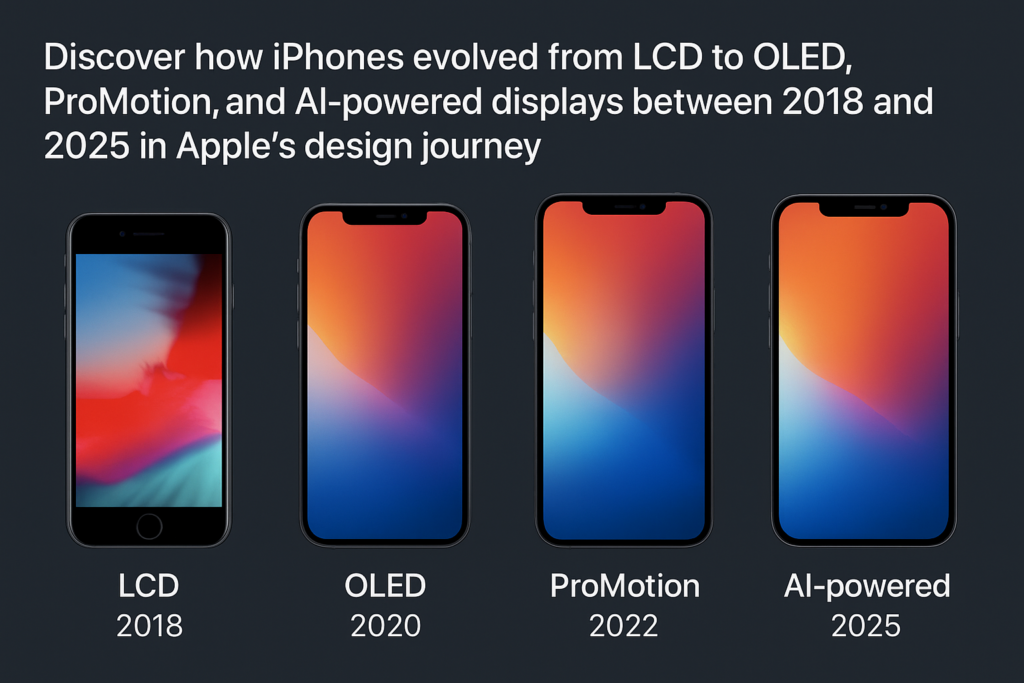
Between 2018 and 2025, Apple transitioned from LCD to OLED across almost all models. The Liquid Retina HD LCDs gave way to Super Retina XDR OLEDs, which now dominate the lineup. The journey also includes significant milestones—such as 5G, ProMotion, Always-On Display, and the switch to USB-C.
By 2025, the iPhone lineup is expected to reach a level of refinement that integrates AI-powered camera systems, smarter displays, and ultra-efficient chipsets.
Understanding Apple’s Display Technologies
LCD vs OLED
LCD (Liquid Crystal Display) was used in earlier models like the iPhone XR and SE. OLED (Organic Light-Emitting Diode), however, provides deeper blacks, better contrast, and improved efficiency—now standard in Apple’s flagship models.
Super Retina HD and XDR
Apple introduced Super Retina HD in 2018 and Super Retina XDR in 2019, offering superior brightness and contrast. The XDR (Extreme Dynamic Range) technology enhances HDR content display, delivering vivid color reproduction.
ProMotion and Always-On Display
ProMotion technology, first appearing in the iPhone 13 Pro, enables a 120Hz refresh rate—creating smoother animations and scrolling. Later, the Always-On Display in the iPhone 14 Pro series kept information visible even when the screen was idle.
iPhone Models Overview (2018–2023)
2018: The OLED and LCD Divide
The iPhone XS, XS Max, and XR marked Apple’s dual approach—premium OLED and affordable LCD options. The XR’s Liquid Retina LCD appealed to budget-conscious users.
2019: Triple Cameras and Performance Boost
The iPhone 11 Pro series brought triple cameras and the A13 Bionic chip, enhancing both photography and battery life.
2020: 5G and Flat-Edge Design
Apple returned to flat edges with the iPhone 12 series, bringing a refreshed design, Ceramic Shield, and 5G connectivity. OLED displays became standard across the lineup.
2021: ProMotion Comes to iPhone
The iPhone 13 Pro and Pro Max featured ProMotion displays, supporting 120Hz refresh rates—ideal for gamers and content creators.
2022: Dynamic Island Revolution
The iPhone 14 Pro series introduced the Dynamic Island, replacing the notch and offering interactive notifications. The Always-On Display and the A16 Bionic chip defined a new era.
2023: Titanium Design and USB-C Integration
The iPhone 15 Pro series introduced titanium frames, USB-C ports, and a customizable Action Button—a significant design and functionality leap.
Predicted Models (2024–2025)
2024: iPhone 16 Series Enhancements
Industry analysts predict that the iPhone 16 Pro will grow to 6.3 inches, while the Pro Max expands to 6.9 inches. Apple may also add a dedicated capture button and improve refresh rates for non-Pro models.
2025: The iPhone 17 Series and Beyond
The iPhone 17 lineup is expected to refine display technology with energy-efficient OLEDs and possibly micro-lens array displays. Apple might also debut AI-assisted display calibration for enhanced visual fidelity.
Complete iPhone Specifications Table (2018–2025)
Below is the comprehensive Excel-style table summarizing all iPhone models from 2018 to 2025:
| Model | Release Year | Display Type & Specs | Dimensions (mm) | Notes |
|---|---|---|---|---|
| iPhone XS | 2018 | 5.8″ OLED, Super Retina HD, 2436×1125, 458 ppi | 143.6 x 70.9 x 7.7 | Discontinued |
| iPhone XS Max | 2018 | 6.5″ OLED, Super Retina HD, 2688×1242, 458 ppi | 157.5 x 77.4 x 7.7 | Discontinued |
| iPhone XR | 2018 | 6.1″ LCD, Liquid Retina HD, 1792×828, 326 ppi | 150.9 x 75.7 x 8.3 | Discontinued |
| iPhone 11 | 2019 | 6.1″ LCD, Liquid Retina HD, 1792×828, 326 ppi | 150.9 x 75.7 x 8.3 | Discontinued |
| iPhone 11 Pro | 2019 | 5.8″ OLED, Super Retina XDR, 2436×1125, 458 ppi | 144 x 71.4 x 8.1 | Discontinued |
| iPhone 11 Pro Max | 2019 | 6.5″ OLED, Super Retina XDR, 2688×1242, 458 ppi | 158 x 77.8 x 8.1 | Discontinued |
| iPhone SE (2nd Gen) | 2020 | 4.7″ LCD, Retina HD, 1334×750, 326 ppi | 138.4 x 67.3 x 7.3 | |
| iPhone 12 Mini | 2020 | 5.4″ OLED, Super Retina XDR, 2340×1080, 476 ppi | 131.5 x 64.2 x 7.4 | Discontinued |
| iPhone 12 | 2020 | 6.1″ OLED, Super Retina XDR, 2532×1170, 460 ppi | 146.7 x 71.5 x 7.4 | |
| iPhone 13 Pro Max | 2021 | 6.7″ OLED, XDR, ProMotion 120Hz | 160.8 x 78.1 x 7.65 | Discontinued |
| iPhone 14 Pro | 2022 | 6.1″ OLED, XDR, Always-On, 2556×1179 | 147.5 x 71.5 x 7.85 | Dynamic Island |
| iPhone 15 Pro | 2023 | 6.1″ OLED, XDR, ProMotion, 2556×1179 | 146.6 x 70.6 x 8.25 | Titanium, USB-C |
| iPhone 16 Pro | 2024* | 6.3″ OLED, XDR, ProMotion | TBD | Predicted |
| iPhone 17 Pro Max | 2025* | 6.9″ OLED, Next-gen XDR | TBD | Predicted |
(*Predicted models subject to change)
Trends and Key Observations
Size Evolution
Apple has progressively increased screen sizes, moving from 5.8″ (iPhone XS) to a predicted 6.9″ (iPhone 17 Pro Max). Compact models like the “mini” line have been phased out due to low demand.
Display Upgrades
From LCD to OLED, Apple’s focus shifted to better brightness, contrast, and energy efficiency. The 120Hz refresh rate and Always-On feature reflect Apple’s push toward seamless interactivity.
Material and Design Changes
Titanium frames, thinner bezels, and improved durability mark the 15 Pro series. Future models are expected to further reduce thickness while maintaining battery life.
Predictions for Future iPhones
Looking ahead, Apple may:
- Adopt microLED displays for unparalleled brightness.
- Integrate AI-powered display calibration.
- Introduce adaptive refresh rates beyond 120Hz.
- Move toward portless designs by 2026.
The iPhone’s evolution clearly mirrors Apple’s ambition to merge technology, artistry, and sustainability in one compact device.
Conclusion
From 2018’s Super Retina debut to the upcoming AI-driven, ultra-efficient models of 2025, the iPhone has transformed into a showcase of engineering excellence. Each model builds on the last, offering users smarter, sleeker, and more sustainable technology.
FAQs
1. Which iPhone first used OLED technology?
The iPhone X (2017) introduced OLED, and by 2020, it became standard across most models.
2. When did Apple introduce ProMotion displays?
In 2021 with the iPhone 13 Pro series.
3. What makes the iPhone 15 Pro’s display unique?
It features a Super Retina XDR OLED, 120Hz ProMotion, and titanium frame for better heat management.
4. Are 2024–2025 iPhone specs confirmed?
Not yet — they’re based on industry analysis and credible leaks.
5. Will Apple bring back smaller iPhones?
Unlikely. Market data shows users prefer larger displays for media and productivity.