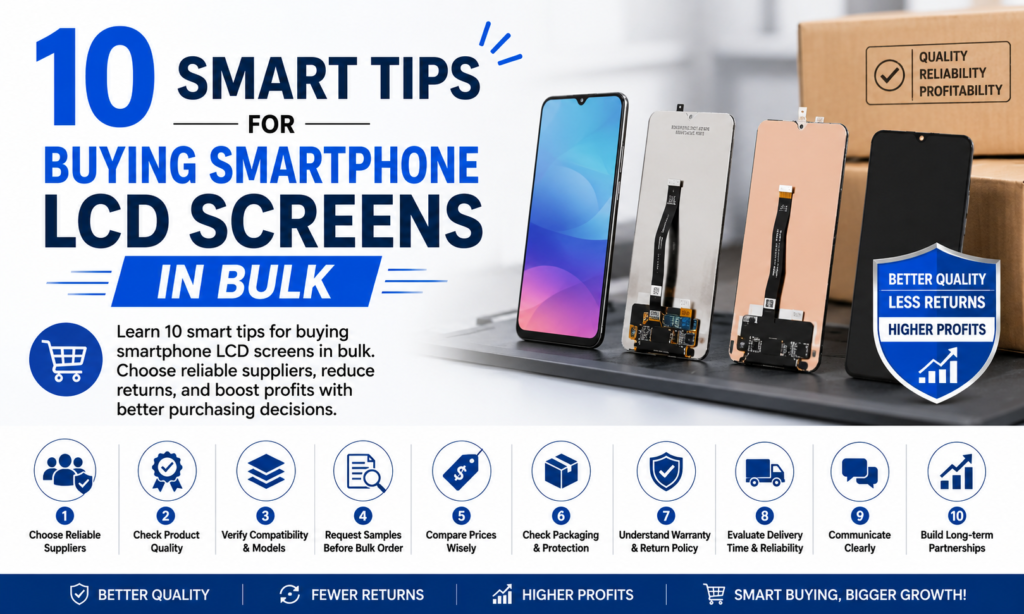
Buying smartphone LCD screens in bulk may seem simple at first glance, but experienced wholesalers know it requires careful planning. A supplier offering an incredibly low price may end up costing far more through defective products, warranty claims, delayed deliveries, and unhappy customers. Whether you operate a repair shop, distribute replacement parts, or refurbish smartphones for resale, every purchasing decision affects your profitability.
Today’s smartphone repair market is highly competitive. Customers expect replacement screens to perform almost like the original display, while repair businesses need healthy profit margins to remain competitive. That means choosing the right supplier is just as important as choosing the right product. Instead of focusing only on discounts, successful buyers evaluate quality consistency, testing procedures, production capacity, and after-sales service before placing large orders. Recent industry research shows that businesses relying on long-term, reliable suppliers generally experience fewer returns and lower operating costs than companies constantly chasing the cheapest offer.
Why Bulk Purchasing Matters
Bulk purchasing provides significant advantages. Larger orders usually reduce the unit price, stabilize inventory, simplify logistics, and strengthen supplier relationships. Buying in volume also gives businesses greater negotiating power for warranties, packaging customization, and delivery schedules.
However, purchasing hundreds or thousands of screens without proper evaluation can quickly become expensive. Even a small defect rate may lead to substantial financial losses once labor, shipping, and customer service costs are considered. This is why professional buyers carefully verify every aspect of the supply chain before committing to large-volume purchases.
Understanding Today’s LCD Wholesale Market
The smartphone display industry continues to grow because millions of cracked screens require replacement every year. While OLED technology dominates many flagship smartphones, LCD screens remain the preferred choice for numerous mid-range devices and cost-effective repairs due to their lower production cost and dependable availability. Industry forecasts estimate that LCD panels still represent a major portion of replacement display shipments worldwide.
Growing Demand from Repair Shops
Independent repair shops, refurbishment companies, insurance providers, and electronics distributors all contribute to the growing demand for replacement LCD screens. As consumers keep smartphones longer, repairs become more economical than buying new devices.
LCD vs OLED in the Replacement Market
Although OLED displays provide deeper blacks and better contrast, LCD screens remain attractive because they are more affordable, easier to source, and suitable for many repair scenarios where customers prioritize value over premium specifications.
| Feature | LCD | OLED |
|---|---|---|
| Cost | Lower | Higher |
| Replacement Price | Affordable | Premium |
| Repair Market Demand | Very High | High |
| Brightness | Excellent | Excellent |
| Durability for Budget Repairs | Good | Good |
Tip 1: Know Exactly Which Models You Need
Never place a bulk order based solely on model names. Smartphone manufacturers often release regional versions with different connectors, display drivers, or frame designs. Even devices sharing nearly identical names may require completely different replacement assemblies.
Study your historical sales records to identify fast-moving models. Concentrate your inventory on devices that generate consistent demand rather than filling your warehouse with slow-selling products. This approach improves inventory turnover and reduces capital tied up in obsolete stock.
Tip 2: Choose the Right Screen Quality Grade
Understanding screen grades prevents expensive mistakes. The terms OEM, Original, Refurbished, Grade A, and Aftermarket are not always standardized across suppliers.
OEM vs Aftermarket vs Refurbished
| Grade | Description | Best For |
| Original/OEM | Highest quality | Premium repairs |
| OEM Equivalent | Excellent balance | Most repair shops |
| Refurbished | Original panel restored | Cost-conscious buyers |
| Aftermarket Grade A | Good quality | General repairs |
| Budget Copy | Lowest price | Entry-level markets |
Always ask suppliers to explain their grading standards rather than assuming identical terminology across factories.
Tip 3: Never Buy Based on Price Alone
One of the biggest mistakes wholesalers make is chasing the cheapest quotation. Low prices often hide compromises in display brightness, touch responsiveness, connector quality, adhesive performance, or long-term durability.
A screen may pass a five-minute inspection but develop flickering, ghost touch, or backlight issues after several weeks of normal use. Industry experts consistently advise buyers to evaluate total ownership cost instead of purchase price alone. A slightly higher-priced screen with lower return rates often produces much better long-term profitability.
Tip 4: Evaluate the Supplier Carefully
Selecting the right supplier is arguably the most important decision in wholesale purchasing.
Production Capacity
Reliable factories should demonstrate:
- Stable monthly production
- Multiple quality inspections
- Batch traceability
- Professional export experience
- Consistent lead times
Suppliers with mature production systems generally deliver more consistent quality across multiple shipments.
Tip 5: Always Request Samples
Never place a large order without testing samples first.
A complete evaluation should include:
- Display brightness
- Color accuracy
- Multi-touch responsiveness
- Frame alignment
- Flex cable durability
- Outdoor visibility
- Dead pixel inspection
Better still, test samples for several weeks under real-world operating conditions before committing to volume purchases.
Tip 6: Verify Quality Control Procedures
Professional manufacturers perform numerous inspections before shipment, including visual examination, touch testing, brightness calibration, connector inspection, and packaging verification.
Ask suppliers questions such as:
- How many QC inspections are performed?
- Is every screen tested?
- Are testing reports available?
- Are photos provided before shipment?
Strong quality control dramatically reduces warranty claims and customer complaints.
Tip 7: Understand Warranty and Return Policies
Warranty terms differ greatly between suppliers. Before placing your order, clarify:
- Warranty period
- Dead-on-arrival policy
- Return shipping responsibility
- Replacement procedures
- Technical support
Clear warranty agreements reduce future disputes and help maintain healthy business relationships.
Tip 8: Inspect Packaging and Shipping Standards
LCD screens are among the most fragile smartphone components. Even perfect products can arrive damaged if packaging is inadequate.
Professional suppliers typically use:
- Anti-static bags
- Protective foam
- Bubble cushioning
- Individual compartments
- Strong export cartons
Proper packaging reduces transportation damage and lowers replacement costs.
Tip 9: Manage Inventory Strategically
Avoid purchasing excessive quantities of slow-moving models simply because they appear inexpensive. Smartphone prices decline rapidly, and replacement part demand shifts as new devices enter the market.
Instead, analyze repair trends and maintain higher inventory levels only for popular models with stable replacement demand. Regular inventory reviews help reduce obsolete stock while improving cash flow.
Tip 10: Build Long-Term Supplier Partnerships
The most successful wholesalers rarely change suppliers every few months. Long-term partnerships often provide better pricing, production priority, faster communication, customized packaging, and improved technical support.
Suppliers who understand your business requirements can also recommend inventory planning, notify you about product updates, and help resolve quality issues more efficiently than new suppliers unfamiliar with your operations.
Conclusion
Bulk purchasing smartphone LCD screens is much more than negotiating the lowest possible price. Successful buyers evaluate compatibility, quality grades, supplier reliability, testing procedures, packaging standards, warranty support, and long-term consistency before investing in large orders. A carefully selected supplier becomes a valuable business partner rather than just another vendor.
By following these ten practical tips, repair shops, wholesalers, distributors, and refurbishment companies can reduce return rates, improve customer satisfaction, strengthen profit margins, and build a more sustainable supply chain in today’s highly competitive smartphone repair market.
Frequently Asked Questions
1. What is the best quality LCD screen for wholesale purchases?
OEM or high-quality OEM-equivalent screens usually provide the best balance between performance, reliability, and cost.
2. Should I always buy the cheapest LCD screens?
No. Extremely low-priced screens often result in higher warranty claims and customer complaints.
3. How many samples should I test before placing a bulk order?
Testing multiple samples from different production batches provides a much better indication of long-term consistency.
4. Which smartphone models should wholesalers prioritize?
Focus on high-volume repair models with steady market demand rather than obsolete or slow-selling devices.
5. Why is supplier consistency more important than price?
Consistent quality reduces returns, improves customer satisfaction, protects your reputation, and lowers your total operating costs over time.