Introduction to Smartphone Display Technologies
Why LCD Packaging Technology Matters
When people talk about smartphone displays, they usually focus on buzzwords like OLED, AMOLED, or IPS. But here’s the thing—what’s happening behind the scenes is just as important. One of the most overlooked yet crucial aspects of a screen is how the display driver chip is connected to the panel. That’s where COG (Chip on Glass) and COF (Chip on Film) come into play.
Think of your phone’s display like a city. The pixels are the buildings, but the driver IC is the traffic control system, directing signals so everything works smoothly. If the connection between the controller and the display isn’t efficient, you’ll experience issues like lag, uneven brightness, or even screen failure.
Modern smartphones are pushing toward slimmer designs, narrower bezels, and better durability. And guess what? The packaging technology—COG or COF—directly influences all of these factors. According to recent industry insights, these two technologies determine things like screen-to-body ratio, cost, reliability, and manufacturing complexity .
So, if you’ve ever wondered why some phones have ultra-thin bezels while others have noticeable “chin” areas, you’re about to uncover the real reason.
The Role of Driver IC in Screens
Before diving into COG and COF, let’s quickly understand the driver IC (Display Driver Integrated Circuit). This tiny chip is essentially the brain behind your display. It converts signals from the phone’s processor into visual output—lighting up pixels, controlling brightness, and ensuring smooth refresh rates.
Without this chip, your display would just be a lifeless sheet of glass.
The way this IC is attached to the display defines whether a screen uses COG or COF technology. And that small difference? It has massive implications for performance, durability, and design.
What is COG (Chip on Glass)?
How COG Technology Works
COG, or Chip on Glass, is one of the most traditional and widely used display technologies. In this method, the driver IC is directly bonded onto the glass substrate of the LCD panel using a material called anisotropic conductive film (ACF) .
Imagine gluing a tiny chip directly onto the surface of the display glass. That’s essentially what COG does. There are no extra layers, no flexible cables in between—just a direct, compact connection.
This setup reduces the number of components and simplifies the manufacturing process. It also shortens the signal path between the chip and the display, which can improve response time and reduce interference.
Key Features of COG Displays
COG technology stands out for its simplicity and efficiency. Because the chip is mounted directly on the glass:
- It reduces overall thickness by eliminating extra layers
- It lowers production costs due to fewer components
- It improves durability since there are fewer flexible parts
In fact, manufacturing reports suggest that COG can reduce packaging space by around 30% and lower production costs significantly .
However, this simplicity comes with trade-offs, especially when it comes to design flexibility and bezel size—which we’ll explore shortly.
What is COF (Chip on Film)?
How COF Technology Works
COF, or Chip on Film, takes a more advanced approach. Instead of attaching the driver IC directly to the glass, the chip is first mounted onto a flexible film (usually polyimide). This film is then connected to the display panel .
Think of it like placing the brain of the display on a flexible ribbon cable rather than directly on the screen. This ribbon can bend, fold, or even be tucked behind the display.
And that flexibility? It’s a game changer.
Key Features of COF Displays
COF technology is all about design freedom and modern aesthetics. Because the chip sits on a flexible film:
- The film can be folded behind the screen
- The visible bezel area is significantly reduced
- It enables near “full-screen” smartphone designs
This is why most flagship smartphones today use COF technology. It allows manufacturers to achieve ultra-thin bezels and higher screen-to-body ratios .
However, this advanced design also introduces higher costs and more complex manufacturing processes.
Core Differences Between COG and COF
Structural Differences
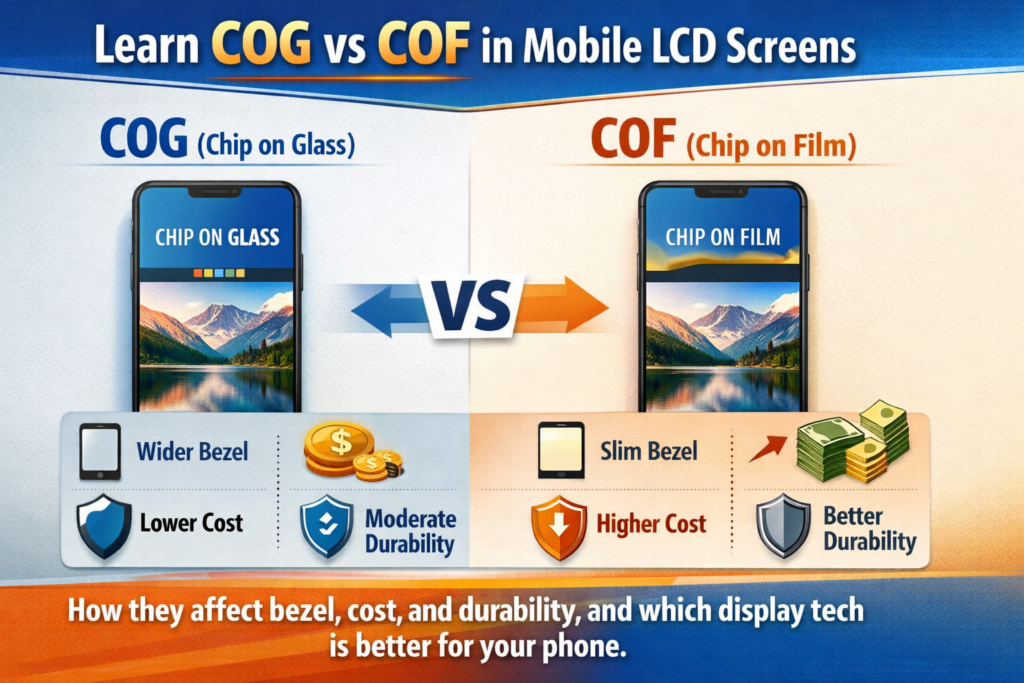
At the most basic level, the difference comes down to where the driver IC is placed:
- COG: Directly on the glass
- COF: On a flexible film connected to the glass
This structural difference affects everything from durability to design possibilities.
Performance Comparison
COG often provides better stability and reliability due to its rigid structure. With fewer components and shorter signal paths, it reduces the risk of connection failure and signal interference.
COF, on the other hand, excels in design and integration. Its flexible structure allows for more advanced layouts but can be slightly more fragile during manufacturing or repair.
Design and Bezel Impact
Here’s where things get interesting.
COF allows manufacturers to fold the chip behind the display, resulting in extremely thin bezels. COG, however, requires space on the glass to place the chip, which often leads to a visible bottom chin.
In fact, some screens using COG technology can be about 2 mm smaller in display area due to chip placement .
So if you’re chasing that sleek, edge-to-edge look, COF is clearly ahead.
Advantages of COG Technology
Cost Efficiency
COG is the king of affordability. Its simpler structure means:
- Lower manufacturing costs
- Faster production times
- Higher yield rates
This is why it’s commonly used in budget smartphones and industrial displays.
Reliability and Stability
Because there are no flexible components, COG displays are more robust. They tend to perform better in harsh conditions like humidity and temperature changes.
Some tests even show COG displays maintaining up to 99.8% brightness consistency under extreme conditions, outperforming COF in durability scenarios .
Advantages of COF Technology
Ultra-Thin Bezels
COF’s biggest advantage is design. It enables:
- Narrower borders
- Higher screen-to-body ratios
- Premium visual aesthetics
This is why flagship phones from brands like Samsung or OPPO heavily rely on COF.
Flexibility and Modern Design
The flexible film allows for innovative designs, including curved or foldable displays. It’s essentially paving the way for the future of smartphones.
Disadvantages of COG vs COF
Limitations of COG
COG struggles with modern design demands:
- Thicker bezels
- Limited flexibility
- Less premium appearance
Limitations of COF
COF, while advanced, comes with trade-offs:
- Higher production cost
- More complex manufacturing
- Fragile flexible components
Real-World Applications
Budget Smartphones vs Flagships
- COG → Budget phones, industrial devices
- COF → Flagship smartphones, premium designs
This distinction explains why cheaper phones often have thicker bezels.
Repair Market Differences
In the repair industry, COF screens are often closer to original factory designs, while COG screens are used as cost-effective replacements.
Comparison Table: COG vs COF
| Feature | COG (Chip on Glass) | COF (Chip on Film) |
|---|---|---|
| Chip Position | On glass | On flexible film |
| Cost | Lower | Higher |
| Bezel Size | Wider | Ultra-thin |
| Flexibility | Rigid | Flexible |
| Durability | Higher | Moderate |
| Application | Budget devices | Flagship smartphones |
Which One Should You Choose?
Choosing between COG and COF depends on what you value most.
If you care about cost and durability, COG is a solid choice. It’s reliable, affordable, and gets the job done without unnecessary complexity.
But if you’re all about design, aesthetics, and cutting-edge technology, COF is the clear winner. It’s what makes modern smartphones look sleek and futuristic.
Conclusion
COG and COF might sound like technical jargon, but they play a huge role in how your smartphone looks and performs. One focuses on simplicity and reliability, while the other pushes the boundaries of design and innovation.
As smartphones continue evolving toward bezel-less and flexible designs, COF is becoming the dominant technology. Still, COG remains relevant, especially in cost-sensitive markets.
Understanding this difference gives you a hidden advantage—whether you’re buying a phone, repairing one, or sourcing display parts.
FAQs
1. Is COF better than COG?
COF is better for design and thin bezels, while COG is better for cost and durability.
2. Why do flagship phones use COF?
Because it allows ultra-thin bezels and modern full-screen designs.
3. Is COG more reliable than COF?
Yes, generally COG is more stable due to fewer flexible components.
4. Can I replace a COF screen with a COG screen?
Yes, but the appearance may differ, especially bezel size.
5. Which is cheaper, COG or COF?
COG is significantly cheaper due to simpler manufacturing.