Introducción
¿Recuerda cuando los teléfonos tenían pantallas pequeñas apenas lo suficientemente grandes como para mostrar un mensaje de texto?? Avance rápido hasta hoy, y vivimos en un mundo donde los teléfonos casi no tienen fronteras, plegable, e incluso pantallas envolventes. El viaje del RAZR de Motorola al Mi Mix de Xiaomi no se trata solo de aumentar el tamaño de la pantalla: es una historia de tecnologías de visualización en evolución., diseños innovadores, e innovación incesante.
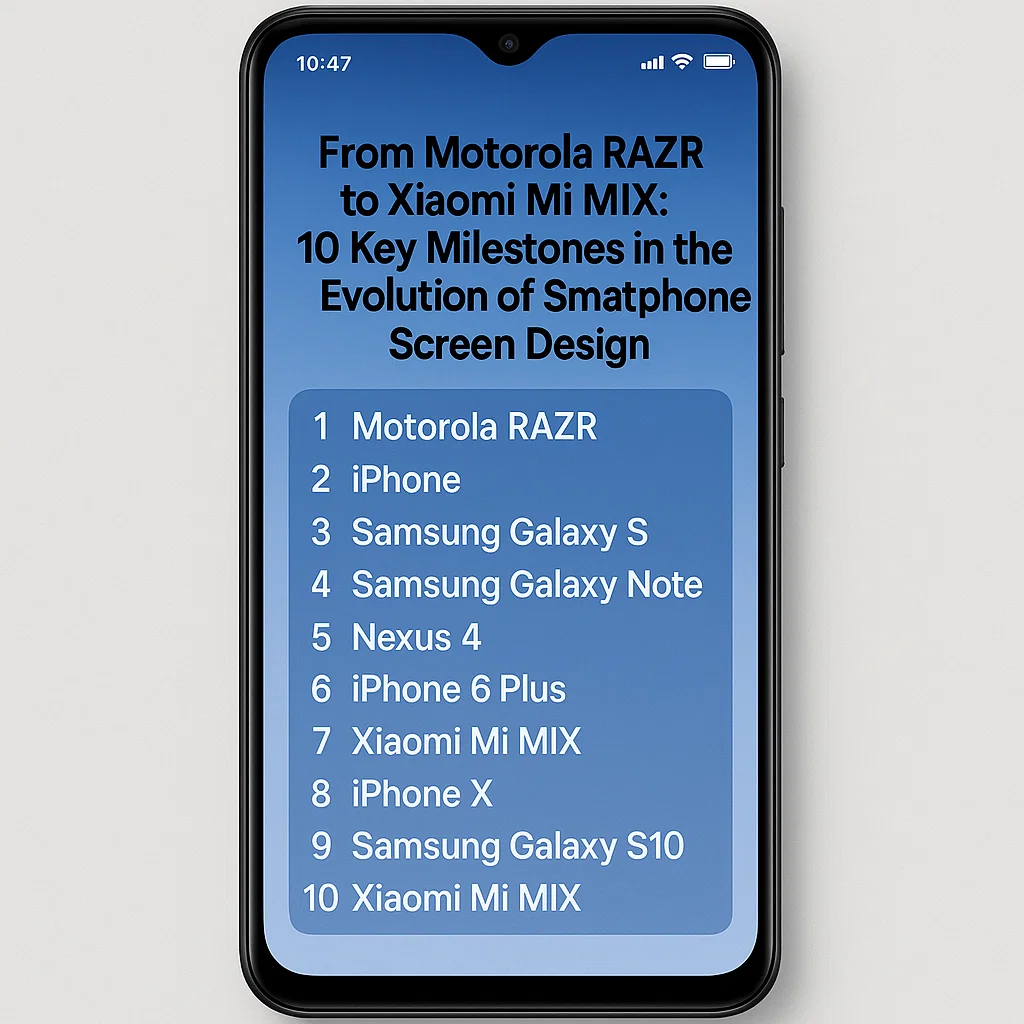
Profundicemos en esta fascinante historia de la evolución de la pantalla a través de 10 Momentos cruciales en la historia de los teléfonos inteligentes., respaldado por información de desmontaje y desgloses de módulos de visualización.
Los primeros días: De LCD a TFT-LCD
¿Qué era TFT-LCD??
Antes de las pantallas táctiles y los paneles flexibles, pantallas móviles basadas en TFT-LCD (Pantalla de cristal líquido con transistor de película delgada). Ofrecía mejor color y contraste que sus predecesores de matriz pasiva, pero tenía problemas con los ángulos de visión y la visibilidad en exteriores limitados..
Limitaciones de las primeras pantallas móviles
Estas pantallas eran rígidas., propenso a imágenes fantasma, y hambriento de poder. Sin curvas, sin contacto: simplemente pantallas estáticas iluminadas por lámparas fluorescentes de cátodo frío (CCFL) retroiluminación.
Hito 1: Motorola RAZR V3 (2004)
Clave icónica con LCD
El Motorola RAZR V3 fue un ícono de la cultura pop. Su cuerpo ultradelgado tenía una pantalla LCD CSTN en su interior y una pequeña pantalla externa..
La revolución de la pantalla dual
Aunque primitivo para los estándares actuales, El RAZR popularizó el concepto de doble pantalla., allanando el camino para pantallas secundarias en dispositivos posteriores como los plegables inteligentes.
Hito 2: iPhone de Apple (2007)
Debut del SLCD con pantalla táctil capacitiva
El primer iPhone de Apple cambió los botones físicos por un SLCD multitáctil capacitivo de 3,5 pulgadas, emparejado con una cubierta protectora de vidrio.
Cómo Multi-Touch cambió la interacción del usuario
Esta innovación redefinió la interacción móvil: pellizco, golpe fuerte, y los gestos de toque se volvieron universales, y la durabilidad de la pantalla ocupó un lugar central en los análisis de desmontaje.
Hito 3: deseo HTC (2010)
Adopción temprana de AMOLED
El Desire de HTC comenzó con pantallas AMOLED, ofreciendo negros profundos y colores vibrantes, luego cambió a SLCD debido a la escasez de paneles AMOLED.
AMOLED frente a SLCD: Un derribo técnico
Los desmontajes revelaron que los píxeles autoemisores de AMOLED eliminaron la necesidad de retroiluminación, hacer que los teléfonos sean más delgados y más eficientes energéticamente, especialmente para interfaces de usuario más oscuras.
Hito 4: Samsung Galaxy Serie S (2010-Presente)
El auge de Super AMOLED
Samsung fue pionero en Super AMOLED, integración de sensores táctiles directamente en la capa de visualización para una mejor capacidad de respuesta y un grosor reducido.
La evolución del sustrato flexible de AMOLED
Por 2013, Samsung pasó de sustratos de vidrio rígido a poliimida flexible (PI) bases, permitiendo conceptos de pantalla curva y plegable.
Hito 5: LG G Flex (2013)
Primera pantalla P-OLED curva comercial
El G Flex fue el primer smartphone con pantalla P-OLED curva, ofreciendo mayor ergonomía y durabilidad.
¿Qué es P-OLED y en qué se diferencia en los desmontajes?
Los expertos en desmontaje señalaron que su sustrato de plástico lo hacía prácticamente irrompible en comparación con las pantallas de vidrio., aunque la precisión del color se quedó atrás.
Hito 6: Samsung Galaxy Nota Borde (2014)
Nacimiento de la pantalla Edge
Este teléfono peculiar pero influyente presentó la primera pantalla de borde curvo del mundo con AMOLED flexible.
Flexibilidad del panel AMOLED en la práctica
Adentro, El sustrato de poliimida de la pantalla permitía una curva de 90 grados sin comprometer la calidad de la imagen, una hazaña analizada en muchos laboratorios de desmontaje..
Hito 7: Xiaomi Mi Mix (2016)
Revolución sin bisel con LCD IPS
Xiaomi sorprendió al mercado con su Mi Mix, un teléfono casi sin bisel que utiliza un panel LCD IPS avanzado con esquinas con formas personalizadas.
Innovación en la colocación de circuitos integrados de controladores de pantalla
Los desmontajes mostraron un enrutamiento creativo de PCB y sensores de proximidad ultrasónicos debajo de la pantalla, estableciendo nuevos puntos de referencia en el diseño de teléfonos.
Hito 8: Samsung Galaxy Pliegue (2019)
AMOLED dinámico plegable
El Galaxy Fold presentó una pantalla plegable similar a un libro que utiliza paneles AMOLED flexibles ultrafinos y un mecanismo de bisagra único..
Sustrato Flexible y UTG (Vidrio ultrafino) tecnología
Los desmontajes revelaron el cambio de Samsung de capas de plástico puro a vidrio ultrafino para mayor durabilidad, marcando un hito en la resiliencia de las pantallas flexibles.
Hito 9: Xiaomi Mi Mix Alfa (2019)
Pantalla AMOLED envolvente
El Mi Mix Alpha llevó la audacia a un nivel superior con su pantalla AMOLED envolvente de 360°, cubriendo casi todo el cuerpo del teléfono.
Cómo el desmontaje reveló desafíos modulares
Los desensambladores notaron complejidades como PCB divididos y conectores de pantalla multiflexibles para admitir la funcionalidad continua de la pantalla..
Hito 10: Serie Vivo X Fold y Oppo Find N (2021-Presente)
Plegables de próxima generación
Estos plegables modernos cuentan con bisagras refinadas, AMOLED resistentes a las arrugas, y durabilidad mejorada con respecto a los modelos de primera generación.
Mejoras en la durabilidad del sustrato flexible
Los desmontajes mostraron sustratos de poliimida avanzados con mayor resistencia al plegado, resolver la fragilidad de las primeras generaciones.
Evolución del módulo de pantalla a lo largo del tiempo
LCD SLCD a IPS
El cambio a IPS LCD mejoró la precisión del color y los ángulos de visión, Reemplazo de pantallas SLCD anteriores en modelos premium..
IPS LCD a AMOLED
El contraste superior y la eficiencia energética de AMOLED, especialmente para temas más oscuros, la convirtió en la tecnología de visualización preferida después de 2015.
El cambio de sustratos rígidos a flexibles
La flexibilidad abrió las puertas a los plegables, enrollables, y pantallas de borde curvo, redefiniendo el diseño del teléfono y las complejidades del desmontaje.
El futuro de las pantallas de los teléfonos inteligentes
MicroLED y más allá
MicroLED promete un brillo aún mejor, eficiencia, y vida útil sin problemas de desgaste, aunque la producción en masa sigue siendo un obstáculo.
Displays Enrollables y Transparentes
Los prototipos ya muestran pantallas OLED enrollables y transparentes, insinuando un futuro en el que la pantalla de su teléfono podría extenderse, retraer, o desaparecer por completo.
Conclusión
desde lo diminuto, Desde las pantallas LCD rígidas de los primeros teléfonos plegables hasta las futuristas AMOLED envolventes y plegables., La historia de las pantallas de los teléfonos inteligentes es una historia de rápida innovación y búsqueda incesante de la perfección.. Cada hito no sólo marcó un salto tecnológico sino que redefinió la forma en que utilizamos, sostener, y experimenta nuestros dispositivos.
Y con MicroLED y pantallas enrollables en el horizonte, esta evolución está lejos de terminar.
Preguntas frecuentes
¿Qué teléfono usó AMOLED por primera vez??
El Samsung Galaxy S fue uno de los primeros teléfonos inteligentes convencionales en utilizar la tecnología Super AMOLED en 2010.
¿Qué es un sustrato flexible??
Un sustrato flexible es un material base flexible como la poliimida., Reemplazo del vidrio tradicional para permitir pantallas plegables o curvas..
¿Por qué Xiaomi eligió IPS LCD para Mi Mix??
En el momento, IPS LCD permitió a Xiaomi lograr una mejor consistencia de color y uniformidad de brillo en su pantalla de borde a borde.
¿Qué es UTG en los teléfonos plegables??
Vidrio ultrafino (PUBLICACIÓN) Es una capa de vidrio súper delgada que se utiliza en pantallas plegables para mejorar la durabilidad y la resistencia a los rayones..
¿Ya están disponibles las pantallas enrollables??
Mientras se muestra en prototipos como Oppo X 2021, Los teléfonos inteligentes enrollables aún no están disponibles comercialmente a gran escala..