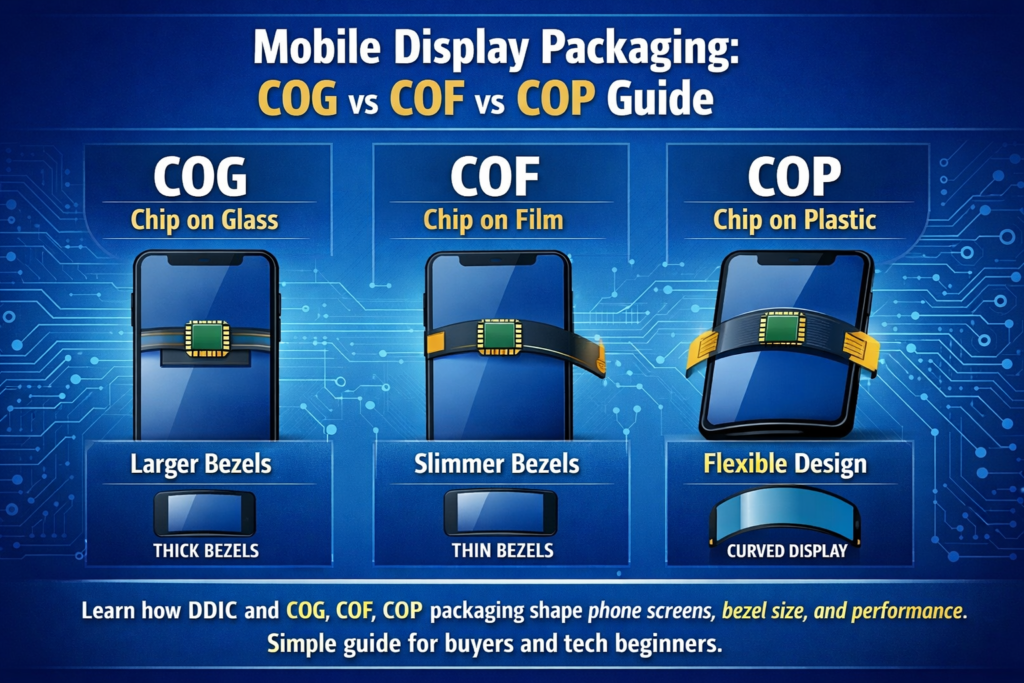
📱 Introducción al embalaje de exhibición móvil
¿Qué es un controlador de pantalla IC? (POLLA)?
Si alguna vez te has preguntado qué controla realmente los píxeles de la pantalla de tu teléfono, la respuesta está en algo llamado Controlador de pantalla IC (POLLA). Este pequeño chip semiconductor actúa como el cerebro de tu pantalla, enviando señales eléctricas a cada píxel para que las imágenes, bandera, y las animaciones aparecen correctamente. sin eso, tu pantalla sería básicamente un trozo de vidrio sin vida.
En los teléfonos inteligentes modernos, El DDIC desempeña un papel fundamental en la traducción de datos del procesador a contenido visible.. Controla el brillo, frecuencia de actualización, precisión del color, e incluso capacidad de respuesta táctil. Según fuentes del sector, Todas las tecnologías de visualización, ya sea LCD u OLED, dependen en gran medida de la eficiencia con la que se integra este chip en el panel. . El posicionamiento y empaquetado de este chip influye directamente en el rendimiento., espesor, y diseño general del dispositivo.
Aquí es donde las cosas se ponen interesantes: La forma en que se monta este chip en la pantalla define si la pantalla utiliza DIENTE, COF, o tecnología COP. y si, Este pequeño detalle técnico puede cambiar drásticamente la apariencia y sensación de un teléfono inteligente en la mano..
Por qué la tecnología de embalaje es importante en los teléfonos inteligentes
Podrías pensar que la calidad de la pantalla depende solo de la resolución o el brillo, pero eso es solo la superficie.. Entre bastidores, La tecnología de embalaje determina cosas como el tamaño del bisel., durabilidad, flexibilidad, e incluso costo.
Por ejemplo, ¿Por qué algunos teléfonos tienen bordes inferiores gruesos mientras que otros parecen casi "sin bordes"?? La respuesta suele estar en si la pantalla utiliza COG, COF, o COP. Estas tecnologías deciden dónde se ubica el chip y cuánto espacio ocupa..
A medida que los teléfonos inteligentes evolucionaron hacia diseños de pantalla completa, Los fabricantes necesitaban formas de reducir los biseles y aumentar la relación pantalla-cuerpo.. Los métodos de embalaje flexible como COF y COP surgieron para resolver este problema., permitiendo que las pantallas se doblen y envuelvan alrededor de los bordes . Mientras tanto, El COG tradicional siguió siendo relevante para las pantallas LCD rentables..
Entonces, Elegir entre estas tecnologías no es sólo una decisión técnica: es una filosofía de diseño..
🔍 Descripción general de COG, COF, y COP
Definición de COG (Chip sobre vidrio)
COG significa Chip sobre vidrio, y es el método de empaque de exhibición más tradicional y ampliamente utilizado.. En esta estructura, El DDIC está adherido directamente al sustrato de vidrio del panel LCD.. Esta conexión directa reduce la complejidad y los costes de fabricación..
Porque todo está montado sobre una base de cristal rígido., Las pantallas COG son muy estables y fiables. Se utilizan comúnmente en pantallas LCD., especialmente en teléfonos inteligentes económicos y dispositivos industriales. Sin embargo, La desventaja es que el vidrio no se puede doblar., lo que limita la flexibilidad del diseño.
Definición de COF (Chip en película)
COF, o Chip en película, representa un importante paso adelante. En lugar de fijar el chip directamente al cristal, el DDIC está montado sobre una película flexible (generalmente un FPC a base de poliimida). Esta película luego se conecta a la pantalla..
Esta flexibilidad permite plegar la película detrás de la pantalla., Reducir los biseles visibles y permitir diseños más modernos.. Como resultado, COF se usa ampliamente en teléfonos inteligentes de alta gama e incluso en algunas pantallas OLED.
Definición de COP (Chip sobre plástico)
COP significa Chip sobre plástico, y es actualmente la tecnología de envasado más avanzada. En esta configuración, El DDIC está directamente integrado en un sustrato de plástico flexible..
A diferencia del COF, que todavía utiliza una película intermedia, COP elimina capas adicionales, permitiendo una flexibilidad aún mayor. Esto lo hace ideal para pantallas curvas., teléfonos plegables, y biseles ultrafinos. De hecho, COP a menudo se considera la solución premium para los dispositivos emblemáticos modernos.
🧩 Análisis profundo de la estructura COG
Cómo funciona COG en paneles LCD
En una estructura COG, El controlador IC se une directamente al sustrato de vidrio mediante técnicas como la película conductora anisotrópica. (ACF). Esto crea una conexión compacta y eficiente entre el chip y la pantalla..
Porque no hay necesidad de circuitos flexibles adicionales, la estructura es relativamente simple. Esta simplicidad se traduce en altos rendimientos de producción y menores costos de fabricación.. Es por eso que COG todavía se usa ampliamente en teléfonos inteligentes y módulos LCD de nivel básico..
Sin embargo, hay una compensación. Dado que el chip se asienta sobre el cristal., Ocupa espacio en el borde de la pantalla, generalmente en la parte inferior.. Esto da como resultado un bisel "barbilla" más grueso., Lo cual es menos deseable en los diseños de pantalla completa actuales..
Ventajas y limitaciones de COG
COG tiene varias fortalezas. Es rentable, confiable, y fácil de producir en masa. Su estructura rígida también lo hace menos propenso a sufrir daños mecánicos en comparación con las soluciones flexibles..
Pero las limitaciones son difíciles de ignorar.. La imposibilidad de doblar o doblar el sustrato significa que los diseñadores deben dejar espacio adicional para el chip.. Esto conduce a biseles más anchos y relaciones pantalla-cuerpo más bajas. .
Entonces, si bien COG es perfecto para dispositivos económicos, lucha por satisfacer las demandas estéticas de los teléfonos inteligentes modernos.
🔄 Análisis profundo de la estructura del COF
Cómo COF mejora el diseño de pantallas
COF cambia las reglas del juego al introducir flexibilidad. Montando el DDIC en una película flexible, Los fabricantes pueden doblar el circuito detrás del panel de visualización.. Este diseño inteligente oculta el chip a la vista y reduce el bisel inferior..
Esta es la razón por la que muchos teléfonos inteligentes modernos tienen biseles casi simétricos. La capacidad de reposicionar el chip permite un uso más eficiente del espacio y una apariencia más limpia..
Ventajas y compensaciones de COF
COF ofrece un sólido equilibrio entre rendimiento y coste. Permite diseños más delgados., biseles más estrechos, y mejor estética. También es compatible con paneles LCD y OLED., haciéndolo versátil.
Sin embargo, esta flexibilidad tiene un precio. El proceso de fabricación es más complejo., y los materiales son mas caros. Además, La película flexible puede ser más vulnerable al estrés y a los daños durante el montaje. .
Aún, para la mayoría de los teléfonos inteligentes de gama media a alta, COF ofrece el compromiso ideal.
🚀 Análisis profundo de la estructura COP
Por qué COP permite visualizaciones de pantalla completa
COP lleva la flexibilidad al siguiente nivel. Integrando el chip directamente en un sustrato de plástico., elimina la necesidad de capas intermedias. Esto permite que la pantalla se doble más libremente., incluso envolviendo los bordes del dispositivo.
Esta es la tecnología detrás de muchos smartphones “sin bisel” y curvos. Permite a los fabricantes superar los límites del diseño y lograr relaciones pantalla-cuerpo extremadamente altas..
Ventajas y desafíos de la COP
COP ofrece un rendimiento superior. Ofrece biseles ultrafinos., excelente flexibilidad, y durabilidad superior bajo tensión de flexión. También es ideal para aplicaciones avanzadas como teléfonos plegables..
La desventaja? Costo. COP es la más cara de las tres tecnologías y requiere procesos de fabricación avanzados. Normalmente está reservado para dispositivos emblemáticos y pantallas OLED de alta gama. .
📊 Diferencias clave entre COG, COF, y COP
Tabla comparativa estructural
| Característica | DIENTE | COF | POLICÍA |
|---|---|---|---|
| Posición del chip | sobre vidrio | En película flexible | Sobre sustrato plástico |
| Flexibilidad | Ninguno | Moderado | Alto |
| Tamaño del bisel | Ancho | Angosto | Ultra |
| Costo | Bajo | Medio | Alto |
| Solicitud | Lcd (presupuesto) | Lcd & Oleado | OLED prémium |
Diferencias de rendimiento y costos
Desde el punto de vista del rendimiento, La COP lidera el grupo, seguido por COF, luego COG. Pero cuando se trata de costos, el orden se invierte. Esto crea una compensación clásica entre precio y rendimiento..
COG es ideal para la asequibilidad, COF equilibra costo y calidad, y COP ofrece rendimiento de primer nivel para dispositivos premium.
📈 Aplicación en Smartphones Modernos (2026 Tendencias)
Escenarios de uso de LCD frente a OLED
En 2026, el mercado de display está claramente dividido. Los paneles LCD todavía dependen en gran medida de COG y COF, mientras que los paneles OLED adoptan cada vez más COF y COP para obtener flexibilidad y ventajas de diseño.
COF sigue dominando las pantallas de alta resolución, Se espera que el mercado crezca de manera constante debido a la demanda de dispositivos ultradelgados y biseles estrechos. .
Tendencias del mercado y tasas de adopción
El cambio hacia dispositivos plegables y sin bisel está acelerando la adopción de COP. Mientras tanto, COG continúa prestando servicios a mercados sensibles a los costos.
Piénsalo así: COG es la “clase económica,COF es “clase ejecutiva,” y COP es “primera clase” en el mundo de la tecnología de visualización..
🛠️ Cómo elegir la tecnología de visualización adecuada
Para fabricantes
Los fabricantes deben equilibrar los costos, actuación, y objetivos de diseño. Si la asequibilidad es clave, COG es la mejor opción. Para una estética premium, Es necesario COF o COP.
Para compradores y la industria de reparación
Si estás comprando pantallas de repuesto, comprender estas tecnologías le ayuda a evitar pagar de más o tener un rendimiento inferior. COF suele ofrecer el mejor valor, mientras que COP ofrece una calidad casi original.
🔮 Tendencias futuras en envases expositores
Pantallas flexibles y plegables
El futuro pertenece a las pantallas flexibles. La tecnología COP ya permite teléfonos inteligentes plegables y pantallas enrollables.
Innovaciones de próxima generación más allá de la COP
Los investigadores están explorando métodos de envasado aún más avanzados, apuntando a más delgado, más eficiente, y pantallas más duraderas.
🏁 Conclusión
DIENTE, COF, y COP puede parecer jerga técnica, pero juegan un papel muy importante a la hora de dar forma a su experiencia con el teléfono inteligente.. Del tamaño del bisel a la durabilidad, Estos métodos de embalaje definen el aspecto y el rendimiento de las pantallas modernas..
Comprender sus diferencias le ayuda a tomar decisiones más inteligentes, ya sea que esté diseñando productos., abastecimiento de piezas, o simplemente eligiendo tu próximo teléfono.
❓ Preguntas frecuentes
1. ¿Cuál es la principal diferencia entre COG y COF??
COG monta el chip directamente sobre el vidrio., mientras que COF utiliza una película flexible, permitiendo biseles más estrechos y una mayor flexibilidad de diseño.
2. ¿Por qué se considera COP la mejor tecnología??
Porque ofrece la máxima flexibilidad, biseles ultrafinos, y rendimiento premium, especialmente para pantallas OLED.
3. ¿Se sigue utilizando COG en 2026?
Sí, principalmente en dispositivos LCD económicos debido a su bajo costo y alta confiabilidad.
4. ¿Cuál es mejor para reparar el teléfono?: COF o COP?
COF suele ser el mejor equilibrio entre precio y rendimiento., mientras que COP está más cerca de la calidad original.
5. ¿El embalaje afecta la calidad de la pantalla??
Sí, afecta el tamaño del bisel, durabilidad, flexibilidad, e incluso tocar el rendimiento.