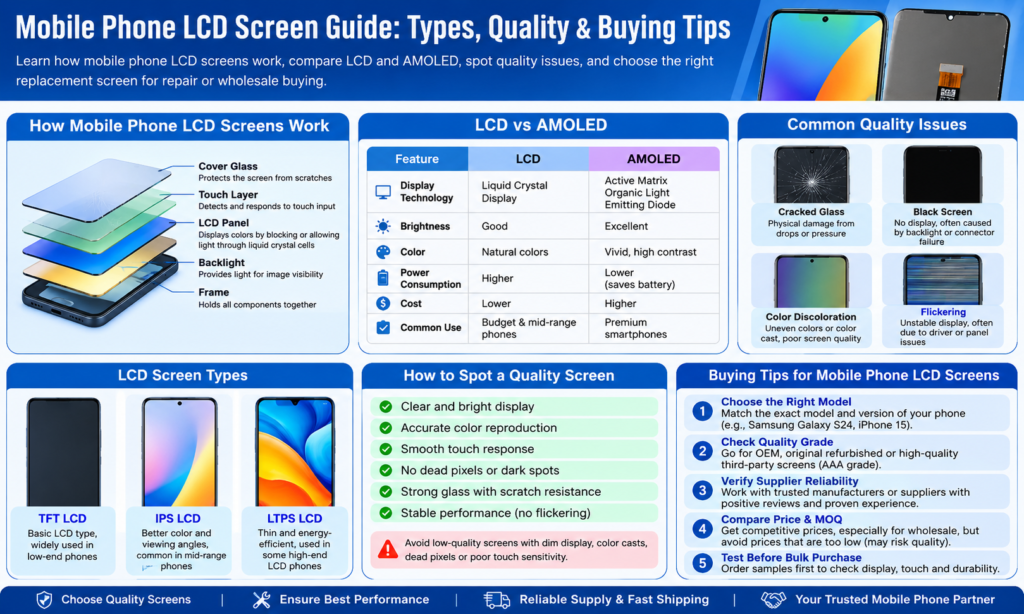
EN mobiltelefon LCD-skærm kan ligne et enkelt tyndt stykke glas, men det er faktisk en omhyggeligt konstrueret displaysamling lavet af flere funktionelle lag og elektroniske komponenter. Selvom OLED- og AMOLED-teknologi dominerer mange premium smartphones i 2026, LCD er fortsat vigtigt, fordi det tilbyder en praktisk kombination af billedkvalitet, produktionsmodenhed, tilgængelighed, og omkostninger. Hvis du køber erstatningsskærme, reparere telefoner, administrere en virksomhed med mobildele, eller blot ønsker at forstå, hvad der er inde i din smartphone, At lære nogle få LCD-grundlæggende funktioner kan spare dig penge og hjælpe dig med at undgå reservedele af dårlig kvalitet. Displayet er også en af de hyppigst håndterede komponenter i en telefon, så at forstå dens konstruktion gør det lettere at genkende, hvorfor revner, døde pixels, linjer, berøringsproblemer, fejl i baggrundsbelysningen, og der sker misfarvning af skærmen. Aktuelle industridata viser, at LCD ikke er forsvundet fra smartphones: TrendForce vurderer, at LCD-smartphonepaneler, inklusive a-Si og LTPS LCD, vil stå for ca 59% af smartphone-panelforsendelser i 2026, eller nogenlunde 1.33 milliarder paneler, mens AMOLED forventes at stå for ca 41%. Det gør LCD-viden overraskende relevant selv på et OLED-tungt smartphonemarked. Denne guide forklarer teknologien i et enkelt sprog og fokuserer på de praktiske detaljer, der betyder noget 2026, fra skærmkonstruktion og specifikationer til udskiftningskvalitet, afprøvning, engros indkøb, opbevaring, og den fortsatte overgang mod AMOLED.
Hvad er en mobiltelefon LCD-skærm?
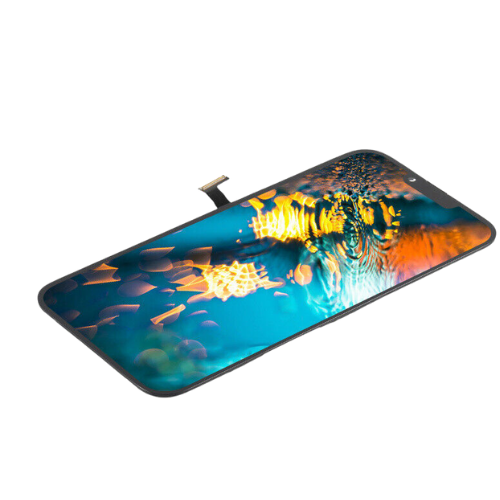
LCD står for Liquid Crystal Display, en teknologi, der bruger flydende krystalmateriale til at kontrollere, hvor meget lys der passerer gennem individuelle pixels. I modsætning til OLED, en LCD-skærm skaber normalt ikke lys af sig selv; i stedet, den er afhængig af en separat baggrundsbelysning placeret bag flydende krystalpanelet. Tænk på baggrundsbelysningen som en lampe bag et sæt små justerbare vinduer: lyset er altid tilgængeligt, mens de flydende krystaller bestemmer, hvor meget af det lys der når dine øjne. Hver pixel er opdelt i mindre underpixels, normalt rød, grøn, og blå, og disse subpixels arbejder sammen for at skabe de farver, du ser på fotografier, videoer, spil, og applikationer. Selve LCD-panelet styres af en tyndfilmstransistor, eller Tft, array, der styrer individuelle pixels med elektriske signaler. En telefonskærm kan også omfatte et berøringsfølende lag, polarisatorer, optiske film, et dækglas, fleksible trykte kredsløb, og et integreret displaydriverkredsløb. Det er derfor, at det kan være lidt misvisende at sige, at en telefon har en "skærm", når man diskuterer reparationsdele: en udskiftning kan referere til LCD-panelet alene eller til en komplet samling, der indeholder flere ekstra lag. På praktiske reparations- og engrosmarkeder, det er vigtigt at forstå præcis, hvilken komponent der sælges, fordi to produkter, der ser næsten identiske ud forfra, kan have meget forskellig konstruktion, Lysstyrke, berøringsydelse, holdbarhed, og pris.
Hvordan en LCD-skærm producerer et billede
Den grundlæggende LCD-billedproduktionsproces er lettere at forstå, hvis du forestiller dig millioner af små skodder arbejder sammen. Baggrundsbelysningen producerer hvidt lys, og det flydende krystallag ændrer mængden af lys, der passerer gennem hver subpixel. Elektriske signaler fortæller TFT-kredsløbet, hvordan hver pixel skal opføre sig, mens farvefiltre bestemmer om lyset bliver rødt, grøn, eller blå. Ved at kontrollere intensiteten af disse tre subpixels, displayet kan gengive et stort udvalg af farver. En pixel, der viser hvid, tillader stærke bidrag fra alle tre kanaler, mens en mørkere pixel reducerer mængden af transmitteret lys. Denne arkitektur er fundamentalt forskellig fra OLED, hvor hver pixel er et emissionselement, der producerer sit eget lys. Denne forskel forklarer flere velkendte egenskaber: LCD'er kræver baggrundsbelysning, mens OLED-pixel individuelt kan slukke; LCD-sortniveauer er derfor generelt begrænset af, hvor effektivt panelet og den optiske stak blokerer baggrundsbelysningen. Kvaliteten af en LCD bestemmes ikke af opløsningen alene, enten. TFT-designet, flydende krystal materiale, optiske film, baggrundslys effektivitet, farvefiltre, driver elektronik, og kalibrering har alle indflydelse på, hvad brugeren faktisk ser. I en erstatningsskærm, selvom to paneler har samme opløsning og stikposition, de leverer muligvis ikke identisk lysstyrke, betragtningsvinkler, farver, berøringsrespons, eller strømforbrug. God LCD-fremstilling er derfor en balancegang mellem elektrisk styring, optisk ydeevne, mekanisk struktur, og produktionsomkostninger.
LCD vs OLED vs AMOLED in 2026
Smartphone-displaymarkedet i 2026 er i stigende grad opdelt efter enhedspositionering. OLED og AMOLED er stærkt forbundet med premium- og øvre mellemtonetelefoner, fordi de kan give fremragende kontrast, dybe sorte, tynde strukturer, og fleksible designs. LCD er fortsat yderst konkurrencedygtig på omkostningsfølsomme enheder og på sekundære markeder og reparationsmarkeder, hvor overkommelighed og bred modeltilgængelighed er ekstremt vigtigt. TrendForce rapporterede i august 2026 at a-Si LCD fortsætter med at have en betydelig efterspørgsel på grund af dens lavere omkostninger og dens anvendelse på entry-level, mellemtone, sekundær, og reparationsapplikationer, mens efterspørgslen efter LTPS LCD-smartphones er faldende. AMOLED-adoptionen udvides stadig, især i de mellemste og højere dele af smartphonemarkedet, men det betyder ikke, at hver LCD-udskiftning er ved at blive forældet. For en telefonejer, forskellen kan være praktisk snarere end ideologisk: en OLED-erstatning kan give bedre kontrast og tyndere konstruktion, mens en LCD-udskiftning kan være det mere økonomiske valg, når den er kompatibel med det originale enhedsdesign. AMOLED introducerer også sine egne reparationsovervejelser, herunder potentiel indbrænding, panel skrøbelighed, bindingskompleksitet, og forskelle mellem fleksible og stive strukturer. I 2026, branchen er også mere opmærksomme på LTPO DU ER, som muliggør variable opdateringshastigheder og kan forbedre strømeffektiviteten i premium-telefoner. Counterpoint forventer, at LTPO-backplanes bliver stadig mere dominerende i avancerede smartphones, med LTPO overskridelse 40% af OLED-smartphonepaneler i henhold til dens 2026 vise forudsigelser. Så, når man sammenligner teknologier, det bedste spørgsmål er ikke blot "Hvilken skærm er bedre?” men “Hvilken skærmteknologi er passende til denne telefon, anvendelse, budget, og reparationskrav?”
Hovedtyper af telefon LCD-skærme
Der er adskillige LCD-teknologier og klassifikationer, der kan optræde i smartphones delekataloger, og terminologien kan hurtigt blive forvirrende. TFT LCD er en bred kategori, der henviser til LCD-paneler styret af tyndfilmstransistorer, mens A-SI LCD bruger amorft silicium som halvledermateriale i TFT-bagpladen og er fortsat vigtig på grund af dets relativt modne og omkostningseffektive fremstilling. LTPS LCD, eller lavtemperatur polysilicium LCD, kan understøtte højere transistormobilitet og har historisk set været nyttig til mobilskærme med højere opløsning og hurtigere respons. IPS, i mellemtiden, refererer til en LCD-arkitektur designet til at forbedre justering af flydende krystaller og visningsegenskaber; det er almindeligvis forbundet med gode betragtningsvinkler og stabil billedpræsentation. Disse udtryk kan overlappe hinanden i produktbeskrivelser, Derfor bør købere ikke gå ud fra, at et markedsføringsmærke fortæller hele historien. En reservedel kan beskrives som IPS, Tft, A -i, eller blot LCD afhængig af leverandør og marked. Panelets fysiske kompatibilitet er også kritisk. En skærm skal matche telefonens dimensioner, stik, flexkabel, vise føreradfærd, berøringsgrænseflade, opløsning, monteringsstruktur, og software forventninger. En billig erstatning, der passer til rammen, men har den forkerte elektriske konfiguration, er ikke ægte kompatibel. Til engroskøbere, dette er en af grundene til, at modelspecifik test er mere nyttigt end at bedømme en skærm ud fra fotografier eller en kort produktbeskrivelse.
TFT LCD, IPS LCD, og a-Si LCD
Den nemmeste måde at forstå disse termer på er at erkende, at de beskriver forskellige aspekter af displayet i stedet for altid at repræsentere helt separate produktkategorier. Tft beskriver det transistorstyringssystem, der bruges til at adressere pixels, mens A -i identificerer det halvledermateriale, der bruges i et bestemt TFT-bagplan. IPS beskriver et flydende-krystal-arrangement beregnet til at give bedre visningsegenskaber end ældre LCD-strukturer. I den virkelige verden handel med telefondele, disse etiketter bruges nogle gange inkonsekvent, så en køber bør verificere de faktiske panelspecifikationer i stedet for at stole på navnet alene. En erstatnings-LCD af høj kvalitet skal give stabil lysstyrke på tværs af skærmen, rimelig farvekonsistens, gode betragtningsvinkler for sin klasse, præcis berøringsrespons, og korrekt kompatibilitet med telefonens skærmcontroller. Paneler af lav kvalitet kan forekomme acceptable under lys udstillingslokale, men afslører svagheder, når de ses udendørs, vippes fra en vinkel, eller bruges med mørke billeder. Nogle billige LCD'er har også en tykkere konstruktion, svagere berøringsydelse, mere synlig variation i baggrundsbelysningen, eller mindre nøjagtig farvegengivelse. Det betyder ikke, at hver TFT-udskiftning er dårlig, eller at alle dyre paneler er fremragende. Kvalitet afhænger i høj grad af paneldesignet, materialer, produktionskontrol, bindingsproces, driver elektronik, og inspektionsstandarder. Af den grund, professionelle købere bør behandle LCD-teknologi type som én specifikation blandt mange, snarere end at bruge det som den eneste indikator for produktkvalitet.
Forstå LCD-skærmlag
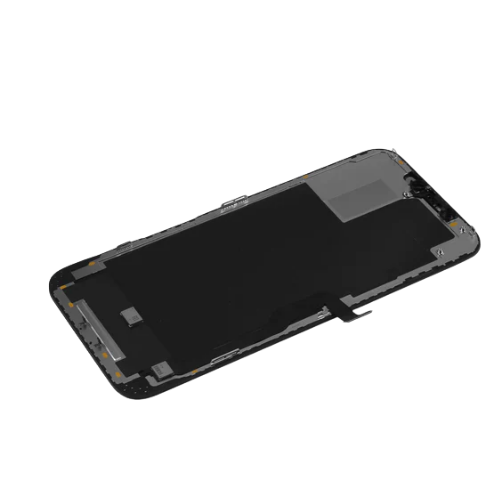
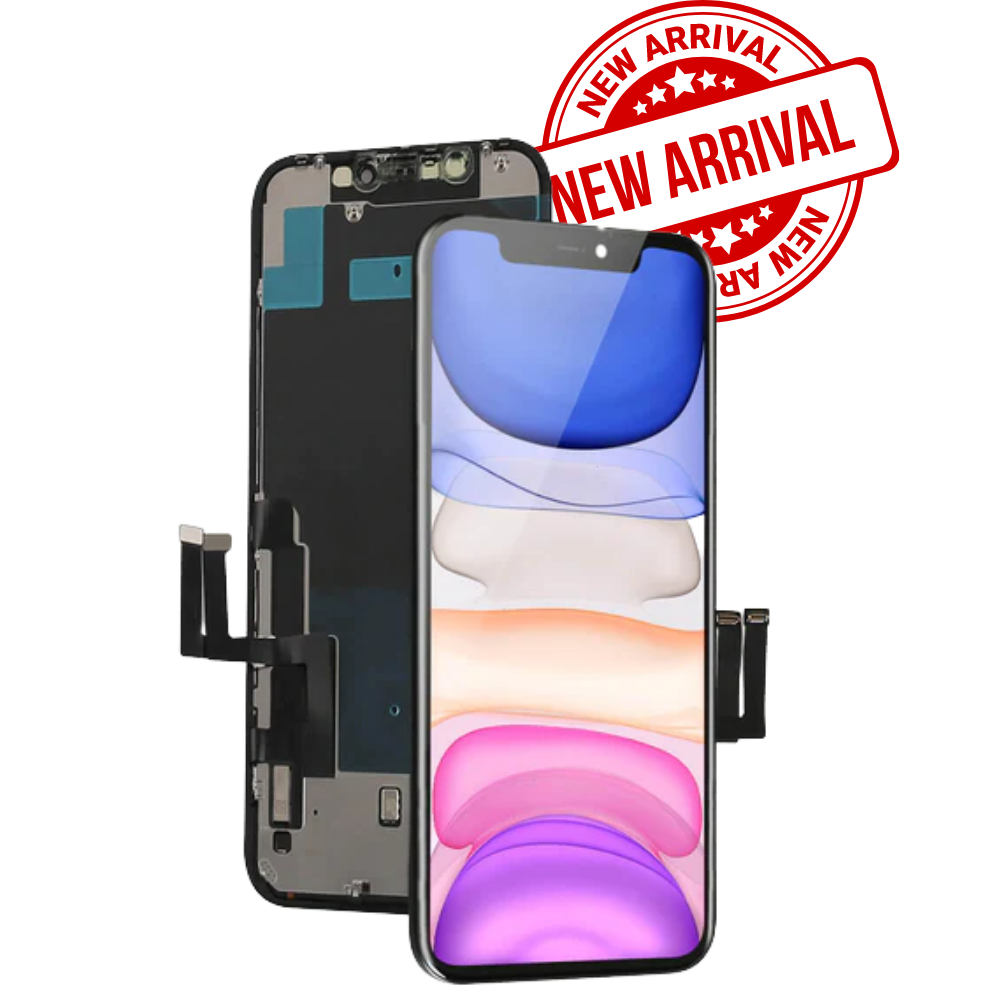
En smartphone LCD-samling ligner en lagdelt sandwich, hvor hvert lag udfører et bestemt job. I midten er LCD-cellen, der indeholder TFT-arrayet, flydende krystal materiale, og farvefilterstruktur. Polarisatorfilm bruges til at kontrollere opførselen af lys, der passerer gennem flydende-krystal-systemet, mens optiske film kan hjælpe med at distribuere eller lede lys fra baggrundslyset. Bag displaycellen sidder LED-baggrundsbelysningsenhed, som leverer den belysning, der kræves af LCD'et. Afhængig af designet, der kan også være et berøringslag eller berøringsfølende struktur placeret over skærmen, efterfulgt af klæbende lag og beskyttende dækglas. Det fleksible trykte kredsløb, ofte kaldet en FPC, bærer elektriske signaler mellem skærmenheden og telefonens bundkort. En skærmdriver-IC styrer de signaler, der kræves for at styre panelet, og dens integration kan variere mellem skærmmodeller. Denne lagdelte konstruktion forklarer, hvorfor udskiftning af "skærmen" kan involvere forskellige procedurer afhængigt af den del, der bruges. Et revnet dækglas betyder ikke nødvendigvis, at LCD-skærmen nedenunder er beskadiget, mens en fungerende LCD stadig kan have et ødelagt berøringslag. Omvendt, stød kan beskadige flere lag samtidigt, skabe symptomer som farvede linjer, sorte områder, berøringsfejl, eller flimrende. Ved vurdering af reservedele, at kende lagstrukturen hjælper teknikere med at identificere, om de har at gøre med glasskader, berøringsfejl, LCD-celleskade, problemer med baggrundsbelysning, eller et elektronisk forbindelsesproblem.
LCD skærmstørrelse, Opløsning, og pixeltæthed
Skærmstørrelse er en af de mest synlige specifikationer, men det fortæller dig ikke, hvor skarpt et billede vil se ud. Opløsning beskriver antallet af pixels arrangeret vandret og lodret, mens Pixeltæthed, almindeligvis udtrykt som pixels per tomme eller PPI, overvejer, hvordan disse pixels er fordelt over det fysiske visningsområde. En 6,5-tommer skærm og en 6,5-tommer skærm kan derfor se meget forskellige ud, hvis deres opløsninger eller pixeltætheder er forskellige. Højere pixeltæthed tillader generelt tekst og detaljerede billeder at fremstå skarpere, selvom fordelen bliver mindre indlysende, efterhånden som pixeltætheden øges, og visningsforholdene ændres. Ved køb af erstatningsskærm, det er vigtigt at matche den originale opløsning, fordi telefonens software, grafikprocessor, og display controller er designet omkring særlige egenskaber. En erstatning med en anden opløsning kan give skaleringsproblemer, usædvanlig billedkvalitet, eller kompatibilitetsproblemer. Størrelsen inkluderer også mere end diagonalmåling: det aktive visningsområde, billedformat, bezel struktur, hak eller hul-arrangement, og monteringsdimensioner skal alle matche enheden. Moderne smartphones bruger ofte smalle rammer og usædvanlige hjørnegeometrier, gør mekanisk kompatibilitet lige så vigtig som panelets annoncerede diagonalstørrelse. Til reparationsvirksomheder, modelnumre og nøjagtige delspecifikationer er derfor meget sikrere identifikatorer end sætninger som "6,5-tommer LCD". En skærm kan have den rigtige størrelse og stadig være helt uegnet til en bestemt telefon.
Opdateringshastighed og berøringssampling
Opdateringshastigheden beskriver, hvor ofte skærmen kan opdatere sit billede, normalt udtrykt i Hz. Et 60Hz panel opdateres 60 gange i sekundet, mens et 90Hz eller 120Hz panel kan producere jævnere bevægelse og rulning, når telefonens software understøtter disse tilstande. Touch sampling rate er en anden specifikation: den beskriver, hvor ofte berøringssystemet registrerer eller behandler berøringsinput. Disse to tal forveksles ofte, fordi begge relaterer sig til lydhørhed, men de måler forskellige ting. En skærm kan have en høj opdateringshastighed uden nødvendigvis at have en usædvanlig høj berøringssamplinghastighed, og et hurtigt berøringssystem gør ikke automatisk, at skærmen opdateres hurtigere. I LCD-reservedele, opretholdelse af den originale opdateringshastighed kan være vigtig for brugere, der forventer jævn rulning eller spilydelse. Imidlertid, panelet, touch-controller, telefonens firmware, skærm driver, og bundkort skal alle arbejde sammen, for at funktionen kan fungere korrekt. I 2026, skærme med høj opdateringshastighed er ikke længere begrænset til de dyreste smartphones, selvom avancerede variabel-refresh-teknologier er særligt fremtrædende i premium OLED-enheder. Counterpoint rapporterer, at 144Hz og 165Hz OLED-skærme dukker op som bredere ydeevnefunktioner, sideløbende med øget LTPO-adoption. Til en LCD-udskiftning, derfor, blot at se et højt tal i en leverandørliste er ikke nok. En professionel test skal verificere den faktiske opdateringsadfærd, berøringsnøjagtighed, latenstid, og stabilitet på måltelefonen.
Hvorfor LCD-skærme har brug for baggrundsbelysning
En af de definerende egenskaber ved LCD-teknologi er dens afhængighed af en separat baggrundsbelysning. Flydende krystaller regulerer lyset, men de genererer normalt ikke selv det synlige lys. I moderne smartphone LCD'er, baggrundsbelysningen bruger generelt LED'er, fordi de er kompakte, effektiv, og velegnet til tynde mobile enheder. Lyset bevæger sig gennem optiske film, der hjælper med at fordele belysningen over panelet, så brugeren ser et rimeligt ensartet billede. Hvis baggrundsbelysningen svigter, LCD-skærmen producerer muligvis stadig billedinformation, selvom brugeren ser en sort eller ekstremt svag skærm. Dette er grunden til, at en tekniker nogle gange opdager, at en telefon har et fungerende displaysignal, men ingen synlig belysning. Baggrundsbelysningsproblemer kan stamme fra selve LED-baggrundsbelysningen, displayet flex, stik, driverkredsløb, strømforsyning, eller beskadigelse af panelenheden. Ujævn belysning kan også forekomme som lyse pletter, mørke områder, skygger, eller synlige pletter, især efter at en skærm er blevet beskadiget eller forkert samlet. Fordi baggrundsbelysningen fungerer kontinuerligt, mens et LCD-billede er synligt, dens effektivitet påvirker også batteriforbruget. OLED har en iboende fordel til at vise sort indhold, fordi individuelle pixels kan slukkes i stedet for kontinuerligt at oplyse en separat baggrundsbelysning. Stadig, LCD-baggrundsbelysningsteknik er blevet meget modent, og gode paneler kan levere stærk lysstyrke og ensartet belysning til relativt lave omkostninger.
Almindelige problemer med mobil LCD-skærm
De mest almindelige LCD-relaterede problemer kommer normalt fra fysisk påvirkning, tryk, fugtighed, aldring, fabrikationsfejl, eller skade under reparation. Et revnet dækglas er det oplagte eksempel, men den underliggende LCD kan forblive funktionel efter nogle typer påvirkning. Andre fiaskoer er mindre dramatiske i starten: et display kan udvikle en lodret linje, lokaliseret misfarvning, flimmer, dunkle sektioner, døde pixels, eller periodisk billedtab. Tryk fra en forkert monteret ramme kan beskadige panelet selv uden en synlig revne, især når telefonen er samlet med overdreven kraft, eller når udskiftningsdelen ikke sidder korrekt. Klæbemiddel kan også skabe problemer, hvis det påføres ujævnt eller forurener følsomme områder. Flex-kabel skader er en anden almindelig årsag, fordi FPC er tynd og skal bøje inden for et begrænset mekanisk område. Fugt kan forårsage korrosion eller elektrisk ustabilitet omkring stik og displaykredsløb, mens varme kan fremskynde forringelsen af elektroniske komponenter og klæbemidler. En erstatningsskærm, der består en simpel "lyser op"-test, kan stadig have defekter, der bliver synlige efter længere tids brug. Derfor bør professionel inspektion omfatte lysstyrke, farve, røre, betragtningsvinkel, kontrol af døde pixel, billedens ensartethed, forbindelsestilstand, og funktionstest. Til engroskøbere, en pålidelig QC-proces er faktisk en forsikringspolice: det koster noget tid før afsendelse, men kan forhindre meget større omkostninger forårsaget af returnering, kundeklager, tabt arbejdskraft, og skadet omdømme.
Hvad forårsager Ghost Touch og berøringsfejl?
Spøgelsesberøring opstår, når telefonen registrerer berøringer, som brugeren faktisk ikke har foretaget. Symptomet kan se næsten mystisk ud: ansøgninger åbner af sig selv, ikoner bevæger sig, tekst indtastes automatisk, eller displayet ser ud til at reagere tilfældigt. Alligevel er årsagen normalt relateret til berøringssensorsystemet, elektrisk interferens, fugtighed, beskadigede komponenter, dårlig montering, eller en inkompatibel erstatningsskærm. Et beskadiget berøringslag eller FPC kan skabe intermitterende signaler, som telefonen fortolker som ægte input. Fugt eller ledende forurening omkring skærmstikket kan have en lignende effekt. Udskiftningsskærme af dårlig kvalitet kan også bruge berøringskomponenter, hvis elektriske egenskaber afviger fra det originale design, producerer ustabil adfærd på visse telefoner. En anden mulighed er mekanisk tryk: hvis et display bliver klemt af rammen eller klæbemidlet, berøringslaget kan opføre sig unormalt. Før du giver LCD-panelet skylden, teknikere bør inspicere stikket, rengør passende kontaktområder, test en anden kendt-god samling, og kontroller, om problemet forsvinder efter skift af display. En god diagnostisk proces er som at løse en detektivsag: eliminer én mistænkt ad gangen i stedet for straks at udskifte hver komponent. For forbrugerne, den vigtige lektie er, at spøgelsesberøring ikke altid betyder, at selve LCD-skærmen er fysisk revnet. Det kan være en display-samling, forbindelse, miljømæssige, eller softwarerelateret problem, så diagnose betyder noget, før du bruger penge på en erstatning.
Sort skærm, Flimrende, og displaylinjer
EN sort skærm kan have flere forskellige årsager, og symptomet alene identificerer ikke den fejlbehæftede komponent. Hvis telefonen vibrerer, modtager opkald, producerer meddelelseslyde, eller på anden måde kan vise sig at køre, skærmsystemet kan være problemet snarere end hele enheden. En fuldstændig sort LCD-skærm kan skyldes en fejlagtig baggrundsbelysning, beskadiget LCD-celle, ødelagt FPC, løst stik, eller strømrelateret displayfejl. Flimren kan ligeledes være forårsaget af et beskadiget panel, ustabil forbindelse, driverkredsløb, eller fysisk pres på skærmenheden. Lodrette eller vandrette linjer indikerer ofte beskadigelse af panelet eller dets forbundne forbindelser, især når de forbliver i samme position uanset det viste billede. Imidlertid, diagnose bør stadig omfatte kontrol af stik og sammenligning af enheden med en kendt skærm, fordi en bundkortfejl nogle gange kan give displaysymptomer. Farveforvrængning kan også give ledetråde: usædvanlig toning kan skyldes panelbeskadigelse, polarisationsproblemer, kalibreringsforskelle, eller en defekt erstatning. Hvis en skærm begynder at udvikle problemer umiddelbart efter installationen, installationsprocessen og kompatibiliteten bør undersøges i stedet for at antage normal aldring. Ved køb af erstatnings-LCD'er, det er nyttigt at føre en fortegnelse over serie- eller batchoplysninger og inspektionsresultater. Det gør det nemmere at identificere, om et problem er isoleret til én enhed eller knyttet til en bestemt produktionsbatch.
Original, OEM, Renoveret, og kompatible skærme
Skærmterminologi kan skabe lige så meget forvirring som selve teknologien. Original refererer normalt til en komponent, der er fremstillet til eller hentet fra den originale enheds forsyningskæde, selvom den præcise kommercielle betydning kan variere alt efter sælger og marked. OEM betyder producent af originalt udstyr, men sælgere bruger nogle gange udtrykket løst, så købere bør spørge præcis, hvem der har fremstillet panelet, og om det er nyt, trukket, renoveret, eller samlet af genvundne komponenter. EN renoveret skærm kan bruge et gendannet originalt LCD- eller OLED-panel, der er blevet parret med nyt glas, et nyt berøringslag, eller andre udskiftningskomponenter. EN kompatibel eftermarkedsskærm er generelt produceret af en tredjepartsproducent og designet til at fungere med den angivne telefonmodel. Ingen af disse mærker garanterer automatisk kvalitet. Et originalt brugt panel med kraftigt slid kan være mindre attraktivt end en ny eftermarkedsdel af høj kvalitet, mens en billig "OEM"-liste muligvis ikke giver den samme ydeevne som en ægte verificeret original komponent. Den sikreste tilgang er at evaluere de faktiske produktegenskaber: Lysstyrke, farve, berøringsrespons, opløsning, passe, stikkvalitet, holdbarhed, defektrate, og garanti. For virksomheder, klar terminologi hjælper også med at forhindre misforståelser med kunderne. En leverandør skal kunne forklare, om et produkt er originalt nyt, original renoveret, OEM-kvalitet, eller eftermarked i stedet for at stole på tvetydige sætninger. I en 2026 reparationsmarked med intens priskonkurrence, gennemsigtig sortering bliver stadig vigtigere, fordi den billigste skærm ikke nødvendigvis er den billigste løsning, når retur og arbejdskraft er inkluderet.
Sådan bedømmer du LCD-skærmkvalitet
At bedømme en LCD-skærm kræver mere end at se på den i et par sekunder under udstillingsbelysning. En ordentlig evaluering bør overveje ensartet lysstyrke, farvegengivelse, berøringsfølsomhed, betragtningsvinkler, pixel defekter, billedstabilitet, passe, flex kvalitet, og langsigtet pålidelighed. Det første trin er normalt visuel inspektion for ridser, forurening, revner, buler, unormale kanter, eller monteringsfejl. Displayet skal derefter testes med forskellige farver, inklusive hvid, sort, rød, grøn, og blå skærme, fordi defekter kan blive meget nemmere at se på bestemte baggrunde. Lysstyrken bør kontrolleres på tværs af forskellige områder i stedet for kun i midten. Berøringstest bør dække hele det aktive område, inklusive hjørner og kanter, fordi nogle samlinger af lav kvalitet kan fungere godt i midten, men svigte nær omkredsen. Teknikere bør også verificere nærhedsrelaterede funktioner, justering af frontkamera, hvor det er relevant, automatisk lysstyrkeadfærd, og viser stabilitet under normale driftsforhold. En professionel leverandør kan bruge flere inspektionstrin i stedet for at stole på en enkelt endelig test. Dette er især vigtigt, fordi fabrikationsfejl kan være periodiske. Brancheforhold i 2026 også gøre QC mere værdifuld: Stigende komponentomkostninger og forsyningskædepres tilskynder producenter og mærker til at være mere opmærksomme på omkostningerne, inventar, og genbrug af platforme. Counterpoint har rapporteret, at pres på hukommelsesomkostninger tilskynder smartphoneproducenter til at udvide eksisterende skærmplatforme og prioritere effektivitetsorienterede forbedringer i nogle 2026 produkter. I dette miljø, ensartet kvalitet kan blive en stærkere konkurrencefordel end blot at tilbyde den laveste indkøbspris.
Udskiftning af LCD-skærm: Hvad brugere bør vide
Udskiftning af en telefonskærm er ikke blot et spørgsmål om at fjerne knust glas og sætte et nyt panel på. Moderne smartphones er stramt sammensatte enheder, hvor skærmen kan limes til rammen, tilsluttet gennem sarte flexkabler, og integreret med touch, sensorer, kameraer, højttalere, og andre komponenter. Før udskiftning, vigtige data bør sikkerhedskopieres, når det er muligt, og enheden skal slukkes i henhold til producentens reparationsprocedure. Under demontering, overdreven varme eller kraft kan beskadige batterierne, kabler, sæler, eller omgivende komponenter. Efter installation af erstatningen, teknikeren bør teste displayet og berøringsfunktionen før den endelige montering. Denne mellemtest er ekstremt værdifuld, fordi opdagelse af en defekt erstatning, efter at telefonen er blevet fuldstændigt forseglet, spilder arbejdskraft og øger risikoen for yderligere skade under omarbejdelse. En god erstatningsarbejdsgang bør bekræfte billedoutput, Lysstyrke, berør hele skærmen, knapper og relevante sensorer, opladning, kameraer, højttalere, og andre funktioner, der kan være blevet forstyrret under reparation. Klæbemiddel og rammejustering har også betydning, fordi selv et teknisk funktionelt panel kan blive upålideligt, hvis det installeres under mekanisk belastning. Forbrugerne bør derfor vælge en reparationsudbyder baseret på proceskvalitet frem for pris alene. En billig reparation, der bruger en uegnet skærm eller forhastet installation, kan blive meget dyrere, hvis telefonen udvikler berøringsproblemer, display linjer, støvforurening, eller strukturelle skader senere.
LCD-skærm Priser og 2026 Forsyningsmarked
Telefon LCD-priser varierer betydeligt alt efter model, skærmstørrelse, teknologi, produktionsvolumen, grad, kilde, og om delen sælges som et panel eller en komplet samling. Ældre modeller eller entry-level modeller kan have relativt billige LCD-udskiftninger, fordi fremstillingen er moden og efterspørgslen er bred. Nyere modeller med usædvanlige dimensioner, høje opdateringshastigheder, integrerede berøringssystemer, eller specialiserede montager kan koste betydeligt mere. Engrospriser afhænger også af mængden, defektrate, emballage, forsendelse, garantibetingelser, og om leverandøren kan levere stabile gentagelsespartier. I 2026, displayforsyningskæden bliver påvirket af et bredere komponent-omkostningspres, især hukommelsesmangel og prisstigninger, der påvirker smartphone-producenter. TrendForces august 2026 forskningsprognoser ca 2.25 milliarder smartphone-panelforsendelser globalt i 2026, repræsenterer en 2.5% år-til-år tilbagegang, mens sekundær efterspørgsel og reparationsefterspørgsel hjælper med at understøtte panelefterspørgslen. Tidligere i marts, TrendForce havde fremskrevet en skarpere 7.3% nedgang, viser, hvor hurtigt markedets forventninger kan ændre sig, efterhånden som udbuds- og efterspørgselsforholdene udvikler sig. For købere, det betyder, at prislister ikke skal behandles som permanente. En god købsstrategi tager højde for de samlede landede omkostninger, ikke kun den oplyste enhedspris. Hvis en lidt dyrere skærm har en væsentlig lavere fejlprocent og bedre kundetilfredshed, det kan give lavere effektive omkostninger pr. vellykket reparation.
| Skærmovervejelse | Lavere pris mulighed | Højere kvalitet mulighed |
|---|---|---|
| Oprindelig enhedspris | Normalt lavere | Normalt højere |
| Farvekonsistens | Kan variere | Generelt mere konsekvent |
| Ensartet lysstyrke | Kan variere efter batch | Normalt bedre kontrolleret |
| Berøringssvar | Modelafhængig | Generelt mere stabil |
| Kvalitetskonsistens | Leverandørafhængig | Normalt stærkere med kontrolleret QC |
| Garantirisiko | Potentielt højere | Ofte lavere |
| Bedste brug | Prisfølsomme reparationer | Professionel reparation og langtidsforsyning |
Hvorfor a-Si LCD stadig betyder noget 2026
Det er let at antage, at LCD forsvinder, blot fordi flagskibssmartphones i stigende grad bruger OLED, men markedsdataene fortæller en mere kompliceret historie. a-Si LCD er fortsat vigtig, fordi smartphones findes i mange prisniveauer, og producenterne designer ikke alle modeller omkring den samme omkostningsstruktur. Entry-level telefoner, udskiftningsenheder, telefoner på det sekundære marked, og reparationskanaler skaber alle efterspørgsel efter økonomisk skærmteknologi. TrendForce identificerer specifikt a-Si LCD som bevarer en betydelig position på grund af dens lavere omkostninger og fortsatte efterspørgsel fra begynderniveau, mellemtone, sekundær, og reparationsapplikationer. Dette skaber en interessant situation, hvor LCD kan miste andel i premium nye telefoner, mens den forbliver kommercielt vigtig på tværs af den bredere installerede base. En reparationsvirksomhed kan derfor fortsætte med at sælge store mængder LCD-skærme, selvom OLED-teknologi dominerer overskrifterne. En anden fordel er produktionsmodenhed. LCD-produktion er blevet forfinet gennem årtier, og mange leverandører forstår, hvordan man fremstiller paneler i stor skala med forudsigelige processer. Udfordringen er, at ikke alle LCD-paneler er lige gode, især på eftermarkedet. Købere skal skelne mellem en moden teknologi og en implementering af høj kvalitet af denne teknologi. Med andre ord, LCD er ikke automatisk forældet, blot fordi OLED er nyere. Det er mere nyttigt at tænke på LCD som en moden, omkostningseffektiv teknologi, hvis stærkeste rolle er flyttet mod værdifokuserede enheder og erstatningsmarkeder.
Skiftet fra LCD til AMOLED
Overgangen fra LCD til AMOLED er en af de største ændringer i smartphone-skærme, og 2026 fortsætter den bevægelse. OLED-baserede skærme kan levere selvudsendende pixels, dybe sorte, høj kontrast, tynde strukturer, og fleksible formfaktorer, hvilket gør dem særligt attraktive for premium smartphones. Kontrapunkt 2026 OLED-forskning beskriver fortsat vækst i avancerede OLED-backplanes såsom LTPO, mens Omdia forudser forsendelser af AMOLED-smartphone-skærme omkring 778 millioner enheder i 2026, -en 7% år-til-år fald på grund af et bredere pres på smartphone-markedet. Dette fald i enhedsforsendelser skal ikke tolkes som et sammenbrud af OLED-teknologi; snarere, det afspejler et kompliceret smartphonemarked, hvor højere komponentomkostninger og svagere efterspørgsel påvirker den samlede produktion. Fleksibel OLED er fortsat strategisk vigtig, fordi den understøtter buede og foldbare designs. På samme tid, producenter søger i stigende grad efter effektivitetsforbedringer i stedet for blot at tilføje større tal til specifikationerne. Kontrapunkt rapporteret i juli 2026 at mange smartphone-producenter beholdt skærmgrundlaget fra tidligere generationer, mens de fokuserede mere på effektivitet, fordi hukommelsesomkostninger lagde pres på enhedsstyklister. Til LCD-leverandører og reparationsvirksomheder, denne overgang skaber både pres og muligheder. Premium LCD-efterspørgslen kan fortsætte med at falde, men den installerede base af LCD-telefoner forbliver enorm, og reparationskunder har stadig brug for overkommelige reservedele. Smartphone-skærmindustrien bevæger sig derfor ikke fra "LCD" til "ingenting"; det er ved at udvikle sig til et multi-tier økosystem, hvor LCD og OLED tjener forskellige økonomiske og tekniske roller.
Sådan køber du telefon LCD-skærme til engros
Engroskøbere bør nærme sig LCD-køb som en kvalitetskontrol og forsyningskædebeslutning, ikke blot en pris-shopping-øvelse. Start med den nøjagtige telefonmodel og varenummer, bekræft derefter skærmstørrelsen, opløsning, stik, berøringskonfiguration, ramme eller ikke-ramme konstruktion, opdateringshastighed, og andre relevante specifikationer. Næste, afklare produktkarakteren skriftligt: original ny, original renoveret, eftermarked, OEM-kvalitet, eller en anden defineret kategori. Spørg, hvordan leverandøren tester skærmene, og om leverandøren kan give en mangelpolitik eller garanti. Prøver bør testes, før der forpligtes til store mængder, især når skærmen skal sælges til professionelle værksteder. Når en leverandør har bestået prøvetestning, Gentag-batch-konsistens bliver det næste spørgsmål. En skærm, der klarer sig godt i en prøve i fem stykker, men som ændrer sig væsentligt på tværs af senere partier, er vanskelig at bygge en pålidelig reparationsvirksomhed omkring. Emballage er også vigtigt, fordi LCD-enheder er sårbare over for tryk, bøjning, indvirkning, elektrostatisk udladning, og fugt under transport. En fornuftig købsproces ser derfor på enhedspris + QC + emballage + forsendelse + defektrate + garanti + meddelelse, frem for enhedsprisen alene. For købere, der køber fra Kina, leverandørverifikation bør omfatte virksomhedens baggrund, produktionsevne, prøve test, inspektionsoptegnelser, og evnen til at opretholde ensartede specifikationer. Det stærkeste leverandørforhold er et, hvor begge sider behandler tekniske specifikationer som målbare krav i stedet for vage markedsføringspåstande.
Praktiske tips til opbevaring og forsendelse af LCD-skærme
En god LCD-skærm kan blive beskadiget, før den nogensinde når en reparationstekniker, hvis opbevaring og transport håndteres dårligt. Skærme bør beskyttes mod for stort tryk, fordi stablet vægt kan belaste tynde paneler og forårsage revner, deformation, eller andre defekter. Emballagen skal også reducere vibrationer og stød under transport, især når forsendelser rejser gennem flere logistikhubs. Beskyttelse mod elektrostatisk afladning kan være nødvendig for samlinger, der indeholder følsomme elektroniske komponenter, mens fugtkontrol er vigtig, når varer bevæger sig gennem fugtige omgivelser eller oplever betydelige temperaturændringer. Skærme bør ideelt set forblive i passende beskyttende emballage, indtil de er klar til inspektion eller installation. Lagerhuse bør undgå skødesløs stabling, ukontrolleret varme, og miljøer, hvor der kan forekomme vandlækage eller kondens. Under modtagelse af inspektion, købere bør tjekke de ydre kartoner, før de åbnes, fordi åbenlyse transportskader kan være nyttige beviser ved håndtering af reklamationer. Det er også nyttigt at inspicere en repræsentativ prøve fra hver indgående batch i stedet for at antage, at en tidligere godkendt leverandør altid vil levere identisk kvalitet. Dette er særligt vigtigt i 2026 fordi forsyningskæder til smartphones forbliver dynamiske, med panelproducenter, der balancerer efterspørgsel efter smartphones mod bilindustrien, DET, og andre skærmapplikationer. Counterpoint rapporterede, at Kina tegnede sig for næsten 75% af det globale TFT-inputområde i 2026, illustrerer omfanget og vigtigheden af kinesisk skærmproduktionskapacitet. Til distributører og reparationsvirksomheder, omhyggelig logistik er derfor ikke en mindre administrativ detalje; de er en del af produktkvalitetsstyringen.
Konklusion
Verden af mobiltelefon LCD-skærme i 2026 er mere interessant, end det umiddelbart ser ud til. LCD er ikke længere standardteknologien for hver ny smartphone, men det forbliver kommercielt vigtigt på grund af dets omkostningsfordele, modent produktionsøkosystem, stor installeret base, og fortsat efterspørgsel fra entry-level, sekundær, og reparationsmarkeder. På samme tid, AMOLED og avancerede OLED-teknologier såsom LTPO fortsætter med at udvide, især i premium- og øvre mellemklasseenheder. Forstå forskellen mellem LCD, Tft, IPS, A -i, LTPS, OLED, og AMOLED hjælper købere med at træffe bedre beslutninger og forhindrer forveksling af en teknologikategori med en kvalitetsklasse. Til reparationsteknikere og forbrugere, den mest nyttige viden er praktisk: en sort skærm betyder ikke altid en død telefon, ghost touch betyder ikke altid en revnet LCD, og en skærm, der passer fysisk, er ikke nødvendigvis en god erstatning. Til engroskøbere, kvalitetskontrol, klar produktklassificering, leverandør verifikation, emballage, garanti, og gentagne batch-konsistens kan have lige så stor betydning som prisen. Jo bredere 2026 Displaymarkedet er også ved at blive formet af stigende komponentomkostninger og ændret efterspørgsel efter smartphones, så leverandører og købere skal holde øje med markedet i stedet for at stole på gamle antagelser. Den enkleste takeaway er dette: kender teknologien, verificere specifikationerne, test selve skærmen, og beregn den samlede pris for kvalitet, før du køber. Disse fire vaner forbliver nyttige, uanset om du udskifter en telefonskærm eller køber tusindvis af LCD-enheder til en reparationsvirksomhed.
Ofte stillede spørgsmål om mobiltelefon LCD-skærme
1. Er LCD stadig en god telefonskærmteknologi i 2026?
Ja. LCD har tabt terræn til OLED i premium smartphones, men det er fortsat yderst relevant på værdifokuserede enheder og erstatningsmarkeder. Dens modne produktionsbase og lavere omkostninger gør den attraktiv til overkommelige smartphones og reparationer. TrendForce forventer, at LCD-paneler repræsenterer ca 59% af globale forsendelser af smartphonepaneler i 2026 når a-Si og LTPS LCD er kombineret.
2. Hvad er forskellen mellem en LCD- og en AMOLED-skærm?
Den vigtigste forskel er, hvordan lys produceres. LCD bruger en separat baggrundsbelysning, der skinner gennem flydende krystaller, mens AMOLED bruger selvudsendende pixels, der genererer deres eget lys. AMOLED kan derfor opnå meget dybe sorte farver og muliggøre tyndere eller fleksible designs, mens LCD forbliver attraktiv til omkostningsfølsomme applikationer.
3. Betyder en dyrere erstatnings-LCD altid bedre kvalitet?
Ikke nødvendigvis. Prisen kan afspejle mange faktorer, inklusive levering, model popularitet, grad, emballage, garanti, og produktionsvolumen. Den bedste måde at bedømme kvaliteten på er gennem faktisk test af lysstyrken, farve, berøringsrespons, passe, pixels, og pålidelighed i stedet for udelukkende at stole på pris eller etiketter som "OEM".
4. Hvorfor har en erstatnings-LCD nogle gange dårlig berøringsrespons?
Mulige årsager omfatter et defekt berøringslag, beskadiget flexkabel, dårlig stikkontakt, inkompatible komponenter, installationstryk, fugtighed, eller en eftermarkedsmontering af lavere kvalitet. At teste telefonen med en kendt skærm er en af de mest nyttige måder at adskille et skærmproblem fra et bundkort eller softwareproblem.
5. Forsvinder LCD helt fra smartphones snart?
Sandsynligvis ikke på kort sigt. OLED-adoption fortsætter med at stige, men LCD betjener stadig prisfølsomme telefoner og har en betydelig efterspørgsel på sekundære markeder og reparationsmarkeder. Det vigtige 2026 Tendensen er ikke blot “LCD forsvinder,” men snarere LCD bliver mere koncentreret i omkostningsfølsomme applikationer, mens OLED udvides til bredere smartphonesegmenter.