A LCD displej mobilného telefónu môže vyzerať ako jeden tenký kus skla, ale v skutočnosti je to starostlivo skonštruovaná zostava displeja vyrobená z niekoľkých funkčných vrstiev a elektronických komponentov. Aj keď technológie OLED a AMOLED dominujú mnohým prémiovým smartfónom 2026, LCD zostáva dôležitý, pretože ponúka praktickú kombináciu kvality obrazu, výrobná zrelosť, dostupnosť, a náklady. Ak si kúpite náhradné obrazovky, oprava telefónov, riadiť obchod s mobilnými dielmi, alebo jednoducho chcete pochopiť, čo je vo vnútri vášho smartfónu, osvojenie si niekoľkých základov LCD vám môže ušetriť peniaze a vyhnúť sa nekvalitným náhradným dielom. Displej je tiež jednou z najčastejšie manipulovaných komponentov v telefóne, takže pochopenie jeho konštrukcie uľahčuje rozpoznanie toho, prečo praskliny, mŕtve pixely, linky, problémy s dotykom, poruchy podsvietenia, a dôjde k zmene farby displeja. Aktuálne údaje z odvetvia ukazujú, že LCD zo smartfónov nezmizli: TrendForce odhaduje, že LCD panely smartfónov, vrátane a-Si a LTPS LCD, bude predstavovať asi 59% zásielok panelov smartfónov v 2026, alebo zhruba 1.33 miliardy panelov, zatiaľ čo sa očakáva, že AMOLED bude predstavovať približne 41%. Vďaka tomu je znalosť LCD prekvapivo relevantná aj na trhu smartfónov s veľkým množstvom OLED. Táto príručka vysvetľuje technológiu jednoduchým jazykom a zameriava sa na praktické detaily, na ktorých záleží 2026, od konštrukcie obrazovky a špecifikácií až po kvalitu výmeny, testovanie, veľkoobchodný nákup, ukladanie, a pokračujúci prechod na AMOLED.
Čo je LCD obrazovka mobilného telefónu?
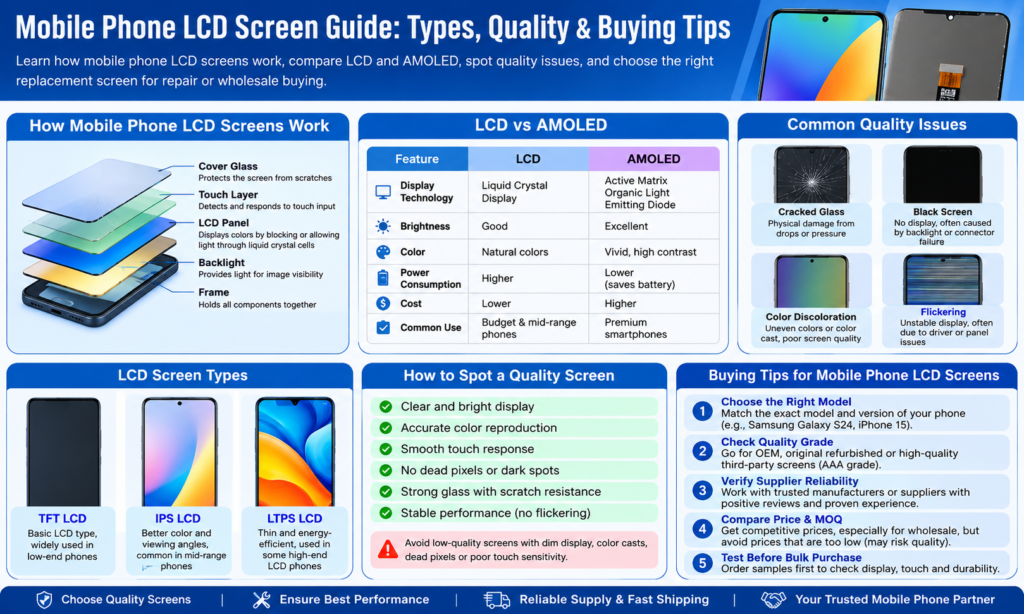
LCD znamená Kvapalina, technológia, ktorá využíva materiál z tekutých kryštálov na riadenie toho, koľko svetla prechádza jednotlivými pixelmi. Na rozdiel od OLED, LCD normálne nevytvára svetlo samo o sebe; namiesto toho, spolieha sa na samostatné podsvietenie umiestnené za panelom z tekutých kryštálov. Predstavte si podsvietenie ako lampu za súpravou malých nastaviteľných okien: svetlo je vždy k dispozícii, zatiaľ čo tekuté kryštály určujú, koľko svetla sa dostane do vašich očí. Každý pixel je rozdelený na menšie subpixely, zvyčajne červená, zelený, a modrá, a tieto subpixely spolupracujú pri vytváraní farieb, ktoré vidíte na fotografiách, videá, hry, a aplikácie. Samotný LCD panel je riadený tenkovrstvovým tranzistorom, alebo TFT, pole, ktoré riadi jednotlivé pixely pomocou elektrických signálov. Zostava displeja telefónu môže tiež obsahovať vrstvu snímajúcu dotyk, polarizátory, optické filmy, krycie sklo, flexibilné plošné spoje, a integrovaný obvod ovládača displeja. To je dôvod, prečo tvrdenie, že telefón má „obrazovku“, môže byť pri diskusii o opravných dieloch mierne zavádzajúce: výmena sa môže týkať samotného LCD panelu alebo kompletnej zostavy obsahujúcej niekoľko ďalších vrstiev. V praktických opravárenských a veľkoobchodných trhoch, Je nevyhnutné presne pochopiť, ktorý komponent sa predáva, pretože dva produkty, ktoré vyzerajú spredu takmer identicky, môžu mať veľmi odlišnú konštrukciu, jas, dotykový výkon, trvanlivosť, a cenu.
Ako LCD obrazovka vytvára obraz
Základný proces výroby obrazu LCD je ľahšie pochopiteľný, ak si predstavíte milióny malých uzávierok, ktoré spolupracujú. Podsvietenie vytvára biele svetlo, a vrstva tekutých kryštálov mení množstvo svetla, ktoré prechádza každým subpixelom. Elektrické signály informujú obvody TFT o tom, ako by sa mal každý pixel správať, zatiaľ čo farebné filtre určujú, či sa svetlo zmení na červené, zelený, alebo modrá. Ovládaním intenzity týchto troch subpixelov, displej dokáže reprodukovať obrovskú škálu farieb. Pixel zobrazujúci bielu farbu umožňuje silné príspevky zo všetkých troch kanálov, zatiaľ čo tmavší pixel znižuje množstvo prepusteného svetla. Táto architektúra je zásadne odlišná od OLED, kde každý pixel je emisný prvok, ktorý produkuje svoje vlastné svetlo. Tento rozdiel vysvetľuje niekoľko známych vlastností: LCD vyžadujú podsvietenie, pričom OLED pixely sa môžu individuálne vypnúť; Úroveň čiernej LCD je preto vo všeobecnosti obmedzená tým, ako účinne panel a optická sústava blokujú podsvietenie. Kvalita LCD nie je určená len jeho rozlíšením, buď. Dizajn TFT, materiál z tekutých kryštálov, optické filmy, účinnosť podsvietenia, farebné filtre, elektronika vodiča, a kalibrácia ovplyvňuje to, čo používateľ skutočne vidí. Na náhradnom displeji, aj keď dva panely majú rovnaké rozlíšenie a polohu konektora, nemusia poskytovať rovnaký jas, pozorovacie uhly, farby, odozva na dotyk, alebo spotreba energie. Dobrá výroba LCD je preto vyvážením medzi elektrickým ovládaním, optický výkon, mechanická štruktúra, a výrobné náklady.
LCD vs OLED vs AMOLED vstup 2026
Trh displejov smartfónov v 2026 sa čoraz viac rozdeľuje polohovaním zariadenia. OLED a AMOLED sú silne spojené s prémiovými telefónmi a telefónmi vyššej strednej triedy, pretože dokážu poskytnúť vynikajúci kontrast, hlboké čierne, tenké štruktúry, a flexibilné dizajny. LCD zostáva vysoko konkurencieschopný v zariadeniach citlivých na náklady a na sekundárnych trhoch a trhoch opráv, kde je mimoriadne dôležitá cenová dostupnosť a široká dostupnosť modelov. TrendForce informoval v auguste 2026 že a-Si LCD si aj naďalej zachováva značný dopyt kvôli nižším nákladom a použitiu na základnej úrovni, stredný rozsah, sekundárne, a opravárenské aplikácie, zatiaľ čo dopyt po LTPS LCD smartfónoch klesá. Prijatie AMOLED sa stále rozširuje, najmä v strednej a vyššej časti trhu so smartfónmi, to však neznamená, že každá výmena LCD sa stáva zastaranou. Pre majiteľa telefónu, rozdiel môže byť skôr praktický ako ideologický: výmena OLED môže poskytnúť lepší kontrast a tenšiu konštrukciu, zatiaľ čo výmena LCD môže byť ekonomickejšou voľbou, ak je kompatibilná s pôvodným dizajnom zariadenia. AMOLED tiež predstavuje svoje vlastné úvahy o opravách, vrátane možného vyhorenia, krehkosť panelu, zložitosť spájania, a rozdiely medzi pružnými a pevnými štruktúrami. In 2026, priemysel tiež venuje väčšiu pozornosť LTPO SI, ktorý umožňuje variabilné obnovovacie frekvencie a môže zlepšiť energetickú účinnosť v prémiových telefónoch. Counterpoint očakáva, že LTPO backplane budú čoraz dominantnejšie v špičkových smartfónoch, s prekročením LTPO 40% OLED panelov smartfónov podľa jeho 2026 zobraziť predpovede. Takže, pri porovnávaní technológií, najlepšia otázka nie je len „Ktorá obrazovka je lepšia?“, ale „Ktorá technológia obrazovky je vhodná pre tento telefón, aplikácie, rozpočtu, a požiadavka na opravu?“
Hlavné typy LCD obrazoviek telefónov
Existuje niekoľko LCD technológií a klasifikácií, ktoré sa môžu objaviť v katalógoch súčiastok smartfónov, a terminológia sa môže rýchlo stať mätúcou. TFT LCD je široká kategória označujúca LCD panely riadené tenkovrstvovými tranzistormi, zatiaľ čo a-Si LCD používa amorfný kremík ako polovodičový materiál v základnej doske TFT a zostáva dôležitý z dôvodu jeho relatívne vyspelej a nákladovo efektívnej výroby. LTPS LCD, alebo nízkoteplotný polysilikónový LCD, môže podporovať vyššiu mobilitu tranzistorov a historicky bol užitočný pre mobilné displeje s vyšším rozlíšením a rýchlejšou odozvou. IPS, medzitým, sa týka architektúry LCD navrhnutej na zlepšenie zarovnania tekutých kryštálov a zobrazovacích vlastností; bežne sa spája s dobrými pozorovacími uhlami a stabilnou prezentáciou obrazu. Tieto výrazy sa môžu v popisoch produktov prekrývať, a preto by kupujúci nemali predpokladať, že marketingové označenie rozpráva celý príbeh. Náhradný diel môže byť označený ako IPS, TFT, a-Si, alebo jednoducho LCD v závislosti od dodávateľa a trhu. Fyzická kompatibilita panelu je tiež kritická. Obrazovka musí zodpovedať rozmerom telefónu, konektor, flex kábel, správanie vodiča displeja, dotykové rozhranie, rozlíšenie, montážna konštrukcia, a softvérové očakávania. Nízkonákladová náhrada, ktorá sa hodí k rámu, ale má nesprávnu elektrickú konfiguráciu, nie je skutočne kompatibilná. Pre veľkoobchodných kupujúcich, to je jeden z dôvodov, prečo je testovanie špecifické pre daný model užitočnejšie ako posudzovanie obrazovky podľa fotografií alebo krátkeho popisu produktu.
TFT LCD, IPS LCD, a a-Si LCD
Najjednoduchší spôsob, ako porozumieť týmto pojmom, je rozpoznať, že popisujú rôzne aspekty displeja a nie vždy predstavujú úplne samostatné kategórie produktov. TFT opisuje tranzistorový riadiaci systém používaný na adresovanie pixelov, zatiaľ čo a-Si identifikuje polovodičový materiál použitý v konkrétnej základnej doske TFT. IPS opisuje usporiadanie z tekutých kryštálov určené na poskytovanie lepších pozorovacích vlastností ako staršie štruktúry LCD. V obchodovaní s telefónnymi dielmi v reálnom svete, tieto označenia sa niekedy používajú nejednotne, takže kupujúci by si mal radšej overiť skutočné špecifikácie panela, než sa spoliehať len na názov. Kvalitný náhradný LCD displej by mal poskytovať stabilný jas naprieč displejom, primeraná farebná konzistencia, dobré pozorovacie uhly na svoju triedu, presná odozva na dotyk, a správna kompatibilita s ovládačom displeja telefónu. Panely nízkej kvality sa môžu javiť ako prijateľné pri jasnom osvetlení showroomu, ale pri pohľade vonku odhalia nedostatky, naklonený z uhla, alebo použiť s tmavými obrázkami. Niektoré lacné LCD majú tiež hrubšiu konštrukciu, slabší dotykový výkon, viditeľnejšia variácia podsvietenia, alebo menej presná reprodukcia farieb. To neznamená, že každá výmena TFT je zlá alebo každý drahý panel je vynikajúci. Kvalita do značnej miery závisí od dizajnu panelu, materiálov, výrobné kontroly, proces lepenia, elektronika vodiča, a inšpekčné normy. Z toho dôvodu, profesionálni kupujúci by mali zaobchádzať Typ technológie LCD ako jedna špecifikácia z mnohých, ako jediný ukazovateľ kvality produktu.
Pochopenie vrstiev LCD obrazovky
Zostava LCD smartfónu pripomína vrstvený sendvič, v ktorom každá vrstva vykonáva špecifickú úlohu. V strede je bunka LCD obsahujúca pole TFT, materiál z tekutých kryštálov, a štruktúru farebného filtra. Polarizačné filmy sa používajú na kontrolu správania svetla prechádzajúceho cez systém tekutých kryštálov, zatiaľ čo optické filmy môžu pomôcť distribuovať alebo viesť svetlo z podsvietenia. Za bunkou displeja sa nachádza Jednotka LED podsvietenia, ktorý poskytuje osvetlenie požadované pre LCD. V závislosti od dizajnu, nad displejom môže byť tiež dotyková vrstva alebo štruktúra snímajúca dotyk, nasledujú lepiace vrstvy a ochranné krycie sklo. Flexibilný plošný spoj, často nazývaný an FPC, prenáša elektrické signály medzi zostavou displeja a základnou doskou telefónu. IC ovládača displeja spravuje signály potrebné na ovládanie panela, a jeho integrácia sa môže medzi modelmi obrazoviek líšiť. Táto vrstvená konštrukcia vysvetľuje, prečo môže výmena „siete“ zahŕňať rôzne postupy v závislosti od použitej časti. Prasknuté krycie sklo nemusí nutne znamenať poškodenie LCD pod ním, zatiaľ čo funkčný LCD môže mať stále porušenú dotykovú vrstvu. A naopak, náraz môže poškodiť niekoľko vrstiev súčasne, vytváranie príznakov, ako sú farebné čiary, čierne plochy, dotykové zlyhanie, alebo blikanie. Pri hodnotení náhradných dielov, znalosť štruktúry vrstiev pomáha technikom identifikovať, či majú čo do činenia s poškodením skla, dotykové zlyhanie, Poškodenie LCD buniek, problémy s podsvietením, alebo problém s elektronickým pripojením.
Veľkosť obrazovky LCD, Rozlíšenie, a hustota pixelov
Veľkosť obrazovky je jednou z najviditeľnejších špecifikácií, ale nehovorí o tom, ako ostrý bude obrázok vyzerať. Rozlíšenie popisuje počet pixelov usporiadaných horizontálne a vertikálne, zatiaľ čo hustota pixelov, bežne vyjadrené ako pixely na palec alebo PPI, zvažuje, ako sú tieto pixely rozložené na ploche fyzického zobrazenia. 6,5-palcový displej a 6,5-palcový displej preto môžu vyzerať veľmi odlišne, ak sa ich rozlíšenie alebo hustota pixelov líšia. Vyššia hustota pixelov vo všeobecnosti umožňuje, aby text a detailné obrázky vyzerali ostrejšie, aj keď so zvyšujúcou sa hustotou pixelov a zmenou podmienok sledovania sa táto výhoda stáva menej zrejmou. Pri nákupe náhradného displeja, zhoda s pôvodným rozlíšením je dôležitá, pretože softvér telefónu, grafický procesor, a ovládač displeja sú navrhnuté podľa konkrétnych charakteristík. Výmena s iným rozlíšením môže spôsobiť problémy s mierkou, nezvyčajná kvalita obrazu, alebo problémy s kompatibilitou. Veľkosť zahŕňa aj viac ako diagonálne meranie: aktívnu zobrazovaciu plochu, pomer strán, rámová konštrukcia, usporiadanie zárezov alebo dierovacích otvorov, a montážne rozmery musia zodpovedať zariadeniu. Moderné smartfóny často používajú úzke rámy a nezvyčajné geometrie rohov, Vďaka tomu je mechanická kompatibilita rovnako dôležitá ako inzerovaná veľkosť uhlopriečky panelu. Pre opravárenské podniky, čísla modelov a presné špecifikácie dielov sú preto oveľa bezpečnejšími identifikátormi ako frázy ako „6,5-palcový LCD“. Obrazovka môže mať správnu veľkosť a napriek tomu môže byť úplne nevhodná pre konkrétny telefón.
Obnovovacia frekvencia a vzorkovanie dotykov
Obnovovacia frekvencia popisuje, ako často môže displej aktualizovať svoj obraz, zvyčajne vyjadrené v Hz. Aktualizuje sa 60Hz panel 60 krát za sekundu, zatiaľ čo panel 90 Hz alebo 120 Hz môže produkovať plynulejší pohyb a posúvanie, keď softvér telefónu podporuje tieto režimy. Vzorkovacia frekvencia dotyku je iná špecifikácia: popisuje, ako často dotykový systém zisťuje alebo spracováva dotykový vstup. Tieto dve čísla sú často zamieňané, pretože obe súvisia s odozvou, ale merajú rôzne veci. Displej môže mať vysokú obnovovaciu frekvenciu bez toho, aby musel mať výnimočne vysokú vzorkovaciu frekvenciu dotyku, a rýchly dotykový systém automaticky nezrýchli obnovovanie displeja. V náhradných dieloch LCD, zachovanie pôvodnej schopnosti obnovovacej frekvencie môže byť dôležité pre používateľov, ktorí očakávajú plynulé posúvanie alebo herný výkon. Avšak, panel, dotykový ovládač, firmvér telefónu, ovládač displeja, a základná doska musia spolupracovať, aby funkcia fungovala správne. In 2026, displeje s vysokou obnovovacou frekvenciou sa už neobmedzujú len na najdrahšie smartfóny, aj keď pokročilé technológie s premenlivým obnovovaním sú obzvlášť významné v prémiových zariadeniach OLED. Counterpoint uvádza, že 144Hz a 165Hz OLED displeje sa objavujú ako širšie výkonové funkcie, spolu so zvyšujúcim sa prijatím LTPO. Na výmenu LCD, preto, simply seeing a high number in a supplier listing is not enough. A professional test should verify actual refresh behavior, presnosť dotyku, latency, and stability on the target phone.
Why LCD Screens Need a Backlight
One of the defining characteristics of LCD technology is its dependence on a separate podsvietenie. Liquid crystals regulate light, but they do not normally generate the visible light themselves. In modern smartphone LCDs, the backlight generally uses LEDs because they are compact, efektívne, and suitable for thin mobile devices. The light travels through optical films that help distribute illumination across the panel so the user sees a reasonably uniform image. If the backlight fails, the LCD may still be producing image information even though the user sees a black or extremely dim screen. This is why a technician may sometimes discover that a phone has a working display signal but no visible illumination. Backlight problems can originate from the LED backlight itself, the display flex, konektor, driver circuitry, power supply, or damage to the panel assembly. Uneven illumination can also appear as bright spots, dark areas, tiene, or visible patches, particularly after a screen has been damaged or improperly assembled. Because the backlight operates continuously while an LCD image is visible, its efficiency also affects battery consumption. OLED has an inherent advantage for displaying black content because individual pixels can be turned off rather than continuously illuminating a separate backlight. Stále, LCD backlight engineering has become highly mature, a dobré panely môžu poskytnúť silný jas a konzistentné osvetlenie pri relatívne nízkych nákladoch.
Bežné problémy s mobilným LCD displejom
Najčastejšie problémy súvisiace s LCD zvyčajne pochádzajú z fyzického nárazu, tlak, vlhkosť, starnutie, výrobné chyby, alebo poškodenie počas opravy. Prasknuté krycie sklo je jasným príkladom, ale základný LCD displej môže zostať funkčný aj po niektorých typoch nárazu. Ostatné zlyhania sú spočiatku menej dramatické: displej môže vytvoriť zvislú čiaru, lokalizované sfarbenie, blikať, matné úseky, mŕtve pixely, alebo občasná strata obrazu. Tlak z nesprávne osadeného rámu môže poškodiť panel aj bez viditeľnej praskliny, najmä ak je telefón zostavený nadmernou silou alebo keď náhradný diel nesedí správne. Lepidlo môže tiež spôsobiť problémy, ak je nanesené nerovnomerne alebo znečistí citlivé miesta. Poškodenie ohybného kábla je ďalšou častou príčinou, pretože FPC je tenký a musí sa ohýbať v obmedzenom mechanickom rozsahu. Vlhkosť môže spôsobiť koróziu alebo elektrickú nestabilitu okolo konektorov a obvodov displeja, zatiaľ čo teplo môže urýchliť poškodenie elektronických komponentov a lepidiel. Náhradná obrazovka, ktorá prejde jednoduchým testom „rozsvieti sa“, môže mať stále chyby, ktoré sa stanú viditeľnými po dlhšom používaní. Preto by odborná kontrola mala zahŕňať jas, farba, dotýkať sa, pozorovací uhol, kontroly mŕtvych pixelov, jednotnosť obrazu, stav konektora, a funkčné testovanie. Pre veľkoobchodných kupujúcich, spoľahlivý proces kontroly kvality je v skutočnosti poistkou: pred odoslaním to stojí nejaký čas, ale môže zabrániť oveľa väčším nákladom spôsobeným vrátením tovaru, sťažnosti zákazníkov, stratená práca, a poškodená povesť.
Čo spôsobuje zlyhanie dotyku duchov a dotyku?
Dotyk ducha occurs when the phone registers touches that the user did not actually make. The symptom can look almost mysterious: applications open by themselves, icons move, text is entered automatically, or the display appears to respond randomly. Yet the cause is usually related to the touch-sensing system, electrical interference, vlhkosť, damaged components, poor assembly, or an incompatible replacement display. A damaged touch layer or FPC can create intermittent signals that the phone interprets as genuine input. Moisture or conductive contamination around the display connector can have a similar effect. Poor-quality replacement screens may also use touch components whose electrical characteristics differ from the original design, producing unstable behavior on certain phones. Another possibility is mechanical pressure: if a display is squeezed by the frame or adhesive, the touch layer can behave abnormally. Before blaming the LCD panel, technicians should inspect the connector, clean appropriate contact areas, test another known-good assembly, and check whether the problem disappears after changing the display. A good diagnostic process is like solving a detective case: eliminate one suspect at a time instead of immediately replacing every component. Pre spotrebiteľov, the important lesson is that ghost touch does not always mean the LCD itself is physically cracked. It can be a display-assembly, connection, environmental, or software-related problem, so diagnosis matters before spending money on a replacement.
Black Screen, Blikanie, and Display Lines
A black screen can have several different causes, and the symptom alone does not identify the failed component. If the phone vibrates, receives calls, produces notification sounds, or can otherwise be shown to be running, the display system may be the problem rather than the entire device. A completely black LCD may result from a failed backlight, damaged LCD cell, broken FPC, loose connector, or power-related display fault. Flickering can similarly be caused by a damaged panel, unstable connection, driver circuitry, or physical pressure on the display assembly. Vertical or horizontal lines often indicate damage to the panel or its bonded connections, especially when they remain in the same position regardless of the displayed image. Avšak, diagnosis should still include checking connectors and comparing the device with a known-good screen because a mainboard fault can sometimes produce display symptoms. Color distortion can also provide clues: unusual tinting may result from panel damage, polarization problems, calibration differences, or a defective replacement. If a screen begins developing problems immediately after installation, the installation process and compatibility should be investigated rather than assuming normal aging. When buying replacement LCDs, it is useful to maintain a record of serial or batch information and inspection results. That makes it easier to identify whether a problem is isolated to one unit or associated with a particular production batch.
Originál, OEM, Zrekonštruovaný, and Compatible Screens
Screen terminology can create as much confusion as the technology itself. Originál usually refers to a component manufactured for or sourced from the original device supply chain, although the precise commercial meaning can vary by seller and market. OEM means original equipment manufacturer, but sellers sometimes use the term loosely, so buyers should ask exactly who manufactured the panel and whether it is new, vytiahol, zrekonštruovaný, or assembled from recovered components. A renovovaná obrazovka may use a recovered original LCD or OLED panel that has been paired with new glass, a new touch layer, or other replacement components. A compatible aftermarket screen is generally produced by a third-party manufacturer and designed to work with the specified phone model. None of these labels automatically guarantees quality. An original used panel with severe wear may be less attractive than a high-quality new aftermarket part, while a cheap “OEM” listing may not provide the same performance as a genuinely verified original component. The safest approach is to evaluate the actual product characteristics: jas, farba, odozva na dotyk, rozlíšenie, fit, kvalita konektora, trvanlivosť, chybovosť, and warranty. For businesses, clear terminology also helps prevent misunderstandings with customers. A supplier should be able to explain whether a product is original new, originál zrekonštruovaný, OEM trieda, or aftermarket rather than relying on ambiguous phrases. In a 2026 repair market with intense price competition, transparent grading is becoming increasingly important because the cheapest screen is not necessarily the cheapest solution after returns and labor are included.
How to Judge LCD Screen Quality
Judging an LCD screen requires more than looking at it for a few seconds under showroom lighting. A proper evaluation should consider rovnomernosť jasu, reprodukciu farieb, citlivosť na dotyk, pozorovacie uhly, pixel defects, image stability, fit, flex kvalita, a dlhodobá spoľahlivosť. The first step is usually visual inspection for scratches, kontaminácie, prasklina, preliačiny, abnormal edges, or assembly defects. The display should then be tested with different colors, including white, čierny, červená, zelený, a modré obrazovky, because defects can become much easier to see against particular backgrounds. Brightness should be checked across different areas rather than only in the center. Touch testing should cover the entire active area, including corners and edges, because some low-quality assemblies may perform well in the middle but fail near the perimeter. Technicians should also verify proximity-related functions, front-camera alignment where applicable, automatic brightness behavior, and display stability under normal operating conditions. A professional supplier may use multiple inspection stages rather than relying on a single final test. This is particularly important because manufacturing defects can be intermittent. Industry conditions in 2026 also make QC more valuable: rising component costs and supply-chain pressure are encouraging manufacturers and brands to pay closer attention to cost, inventory, and platform reuse. Counterpoint has reported that memory-cost pressure is encouraging smartphone makers to extend existing display platforms and prioritize efficiency-oriented improvements in some 2026 produktov. In this environment, consistent quality can become a stronger competitive advantage than simply offering the lowest purchase price.
LCD Screen Replacement: What Users Should Know
Replacing a phone display is not simply a matter of removing broken glass and attaching a new panel. Modern smartphones are tightly assembled devices in which the display may be bonded to the frame, connected through delicate flex cables, and integrated with touch, senzory, kamery, reproduktory, a ďalšie komponenty. Before replacement, important data should be backed up when possible, and the device should be powered down according to the manufacturer’s repair procedure. During disassembly, excessive heat or force can damage batteries, káblov, seals, or surrounding components. After installing the replacement, the technician should test the display and touch function before final assembly. This intermediate test is extremely valuable because discovering a defective replacement after the phone has been completely sealed wastes labor and increases the risk of additional damage during rework. A good replacement workflow should verify image output, jas, touch across the entire screen, buttons and relevant sensors, nabíjanie, kamery, reproduktory, and other functions that may have been disturbed during repair. Adhesive and frame alignment also matter because even a technically functional panel can become unreliable if it is installed under mechanical stress. Consumers should therefore choose a repair provider based on process quality rather than price alone. A cheap repair that uses an unsuitable screen or rushed installation can become much more expensive if the phone develops touch problems, display lines, kontaminácia prachom, or structural damage later.
LCD Screen Prices and the 2026 Supply Market
Phone LCD pricing varies significantly according to model, veľkosť obrazovky, technológie, objem výroby, stupňa, zdroj, and whether the part is sold as a panel or a complete assembly. Older or entry-level models can have relatively inexpensive LCD replacements because manufacturing is mature and demand is broad. Newer models with unusual dimensions, vysoké obnovovacie frekvencie, integrated touch systems, or specialized assemblies can cost considerably more. Wholesale pricing also depends on quantity, chybovosť, balenie, preprava, záručné podmienky, and whether the supplier can provide stable repeat batches. In 2026, the display supply chain is being influenced by broader component-cost pressure, especially memory shortages and price increases affecting smartphone manufacturers. TrendForce’s August 2026 research forecasts approximately 2.25 billion smartphone panel shipments globally in 2026, zastupujúci a 2.5% year-on-year decline, while secondary and repair demand is helping support panel demand. Earlier in March, TrendForce had projected a sharper 7.3% decline, showing how quickly market expectations can change as supply and demand conditions evolve. Pre kupujúcich, that means price lists should not be treated as permanent. A good purchasing strategy considers total landed cost, not just the quoted unit price. If a slightly more expensive screen has a substantially lower defect rate and better customer satisfaction, it may produce a lower effective cost per successful repair.
| Screen consideration | Lower-cost option | Higher-quality option |
|---|---|---|
| Initial unit price | Usually lower | Usually higher |
| Konzistencia farieb | Can vary | Generally more consistent |
| Rovnomernosť jasu | May vary by batch | Usually better controlled |
| Odozva na dotyk | Model-dependent | Generally more stable |
| Quality consistency | Supplier-dependent | Usually stronger with controlled QC |
| Warranty risk | Potentially higher | Často nižšie |
| Best use | Price-sensitive repairs | Professional repair and long-term supply |
Why a-Si LCD Still Matters in 2026
It is easy to assume that LCD is disappearing simply because flagship smartphones increasingly use OLED, but the market data tells a more complicated story. a-Si LCD remains important because smartphones exist at many price levels, and manufacturers do not design every model around the same cost structure. Základné telefóny, replacement devices, secondary-market phones, and repair channels all create demand for economical display technology. TrendForce specifically identifies a-Si LCD as retaining a significant position because of its lower cost and continued demand from entry-level, stredný rozsah, sekundárne, a opravárenské aplikácie. This creates an interesting situation in which LCD can lose share in premium new phones while remaining commercially important across the broader installed base. A repair business may therefore continue selling large volumes of LCD screens even while OLED technology dominates the headlines. Another advantage is manufacturing maturity. LCD production has been refined over decades, and many suppliers understand how to manufacture panels at scale with predictable processes. The challenge is that not every LCD panel is equally good, particularly in the aftermarket. Buyers need to distinguish between a mature technology and a high-quality implementation of that technology. Inými slovami, LCD is not automatically outdated simply because OLED is newer. It is more useful to think of LCD as a mature, cost-efficient technology whose strongest role has shifted toward value-focused devices and replacement markets.
The Shift From LCD to AMOLED
The transition from LCD toward AMOLED is one of the biggest changes in smartphone displays, a 2026 continues that movement. OLED-based displays can deliver self-emissive pixels, hlboké čierne, vysoký kontrast, tenké štruktúry, a flexibilné tvarové faktory, making them especially attractive for premium smartphones. Counterpoint’s 2026 OLED research describes continued growth in advanced OLED backplanes such as LTPO, while Omdia forecasts AMOLED smartphone display shipments at around 778 miliónov jednotiek v 2026, a 7% year-on-year decline amid broader smartphone-market pressure. That decline in unit shipments should not be interpreted as a collapse of OLED technology; rather, it reflects a complicated smartphone market in which higher component costs and weaker demand affect overall production. Flexible OLED continues to be strategically important because it supports curved and foldable designs. V rovnakom čase, manufacturers are increasingly looking for efficiency improvements rather than simply adding bigger numbers to specifications. Counterpoint reported in July 2026 that many smartphone makers were retaining display fundamentals from previous generations while focusing more heavily on efficiency because memory costs were placing pressure on device bills of materials. For LCD suppliers and repair businesses, this transition creates both pressure and opportunity. Premium LCD demand may continue shrinking, but the installed base of LCD phones remains enormous, and repair customers still need affordable replacement parts. The smartphone display industry is therefore not moving from “LCD” to “nothing”; it is developing into a multi-tier ecosystem where LCD and OLED serve different economic and technical roles.
How to Buy Phone LCD Screens for Wholesale
Wholesale buyers should approach LCD purchasing as a quality-control and supply-chain decision, not simply a price-shopping exercise. Start with the exact phone model and part number, then confirm the display size, rozlíšenie, konektor, dotyková konfigurácia, frame or no-frame construction, obnovovacia frekvencia, and other relevant specifications. Najbližší, clarify the product grade in writing: original new, originál zrekonštruovaný, trh s náhradnými dielmi, OEM trieda, or another defined category. Ask how the supplier tests the screens and whether the supplier can provide a defect policy or warranty. Samples should be tested before committing to large quantities, particularly when the screen will be sold to professional repair shops. Once a supplier passes sample testing, repeat-batch consistency becomes the next question. A screen that performs well in a five-piece sample but changes significantly across later batches is difficult to build a reliable repair business around. Packaging is also important because LCD assemblies are vulnerable to pressure, ohýbanie, vplyv, elektrostatický výboj, and moisture during transportation. A sensible purchasing process therefore looks at jednotková cena + QC + balenie + preprava + chybovosť + záruka + komunikácia, rather than unit price alone. For buyers sourcing from China, supplier verification should include company background, production capability, testovanie vzorky, inspection records, and the ability to maintain consistent specifications. The strongest supplier relationship is one where both sides treat technical specifications as measurable requirements instead of vague marketing claims.
Practical Tips for Storing and Shipping LCD Screens
A good LCD screen can be damaged before it ever reaches a repair technician if storage and transportation are handled poorly. Displays should be protected from excessive pressure because stacked weight can stress thin panels and cause cracks, deformation, or other defects. Packaging should also reduce vibration and impact during transportation, particularly when shipments travel through multiple logistics hubs. Electrostatic discharge protection may be necessary for assemblies containing sensitive electronic components, while moisture control is important when goods move through humid environments or experience significant temperature changes. Screens should ideally remain in appropriate protective packaging until they are ready for inspection or installation. Warehouses should avoid careless stacking, uncontrolled heat, and environments where water leakage or condensation could occur. During receiving inspection, buyers should check the outer cartons before opening them because obvious transport damage can provide useful evidence when handling claims. It is also helpful to inspect a representative sample from every incoming batch instead of assuming that a previously approved supplier will always deliver identical quality. This is particularly important in 2026 because smartphone display supply chains remain dynamic, with panel manufacturers balancing smartphone demand against automotive, IT, and other display applications. Counterpoint reported that China accounted for nearly 75% of global TFT input area v 2026, illustrating the scale and importance of Chinese display manufacturing capacity. For distributors and repair businesses, careful logistics are therefore not a minor administrative detail; they are part of product quality management.
Záver
The world of mobile phone LCD screens in 2026 is more interesting than it first appears. LCD is no longer the default technology for every new smartphone, but it remains commercially important because of its cost advantages, mature manufacturing ecosystem, huge installed base, and continuing demand from entry-level, sekundárne, and repair markets. V rovnakom čase, AMOLED and advanced OLED technologies such as LTPO continue to expand, especially in premium and upper-midrange devices. Understanding the difference between LCD, TFT, IPS, a-Si, LTPS, OLED, and AMOLED helps buyers make better decisions and prevents confusing a technology category with a quality grade. For repair technicians and consumers, the most useful knowledge is practical: a black screen does not always mean a dead phone, ghost touch does not always mean a cracked LCD, and a screen that fits physically is not necessarily a good replacement. Pre veľkoobchodných kupujúcich, kontrola kvality, clear product grading, overenie dodávateľa, balenie, záruka, and repeat-batch consistency can matter just as much as price. The broader 2026 display market is also being shaped by rising component costs and changing smartphone demand, so suppliers and buyers need to watch the market rather than rely on old assumptions. The simplest takeaway is this: know the technology, verify the specifications, test the actual screen, and calculate the total cost of quality before you buy. Those four habits remain useful whether you are replacing one phone screen or purchasing thousands of LCD assemblies for a repair business.
FAQs About Mobile Phone LCD Screens
1. Is LCD still a good phone screen technology in 2026?
Áno. LCD has lost ground to OLED in premium smartphones, but it remains highly relevant in value-focused devices and replacement markets. Its mature manufacturing base and lower cost make it attractive for affordable smartphones and repairs. TrendForce expects LCD panels to represent about 59% of global smartphone panel shipments in 2026 when a-Si and LTPS LCD are combined.
2. What is the difference between an LCD and an AMOLED screen?
The key difference is how light is produced. LCD uses a separate backlight that shines through liquid crystals, while AMOLED uses self-emissive pixels that generate their own light. AMOLED can therefore achieve very deep blacks and enable thinner or flexible designs, while LCD remains attractive for cost-sensitive applications.
3. Does a more expensive replacement LCD always mean better quality?
Nie nevyhnutne. Price can reflect many factors, including supply, popularita modelu, stupňa, balenie, záruka, and production volume. The best way to judge quality is through actual testing of brightness, farba, odozva na dotyk, fit, pixelov, and reliability rather than relying solely on price or labels such as “OEM.”
4. Why does a replacement LCD sometimes have poor touch response?
Possible causes include a defective touch layer, damaged flex cable, poor connector contact, incompatible components, installation pressure, vlhkosť, or a lower-quality aftermarket assembly. Testing the phone with a known-good screen is one of the most useful ways to separate a display problem from a motherboard or software problem.
5. Will LCD completely disappear from smartphones soon?
Probably not in the short term. OLED adoption continues to increase, but LCD still serves price-sensitive phones and has substantial demand in secondary and repair markets. The important 2026 trend is not simply “LCD disappears,” but rather LCD becomes more concentrated in cost-sensitive applications while OLED expands into broader smartphone segments.