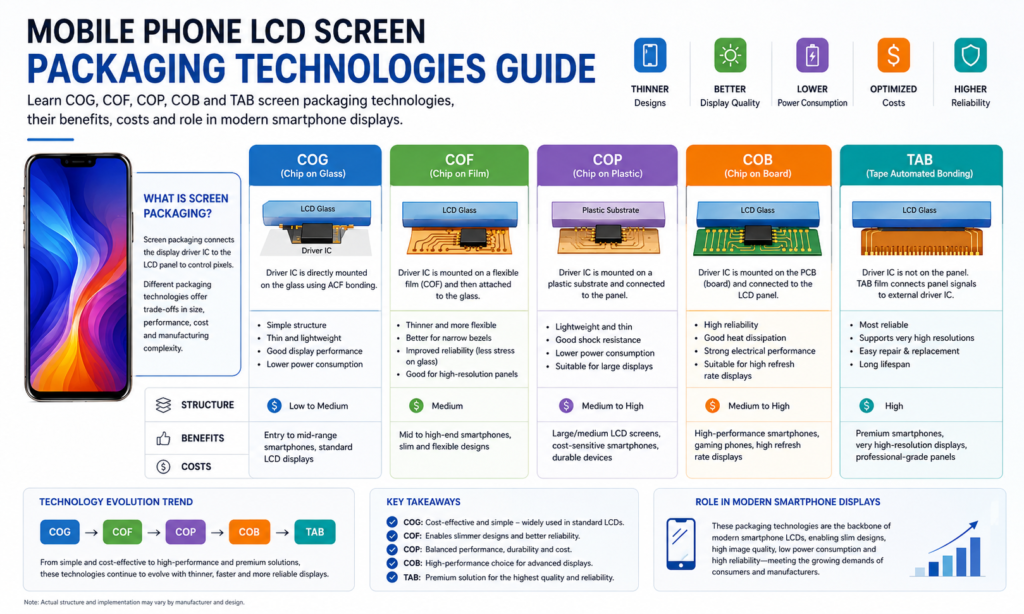
Forstå LCD-skærmemballage i smartphones
Hvad er LCD-skærmemballage?
Når folk taler om smartphone-skærme, de fokuserer normalt på skærmstørrelse, opløsning, opdateringshastighed, eller lysstyrke. Men bag hver skærm ligger en meget sofistikeret fremstillingsproces kendt som skærmemballeringsteknologi. Enkelt set, emballage refererer til den metode, der bruges til at forbinde skærmdriver-IC'er (Integrerede kredsløb) med LCD- eller OLED-panelet. Denne forbindelse er ansvarlig for overførsel af billeddata, kontrollerende pixels, og sikre, at skærmen fungerer korrekt.
Tænk på emballageteknologi som nervesystemet på en smartphoneskærm. Uanset hvor avanceret et skærmpanel måtte være, den kan ikke fungere effektivt uden en pålidelig forbindelse mellem driverchippen og displaysubstratet. Emballagemetoder bestemmer ikke kun skærmens elektriske ydeevne, men også dens tykkelse, holdbarhed, reparationsevne, og produktionsomkostninger.
I løbet af det seneste årti, smartphone-producenter har skubbet i retning af slankere enheder, smallere rammer, og større skærm-til-krop-forhold. For at nå disse mål, displayproducenter har løbende udviklet mere avancerede emballageteknologier. I dag, udtryk som f.eks COG, COF, COP, COB, og TAB er blevet almindelige inden for displayfremstillingsindustrien.
Forståelse af disse teknologier er især vigtigt for mobiltelefonværksteder, grossister, renovatører, og skærmfordelere. Forskellige emballeringsmetoder har direkte indflydelse på produktkvaliteten, Kompatibilitet, og prisfastsættelse. At kende forskellene kan hjælpe virksomheder med at træffe bedre købsbeslutninger og samtidig hjælpe forbrugerne med at forstå, hvorfor nogle skærme koster væsentligt mere end andre.
Hvorfor emballageteknologi betyder noget
Skærmemballage er langt vigtigere, end de fleste brugere er klar over. Det påvirker flere aspekter af smartphones ydeevne og design. For eksempel, moderne flagskibstelefoner har ofte ekstremt smalle rammer, der virker næsten usynlige. Denne visuelle effekt opnås i høj grad gennem avancerede emballeringsmetoder som COF og COP.
Emballagen påvirker også skærmens pålidelighed. En dårligt pakket skærm kan lide af signalstabilitet, berøringsfejl, billedforvrængning, eller for tidlig komponentfejl. I modsætning hertil, emballage af høj kvalitet forbedrer holdbarheden, øger varmeafgivelsen, og forlænger produktets levetid.
Producenter bruger også emballageteknologi til at optimere produktionseffektiviteten. Visse emballeringsmetoder reducerer materialeforbrug og montagekompleksitet, hjælper med at sænke produktionsomkostningerne. Andre prioriterer premium ydeevne, muliggør højere skærmkvalitet på bekostning af øgede produktionsomkostninger.
I takt med at smartphones fortsætter med at udvikle sig mod foldbare, rullebar, og ultratynde designs, emballageteknologi er blevet en vigtig konkurrencefordel. Det er ikke længere blot en produktionsproces – det er en strategisk faktor, der former fremtiden for mobildisplayinnovation.
Udviklingen af skærmemballage til mobiltelefoner
Fra tykke rammer til fuldskærmsdesign
Smartphone-industrien har gennemgået en bemærkelsesværdig transformation. Tidlige mobiltelefoner havde tykke rammer og relativt små skærme. I de dage, traditionelle emballageteknologier var tilstrækkelige, fordi pladsbegrænsninger ikke var et stort problem.
Efterhånden som forbrugernes efterspørgsel skiftede mod større skærme uden at øge enhedsstørrelsen, producenterne stod over for en vanskelig udfordring. De havde brug for at minimere rammebredden og samtidig bevare skærmens ydeevne og pålidelighed. Denne udfordring accelererede udviklingen af avancerede emballageteknologier.
Indledningsvis, COG-teknologi dominerede LCD-markedet på grund af dens enkelhed og lave omkostninger. Imidlertid, efterhånden som smartphone-design blev mere sofistikeret, COGs begrænsninger blev mere og mere tydelige. Behovet for snævrere grænser førte til udbredt anvendelse af COF-teknologi, især i premium LCD-skærme.
Introduktionen af fleksible OLED-paneler revolutionerede industrien yderligere. Fleksible substrater muliggjorde udviklingen af COP-teknologi, giver producenterne mulighed for at folde displaykredsløb bag selve panelet. Denne innovation reducerede den nederste ramme dramatisk og banede vejen for moderne smartphones uden ramme.
Hvordan emballage påvirker moderne smartphones
Nutidens smartphones er tekniske vidundere, der kombinerer æstetik med funktionalitet. Emballageteknologi spiller en central rolle for at opnå denne balance. Det påvirker ikke kun udseendet, men også det indre komponentarrangement, batterikapacitet, og den samlede enhedstykkelse.
For eksempel, en smartphone, der bruger COP-teknologi, kan allokere mere frontvendt plads til skærmen og reducere unødvendige grænseområder. Dette forbedrer brugeroplevelsen og forbedrer den visuelle fordybelse. Tilsvarende, avancerede emballeringsteknikker understøtter skærme med høj opdateringshastighed, HDR ydeevne, og forbedret berøringsfølsomhed.
Indflydelsen strækker sig ud over forbrugerenheder. Emballageinnovationer er også kritiske for tablets, automotive displays, bærbare enheder, og industrielle skærme. Efterhånden som displaykravene bliver mere krævende, emballageteknologi fortsætter med at udvikle sig sammen med panelteknologi.
COG (Chip på glas) Emballage teknologi
Struktur og arbejdsprincip
COG (Chip på glas) er en af de tidligste og mest udbredte teknologier til displayemballage. I denne metode, driver-IC'en er monteret direkte på LCD-panelets glasunderlag ved hjælp af ledende klæbende materialer.
Processen involverer præcis justering af driverchippen med displayelektroderne. Når den er vedhæftet, elektriske forbindelser etableres gennem ledende partikler indlejret i bindingsmaterialet. Dette skaber en kompakt og effektiv kommunikationsvej mellem IC'en og skærmpanelet.
COG-teknologi vandt popularitet, fordi den forenklede produktionen og reducerede produktionsomkostningerne. Ved at eliminere yderligere fleksible kredsløbslag, fabrikanter kunne strømline samlingen og samtidig opretholde en acceptabel skærmydelse.
Den direkte chip-til-glas-forbindelse reducerer også signaltransmissionsafstanden, som kan forbedre den elektriske effektivitet. Dette gør COG velegnet til mange mellemklasse- og entry-level LCD-applikationer, hvor omkostningsoptimering er et primært mål.
Fordele og begrænsninger
COG-teknologi tilbyder flere væsentlige fordele:
| Fordele | Beskrivelse |
|---|---|
| Lavere omkostninger | Forenklet fremstillingsproces |
| Kompakt design | Færre komponenter påkrævet |
| God signalydelse | Kort transmissionsvej |
| Moden teknologi | Bred tilgængelig og pålidelig |
Imidlertid, COG har også begrænsninger. Driver-IC'en optager plads direkte på glassubstratet, gør bezel reduktion mere udfordrende. Dette begrænser dens egnethed til moderne ultratynde smartphone-designs.
Reparation kan også være problematisk. Da chippen er fastgjort direkte til glasset, skader kræver ofte udskiftning af hele displayet. Som et resultat, mange premium-smartphone-producenter har skiftet til mere avancerede alternativer såsom COF og COP.
COF (Chip på film) Emballage teknologi
Sådan fungerer COF-teknologi
COF (Chip på film) teknologi repræsenterer et stort fremskridt i forhold til COG. I stedet for at montere driver IC direkte på skærmglasset, chippen er fastgjort til en fleksibel polyimidfilm.
Denne fleksible film fungerer som et mellemliggende forbindelseslag mellem skærmpanelet og driver-IC. Fordi filmen kan bøjes og foldes, producenter opnår væsentligt større designfleksibilitet. Førerchippen kan placeres uden for det synlige displayområde, tillader smallere rammer.
Limningsprocessen kræver høj præcision og specialiseret udstyr. Elektriske forbindelser skal forblive stabile på trods af mekaniske belastninger og temperaturvariationer. Moderne COF-produktionslinjer anvender avancerede automatiseringssystemer for at sikre ensartethed og pålidelighed.
Applikationer i avancerede smartphones
COF-teknologi er blevet det foretrukne valg for mange premium LCD-smartphone-skærme. Dens evne til at minimere rammebredden og samtidig opretholde fremragende signalydelse gør den ideel til moderne fuldskærmsdesign.
Mange flagskibsenheder introduceret i løbet af de sidste mange år har taget COF-emballage til at opnå imponerende skærm-til-krop-forhold. Teknologien understøtter også højere skærmopløsninger og hurtigere opdateringshastigheder på grund af forbedret kredsløbsintegration.
Fra et reparationsindustriperspektiv, COF-skærme kræver ofte højere priser på grund af deres avancerede produktionskrav. Ikke desto mindre, de leverer overlegen visuel æstetik og forbedret produktkonkurrenceevne, hvilket gør dem til en værdifuld investering for premium smartphonemærker.
COP (Chip på plastik) Emballage teknologi
Hvorfor COP muliggør ultrasmalle rammer
Blandt aktuelle display-emballageløsninger, COP (Chip på plastik) betragtes bredt som en af de mest avancerede teknologier til rådighed. COP bruger fleksible plastsubstrater frem for traditionelle glasbaserede strukturer.
Den væsentligste fordel ligger i evnen til at bøje displaykredsløbet under panelet. Dette giver producenterne mulighed for at skjule driverkredsløb bag skærmen, reducerer den nederste ramme dramatisk.
Forestil dig at rulle kanten af en plakat bag en ramme, så den bliver usynlig. COP opnår en lignende effekt med displayelektronik. Resultatet er en elegant, et næsten grænseløst udseende, der er blevet synonymt med flagskibssmartphones.
Denne teknologi har spillet en afgørende rolle i udviklingen af moderne enheder uden ramme, muliggør slanke designs, der maksimerer visningsområdet uden at øge enhedens overordnede dimensioner.
Fordele ved OLED og fleksible skærme
COP-teknologi fungerer usædvanligt godt med fleksible OLED-skærme. Da OLED-paneler kan bøjes uden at gå i stykker, fabrikanter kan folde displayet under produktionen, skabe innovative formfaktorer.
Fordelene er bl.a:
- Ultratynde skærmmoduler
- De smalleste muligheder for bezeldesign
- Forbedret æstetisk appel
- Kompatibilitet med buede skærme
- Understøttelse af foldbare smartphone-designs
Den største ulempe er omkostningerne. COP-fremstilling kræver avancerede materialer, præcisionsudstyr, og strenge kvalitetskontrolprocedurer. Følgelig, COP-skærme findes typisk i premium-enheder frem for budgetsmartphones.
Efterhånden som foldbare telefoner vinder popularitet, COP-teknologi forventes at blive endnu vigtigere. Dens fleksibilitet passer perfekt til nye displaytrends og næste generations enhedsarkitekturer.
COB (Chip ombord) Emballage teknologi
Fremstillingsproces
COB (Chip ombord) emballage involverer montering af halvlederchips direkte på et printkort. Trådbindingsteknikker forbinder chippen med kredsløbsspor, før beskyttende indkapsling påføres.
Denne metode er almindeligt anvendt i elektroniske enheder, hvor kompakt integration og pålidelig ydeevne er påkrævet. Selvom det ikke er så udbredt i avancerede smartphone-skærme, COB er fortsat vigtig i forskellige display-relaterede applikationer.
Fremstillingsprocessen inkluderer placering af spåner, trådbinding, elektrisk test, indkapsling, og afsluttende eftersyn. Hvert trin kræver præcis kvalitetskontrol for at sikre stabil ydeevne og langsigtet pålidelighed.
Typiske anvendelsestilfælde
COB-teknologi findes ofte i:
- Industrielle udstillinger
- Små LCD-moduler
- Instrumentpaneler
- Forbrugerelektronik
- Displaysystemer til biler
Dens styrke ligger i omkostningseffektivitet og holdbarhed. Selvom nyere emballeringsmetoder dominerer flagskibssmartphones, COB fortsætter med at tjene mange praktiske applikationer, hvor ultratynde rammer ikke er afgørende.
TAB (Automatisk tape limning) Teknologi
Tekniske egenskaber
TAB (Automatisk tape limning) var en vigtig overgangsteknologi i udviklingen af displayemballage. Den anvender fleksible tapebærere med præformede ledende spor til chipforbindelse.
Teknologien giver forbedret montagehastighed og relativt høj produktionseffektivitet. Før COF blev udbredt, TAB blev almindeligvis brugt i forskellige LCD-applikationer på grund af dets balance mellem ydeevne og omkostninger.
TAB understøtter automatiserede fremstillingsprocesser og giver pålidelige elektriske forbindelser. Imidlertid, dens fysiske begrænsninger gør den mindre velegnet til nutidens ultrakompakte smartphone-designs. Som et resultat, TAB er efterhånden blevet erstattet af mere avancerede løsninger inden for moderne forbrugerelektronik.
På trods af dets faldende brug i smartphones, TAB er fortsat en vigtig milepæl i skærmproduktionshistorien og fortsætter med at påvirke nuværende emballagemetodologier.
Sammenligning af store LCD-skærme-emballageteknologier
Teknologi sammenligningstabel
| Teknologi | Koste | Bezel Reduktion | Pålidelighed | Fleksibilitet | Typisk anvendelse |
|---|---|---|---|---|---|
| COG | Lav | Moderat | Høj | Lav | Entry-Level LCD'er |
| COF | Medium | Høj | Høj | Medium | Premium LCD-telefoner |
| COP | Høj | Fremragende | Meget høj | Fremragende | OLED flagskibe |
| COB | Lav-Middel | Begrænset | Høj | Lav | Industrielle skærme |
| TAB | Medium | Moderat | God | Medium | Ældre LCD-produkter |
Nøglefaktorer, der påvirker emballagevalg
Koste
Omkostninger er fortsat en af de mest indflydelsesrige faktorer i valget af emballageteknologi. Budget smartphones prioriterer overkommelighed, gør COG til et attraktivt valg. Premium-enheder fokuserer på fremragende design og brugeroplevelse, ofte retfærdiggør de højere udgifter forbundet med COF- og COP-teknologier.
Producenter skal omhyggeligt balancere ydeevne, produktionseffektivitet, og markedspositionering. At vælge den forkerte emballageteknologi kan have stor indflydelse på produktets konkurrenceevne og rentabilitet.
Pålidelighed
Pålidelighed er afgørende, fordi visningsfejl direkte påvirker brugertilfredsheden. Emballagemetoder skal modstå mekanisk belastning, temperaturudsving, eksponering for fugt, og langsigtet drift.
Avancerede emballageteknologier inkorporerer typisk stærkere bindingsmaterialer og forbedrede strukturelle design. Disse forbedringer reducerer fejlfrekvensen og forbedrer produktets levetid, gør dem attraktive for avancerede enheder.
Vis ydeevne
Skærmkvalitet afhænger i høj grad af signalintegritet. Emballagemetoder påvirker transmissionseffektiviteten, modstand mod elektromagnetisk interferens, og responshastighed.
Avancerede teknologier understøtter generelt mere sofistikerede skærmfunktioner såsom høje opdateringshastigheder, HDR indhold, og avanceret berøringsfunktion. Dette forklarer, hvorfor flagskibssmartphones ofte bruger premium emballageløsninger på trods af højere produktionsomkostninger.
Fremtidige tendenser inden for smartphone-skærmemballage
Fleksible skærme og foldbare enheder
Fremtiden for skærmteknologi er stadig mere fleksibel. Sammenfoldelige smartphones, rullebare skærme, og buede skærme driver efterspørgslen efter innovative emballageløsninger, der kan modstå gentagne bøjninger uden at gå på kompromis med ydeevnen.
COP-teknologien leder i øjeblikket denne overgang, men forskere er allerede ved at udforske næste generations tilgange, der involverer avancerede polymermaterialer, sammenkoblinger i mikroskala, og integrerede kredsløbsarkitekturer.
Efterhånden som fremstillingsprocesser modnes, omkostningerne forventes at falde, gør fleksible emballeringsteknologier tilgængelige for en bredere vifte af enheder.
Avancerede emballageinnovationer
Nye udviklinger omfatter:
- Ultratynde fleksible underlag
- Integreret touch-display emballage
- Forbedrede varmeafledningsstrukturer
- AI-assisteret produktionsinspektion
- Forbedret holdbarhed til foldbare skærme
Industrieksperter forudsiger, at fremtidig displayemballage vil fokusere på at reducere modultykkelsen og samtidig øge pålideligheden og energieffektiviteten. Disse fremskridt vil understøtte stadig mere fordybende smartphone-oplevelser og nye enhedskategorier.
Konklusion
Emballeringsteknologi til mobiltelefoner er et af de vigtigste, men mindst forståede aspekter af smartphone-fremstilling. Fra traditionel COG løsninger til avancerede COP arkitekturer, hver teknologi repræsenterer en forskellig omkostningsbalance, præstation, fleksibilitet, og designevne.
Som smartphone-producenter fortsætter med at forfølge tyndere enheder, større skærme, og innovative formfaktorer, emballageteknologi vil forblive i hjertet af displayudviklingen. COF og COP dominerer i øjeblikket premium-applikationer, mens COG og COB fortsætter med at betjene omkostningsfølsomme markeder og specialiserede industrier.
For grossister, værksteder, renovatører, og udstillingskøbere, Det er vigtigt at forstå disse emballeringsmetoder. Det muliggør et bedre produktvalg, mere præcis kvalitetsvurdering, og smartere købsbeslutninger. Efterhånden som fleksible skærme og foldbare enheder bliver mere og mere mainstream, betydningen af avancerede emballageteknologier vil kun blive ved med at vokse.
FAQS
1. Hvad er den mest almindelige LCD-skærm emballageteknologi i dag?
COF er i øjeblikket en af de mest udbredte emballageteknologier i premium LCD-smartphones, fordi den muliggør smalle rammer, samtidig med at den opretholder pålidelig ydeevne.
2. Hvilken emballageteknologi giver de tyndeste rammer?
COP-teknologi tilbyder det smalleste rammedesign ved at tillade displaykredsløb at folde bag skærmen ved hjælp af fleksible substrater.
3. Anvendes COP kun til OLED-skærme?
COP er oftest forbundet med fleksible OLED-skærme, selvom lignende principper kan anvendes i andre avancerede skærmarkitekturer.
4. Hvorfor er COF- og COP-skærme dyrere?
De kræver sofistikerede materialer, præcisionsfremstillingsudstyr, og komplekse produktionsprocesser, resulterer i højere produktionsomkostninger.
5. Hvilken emballageteknologi er bedst til reparationsmarkedsudskiftninger?
Valget afhænger af målenheden. COF-skærme er populære i premium LCD-udskiftninger, mens COG-skærme forbliver almindelige i budget- og mellemstore smartphonereparationer.