Introduction to LCD Quality Control
In today’s smartphone industry, the quality of an LCD screen can determine whether a customer is satisfied or disappointed with a device. The display is one of the most important components of any mobile phone because it directly affects the user’s visual experience and interaction with the device. Whether a customer is watching videos, browsing social media, playing games, or conducting business tasks, the screen remains the primary point of engagement. As a result, manufacturers invest significant resources into quality control procedures to ensure every LCD screen performs reliably before reaching the market.
The mobile phone LCD industry has become increasingly competitive, with manufacturers supplying displays to brands, repair shops, wholesalers, refurbishers, and distributors worldwide. A single defective screen can result in warranty claims, customer complaints, returns, and damage to a company’s reputation. This is why comprehensive testing is performed throughout the manufacturing process and again before international shipment.
Quality control is not simply about finding defects. It is about preventing problems before they occur. Modern factories implement multiple checkpoints, automated inspection systems, and reliability tests to ensure every LCD screen meets strict standards. From raw material inspection to final packaging verification, each step contributes to delivering a product that performs consistently in real-world conditions.
Understanding these testing procedures helps buyers, wholesalers, repair businesses, and smartphone manufacturers appreciate the effort involved in producing high-quality LCD screens for global markets.
Why LCD Testing Matters
Imagine purchasing a smartphone replacement screen only to discover dead pixels, poor touch sensitivity, or color distortion after installation. Such issues create frustration for both customers and repair technicians. LCD testing exists specifically to prevent these situations.
A properly tested screen delivers accurate colors, stable brightness, responsive touch functionality, and long-term durability. Testing also helps manufacturers identify process issues early, reducing waste and production costs. In large-scale manufacturing environments where thousands of screens are produced daily, even a small defect rate can lead to significant financial losses.
Testing also protects brand reputation. Companies that consistently ship reliable LCD screens earn trust among wholesalers, distributors, and repair centers. This trust often translates into long-term business relationships and repeat orders.
For export markets, testing becomes even more critical because products must withstand extended transportation periods, changing environmental conditions, and strict quality expectations from international buyers. Every screen that passes inspection represents a commitment to quality, consistency, and customer satisfaction.
Understanding Mobile Phone LCD Screen Manufacturing
Before discussing testing procedures, it is important to understand the complexity of smartphone LCD screen production. Modern displays contain numerous precision components working together to create images and respond to touch input.
A typical mobile phone LCD assembly may include the LCD panel, touch digitizer, backlight unit, polarizer layers, flex cables, integrated circuits, connectors, and protective glass. Each component must function perfectly and integrate seamlessly with the others.
Manufacturing these assemblies requires precise equipment, controlled environments, and strict process management. Even microscopic contamination can affect display quality. Dust particles, scratches, bonding defects, and alignment errors can all lead to product failures.
Common defects manufacturers monitor include:
| Defect Type | Description |
|---|---|
| Dead Pixels | Pixels that remain permanently off |
| Bright Dots | Pixels permanently illuminated |
| Mura Effect | Uneven brightness or color distribution |
| Light Leakage | Backlight escaping from screen edges |
| Touch Failure | Unresponsive touch areas |
| Color Deviation | Inaccurate color reproduction |
| Scratches | Surface damage affecting appearance |
| Connector Issues | Faulty flex cable connections |
Preventing these issues requires a comprehensive testing strategy throughout production.
Pre-Production Quality Inspection
Quality control begins long before the LCD screen reaches the assembly line. Raw material inspection is one of the most important stages because defects introduced early can multiply throughout the manufacturing process.
Manufacturers carefully examine incoming LCD panels, touch sensors, IC chips, connectors, adhesives, and glass components. Suppliers are evaluated according to strict quality standards, and each batch undergoes verification before acceptance. This process helps ensure consistency across production runs.
Component compatibility testing is another critical step. Engineers verify that display drivers, touch controllers, and flex cables communicate correctly. Sample assemblies are often built and tested before mass production begins. Any incompatibility discovered at this stage can be corrected before thousands of units are manufactured.
Factories also use statistical quality control methods to monitor supplier performance. By tracking defect rates and material consistency over time, manufacturers can identify trends and improve procurement decisions. This proactive approach reduces the likelihood of production disruptions and improves final product quality.
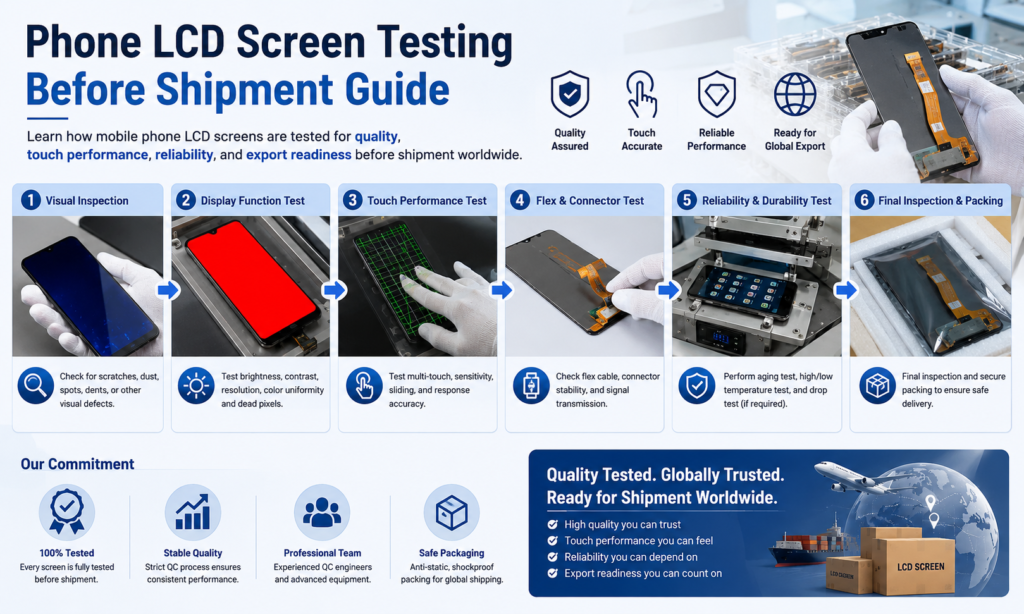
LCD Screen Factory Testing Process
Appearance Inspection
Appearance inspection is typically the first major quality checkpoint after assembly. Trained inspectors and automated optical inspection systems examine each screen under controlled lighting conditions.
Inspectors look for scratches, dust contamination, bubbles, cracks, dents, fingerprints, and cosmetic imperfections. Even small defects can affect customer perception, especially in premium smartphone markets where visual quality expectations are extremely high.
Factories often define acceptable defect standards according to industry guidelines. Inspection criteria specify maximum allowable defect sizes, locations, and quantities. Products that fail cosmetic standards are rejected or reworked before proceeding to the next stage.
Advanced manufacturers increasingly rely on AI-powered optical systems capable of detecting microscopic defects with greater consistency than human inspectors alone. These systems improve accuracy while reducing inspection time.
Functional Testing
Once appearance requirements are met, the LCD screen undergoes comprehensive functional testing. This process verifies that all electronic and mechanical functions operate correctly.
Technicians connect screens to specialized testing equipment that simulates smartphone operation. The system checks power consumption, signal transmission, display activation, touch responsiveness, and communication between integrated circuits.
Touch sensitivity verification plays a particularly important role. Testing equipment evaluates multi-touch performance, gesture recognition, response speed, and touch accuracy across the entire display surface. Dead zones or inaccurate touch responses can significantly impact user experience and must be identified before shipment.
Functional testing ensures every screen operates according to design specifications and performs reliably when installed in a smartphone.
Display Performance Testing
Display quality represents one of the most visible aspects of LCD performance. Even if a screen functions correctly, poor image quality can result in customer dissatisfaction.
Factories measure brightness levels using specialized photometric equipment. These instruments verify that displays meet target luminance specifications and maintain uniform illumination across the screen surface.
Color accuracy testing evaluates how closely the display reproduces intended colors. Calibration systems compare measured output against predefined standards and identify deviations requiring correction. Uniformity testing examines consistency across the panel, ensuring users do not notice uneven brightness or color variations.
Contrast ratio, viewing angle performance, and response time are also evaluated. Together, these tests provide a comprehensive assessment of visual performance and help maintain consistent quality across production batches.
Manufacturers often compare test results against customer specifications and industry benchmarks to ensure displays meet market expectations.
Dead Pixel and Mura Inspection
Dead pixel inspection remains one of the most recognized LCD quality tests. A single dead pixel may appear insignificant, but multiple defects can significantly affect visual quality.
During testing, displays show solid color patterns including white, black, red, green, and blue. These patterns make defective pixels easier to identify. Automated camera systems scan the display and record defect locations with high precision.
Mura inspection focuses on detecting subtle irregularities in brightness or color uniformity. Unlike dead pixels, Mura defects can be difficult to identify because they often appear as cloudy areas or uneven shading. Controlled lighting environments help inspectors detect these issues accurately.
Because premium customers demand exceptional visual quality, strict acceptance standards are commonly applied. Displays exhibiting excessive dead pixels or visible Mura effects are rejected from shipment.
This stage helps ensure customers receive screens with clean, consistent image quality.
Aging and Burn-In Testing
Aging tests simulate extended product usage before shipment. Manufacturers understand that some defects only appear after a display operates continuously for an extended period.
During burn-in testing, LCD screens remain powered on for several hours or even days while displaying various test patterns. This process helps reveal unstable components, electrical failures, and intermittent defects that might otherwise escape detection.
Temperature monitoring systems track operating conditions throughout the test cycle. Engineers analyze performance data to identify abnormal behavior and remove defective units before shipment.
Aging tests improve long-term reliability and reduce field failure rates. Although they increase manufacturing time and cost, they provide valuable assurance that products will perform consistently after installation.
For high-volume export orders, burn-in testing often serves as a final reliability verification step before packaging.
Reliability Testing Before Shipment
Reliability testing evaluates how LCD screens perform under challenging environmental conditions. International shipments may encounter temperature fluctuations, humidity exposure, vibration, and physical stress during transportation.
Temperature and humidity testing expose screens to extreme environmental conditions inside specialized chambers. These tests verify that displays continue functioning correctly after exposure to hot, cold, dry, and humid environments.
Drop testing and vibration testing simulate transportation impacts. Engineers evaluate packaging effectiveness while ensuring screens remain protected throughout logistics operations. Products intended for global distribution must withstand long-distance shipping without sustaining damage.
Electrostatic discharge testing examines resistance to static electricity. Since static discharge can damage sensitive electronic components, manufacturers verify adequate protection measures before shipment.
Together, these reliability tests provide confidence that LCD screens can survive real-world handling and transportation conditions.
Export Testing Process for Overseas Shipments
International customers often require additional quality verification before accepting shipments. Export testing procedures focus on batch consistency, packaging integrity, and regulatory compliance.
Batch sampling inspection involves selecting representative units from production lots for detailed examination. Statistical sampling methods help verify overall quality levels while maintaining production efficiency.
Packaging verification ensures screens are protected during international transportation. Manufacturers evaluate anti-static packaging materials, cushioning systems, moisture barriers, and carton strength. Proper packaging minimizes shipping damage and reduces customer complaints.
Many overseas buyers require customized testing reports, inspection certificates, and quality documentation. Third-party inspection agencies may also conduct independent evaluations before shipment approval.
Compliance verification confirms products meet destination market requirements. Depending on the region, manufacturers may need to provide RoHS, REACH, CE, or other compliance documentation. Meeting these requirements helps avoid customs delays and ensures smooth market entry.
Final Quality Assurance Before Delivery
The final quality assurance stage serves as the last defense against defects reaching customers. At this point, manufacturers review inspection records, testing results, and production data to verify compliance with customer requirements.
Quality teams conduct final audits to confirm labeling accuracy, packaging integrity, documentation completeness, and shipment readiness. Any discrepancies identified during this review are corrected before goods leave the factory.
Many professional LCD manufacturers maintain traceability systems that allow each screen to be tracked back to specific production batches, materials, and test records. This capability supports continuous improvement efforts and facilitates rapid issue resolution if problems arise in the field.
Final quality assurance represents the culmination of the entire testing process. Every inspection, measurement, and verification step contributes to delivering reliable LCD screens to customers worldwide.
Conclusion
The journey of a mobile phone LCD screen from factory production to international shipment involves far more than simple assembly. Manufacturers implement comprehensive testing procedures covering raw material inspection, appearance verification, functional evaluation, display performance analysis, reliability assessment, and export compliance checks. Each stage plays a critical role in ensuring consistent product quality and customer satisfaction.
As the global smartphone repair and replacement market continues to expand, buyers increasingly expect LCD screens that deliver reliable performance immediately after installation. Comprehensive factory testing and export quality control help manufacturers meet these expectations while reducing returns, warranty claims, and reputation risks.
For wholesalers, distributors, repair shops, and smartphone brands, understanding these testing processes provides valuable insight into what separates a premium LCD supplier from an average one. Quality is not created at the final inspection stage—it is built into every step of the manufacturing and testing journey.
FAQs
1. Why is LCD screen testing important before shipment?
LCD testing ensures the screen functions correctly, displays accurate colors, responds to touch inputs, and meets quality standards before reaching customers.
2. What is a dead pixel test?
A dead pixel test identifies pixels that fail to display colors correctly or remain permanently on or off.
3. How long does LCD aging testing usually take?
Depending on customer requirements, aging tests can last from several hours to multiple days.
4. What is Mura inspection?
Mura inspection detects uneven brightness, color inconsistency, or cloudy visual defects on LCD panels.
5. Why is export packaging testing necessary?
Export packaging testing ensures LCD screens remain protected from vibration, moisture, impact, and static electricity during international transportation.