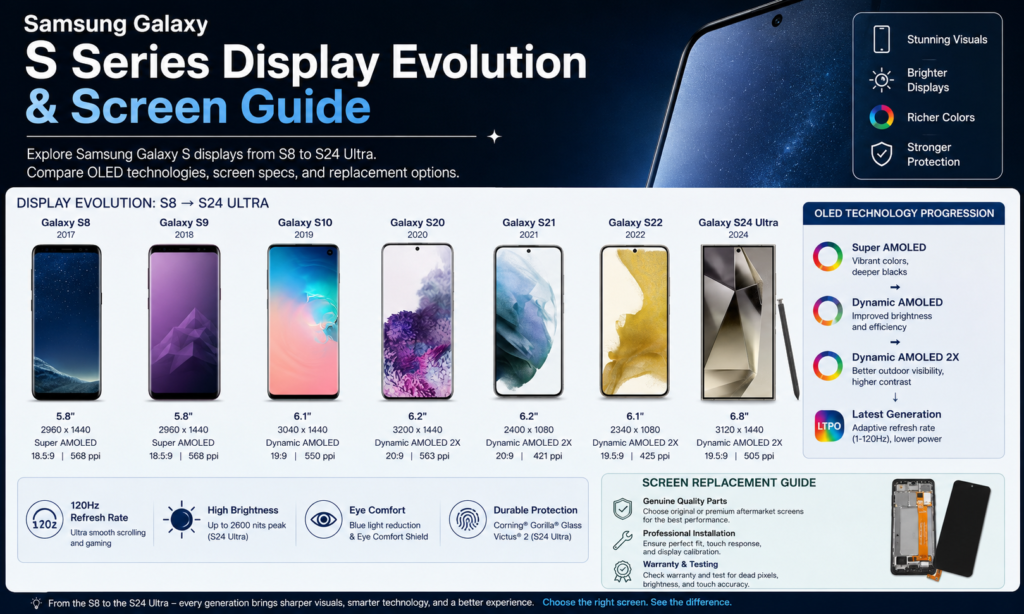
Samsung ha sido constantemente uno de los principales fabricantes de teléfonos inteligentes del mundo., y el Serie Galaxy S representa la línea insignia de teléfonos inteligentes de la compañía. Desde el lanzamiento del Galaxy S8 en 2017, Samsung ha transformado la tecnología de visualización de teléfonos inteligentes de la tradicional Súper AMOLED paneles en muy avanzado AMOLED dinámico 2X pantallas con frecuencias de actualización adaptativas, brillo excepcional, y precisión de color líder en la industria.
El Galaxy S8 marcó un importante punto de inflexión en el diseño de teléfonos inteligentes. Su Infinity Display introdujo biseles ultrafinos y una impresionante pantalla OLED curva que rápidamente se convirtió en el punto de referencia para los teléfonos inteligentes premium.. El Galaxy S8 presentaba una pantalla Super AMOLED de 5,8 pulgadas con una resolución de 2960 × 1440 píxeles y una densidad de píxeles de aproximadamente 570 IPP. En el momento, entregó una de las pantallas más nítidas y vibrantes disponibles en el mercado de teléfonos inteligentes.
Desde entonces, Samsung ha lanzado varias generaciones de dispositivos Galaxy S, cada uno mejorando la calidad de visualización, durabilidad, brillo, tasas de actualización, y eficiencia energética. Hoy, Las pantallas OLED originales de Samsung son muy buscadas en la industria de reparación y reacondicionamiento porque continúan ofreciendo una sensibilidad táctil superior., reproducción del color, y durabilidad en comparación con muchas alternativas del mercado de accesorios.
Lista completa de modelos de la serie Samsung Galaxy S después del Galaxy S8
Serie Galaxy S9 y S10
Tras el éxito del Galaxy S8, Samsung lanzó el Galaxy S9 y S9 Plus en 2018. Estos modelos conservaron el concepto Infinity Display al tiempo que mejoraron el brillo., rendimiento de la cámara, y capacidades de audio estéreo.
La familia Galaxy S10 presentó varios modelos nuevos:
- Galaxia S10e
- Galaxia S10
- Galaxia S10 Plus
- Galaxia S10 5G
La serie S10 presentó la primera generación de Samsung AMOLED dinámico pantallas e introdujo sensores ultrasónicos de huellas dactilares integrados debajo de la pantalla. Esto representó un importante avance en la tecnología de visualización y la experiencia del usuario..
Serie Galaxy S20 y S21
En 2020, Samsung cambió el nombre de la línea de S11 a S20, alinear los nombres de los productos con el año de lanzamiento.
La familia Galaxy S20 incluida:
| Modelo | Tipo de pantalla | Frecuencia de actualización |
|---|---|---|
| Galaxia S20 | AMOLED dinámico 2X | 120Hz |
| Galaxia S20+ | AMOLED dinámico 2X | 120Hz |
| Galaxy S20 Ultra | AMOLED dinámico 2X | 120Hz |
La introducción de 120Hz frecuencias de actualización suavidad de desplazamiento dramáticamente mejorada, rendimiento de juego, y capacidad de respuesta general.
La línea S21 continuó perfeccionando la tecnología Dynamic AMOLED 2X mientras mejoraba la eficiencia energética y los niveles de brillo..
Serie Galaxy S22 y S23
La serie S22 trajo tecnología LTPO mejorada, Permitir que las pantallas ajusten dinámicamente las frecuencias de actualización y ahorren energía de la batería..
La línea S23 presentada:
- Galaxia S23
- Galaxia S23+
- Galaxia S23 Ultra
Brillo de pantalla optimizado por Samsung, visibilidad exterior, y calibración de color. El S23 Ultra se volvió especialmente popular entre los usuarios profesionales debido a su combinación de funciones de productividad y calidad de visualización superior..
Serie Galaxy S24 y más allá
La familia Galaxy S24 representa actualmente una de las generaciones de teléfonos inteligentes más avanzadas de Samsung.
Características del Galaxy S24 Ultra:
| Especificación | Galaxia S24 Ultra |
|---|---|
| Tamaño de pantalla | 6.8-pulgada |
| Tipo de pantalla | AMOLED dinámico 2X |
| Resolución | 3120 × 1440 |
| Frecuencia de actualización | 1-120Hz adaptativo |
| Brillo máximo | Arriba a 2600 liendres |
| Soporte HDR | HDR10+ |
Las especificaciones oficiales de Samsung destacan el panel Dynamic AMOLED 2X del S24 Ultra, frecuencia de actualización adaptativa de 120 Hz, y resolución Quad HD+.
Desarrollo de tecnología de visualización de teléfonos inteligentes Samsung
Tecnología Súper AMOLED
Samsung Súper AMOLED Las pantallas se hicieron famosas por ofrecer negros profundos., colores vibrantes, y excelente eficiencia energética. A diferencia de las pantallas LCD tradicionales que requieren retroiluminación, La tecnología OLED permite que cada píxel emita su propia luz.
El Galaxy S8 utilizó un panel Super AMOLED midiendo 5.8 pulgadas con soporte HDR y una resolución de 2960 × 1440 píxeles. Esta tecnología proporcionó relaciones de contraste excepcionales y ayudó a establecer a Samsung como líder en innovación de pantallas móviles..
Una de las principales ventajas de la tecnología Super AMOLED es el menor consumo de energía al mostrar contenido oscuro.. Porque los píxeles negros permanecen completamente apagados, La eficiencia de la batería mejora significativamente..
Tecnología AMOLED dinámica
Samsung presentó AMOLED dinámico con la serie Galaxy S10. Esta tecnología mejoró la precisión del color., reducción de las emisiones nocivas de luz azul, y rendimiento HDR mejorado.
Pantallas AMOLED dinámicas entregadas:
- Mejor precisión del color
- Niveles de brillo más altos
- Mayor comodidad para los ojos
- Soporte de contenido HDR mejorado
Para usuarios que consumen vídeos, contenido de juegos, y redes sociales, Las pantallas AMOLED dinámicas brindaron una experiencia de visualización más realista.
Tecnología dinámica AMOLED 2X
Dynamic AMOLED 2X representa la última tecnología de pantalla insignia de Samsung.
Los dispositivos Galaxy S24 modernos utilizan paneles Dynamic AMOLED 2X con:
- Frecuencias de actualización adaptativas de 1 Hz a 120 Hz
- Brillo máximo alcanzando 2600 liendres
- Soporte HDR10+
- tecnología LTPO
- Visibilidad exterior mejorada
Las pantallas insignia de Samsung continúan estableciendo estándares de brillo y eficiencia en la industria. La pantalla Dynamic AMOLED 2X del Galaxy S24 Ultra logra un brillo significativamente mayor que el de generaciones anteriores al tiempo que mantiene una excelente administración de energía..
Comparación de especificaciones de pantalla de la serie Samsung Galaxy S
Evolución del tamaño de la pantalla
Los tamaños de pantalla han aumentado constantemente a lo largo de los años..
| Modelo | Tamaño de pantalla |
|---|---|
| Galaxia S8 | 5.8″ |
| Galaxia S10 | 6.1″ |
| Galaxy S20 Ultra | 6.9″ |
| Galaxia S23 Ultra | 6.8″ |
| Galaxia S24 Ultra | 6.8″ |
Los consumidores ahora esperan pantallas más grandes para la transmisión, juego de azar, y multitarea. Samsung ha conseguido aumentar el tamaño de la pantalla manteniendo una cómoda ergonomía a través de biseles más finos.
Resolución y densidad de píxeles
Samsung ha entregado consistentemente pantallas QHD+ en muchos dispositivos emblemáticos.
El Galaxy S8 presentó una notable 570 Densidad del IPP, mientras que los dispositivos Galaxy Ultra modernos mantienen una nitidez excepcional a aproximadamente 500 IPP. A pesar de una densidad de píxeles ligeramente inferior, Las pantallas más nuevas proporcionan mejor brillo., tasas de actualización, y calidad de imagen general.
Mejoras en la frecuencia de actualización
Uno de los mayores avances en pantalla ha sido la tecnología de frecuencia de actualización..
| Generación | Frecuencia de actualización |
|---|---|
| Galaxia S8 | 60Hz |
| Galaxia S20 | 120Hz |
| Galaxia S24 Ultra | 1-120Hz adaptativo |
La diferencia entre 60 Hz y 120 Hz se siente como pasar de una carretera normal a una autopista recién pavimentada.. Todo parece más fluido y con mayor capacidad de respuesta..
La tecnología LTPO de Samsung permite que las frecuencias de actualización se ajusten dinámicamente según el contenido, mejorar la duración de la batería sin sacrificar la experiencia del usuario.
Brillo y rendimiento HDR
El brillo ha mejorado drásticamente desde el Galaxy S8.
| Modelo | Brillo máximo |
|---|---|
| Galaxia S8 | Alrededor 540 liendres |
| Galaxia S24 Ultra | Arriba a 2600 liendres |
Este aumento hace que los teléfonos Galaxy modernos sean mucho más fáciles de usar bajo la luz solar directa.. El contenido HDR también se beneficia de un mayor contraste y un mayor rango dinámico.
Tipos de pantallas originales de Samsung explicadas
Pantallas originales del paquete de servicio
Pantallas del Service Pack original Son pantallas Samsung fabricadas en fábrica y distribuidas a través de canales de reparación autorizados..
Las características incluyen:
- Panel OLED original
- Capa táctil original
- Montaje de marco original
- Calibración de color de fábrica
Estas pantallas brindan el rendimiento más cercano al de un dispositivo nuevo y generalmente se consideran la opción de reemplazo de mayor calidad..
Pantallas originales retiradas
Las pantallas originales extraídas provienen de dispositivos usados.
Los técnicos retiran cuidadosamente las pantallas que funcionan de los teléfonos donantes y las reutilizan en las reparaciones.
Las ventajas incluyen:
- Panel OLED original de Samsung
- Sensibilidad táctil original
- Precio más bajo que las pantallas Service Pack
La calidad depende del estado del dispositivo donante..
Pantallas OLED reacondicionadas
Las pantallas reacondicionadas utilizan paneles OLED originales de Samsung con cristal de repuesto.
Durante la remodelación:
- Se retiran los cristales rotos.
- El OLED original permanece intacto.
- El vidrio nuevo está laminado..
- La unión al vacío restaura la apariencia.
Estas pantallas suelen ofrecer un valor excelente cuando las restauran fábricas experimentadas..
Pantallas OLED del mercado de accesorios
Las pantallas OLED del mercado de accesorios son fabricadas por proveedores externos.
Los beneficios incluyen:
- Menor costo
- Mayor disponibilidad
Los posibles inconvenientes incluyen:
- Brillo más bajo
- Calibración de color diferente
- Durabilidad reducida
- Rendimiento táctil variable
Los talleres de reparación ofrecen con frecuencia OLED del mercado de accesorios como alternativas económicas.
Pantallas de repuesto LCD Incell
Para algunos modelos de Samsung, oferta de proveedores Pantallas LCD Incell.
Aunque significativamente más barato, Los reemplazos de LCD tienen varias desventajas:
- Relación de contraste más baja
- Brillo reducido
- Mayor consumo de energía
- Estructura de visualización más gruesa
- Niveles de negro inferiores
Muchas empresas de reparación profesionales recomiendan reemplazos OLED siempre que sea posible para preservar la experiencia del usuario original..
Guía de identificación de pantalla original de Samsung
Métodos de inspección física
Identificar una pantalla Samsung original requiere una inspección cuidadosa.
Los indicadores clave incluyen:
- Niveles de negro OLED consistentes
- Brillo uniforme
- Reproducción precisa del color
- Rendimiento táctil responsivo
- Compatibilidad adecuada con el sensor de huellas dactilares
Las pantallas OLED originales de Samsung suelen exhibir una uniformidad de bordes superior y animaciones más suaves..
Los técnicos de reparación suelen utilizar software de prueba especializado para verificar la autenticidad de la pantalla e identificar el historial de reemplazo..
Mostrar indicadores de calidad
Varios factores de rendimiento ayudan a determinar la calidad de la pantalla.:
| Indicador | OLED originales | OLED del mercado de accesorios | Lcd |
|---|---|---|---|
| Niveles de negro | Perfecto | Muy bien | Limitado |
| Brillo | Excelente | Moderado | Más bajo |
| Respuesta táctil | Excelente | Bien | Moderado |
| Eficiencia energética | Excelente | Bien | Más bajo |
| Soporte de huellas dactilares | Lleno | Parcial | A menudo limitado |
Al comparar pantallas una al lado de la otra, Las pantallas OLED originales de Samsung suelen producir colores más ricos, negros más profundos, y una representación de imágenes más natural.
Tendencias del mercado de reemplazo de pantallas en 2026
La industria de reparación de teléfonos inteligentes continúa expandiéndose a medida que los consumidores conservan sus dispositivos por más tiempo.
Muchos Galaxy S8, T9, T10, S20, S21, S22, y los dispositivos S23 siguen activos en los mercados globales, creando una fuerte demanda de pantallas de repuesto. Las pantallas OLED reacondicionadas se han vuelto especialmente populares porque equilibran asequibilidad y rendimiento..
Los profesionales de la industria prefieren cada vez más la renovación del OLED original a la sustitución completa del panel. Este enfoque reduce los desechos electrónicos y al mismo tiempo preserva la calidad superior de la pantalla de Samsung..
La demanda del mercado es particularmente fuerte entre:
- talleres de reparación de móviles
- Fábricas de rehabilitación
- Distribuidores mayoristas
- Proveedores de reparación de seguros
- Recicladores de electrónica
Mientras los precios de los teléfonos inteligentes emblemáticos siguen aumentando, La restauración profesional de pantallas se ha convertido en un segmento importante del ecosistema de dispositivos móviles..
Elegir el reemplazo de pantalla Samsung adecuado
Seleccionar la pantalla de reemplazo adecuada depende de su presupuesto y expectativas de calidad..
Si el máximo rendimiento es tu objetivo, un Pantalla del paquete de servicio original de Samsung sigue siendo la mejor opción. Estas pantallas ofrecen brillo a nivel de fábrica, precisión del color, sensibilidad al tacto, y durabilidad.
Para talleres de reparación que buscan un equilibrio entre coste y calidad., pantallas OLED originales reacondicionadas a menudo proporcionan el valor más alto. Conservan el panel OLED original de Samsung y reducen significativamente los costos de reemplazo..
Los consumidores con presupuestos limitados pueden considerar pantallas OLED no originales. Si bien generalmente funcionan bien para el uso diario, Es posible que no coincidan completamente con el brillo., consistencia del color, o longevidad de los paneles originales Samsung.
Los reemplazos de LCD generalmente deben reservarse para reparaciones económicas porque alteran fundamentalmente la experiencia OLED premium por la que son conocidos los teléfonos inteligentes Galaxy S..
Conclusión
La serie Samsung Galaxy S ha experimentado una notable evolución desde el lanzamiento del Galaxy S8. Desde la pantalla Infinity Super AMOLED original hasta la tecnología Dynamic AMOLED 2X actual, Samsung ha superado constantemente los límites de la innovación en pantallas de teléfonos inteligentes.
El Galaxy S8 presentó un diseño revolucionario con un panel Super AMOLED de 5,8 pulgadas, mientras que los dispositivos modernos como el Galaxy S24 Ultra cuentan con pantallas dinámicas AMOLED 2X adaptativas de 120 Hz capaces de alcanzar 2600 liendres de brillo. Estos avances han transformado la forma en que los usuarios interactúan con los teléfonos inteligentes para trabajar., entretenimiento, fotografía, y juegos.
Para empresas de reparación, mayoristas, y restauradores, comprender las diferencias entre las pantallas originales del Service Pack, OLED extraídos, OLED reacondicionados, OLED del mercado de accesorios, y los reemplazos de LCD son esenciales. Elegir la pantalla adecuada no sólo afecta la calidad de la reparación, sino que también impacta directamente en la satisfacción del cliente y la longevidad del dispositivo..
Preguntas frecuentes
1. ¿Qué tipo de pantalla usa el Samsung Galaxy S8??
El Samsung Galaxy S8 utiliza una pantalla de 5,8 pulgadas Súper AMOLED pantalla con una resolución de 2960 × 1440 píxeles y compatibilidad con HDR.
2. ¿Cuál es la diferencia entre Super AMOLED y Dynamic AMOLED??
Dynamic AMOLED mejora la precisión del color, Rendimiento HDR, reducción de luz azul, y eficiencia general de la pantalla en comparación con la tecnología Super AMOLED anterior.
3. ¿Es original una pantalla OLED reacondicionada??
Sí. Una pantalla OLED reacondicionada generalmente conserva el panel OLED original de Samsung mientras reemplaza el vidrio dañado y restaura la funcionalidad..
4. ¿Qué modelo de Samsung Galaxy tiene la pantalla más brillante??
El Galaxy S24 Ultra puede alcanzar niveles máximos de brillo de hasta 2600 liendres, convirtiéndola en una de las pantallas de teléfonos inteligentes más brillantes de Samsung.
5. ¿Vale la pena comprar pantallas OLED del mercado de accesorios??
Las pantallas OLED del mercado de accesorios pueden ser una solución rentable, pero es posible que no coincidan completamente con el brillo, precisión del color, capacidad de respuesta táctil, y durabilidad de las pantallas originales de Samsung.