Introduction
Dans 2018, Samsung a continué de dominer le marché mondial des smartphones avec une vaste gamme répondant à tous les segments, des produits phares de luxe aux produits essentiels d'entrée de gamme.. Une caractéristique déterminante de Samsung 2018 le portefeuille était son utilisation intensive de la technologie d’affichage AMOLED, une marque d’innovation de la marque.
Alors que Super AMOLED dominé les appareils phares de Samsung et la plupart des appareils de milieu de gamme, Panneaux LCD (principalement PLS TFT) étaient réservés à quelques modèles économiques. Explorons en détail quels modèles présentaient quels types d'affichage et pourquoi.
Samsung 2018 Stratégie d'affichage
Samsung avait une vision claire en 2018: offrir des expériences visuelles haut de gamme sur l'ensemble de sa gamme tout en gérant les coûts des modèles d'entrée de gamme. Écrans AMOLED, connu pour leur couleurs vives, Noirs profonds, et efficacité énergétique, est devenu un différenciateur clé.
Entre-temps, Écrans LCD persisté dans les modèles budgétaires, offrir un prix abordable au détriment du contraste et de la luminosité. La tendance a signalé le progressif de Samsung démocratisation de la technologie AMOLED, retombant de ses appareils haut de gamme vers les options de milieu de gamme.
Ligne phare: Galaxy S et Galaxy Note
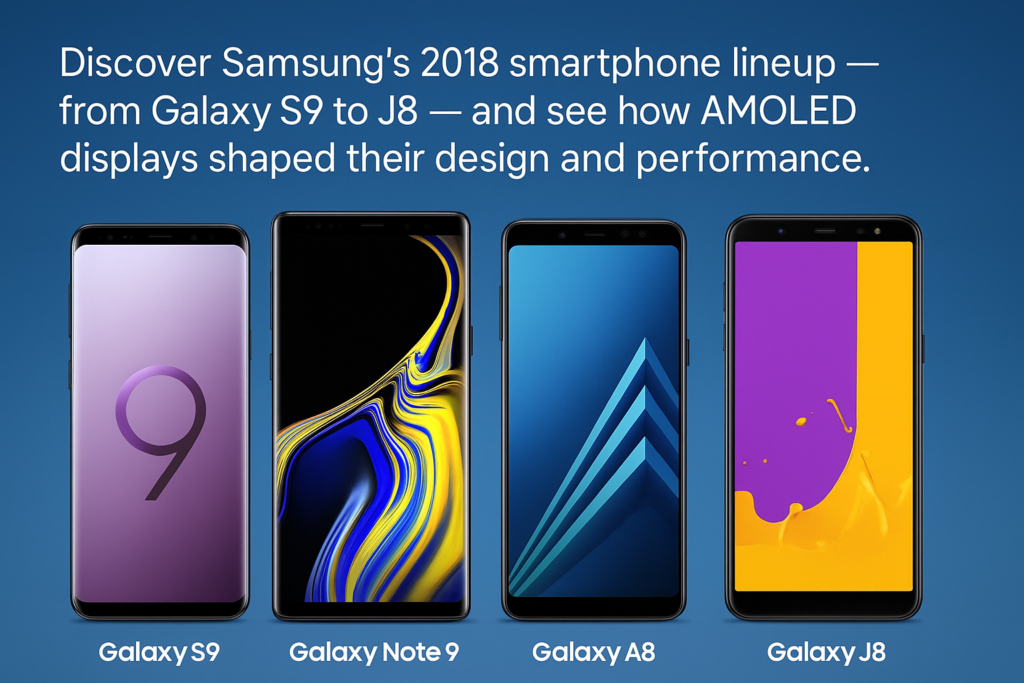
Au sommet de l’écosystème de Samsung se trouvait le Galaxie S9/S9+ et Galaxy Note9, tous deux alimentés par Écrans Super AMOLED. Ces modèles représentaient la maîtrise technologique de Samsung en offrant des visuels immersifs, bords incurvés, et un contrôle exceptionnel de la luminosité.
Galaxy S9 et S9+: La norme phare
- Date de lancement: Février 2018
- Type d'affichage: Super AMOLED
- Points forts: Caméra à double ouverture, Écran Infinity bord à bord
La série Galaxy S9 perpétue la tradition d’excellence de Samsung, offrir une expérience visuelle cinématographique. Le Super AMOLED le panneau produit des rapports de contraste inégalés, ce qui le rend idéal pour le contenu HDR. Sa luminosité adaptative et ses fonctions d'affichage permanent étaient des caractéristiques remarquables.
Galaxy Note9: La puissance rencontre la précision
- Date de lancement: Août 2018
- Type d'affichage: Super AMOLED
- Points forts: S-Pen avec Bluetooth, écran massif de 6,4 pouces
Le Remarque9 représentait le summum de la productivité et du design de Samsung. Le Super AMOLED l'écran offre des détails nets et une précision des couleurs, garantissant que chaque coup avec le S-Pen soit réactif et réaliste.
Médium et haut médium: Série Galaxy A
Le Série Galaxy A était le pont de Samsung entre les fonctionnalités phares et l’abordabilité. Dans 2018, cela a montré la détermination de Samsung à étendre l'adoption de l'AMOLED sur le segment intermédiaire.
Galaxy A8 et A8+ (2018): Options de milieu de gamme haut de gamme
- Période de lancement: En retard 2017 (largement commercialisé dans 2018)
- Type d'affichage: Super AMOLED
- Points forts: Affichage infini, double caméra frontale
La gamme A8 a brouillé la frontière entre milieu de gamme et premium. Avec son Écran AMOLED, les utilisateurs ont apprécié des visuels quasi-phares, contraste riche, et un langage de conception futuriste.
Galaxie A9 (2018): Le premier téléphone à quatre caméras au monde
- Date de lancement: Octobre 2018
- Type d'affichage: Super AMOLED
- Points forts: Quatre caméras arrière, 6.3-affichage en pouces
Un véritable jalon de l’innovation, l'A9 (2018) combine une technologie de caméra avancée avec un Écran Super AMOLED qui a fait ressortir chaque photo avec de la couleur. Ce modèle a renforcé l’engagement de Samsung à utiliser AMOLED au-delà de ses produits phares.
Galaxy A6 et A6+: La fracture d’affichage
- Date de lancement: Peut 2018
- Types d'affichage:
- Galaxie A6: Super AMOLED
- Galaxie A6+: Écran LCD TFT
Cette gamme présentait l’un des rares contrastes internes de Samsung: le plus petit A6 reçu un écran AMOLED, tandis que le A6+ utilisé un panneau LCD. Cette décision découle probablement de stratégies de coûts et de tarification régionales, montrant comment Samsung a soigneusement équilibré l'innovation avec l'économie de marché.
Budget et niveau d'entrée: La série Galaxy J
Le série J était la réponse de Samsung aux acheteurs soucieux de leur budget, en particulier sur les marchés en développement comme l'Inde et l'Asie du Sud-Est. Ici, Samsung a expérimenté à la fois l'AMOLED et l'écran LCD pour trouver l'équilibre parfait entre prix abordable et attrait.
Galaxies J8 et J6: AMOLED entre dans les téléphones économiques
- Galaxie J8 (2018): Super AMOLED
- Galaxie J6 (2018): Super AMOLED
Les deux modèles ont marqué un tournant :amener AMOLED aux téléphones économiques. Leurs écrans offraient des noirs plus profonds et une meilleure efficacité de la batterie, donnant à Samsung un avantage sur ses concurrents équipés d'écrans LCD comme Xiaomi et Oppo.
Galaxy J4 et J2 Pro: L'écran LCD est toujours vivant
- Galaxie J4 (2018): SVP LCD
- Galaxy J2 Pro (2018): Super AMOLED
Alors que le J4 maintenu une conception LCD rentable, le J2Pro, bien qu'il s'agisse d'un modèle de niche, étonnamment présenté un Écran Super AMOLED— prouvant l'engagement de Samsung envers la qualité d'écran, même sur les appareils spécialisés.
AMOLED contre LCD: Performance et impact sur le marché
Donc, ce qui a fait d'AMOLED le grand gagnant?
- Contraste et couleur: Les écrans AMOLED affichent des noirs purs en désactivant les pixels individuels.
- Efficacité énergétique: AMOLED consomme moins d'énergie lors de l'affichage d'un contenu plus sombre.
- Flexibilité de conception: Écrans plus fins et incurvés activés.
Par comparaison, Panneaux LCD est resté moins cher mais ne pouvait pas égaler la profondeur et le dynamisme des couleurs de l'AMOLED. Dans 2018, cette fracture technologique a façonné l’avantage concurrentiel de Samsung à l’échelle mondiale.
La tendance plus large: Technologie haut de gamme en aval
Samsung 2018 la programmation a raconté une histoire claire: la technologie haut de gamme se répandait sur l'échelle. Des fonctionnalités autrefois exclusives aux séries Galaxy S et Note, comme Panneaux AMOLED-est devenu accessible dans les modèles de milieu de gamme et même d'entrée de gamme.
Ce réduction stratégique a non seulement solidifié la perception de la marque Samsung, mais a également perturbé le marché des smartphones de milieu de gamme en redéfinissant ce à quoi les utilisateurs pouvaient s'attendre à chaque niveau de prix..
Conclusion
En résumé, 2018 C'est l'année où AMOLED est devenu l'identité de Samsung. Des Galaxy S9 et Note9 aux séries A et J plus abordables, AMOLED domine la gamme mondiale de smartphones de Samsung. Seulement quelques modèles, comme le Galaxie A6+ et Galaxie J4, écrans LCD conservés en raison de la segmentation du marché.
Cette transition a marqué un moment charnière dans l’évolution des écrans de Samsung :un passage de l’exclusivité à l’ubiquité, établir une nouvelle norme visuelle dans l'ensemble de l'industrie des smartphones.
FAQ
1. Lequel 2018 Les téléphones Samsung utilisaient des écrans LCD?
Les Galaxy A6+ et Galaxy J4 étaient les principaux 2018 modèles utilisant l'écran LCD (TFT/PLS) affiche.
2. Est-ce que tous les téléphones Samsung phares 2018 utiliser des écrans AMOLED?
Oui, tous les modèles phares (Galaxy S9/S9+ et Galaxy Note9) étaient équipés des écrans Super AMOLED avancés de Samsung.
3. Pourquoi Samsung a-t-il continué à utiliser l'écran LCD dans certains modèles?
Réduire les coûts de production et répondre aux marchés budgétaires, surtout dans les régions où la sensibilité aux prix est élevée.
4. Lequel 2018 Le modèle Samsung était doté de la première configuration à quatre caméras au monde?
Le Galaxie A9 (2018) a présenté le premier système de caméra arrière quadruple au monde.
5. Comment les écrans AMOLED ont-ils profité à l’image de marque de Samsung?
Ils ont renforcé la réputation de Samsung en matière d’innovation et de qualité d’affichage supérieure., devenir un différenciateur clé sur un marché encombré des smartphones.