
Introduction
In 2020, Samsung demonstrated its unmatched dominance in smartphone display innovation. From foldable flagships to mid-range heroes, every lineup showcased how far AMOLED technology had come. The year was pivotal — not only did Samsung refine its Dynamic AMOLED 2X panels for top-tier phones, but it also expanded Super AMOLED screens to more affordable devices, marking the near-complete phase-out of LCD screens in its global lineup.
Samsung’s Display Evolution
Before 2020, LCD screens were still common across various smartphone tiers. But by this year, Samsung made one thing clear — AMOLED was the future. With richer colors, better contrast, and superior energy efficiency, AMOLED panels became a cornerstone of Samsung’s visual experience.
Dynamic AMOLED 2X vs. Super AMOLED
- Dynamic AMOLED 2X: Found on flagship models, it supports HDR10+, 120Hz adaptive refresh rates, and superior brightness calibration.
- Super AMOLED: Used for mid- and upper-mid-range models, still delivers excellent contrast but lacks some advanced features like adaptive refresh rate and HDR10+ support.
In short, Dynamic AMOLED 2X was Samsung’s statement piece, while Super AMOLED was the workhorse technology driving its mass-market dominance.
Foldable Flagships – The Z Series
Galaxy Z Fold2 5G
Samsung’s second-generation foldable, the Z Fold2, showcased a massive 7.6-inch Dynamic AMOLED 2X main display with 120Hz adaptive refresh rate. The 6.23-inch cover screen also featured AMOLED technology, making it a full-fledged smartphone even when closed. Its Ultra-Thin Glass (UTG) improved durability and touch sensitivity, making it one of the most advanced foldable screens ever produced.
Galaxy Z Flip
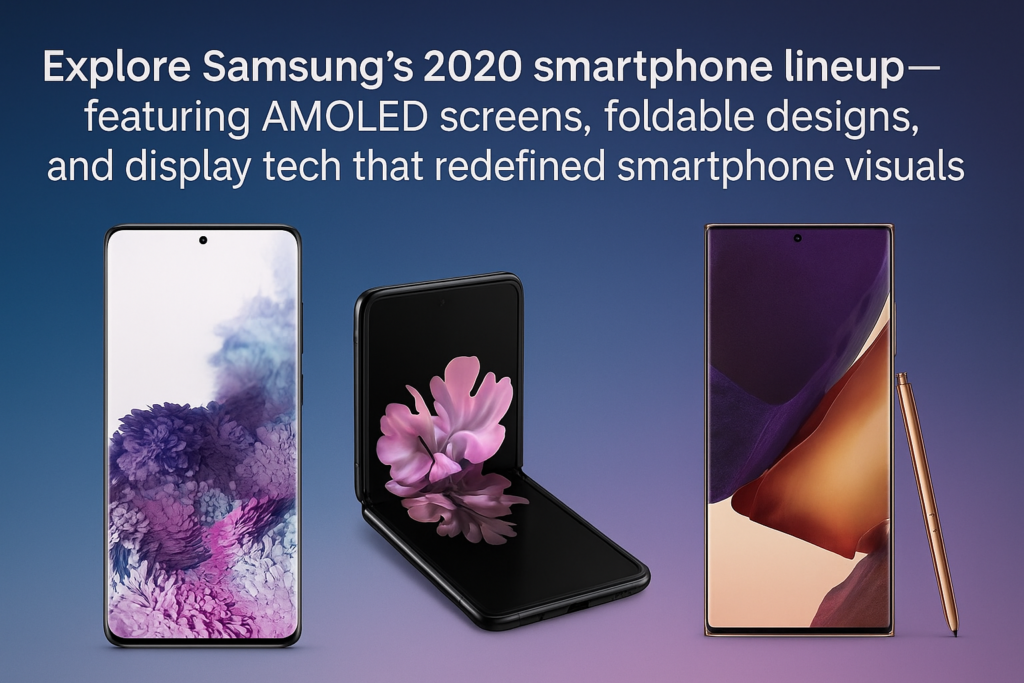
Unlike the Fold, the Z Flip adopted a nostalgic vertical clamshell design. Its 6.7-inch Dynamic AMOLED display folded seamlessly, offering a compact pocketable experience without compromising on color accuracy or brightness. The small 1.1-inch Super AMOLED cover display added functionality for quick notifications and selfies.
The Galaxy S Series – The Flagship Standard
Galaxy S20 Ultra 5G
At the top of the S lineup, the S20 Ultra featured a stunning 6.9-inch WQHD+ Dynamic AMOLED 2X display. It supported 120Hz refresh rate, ensuring ultra-smooth visuals for gaming and scrolling. However, early software versions limited 120Hz at full resolution — a trade-off Samsung later refined.
Galaxy S20+ and S20
Both models mirrored the Ultra’s brilliance, offering 6.7-inch and 6.2-inch Dynamic AMOLED 2X panels respectively. Each provided vibrant colors, deep blacks, and HDR10+ certification, continuing Samsung’s tradition of display excellence.
Galaxy S20 FE 5G
The Fan Edition brought flagship performance to a wider audience. Although it used a Super AMOLED screen instead of Dynamic AMOLED, it retained a 120Hz refresh rate, offering a near-premium experience at a mid-tier price point.
The Business-Class Powerhouses – Galaxy Note Series
Galaxy Note20 Ultra 5G
The Note20 Ultra was Samsung’s first device with a variable refresh rate ranging from 10Hz to 120Hz, intelligently adjusting to save power. Its 6.9-inch Dynamic AMOLED 2X display was a masterpiece — sharp, vibrant, and silky-smooth for S Pen use.
Galaxy Note20
In contrast, the standard Note20 featured a 6.7-inch Super AMOLED Plus display with a 60Hz refresh rate. It skipped some high-end perks but remained ideal for professionals who valued practicality over flash.
Mid-Range Champions – The Galaxy A Series
Samsung’s A-series became the brand’s volume leader in 2020. Equipped mostly with Super AMOLED screens, these phones struck a balance between affordability and visual excellence.
- Galaxy A71 5G – 6.7-inch Super AMOLED Plus, Infinity-O design, bright and vibrant.
- Galaxy A51 5G – 6.5-inch Super AMOLED, one of the best-selling Android phones globally.
- Galaxy A41 & A31 – Super AMOLED displays with Full HD+ resolution.
- Galaxy A21s & A11 – Budget-friendly models using PLS TFT LCD, a rare non-AMOLED choice in Samsung’s 2020 lineup.
Affordable Performance – The Galaxy M Series
Samsung’s M-series, focused on online markets and budget-conscious buyers, delivered solid AMOLED experiences.
- Galaxy M51 – Featured a 6.7-inch Super AMOLED Plus screen and a massive 7000mAh battery.
- Galaxy M31s & M21 – Both sported Super AMOLED displays, offering vivid visuals at competitive prices.
These models proved that great screens weren’t just for premium buyers.
Key Display Trends of 2020
- High Refresh Rates Go Mainstream – Samsung made 120Hz displays the new standard for flagships.
- AMOLED Dominance – Nearly all models featured AMOLED technology, reducing reliance on LCDs.
- Foldable Innovation – The Z Fold2 and Z Flip marked a major step toward flexible future designs.
- Adaptive Brightness & Efficiency – Displays became smarter, adjusting refresh rates and brightness to save power.
How Samsung Set the Standard for Smartphone Displays
In 2020, competitors like Apple and Huawei lagged behind Samsung’s OLED expertise. While others adopted OLED panels later, Samsung Display remained the primary supplier for many brands, including its rivals. This dominance wasn’t luck — it was years of refinement in contrast control, touch integration, and energy management.
The Future of Samsung Displays
Samsung’s vision for display technology goes beyond 2020. The company continues developing:
- Under-display cameras
- Rollable and tri-fold displays
- Eco-friendly OLED materials
Each innovation pushes smartphones toward an era where displays are not just tools, but experiences.
Conclusion
Samsung’s 2020 lineup was more than a product release — it was a showcase of innovation. From the foldable Z Fold2 to the value-driven A and M series, Samsung managed to make AMOLED the gold standard. Whether you wanted cutting-edge performance or everyday reliability, Samsung had a screen for you — and it was likely an AMOLED.
FAQs
1. What’s the difference between Dynamic AMOLED 2X and Super AMOLED?
Dynamic AMOLED 2X offers higher brightness, HDR10+, and adaptive refresh rates up to 120Hz. Super AMOLED delivers excellent visuals but lacks these advanced features.
2. Which 2020 Samsung phone had the best display?
The Galaxy Note20 Ultra 5G and Galaxy S20 Ultra topped the list with WQHD+ resolution and adaptive refresh technology.
3. Why did Samsung move away from LCD screens?
AMOLED panels are thinner, more energy-efficient, and provide superior contrast, making LCD less competitive.
4. Is there a big difference between A-series and M-series displays?
Both use Super AMOLED, but A-series models often feature slightly better calibration and build quality.
5. What display innovations did Samsung introduce in 2020?
Key innovations included foldable Ultra-Thin Glass, adaptive refresh rates, and full-screen AMOLED coverage across most models.



