Cén Fáth a bhfuil Sonraíochtaí Scáileáin Smartphone Níos Tábhachta ná Riamh i 2026 Sonraíochtaí Scáileáin Níos Tábhachtach ná Riamh i 2026
Má cheapann tú faoi, an scáileán Is é an anam an smartphone. Is é an t-aon chuid a dhéanann tú teagmháil leis na céadta uair gach lá. Léann tú teachtaireachtaí air, féachaint ar fhíseáin air, scrollaigh na meáin shóisialta air, cuir grianghraif in eagar air, agus b'fhéidir fiú oibriú uaidh. Is cuma cé chomh cumhachtach is atá an próiseálaí nó cé mhéad megapixel a thairgeann an ceamara, má bhraitheann an scáileán dull, doiléir, nó míchompordach chun breathnú ar, mothaíonn an taithí fón iomlán níos laige. Sin an fáth go bhfuil níos mó tábhachta ag baint le tuiscint a fháil ar shonraíochtaí taispeána fón cliste ná mar a thuigeann go leor daoine.
I 2026, coinníonn an teicneolaíocht taispeána ag gluaiseacht go tapa. Sroicheann fóin préimhe go rialta anois 3,000+ nits gile, in ainneoin go 120Rátaí athnuachana oiriúnaitheacha Hz tar éis éirí coitianta ar fud feistí lár-réimse uachtair. Ard-minicíocht PWM dimming thuas 2,160Hz ag éirí níos coitianta freisin, go háirithe i gcompord príomhthionscadal OLEDe. citeturn0search0turn0search2
An chuid tricky? Caitheann an chuid is mó de na bileoga sonraí uimhreacha chugat gan a mhíniú cad is brí leo. PPI, cóimheas codarsnachta, ráta athnuachana, gamut datha - is maith leis teanga eile a léamh. Briseann an treoir seo gach rud síos i mBéarla simplí, mar sin cibé an bhfuil fón nua á cheannach agat, comparáid idir LCD agus OLED, nó díreach fiosrach faoin teicneolaíocht taispeána, beidh a fhios agat go díreach cad ba cheart duit a lorg.
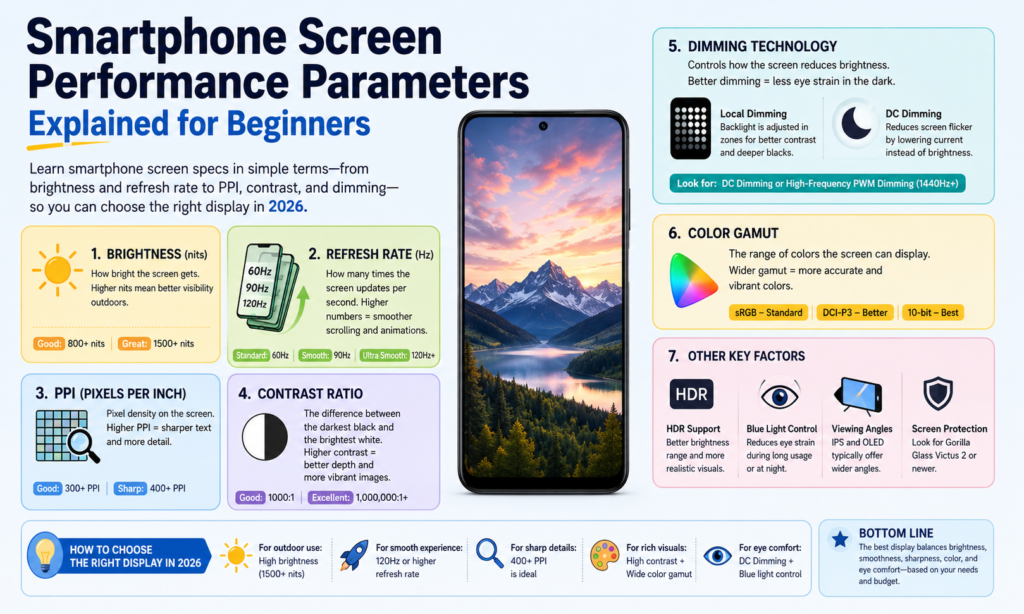
Teicneolaíocht dimming
Cad é DC Dimming?
DC dimming coigeartaíonn sé gile tríd an sruth leictreach a sholáthraítear don taispeáint a athrú go díreach. Smaoinigh air mar a bheadh cnag faucet síos go mall - coinníonn an t-uisce ag sileadh, ach le fórsa níos lú. Fanann an solas leanúnach, ach titeann gile.
Le haghaidh Scáileáin LCD, tagann gile go príomha as an backlight, mar sin laghdaítear an voltas nó an sruth gile. Le haghaidh Scáileáin OLED, astaíonn gach picteilín a solas féin, mar sin athraíonn gile tríd an sruth a sheoltar chuig na picteilíní aonair sin a laghdú.
Is fearr le go leor úsáideoirí DC dimming mar go mothaíonn sé cobhsaí amhairc. Ós rud é nach bhfuil an solas ag caochadh go tapa ar aghaidh agus as, is féidir é a bheith níos éasca ar shúile íogair. Tá sé sin thar a bheith tábhachtach do dhaoine a chaitheann uaireanta ag féachaint ar a bhfóin i dtimpeallachtaí dorcha.
Is é an comhbhabhtáil ná go bhféadfadh tionchar a bheith ag maolú DC uaireanta ar chomhsheasmhacht dath ag gile an-íseal ar phainéil OLED. Féadfaidh Blacks fanacht den scoth, ach is féidir le calabrú dath a athrú beagán ag brath ar dhearadh an phainéil. Is minic a dhéanann monaróirí iarracht compord súl agus cruinneas dath a chothromú anseo.
Cad é PWM Dimming?
PWM sheasann do Modhnú Leithead Pulse. In ionad an chumhacht a ísliú go leanúnach, athraíonn an taispeáint go tapa idir ar → as → ar → as ag luas ard.
Samhlaigh lasc solais a smeach na céadta nó na mílte uair in aghaidh an tsoicind. De ghnáth ní féidir le do shúile an caochaíl a bhrath go díreach, mar sin dealraíonn sé dimmer seachas blinking.
Cinneann an méid ama a fhanann an solas “ar” le linn gach timthrialla gile:
- Am “ar siúl” níos faide = scáileán níos gile
- Am “ar” níos giorra = scáileán dimmer
Tá PWM thar a bheith coitianta ar fhóin chliste OLED.
I 2026, Is mó a fhógraíonn fóin shuaitheanta Android 2,160Hz go 3,840Hz PWM dimming, atá i bhfad níos airde ná feidhmiúcháin 240Hz–480Hz níos sine. Úsáideoirí tendany PWM minicíocht níos airde. citeturn0search8turn0search6
Cé acu ceann is fearr do chompord súl?
Níl aon fhreagra uilíoch ann toisc go bhfuil súile an duine thar a bheith casta.
Ní thugann roinnt úsáideoirí faoi deara flicker PWM ar chor ar bith. Mothaíonn daoine eile tinneas cinn tar éis 10 nóiméad.
Go ginearálta:
| Teicneolaíocht | Príomhbhuntáiste | Príomh-Ais-tarrac |
|---|---|---|
| DC dimming | Flicker níos lú infheicthe, go minic níos éasca ar shúile | Is féidir leis tionchar beagán a imirt ar fheidhmíocht dath OLED |
| PWM dimming | Rialú gile níos fearr agus comhsheasmhacht dath | D’fhéadfadh sé brú súl a chur ar úsáideoirí íogaire |
Má tá tú íogair maidir le caochaíl scáileáin, DC dimming nó PWM ard-minicíochta is fiú tús áite a thabhairt.
Feidhmíocht Dath
Sáithiú
Sáithiú cur síos ar cé chomh saibhir nó íon atá dath le feiceáil.
Mothaíonn dathanna an-sáithithe beoga agus punchy. Breathnaíonn sáithiúchán íseal balbhaithe nó nite amach.
Smaoinigh ar sútha talún dearg aibí i gcomparáid le léine bándearg faded fágtha sa ghrian ró-fhada. Teaghlaigh den dath céanna - déine an-difriúil.
Is minic a bhraitheann painéil OLED níos sáithithe toisc go n-astaíonn gach picteilín a solas féin go neamhspleách.
Is breá le roinnt daoine an éifeacht “wow”.. Is fearr le daoine eile dathanna níos nádúrtha chun grianghraif a chur in eagar.
Dath Gamut
Cearrbhachas dath tagraíonn sé don raon iomlán dathanna is féidir le scáileán a thaispeáint.
Ciallaíonn gamut níos leithne gur féidir leis an taispeáint níos mó dathanna a atáirgeadh.
Áirítear le caighdeáin choitianta:
- sRGB
- DCI-P3
- Adobe RGB
- BT.2020
I smartphones, DCI-P3 anois an-choitianta i taispeántais préimhe.
Na coincheapa taispeána is déanaí ó Samsung léirithe ag Seachtain Taispeána SID 2026 léirithe suas go dtí 96% Clúdach BT.2020, agus taispeántais. citeturn0nuacht16cas0nuacht17
Cruinneas Datha
Cruinneas dath tomhaiseann sé cé chomh gar agus atá an dath ar taispeáint don bhundath atá beartaithe.
Baineann sé seo go mór le:
- grianghrafadóirí
- eagarthóirí físeán
- dearthóirí
- díoltóirí ar líne a thaispeánann dathanna an táirge
Má tá an chuma ar íomhá bán buí nó grianghraf táirge dearg cuma oráiste, tá cruinneas dath bocht.
Tá tomhas coitianta anseo Delta E.
Íochtarach Delta E = atáirgeadh dath níos cruinne.
Scála Liath
Tagraíonn scála liath do na leibhéil gile idir dubh agus bán.
Ciallaíonn dea-fheidhmíocht scála liath aistrithe réidh.
Cruthaíonn drochscála liath bandáil infheicthe nó scáthú míchothrom.
Éiríonn sé seo an-suntasach nuair a bhíonn tú ag féachaint ar scannáin dorcha nó ag féachaint ar ghrianghraif íseal-éadrom.
Gile agus Codarsnacht
Gile Mínithe
Déantar gile a thomhas i nits.
Nits níos airde = taispeáint níos gile.
Cén fáth a bhfuil sé tábhachtach?
Toisc go bhfuil solas na gréine ann.
D'fhéadfadh cuma foirfe a bheith ar fhón taobh istigh ach nach mbeidh sé inléite amuigh faoin aer.
Fón cliste suaitheanta i 2026 teacht go coitianta 3,000–3,500 nits buaicghile. Mar shampla, an OnePlus 15 tuairiscítear timpeall 3,500 nits, agus Pixe thart 3,300 nits. citecasadh0cuardaigh2
Míniú ar Chóimheas Codarsnachta
Is é cóimheas codarsnachta an difríocht idir:
bán is gile ÷ dubh is dorcha
Cruthaíonn codarsnacht níos airde:
- blacks níos doimhne
- buaicphointí níos láidre
- HDR níos fearr
- doimhneacht íomhá níos saibhre
Tá OLED i gceannas anseo mar is féidir le picteilíní a mhúchadh go hiomlán.
Cruthaíonn sé sin fíor dubh.
Ní féidir le LCD an backlight a mhúchadh go hiomlán ar an mbealach céanna.
Sin an fáth go mothaíonn blacks OLED go minic ag féachaint isteach i spéir dorcha na hoíche.
Soiléireacht agus Géar
Réiteach (DPI)
Tagraíonn Taifeach do cé mhéad picteilín atá ann go cothrománach agus go hingearach.
Samplaí:
- 1080 × 2400
- 1440 × 3200
Níos mó picteilín = níos mó sonraí.
Cé thar pointe áirithe, bíonn sé níos deacra an difríocht a thabhairt faoi deara ag an ngnáthfhad féachana.
Dlús picteilíní (PPI)
PPI ciallaíonn picteilín in aghaidh an orlach.
Insíonn sé duit cé chomh daingean is atá na picteilíní.
PPI níos airde = téacs níos géire agus imill níos glaine.
Samplaí:
| Cineál Taispeána | PPI tipiciúil |
|---|---|
| Buiséad LCD | 300–400 |
| OLED lár-raon | 400–460 |
| OLED suaitheanta | 450–550+ |
Thuas go garbh 450 PPI, De ghnáth bíonn cuma ghéar ar an téacs.
Picteilíní
Is é páirc picteilíní an fad idir na picteilíní comharsanacha.
Páirc picteilín níos lú = géire níos airde.
Mar gheall ar bhearnaí níos lú idir picteilíní mothaíonn íomhánna níos gan uaim agus níos snasta.
Tairiscint agus Sofhreagracht
Am Freagartha
Tomhaiseann am freagartha cé chomh tapa agus a athraíonn picteilín ó staid amháin go stát eile.
Is minic a thuairiscítear mar:
Dubh → Bán → Dubh
Cuidíonn am freagartha níos ísle le laghdú:
- taibhse
- doiléir
- ag smearadh
Go háirithe faoi deara le linn cluichíochta nó athsheinm físe tapa.
Ráta Athnuachan
Ráta athnuachana = cé mhéad uair a athnuachan an taispeáint gach soicind.
Tomhaistear i Hz.
Samplaí:
- 60Hz
- 90Hz
- 120Hz
- 144Hz
A 120Taispeáint Hz athnuachan dhá uair chomh minic le 60Hz.
Mar sin mothaíonn scrollaithe níos míne agus beochan níos sreabhánaí.
Nuair a úsáideann tú 120Hz go rialta, is féidir dul ar ais go 60Hz a bhraitheann cosúil le siúl trí ghaineamh fliuch.
Fachtóirí Taispeána Tábhachtacha Eile
Uillinn Amharc
Ciallaíonn uillinn féachana cé chomh maith agus is féidir leat an taispeáint a fheiceáil fós ón taobh.
Coinníonn uillinneacha féachana maith:
- gile
- dath
- codarsnacht
Is gnách go bhfeidhmíonn OLED níos fearr ná LCD anseo.
Tomhaltas cumhachta
Ídíonn taispeántais cuid mhór de shaol ceallraí an fhóin chliste.
Is féidir le OLED a bheith níos éifeachtaí le mód dorcha mar is féidir le picteilíní dubha stop a chur go hiomlán.
Fanann backlights LCD ar siúl go leanúnach.
Sin é an fáth gur féidir le modh dorcha ceallraí a shábháil ar fheistí OLED.
Radaíocht Leictreamaighnéadach
Scaoileann taispeántais fuinneamh trí réimsí leictreacha agus maighnéadacha chomh maith le solas agus teas infheicthe.
Le haghaidh gnáthúsáid smartphone, tá sé seo fós laistigh de chaighdeáin sábháilteachta leictreonaice tomhaltóra.
Is é an rud a thugann úsáideoirí faoi deara de ghnáth níos praiticiúla:
- nochtadh solas gorm
- tuirse súl
- giniúint teasa
seachas radaíocht leictreamaighnéadach féin.
Conas an Scáileán Cliste Ceart a Roghnú Bunaithe ar Do Riachtanais
Is cosúil le roghnú taispeáint smartphone a roghnú le péire de spéaclaí. Braitheann an ceann “is fearr” ort.
Más cúram duit is mó féachaint ar scannáin, tosaíochta:
- Ollainn
- codarsnacht ard
- HDR
- gile ard
Má tá tú a imreoir soghluaiste, díriú ar:
- 120Hz+
- am freagartha tapa
- sampláil dteagmháil ard
Má tá tú íogair do bhrú súl:
- DC dimming
- PWM ard-minicíochta
- suímh chompord súl
Más tábhachtaí ceallraí:
- LTPO TÁ TÚ
- ráta athnuachana oiriúnaitheach
- bainistíocht gile éifeachtach
Ná ruaig gach uimhir.
Lean na huimhreacha a mheaitseálann an chaoi a n-úsáideann tú do ghuthán.
Deireadh
Ní dronuilleoga a lasann suas a thuilleadh atá i dtaispeántais fóin chliste. Is iad seo an doras tosaigh do do shaol digiteach ar fad.
Tuiscint DC dimming, PWM, saturation, cóimheas codarsnachta, rún, PPI, ráta athnuachana, am freagartha, gamut dath, is tomhaltas cumhachta chuidíonn leat léamh níos faide ná an margaíocht.
Ní bhíonn scáileán níos gile níos fearr i gcónaí.
Ní bhíonn ráta athnuachana níos airde riachtanach i gcónaí.
Níl gamut datha níos leithne úsáideach má tá cruinneas dath lag.
Is é an scáileán smartphone is fearr an ceann a mhothaíonn gan stró gach uair a dhíghlasálann tú do ghuthán.
Agus nuair a bheidh a fhios agat cad a chiallaíonn na sonraíochtaí seo i ndáiríre, éiríonn i bhfad níos éasca an scáileán sin a roghnú.
Ceisteanna Coitianta
1. Cé acu is fearr do na súile: DC dimming nó PWM dimming?
I gcás go leor úsáideoirí íogair do chaochadh, DC dimming mothaíonn níos compordaí. Is féidir le PWM ard-minicíochta a bheith compordach freisin ag brath ar íogaireacht.
2. An bhfuil PPI níos airde i gcónaí níos fearr?
Ní i gcónaí. Níos faide ná timpeall 450–500 PPI, bíonn sé níos deacra difríochtaí a thabhairt faoi deara le linn gnáthúsáide.
3. An bhfuil OLED níos fearr ná LCD?
De ghnáth cuireann OLED codarsnacht níos fearr, blacks níos doimhne, agus dath níos saibhre. Is féidir le LCD gile den scoth a thairiscint go fóill agus is minic a sheachnaíonn sé imní flicker OLED.
4. An fiú 120Hz é ar fhón cliste?
Is féidir - go háirithe má dhéanann tú cluiche nó scrollbharra go minic. Tá an tairiscint smoother an-suntasach.
5. Cé acu sonraíocht scáileáin is tábhachtaí?
Níl aon fhreagra amháin ann. Don chuid is mó daoine, tagann an tionchar laethúil is mó as:
- gile
- ráta athnuachana
- codarsnacht
- chompord súl