Introduction
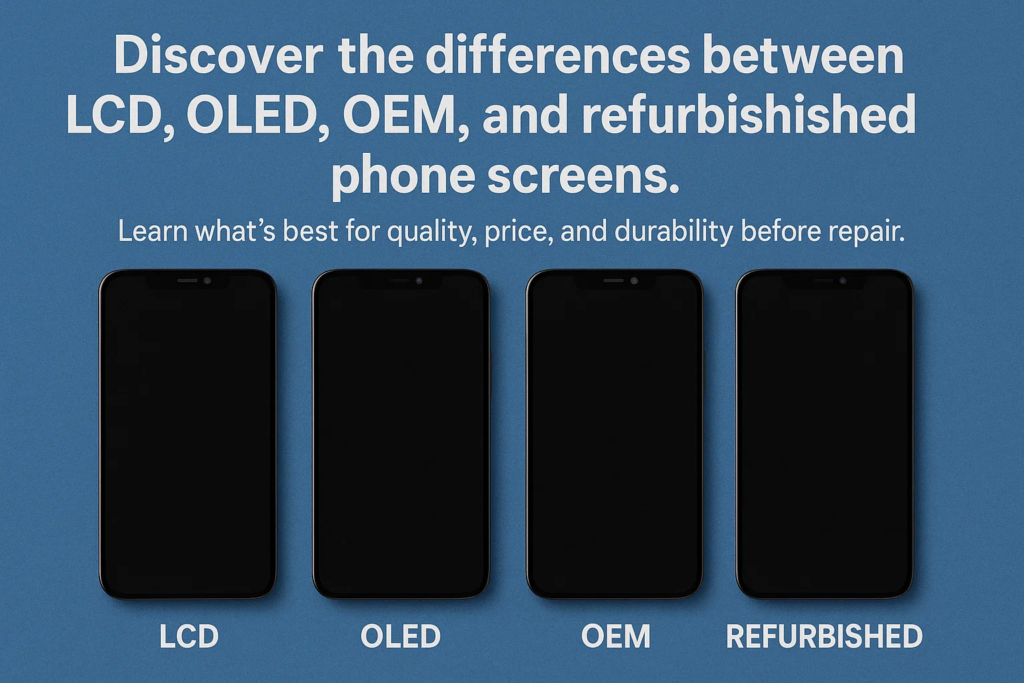
Vous êtes-vous déjà demandé pourquoi deux écrans de remplacement pour le même téléphone peuvent avoir des prix si différents ?? Ou pourquoi certains écrans semblent plus lumineux et plus réactifs que d'autres? La vérité est, tous les écrans de smartphones ne sont pas égaux. Depuis LCD contre OLED à Écrans OEM vs reconditionnés, connaître la différence peut vous faire économiser de l'argent, prévenir la frustration, et vous aider à choisir la bonne option de réparation.
Bases des écrans de smartphone
Un écran de smartphone est bien plus qu'un simple morceau de verre. Il est composé de couches qui incluent:
- Panneau d'affichage – affiche des images et des couleurs.
- Numériseur tactile – détecte les mouvements de vos doigts.
- Protection du verre – garde tout en sécurité.
Quand l'un d'eux se brise, les options de réparation diffèrent en fonction des dommages.
Qu'est-ce qu'un écran LCD?
LCD (Affichage à cristaux liquides) est l'une des technologies d'écran les plus anciennes mais encore largement utilisées.
- Comment ça marche: Les écrans LCD utilisent un rétroéclairage qui brille à travers des cristaux liquides pour produire des images.
- Pros: Abordable, durable, bonne luminosité.
- Inconvénients: Contraste limité, conception plus épaisse, noirs plus faibles.
Qu'est-ce qu'un écran OLED?
Oled (Diode électroluminescente organique) est un plus récent, type d'affichage plus avancé.
- Comment ça marche: Chaque pixel émet sa propre lumière, pas besoin de rétroéclairage.
- Pros: Noirs profonds, couleurs vibrantes, conception mince, économe en énergie.
- Inconvénients: Plus cher, risque de brûlure d'écran.
Différence clé entre LCD et OLED
- Principe d'émission de lumière: L'écran LCD repose sur le rétroéclairage, Les pixels OLED brillent individuellement.
- Précision des couleurs: OLED offre plus riche, des couleurs plus vives.
- Luminosité et contraste: OLED atteint un contraste infini; L'écran LCD est limité.
- Consommation d'énergie: OLED économise plus d'énergie sur les écrans sombres, L'écran LCD consomme plus régulièrement.
Considérez l'écran LCD comme un lampe de poche qui brille à travers du papier de couleur, alors que OLED est comme petites étoiles brillantes sur un ciel noir.
Écrans d'origine du fabricant (OEM)
OEM (Fabricant d'équipement d'origine) les écrans sont fabriqués par la même usine que la marque de votre téléphone.
- Avec cadre: Plus facile à installer, coût plus élevé.
- Sans cadre: Moins cher, nécessite une installation qualifiée.
- Pros: Meilleure qualité, ajustement parfait, longue durée.
- Inconvénients: Cher.
Écrans remis à neuf: Quels sont-ils?
Un écran reconditionné est généralement un écran original qui a eu son verre extérieur remplacé.
- Le panneau intérieur LCD ou OLED reste le même.
- La qualité dépend du processus de réparation.
Si cela est fait professionnellement, les écrans remis à neuf peuvent fonctionner presque comme neufs.
Écrans re-verrés/après-pressés
Ce type implique remplacer uniquement la vitre extérieure cassée, garder l'ancien panneau d'affichage.
- Pros: Option la moins chère.
- Inconvénients: Fort risque de problèmes comme des bulles, adhésif faible, ou perte de sensibilité tactile.
Imaginez mettre un nouveau pare-brise sur un châssis de voiture fissuré—ça a l'air bien au début mais pourrait ne pas tenir le coup.
Écrans assemblés
Les écrans assemblés sont construits à partir de pièces d'origines différentes. Par exemple, un panneau LCD générique avec un numériseur à faible coût et un cadre en verre.
- Caractéristiques: Prix inférieur, performances incohérentes.
- Panneaux d'avertissement: Inadéquation des couleurs, mauvaise luminosité, contact retardé.
Indices visuels pour identifier les types d'écran
- Écrans OEM: Alignement parfait, couleurs naturelles, toucher doux.
- Remis à neuf: Petits signes de retouche, comme des résidus de colle.
- Après-pressage: Petites bulles ou toucher mat.
- Assemblé: Forme ou épaisseur du cadre légèrement différente.
Risques liés à l'utilisation d'écrans après-pressés
- Bulles d'air se formant sous verre.
- Le toucher ne répond pas correctement.
- Écran qui se décolle au bout de quelques mois.
Conseils pour identifier les écrans d'origine et les écrans re-glass
- Vérifier l'emballage – L'OEM est livré scellé.
- Regardez le cadre – les originaux sont homogènes.
- Inspecter le toucher – pas de décalage, pas de points morts.
- Logos d'usine – souvent manquant dans les copies.
Différence de prix expliquée
- Écran OEM: Prix le plus élevé, meilleure fiabilité.
- Écran remis à neuf: Milieu de gamme, bon compromis.
- Après-pressé/assemblé: Le moins cher, risqué à long terme.
En gros, vous choisissez entre prime, équilibré, ou jouer.
Conseils pratiques pour les consommateurs
- Si tu veux fiabilité à long terme, aller OEM.
- Si tu veux économique mais de qualité correcte, considérer comme remis à neuf.
- Si vous voulez le solution la moins chère, soyez prêt à faire des compromis avec les écrans après-pressés.
Demandez toujours aux ateliers de réparation: Est-ce OEM, remis à neuf, ou assemblé?
Conclusion
L’écran de votre téléphone n’est pas qu’un morceau de verre : c’est la fenêtre de votre vie numérique. Connaître la différence entre LCD, Oled, OEM, remis à neuf, et écrans après-pressés vous aide à éviter les escroqueries et à faire des choix plus judicieux. Souviens-toi: un écran qui semble bon marché aujourd'hui pourrait coûter plus cher en maux de tête demain.
FAQ
1. Comment savoir si mon écran est OEM?
Vérifier l'emballage, qualité du cadre, et réponse tactile douce. Les écrans OEM sont impeccables.
2. L'OLED est-il toujours meilleur que l'écran LCD?
Pas toujours. OLED a de meilleures couleurs, mais l'écran LCD est moins cher et parfois plus durable.
3. Les écrans re-verrés peuvent-ils durer longtemps?
Ils peuvent, mais généralement pas aussi longtemps que l'OEM. Des risques de bulles et de problèmes de toucher demeurent.
4. Comment tester la sensibilité tactile après réparation?
Essayez les balayages rapides, dactylographie, et touches de bord. Tout décalage signifie une mauvaise qualité.
5. Pourquoi les écrans OEM sont-ils plus chers?
Parce qu'ils sont fabriqués par le même fabricant que le téléphone d'origine, garantir une qualité supérieure.