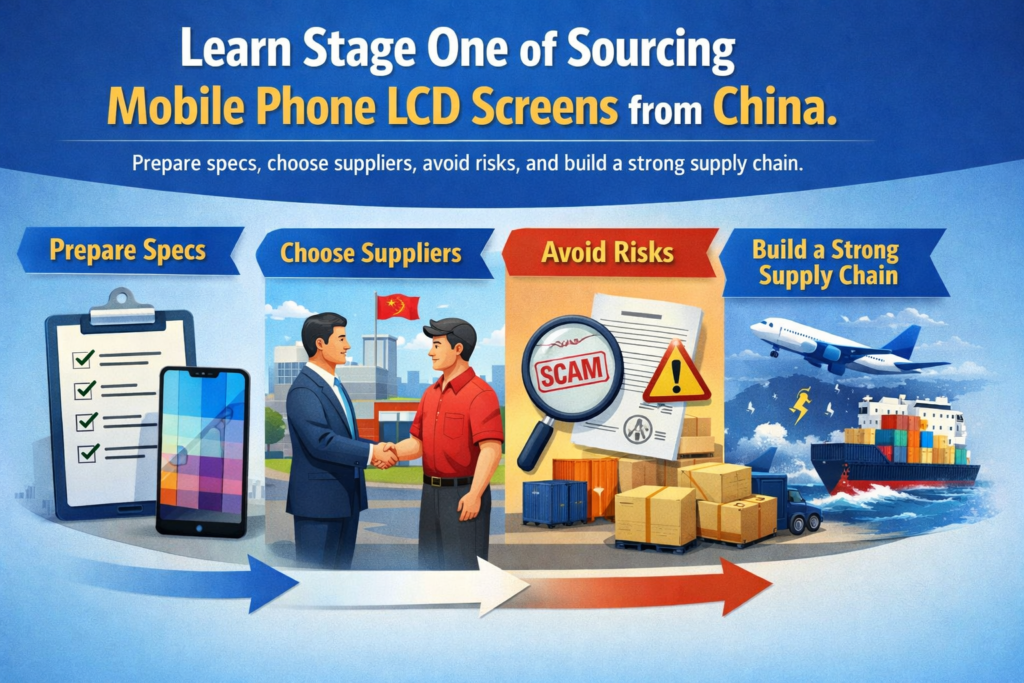
Introduction: Pourquoi la première étape détermine le succès de l'ensemble de la chaîne d'approvisionnement
S'approvisionner en écrans LCD pour téléphones portables en Chine ne consiste pas seulement à trouver le prix le moins cher et à passer une commande.. Pensez-y comme si vous construisiez une maison. Si la fondation est faible, tout ce qui est dessus va craquer tôt ou tard. La première étape – la préparation et l’approvisionnement avant l’achat – est cette base.
Cette étape se concentre sur la définition de vos besoins, fournisseurs de criblage, confirmer les normes, et fixer des conditions commerciales et juridiques claires. Obtenez cette partie correctement, et le reste du processus se déroule sans problème. Se tromper, et tu seras confronté à des retards, pertes, et des disputes sans fin.
Décomposons l'étape une étape par étape, en anglais simple.
Comprendre vos exigences et réglementations en matière d'importation
Règles d'importation du pays de destination
Avant même d’envoyer un message à un fournisseur chinois, arrête-toi et pose-toi une question: Puis-je légalement importer ces écrans dans mon pays?
Différents pays traitent les pièces de téléphone différemment. Certains classent les écrans LCD mobiles comme des composants électroniques généraux, tandis que d'autres les soumettent à des réglementations plus strictes en matière de télécommunications ou d'accessoires électroniques.. Ignorer cette étape, c'est comme conduire les yeux bandés : vous ne verrez pas l'accident arriver..
Certifications obligatoires (CE, FCC, RoHS)
La plupart des écrans LCD de téléphones portables nécessitent le respect de normes telles que:
- CE pour l'Union européenne
- FCC pour les États-Unis
- RoHS pour le contrôle des substances dangereuses
Confirmez tôt si ces certifications sont obligatoires sur votre marché. Si nécessaire, assurez-vous que votre fournisseur peut fournir des produits conformes et des pièces justificatives.
Définir clairement les normes de produits
Sélection d'écran LCD ou OLED
Tous les écrans ne sont pas égaux. Les écrans LCD sont généralement plus abordables et largement utilisés dans les appareils économiques et de milieu de gamme.. Écrans OLED, d'autre part, offrir un meilleur contraste, Noirs plus profonds, et des conceptions plus fines, mais à un coût plus élevé.
Votre choix doit correspondre à votre marché cible. Vente de pièces de rechange pour téléphones d'entrée de gamme? L'écran LCD pourrait suffire. Réparations haut de gamme? L'OLED est souvent attendu.
Compatibilité des modèles et précision des tailles
Un petit décalage peut rendre un écran inutile. Précisez toujours:
- Marque et modèle de téléphone
- Taille de l'écran en pouces
- Code de modèle exact (le cas échéant)
Ne présumez jamais que les « modèles similaires » utilisent le même écran. Souvent, ils ne le font pas.
Résolution, Interface, et paramètres techniques
Approfondissez le côté technique:
- Résolution (HD, FHD, etc.)
- Type de connecteur et définition des broches
- Technologie tactile et taux de rafraîchissement
Ces détails comptent plus que vous ne le pensez, spécialement pour les écrans de rechange.
Les niveaux de qualité expliqués (Une note, Catégorie B, Remis à neuf)
Les fournisseurs chinois classent souvent les écrans par qualité:
- Une note: Pas de pixels morts, pas de rayures, meilleure qualité d'affichage
- Catégorie B: Défauts cosmétiques mineurs, performances acceptables
- Remis à neuf: Panneaux d'origine réparés ou remontés
Soyez parfaitement clair sur la qualité que vous achetez. L'ambiguïté ici conduit à des différends plus tard.
Identifier les fournisseurs chinois fiables
Usine vs société commerciale
Les usines offrent généralement de meilleurs prix et un meilleur contrôle de la qualité. Les sociétés commerciales offrent de la flexibilité et de multiples options d'approvisionnement. Ni l’un ni l’autre n’est « meilleur » par défaut : cela dépend de vos besoins.
Pour les grands, commandes stables, les usines sont idéales. Pour les modèles mixtes et les petits volumes, les traders peuvent être plus pratiques.
Vérification des antécédents des fournisseurs
Faites vos devoirs:
- Vérifier les licences commerciales
- Examiner l'expérience d'exportation
- Demandez des références clients
La confiance c'est bien. La vérification est meilleure.
Demande d'échantillons et réalisation de tests
Pourquoi les échantillons ne sont pas négociables
Ne sautez jamais d’échantillons. Jamais. Les échantillons sont votre police d'assurance avant la production en série ou l'expédition en vrac.
Afficher, Touche, et tests de compatibilité
Tester des échantillons pour:
- Luminosité et précision des couleurs
- Sensibilité tactile
- Compatibilité avec les appareils actuels
Un écran qui semble bien sur le papier peut échouer dans le monde réel.
Négociation des prix et conditions commerciales
Stratégie de prix unitaire et de MOQ
Négocier intelligemment, pas agressif. Comprendre:
- Niveaux de prix unitaires
- Quantité minimale de commande (MOQ)
- Différences de prix par catégorie
Parfois, payer un peu plus par unité réduit le risque de défaut et permet d'économiser de l'argent à long terme..
Période de validité du prix
Confirmez combien de temps le prix indiqué reste valable. Les prix des composants fluctuent rapidement, surtout sur le marché de l'électronique.
Choisir les bons Incoterms
EXW
Avec EXW (départ usine), le fournisseur met les marchandises à disposition à l'usine. Vous gérez tout le reste. C'est bon marché sur le papier mais lourd en responsabilité.
FOB expliqué
GOUSSET (Gratuit à bord) signifie que le fournisseur livre les marchandises au port et dédouane l'exportation. C'est l'option la plus couramment utilisée et équilibrée.
CIF expliqué
CIF (Coût, Assurance, et fret) comprend l'expédition et l'assurance jusqu'à votre port de destination. C’est pratique mais souvent moins transparent sur les coûts.
Choisissez judicieusement : cela affecte à la fois le risque et le coût.
Sélection des méthodes de paiement sécurisées
Virement bancaire (T/T)
Rapide et commun, mais risqué si vous ne faites pas confiance au fournisseur. Implique généralement un dépôt et un paiement du solde.
Lettre de crédit (L/C)
Plus sûr pour les grosses commandes. Les banques jouent le rôle d'intermédiaires, mais les frais et la complexité sont plus élevés.
Plateformes de dépôt tierces
Idéal pour les nouveaux partenariats. Les fonds ne sont débloqués qu’une fois les conditions remplies.
Signature d'un contrat d'achat formel
Clauses clés qui doivent être incluses
Un contrat approprié doit indiquer clairement:
- Spécifications du produit
- Quantité et prix
- Délai de livraison
- Normes de qualité
- Méthode de contrôle
- Conditions de paiement
- Responsabilité en cas de manquement
Si ce n'est pas écrit, ça n'existe pas.
Licence d'importation et dépôt réglementaire
Lorsqu'une licence d'importation est requise
Certains pays exigent des licences d'importation ou un dépôt préalable pour les composants électroniques. Postulez tôt – la bureaucratie évolue lentement.
Nommer un transitaire
Transitaire autogéré ou professionnel
Si tu es nouveau, faire appel à un transitaire professionnel. Ils s'occupent de l'expédition, douane, et documentation, vous faisant gagner du temps et des erreurs coûteuses.
Enregistrement et dépôt de l'importateur
Exigences d'enregistrement en douane
La plupart des pays exigent l'enregistrement de l'importateur avant le dédouanement. Effectuez cette étape tôt pour éviter les retards d'expédition.
Confirmation du code SH
Codes SH courants pour les écrans LCD de téléphones portables
Les codes SH corrects déterminent votre taux de taxe et de droit. Les écrans LCD des téléphones portables font généralement partie des pièces détachées des appareils portables sans fil., tel que Code SH 8517.7030.
Vérifiez toujours auprès des autorités douanières.
Estimation des droits de douane et des taxes
Droit d'importation
Les taux de droits varient selon les pays et les accords commerciaux. Estimez-les avant de finaliser votre coût.
TVA et autres taxes
N'oubliez pas la TVA, TPS, ou taxe de vente. Ceux-ci peuvent affecter considérablement votre coût au débarquement.
Erreurs courantes à éviter lors de la première étape
- Ignorer les contrôles de certification
- Acheter sans échantillons
- Spécifications du produit vagues
- Choisir les mauvais Incoterms
- Sous-estimer les impôts et taxes
Évitez-les, et vous êtes déjà en avance sur de nombreux acheteurs.
Conclusion: Construisez la bonne fondation avant d’expédier
La première étape de l’approvisionnement en écrans LCD pour téléphones portables en Chine n’est pas glamour, mais c'est critique. Cette phase définit les attentes, définit les responsabilités, and protects your investment.
When you clarify requirements, échantillons de test, negotiate smartly, and lock everything into a solid contract, you’re not just buying screens—you’re building a reliable supply chain.
Do it right once, and future orders become easier, plus rapide, and more profitable.
FAQ
1. Is it safe to buy mobile phone LCD screens from China?
Oui, if you verify suppliers, request samples, and use secure payment methods.
2. Should I choose LCD or OLED screens for bulk purchasing?
It depends on your target market, budget, and phone models you serve.
3. What is the best Incoterm for beginners?
FOB is usually the safest and most balanced option.
4. Are refurbished screens suitable for resale?
Oui, if clearly labeled and quality-tested, especially for budget repairs.
5. Why is HS code accuracy so important?
Des codes HS incorrects entraînent des taxes erronées, amendes, ou des retards douaniers.