Smartphone displays have evolved dramatically over the past decade. What was once a simple choice between a low-cost LCD panel and a premium OLED display has transformed into a sophisticated battle of technologies, manufacturing capabilities, and user experiences. In 2026, consumers purchasing a smartphone, repair shops sourcing replacement screens, and wholesalers buying display assemblies all face the same fundamental question: Should you choose a TFT LCD screen or an OLED screen?
The answer is no longer as straightforward as it was five years ago. According to recent market research, AMOLED-equipped smartphones accounted for approximately 63% of global smartphone shipments during Q1 2025, while LCD-based smartphones declined to around 37%, demonstrating the accelergy in both flagship and mid-range devices. citeturn0search4turn0search7
At the same time, TFT LCD technology remains dominant in entry-level smartphones, industrial devices, and the mobile repair aftermarket because of its affordability, durability, and mature manufacturing ecosystem. Understanding the differences between these two technologies requires looking beyond marketing terms and examining how each display actually works, how they perform in real-world conditions, and where the industry is heading.
What Are Smartphone Display Technologies?
Smartphone displays are essentially the communication bridge between humans and machines. Every photo you capture, every video you watch, every game you play, and every message you send depends entirely on the quality of the display panel beneath your fingertips. The display industry has experienced one of the fastest technological evolutions in consumer electronics, moving from monochrome screens to high-resolution OLED panels capable of displaying billions of colors with exceptional contrast and brightness.
The importance of display technology has increased substantially because smartphones have become our primary computing devices. Consumers now spend several hours daily interacting with their smartphone screens, making factors such as eye comfort, power efficiency, color accuracy, refresh rate performance, and outdoor visibility more important than ever. Manufacturers like Apple, Samsung, Xiaomi, OPPO, and Google have invested billions of dollars into display innovation because they recognize that the screen is often the first feature users notice.
Industry analysts estimate that global smartphone panel shipments will exceed 2.2 billion units in 2025, with OLED continuing to gain market share due to lower production costs and increased manufacturing capacL CSOT, Visionox, and Tianma. citeturn0search0turn0search1turn0search3
The Evolution of Mobile Phone Displays
The journey of smartphone displays resembles the evolution of transportation. Early mobile phones were like bicycles—simple, practical, and reliable. TFT LCD technology represented the automobile era, delivering color, speed, and mass accessibility. OLED technology, meanwhile, represents the electric supercar: faster, more efficient, and more sophisticated.
In the early 2000s, most mobile phones used passive matrix displays. These were quickly replaced by TFT (Thin-Film Transistor) LCD technology, which offered better image quality, faster response times, and higher resolutions. As smartphones became more advanced, TFT LCD technology diversified into IPS LCD, LTPS LCD, and various high-refresh-rate implementations.
OLED technology entered the mainstream smartphone market with devices like the Samsung Galaxy series and later became widely adopted by Apple following the introduction of the iPhone X in 2017. Today, virtually all flagship smartphones utilize OLED displays, and even mid-range devices increasingly adopt flexible AMOLED panels. Apple completed its transition away from LCD iP industry’s movement toward OLED dominance. citeturn0news41turn0search4
What Is a TFT LCD Screen?
A TFT screen, or Thin-Film Transistor Liquid Crystal Display, is one of the most mature and widely manufactured display technologies in history. Unlike OLED displays that generate their own light, TFT LCD screens depend on a backlight system to illuminate liquid crystal layers and create images.
Think of a TFT display like a stained-glass window illuminated by sunlight. The backlight serves as the sun, while millions of tiny liquid crystal shutters control how much light passes through each pixel. This architecture enables TFT displays to produce accurate colors, maintain long operating lifespans, and achieve relatively low manufacturing costs.
TFT displays continue to dominate entry-level smartphones, rugged industrial devices, automotive displays, and replacement screen markets because of their excellent cost-to-performance ratio. Despite the growth of OLED, global LCD smartphone panel shipments still exceeded **340 million unitsillustrating their continued relevance in the industry. citeturn0search0
How TFT LCD Technology Works
Inside a TFT LCD panel, every pixel contains multiple thin-film transistors responsible for controlling liquid crystal orientation. When voltage is applied, these liquid crystals rotate and either block or allow light from the backlight system to pass through color filters. The resulting combination creates the images visible on the screen.
This process provides several advantages. TFT displays offer stable image quality, minimal risk of permanent image retention, predictable aging characteristics, and relatively low repair costs. Because the display relies on a shared backlight, manufacturing yields remain high and production expenses stay relatively low compared to OLED fabrication.
However, this architecture also introduces limitations. Since black pixels cannot completely turn off the backlight, TFT screens struggle to achieve true blacks. Contrast ratios remain significantly lower than OLED panels, and power consumption remains relatively constant regardless of displayed content.
Types of TFT LCD Panels Used in Smartphones
Not all TFT screens are created equally. Modern smartphones primarily use three major LCD technologies:
| Technology | Characteristics | Typical Usage |
|---|---|---|
| a-Si LCD | Lowest cost, mature production | Budget smartphones |
| LTPS LCD | Higher resolution and efficiency | Mid-range smartphones |
| IPS LCD | Wide viewing angles and color accuracy | Premium LCD smartphones |
Recent industry reports indicate that a-Si LCD technology remains resilient due to its affordability and strong manufacturing capacity expansion among Chinese panel suppliers. In fact, globad to exceed 1.3 billion units in 2025. citeturn0search3turn0search6
What Is an OLED Screen?
OLED stands for Organic Light Emitting Diode. Unlike TFT LCD technology, OLED panels eliminate the need for a separate backlight because each individual pixel generates its own light. This seemingly simple difference fundamentally changes how displays perform and why OLED has become the preferred technology for premium smartphones.
Imagine a city skyline at night. In a TFT display, every building is illuminated by one giant floodlight. In an OLED display, every window has its own independent light source. This independence allows OLED screens to create perfect blacks, extraordinary contrast ratios, faster response times, and superior energy efficiency under many operating conditions.
The rapid growth of OLED technology has been remarkable. Industry forecasts suggest smartphone OLED shipments could approach 900 million units during 2025, wting for nearly half of global production. citeturn0search1turn0search2
How OLED Technology Works
OLED displays consist of multiple organic semiconductor layers sandwiched between conductive electrodes. When electrical current flows through these organic materials, they emit visible light directly. Each subpixel operates independently, meaning that black pixels consume virtually no power because they remain completely switched off.
This architecture delivers several advantages. OLED screens produce infinite contrast ratios, exceptional color saturation, ultrafast response times, thinner form factors, and support for flexible display designs. These characteristics explain why foldable smartphones and curved-edge displays depend almost exclusively on OLED technology.
The manufacturing process, however, remains more complex than TFT LCD production. OLED fabrication requires advanced deposition techniques, sophisticated encapsulation methods, and strict quality control measures to ensure panel reliability and longevity.
AMOLED, Super AMOLED, and LTPO OLED Explained
Modern smartphone OLED displays have evolved into several specialized categories:
- AMOLED (Active Matrix OLED): The standard architecture used in most smartphones.
- Super AMOLED: Samsung’s integrated touch-layer OLED technology.
- LTPO OLED: Advanced variable refresh-rate OLED technology designed for improved power efficiency.
LTPO OLED panels have become especially important because they allow refresh rates to dynamically adjust between 1Hz and 120Hz or even 144Hz. This capability significantly reduces battery consumption while maintaining smooth visual performance. Premium smartphones from Apple, Samsung, Google, and Chinese flagship brands increasingly rely on LTPO technology.
TFT vs OLED: Technical Comparison
The battle between TFT and OLED resembles comparing traditional gasoline engines to electric motors. Both accomplish the same objective, but they achieve it through fundamentally different engineering philosophies.
Display Structure and Pixel Control
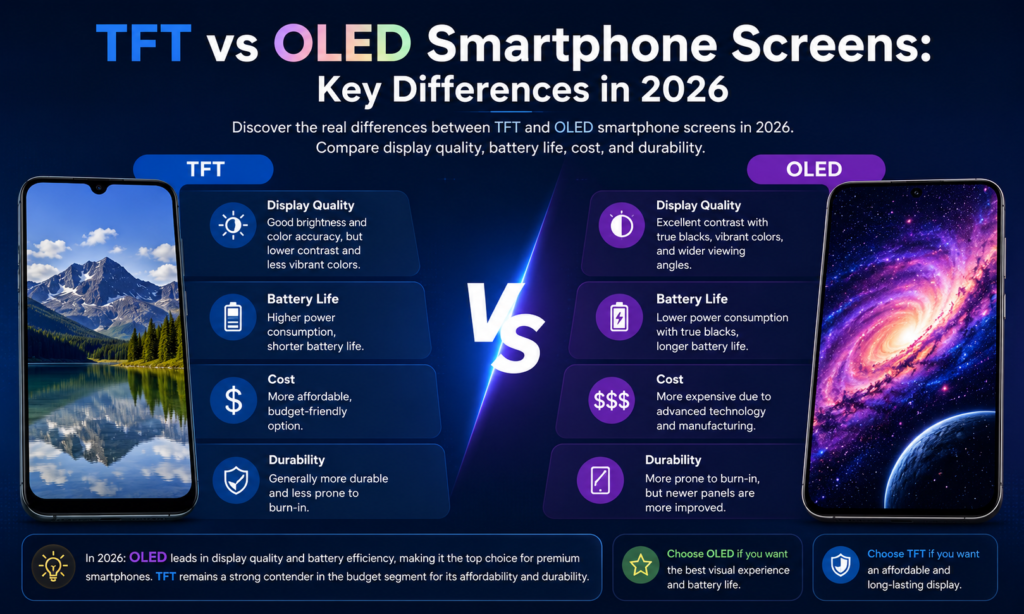
The primary difference lies in how images are generated. TFT displays require multiple layers, including backlights, liquid crystals, polarizers, and color filters. OLED panels simplify this architecture by allowing pixels to emit light independently.
This structural advantage enables OLED displays to be thinner, lighter, and more flexible. Manufacturers leverage these benefits to produce foldable smartphones, curved displays, and ultra-thin flagship devices.
Brightness and Outdoor Visibility
Historically, TFT displays maintained an advantage in sustained brightness. However, modern OLED technology has narrowed this gap considerably. Recent OLED panels can achieve exceptionally high peak brightness levels while maintaining excellent visibility under direct sunlight. Independent certifications have demonstrated substantial impruracy under real-world lighting conditions. citeturn0news30turn0search2
Still, high-quality IPS LCD panels continue to perform competitively outdoors due to their consistent full-screen brightness characteristics.
Color Accuracy and Contrast Ratio
This category overwhelmingly favors OLED technology. Because OLED pixels can completely turn off, they produce perfect black levels and effectively infinite contrast ratios. Movies, HDR content, and games benefit enormously from this capability.
TFT displays, despite significant improvements, cannot fully eliminate backlight leakage. Their blacks appear dark gray rather than truly black. Professional users may still appreciate the color consistency of calibrated IPS LCD panels, but most consumers perceive OLED displays as more vibrant and visually impressive.
Refresh Rate and Gaming Performance
Modern gaming smartphones increasingly utilize OLED technology because of its exceptionally fast pixel response times. OLED pixels transition almost instantly, reducing motion blur and ghosting effects during gameplay.
That said, high-end TFT gaming displays remain highly competitive. Many gaming-focused LCD panels support refresh rates of 144Hz or higher while offering excellent responsiveness at lower manufacturing costs.
Power Consumption and Battery Life
Power efficiency depends heavily on usage patterns. OLED displays excel when displaying dark interfaces because black pixels consume virtually no power. This advantage explains why dark mode can noticeably extend battery life on OLED-equipped smartphones.
TFT displays consume relatively constant power regardless of image content because their backlights remain continuously active. Bright interfaces often reduce OLED’s efficiency advantage, although modern LTPO technologies continue improving overall power performance.
Durability and Lifespan
Durability remains one of TFT technology’s strongest advantages. TFT displays rarely experience burn-in effects and generally maintain consistent performance throughout their operational lifespan.
OLED panels have improved dramatically over recent years, but long-term image retention remains a potential concern under extreme usage conditions. Manufacturers have introduced sophisticated compensation algorithms and improved organic materials to minimize these risks.
Manufacturing Costs and Supply Chains
The economics of smartphone displays have shifted dramatically. Ten years ago, OLED technology was prohibitively expensive for mass-market devices. Today, economies of scale and expanded manufacturing capacity have reduced OLED costs significantly.
Major TFT and OLED Panel Manufacturers in 2026
The smartphone display industry is dominated by several major manufacturers:
| TFT LCD Leaders | OLED Leaders |
|---|---|
| BOE | Samsung Display |
| TCL CSOT | LG Display |
| Tianma | BOE |
| Innolux | Visionox |
| Sharp | TCL CSOT |
Chinese manufacturers have emerged as dominant players in both LCD and OLED production. Recent market analysis suggests Chinese half of global smartphone OLED shipments. citeturn0search1turn0search6
Why OLED Is Becoming the Industry Standard
Several factors explain OLED’s rapid expansion. Manufacturing yields have improved substantially, production costs have fallen, and consumer demand increasingly favors premium visual experiences. According to Omdia, smartphones equipped with AMOLED displays represented approximately 63% of global shipments during early 2025, reflectinom premium luxury to mainstream necessity. citeturn0search4turn0search7
Foldable smartphones, always-on displays, under-display fingerprint sensors, and advanced refresh rate technologies have also accelerated OLED adoption.
Which Display Technology Should You Choose in 2026?
Choosing between TFT and OLED ultimately depends on your priorities.
If affordability, durability, and ease of replacement matter most, TFT LCD remains an outstanding choice. Repair shops and wholesalers often prefer TFT replacement screens because they offer stable quality and competitive pricing.
If image quality, battery efficiency, premium design, and future-proof technology are priorities, OLED provides a superior experience. The display quality difference between modern OLED and traditional TFT panels is immediately noticeable for most users.
For smartphone manufacturers and repair industry professionals, the practical reality is clear: OLED dominates the premium market, while TFT continues serving the value segment efficiently. Both technologies remain essential components of the global smartphone ecosystem.
Conclusion
The competition between TFT and OLED displays is not about one technology completely replacing the other. Instead, it reflects the evolution of consumer priorities and manufacturing capabilities. TFT LCD technology continues delivering exceptional value, reliability, and affordability, while OLED pushes the boundaries of visual performance, power efficiency, and industrial design.
As manufacturing costs continue declining and production capacity expands, OLED will likely strengthen its position across mainstream smartphones. Yet TFT displays remain indispensable for budget devices, industrial applications, and the global repair market. Understanding the strengths and limitations of each technology enables consumers, wholesalers, repair professionals, and manufacturers to make better purchasing decisions in an increasingly competitive smartphone industry.
Frequently Asked Questions
1. Is OLED always better than TFT LCD?
No. OLED offers superior image quality and contrast, while TFT LCD provides better affordability and often greater durability.
2. Do OLED screens consume less battery?
Generally yes, especially when displaying dark content or using dark mode interfaces.
3. Can TFT screens experience burn-in?
No. TFT LCD displays do not suffer from permanent image retention like OLED panels potentially can.
4. Why are OLED replacement screens more expensive?
OLED manufacturing involves more complex production processes, lower yields, and higher material costs.
5. Will TFT screens disappear in the future?
Unlikely. TFT LCD technology remains highly competitive for budget smartphones, industrial devices, and aftermarket repair applications.