Le marché de la réparation d’écran iPhone est énorme. Pas seulement grand, mais complexe, en couches, et parfois déroutant. Pour les ateliers de réparation et les grossistes, comprendre les spécifications de l’écran du marché secondaire n’est pas facultatif. C’est la différence entre des profits élevés et des plaintes constantes des clients.
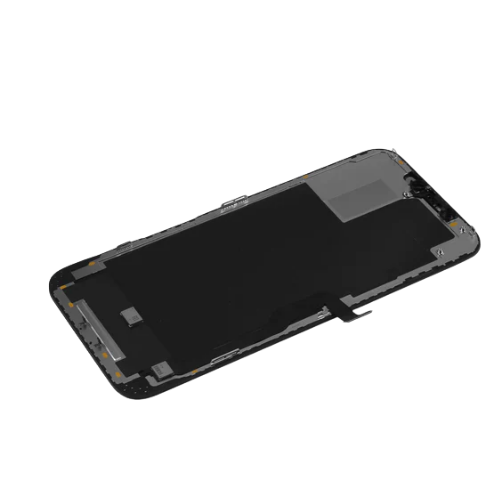
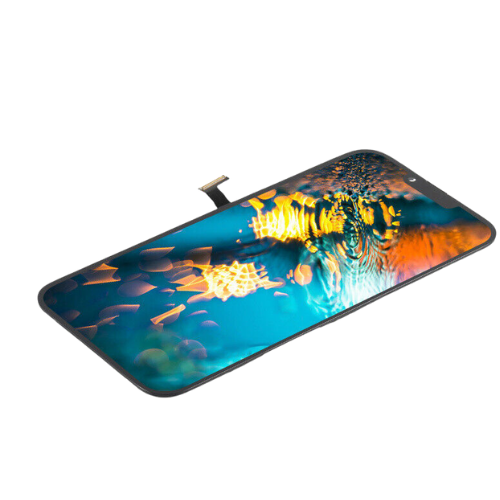
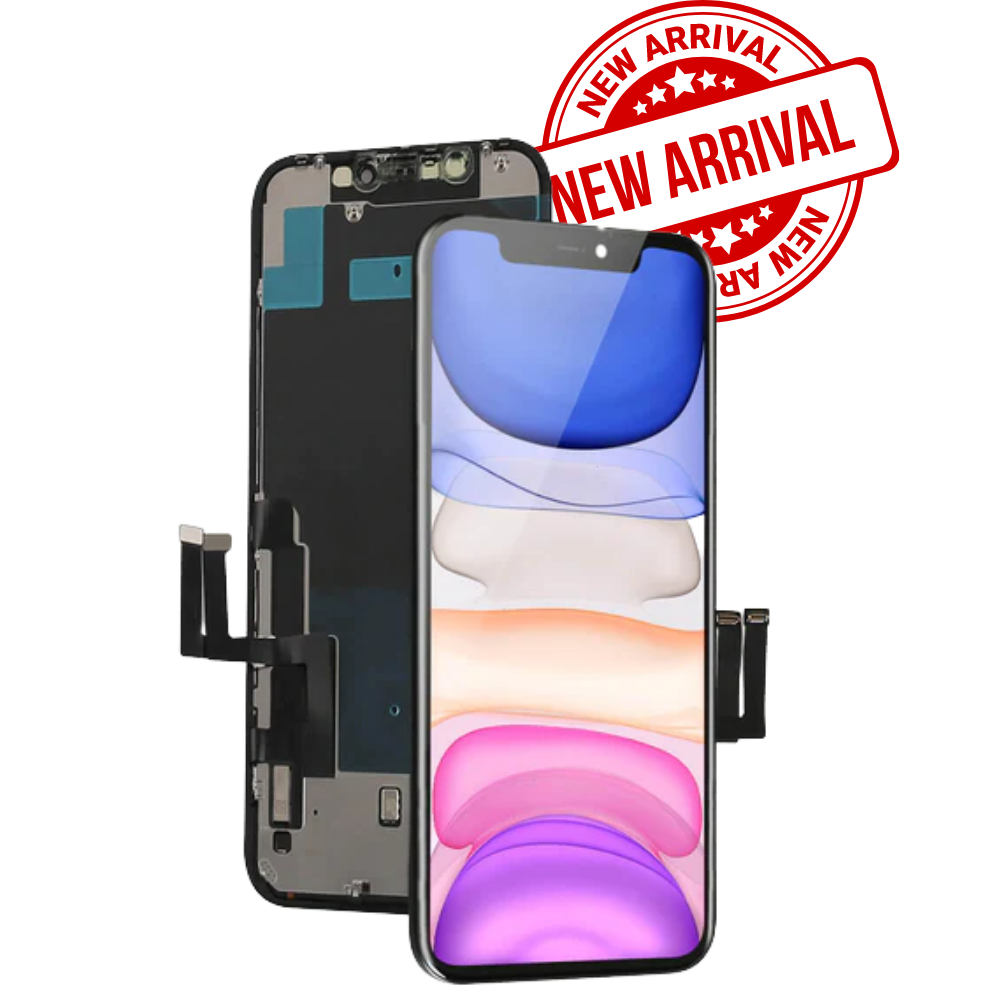
Pensez à l’écran d’un iPhone comme au cœur du téléphone. Ce n'est pas juste un morceau de verre. C'est un module entièrement intégré combinant affichage, numériseur tactile, Composants d'identification de visage, capteurs de proximité, écouteur, Et plus. Remplacez-le incorrectement, et toute l'expérience change.
Alors comment choisir le bon écran? Décomposons-le étape par étape.
Pourquoi les écrans d'iPhone dominent le secteur de la réparation
Les dommages à l’écran sont la réparation d’iPhone numéro un dans le monde. Les chutes se produisent. Fissures de verre. Les écrans deviennent noirs. Et quand cela arrive, les clients ne veulent pas d'explications, ils veulent des solutions.
Mais voici la partie délicate: tous les écrans de remplacement ne sont pas identiques.
Vous pouvez acheter un écran pour $15 ou $150. Les deux « conviennent ». Mais font-ils la même chose? Absolument pas.
C’est là que la compréhension des spécifications devient votre avantage concurrentiel.
La Fondation – Deux technologies d’écran de base
Avant même de parler des qualités du marché secondaire, nous devons comprendre une vérité fondamentale:
Il n'y a que deux technologies d'affichage de base dans les iPhones.
La technologie LCD expliquée
LCD (Affichage à cristaux liquides) des écrans ont été utilisés dans des modèles comme:
- iPhone 6 / 7 / 8
- iPhone XR
- iPhone 11
- Série iPhone SE
Les écrans LCD nécessitent un rétroéclairage pour éclairer les pixels. C'est pourquoi les noirs apparaissent légèrement gris : le rétroéclairage est toujours allumé..
Avantages:
- Coût inférieur
- Fourniture de pièces de rechange matures
- Performances stables
Limites:
- Contraste inférieur
- Des couleurs moins vives
- Structure légèrement plus épaisse
La technologie OLED expliquée
À partir de l'iPhone X, Apple est passé à OLED pour la plupart des modèles haut de gamme.
Les panneaux OLED sont utilisés dans:
- iPhoneX
- iPhone 12 / 13 / 14 / 15 / 16 série (sauf SE)
Chaque pixel émet sa propre lumière. Cela signifie de vrais noirs, contraste infini, et une meilleure efficacité énergétique.
OLED est plus fin, plus brillant, et plus dynamique – mais aussi beaucoup plus cher à produire.
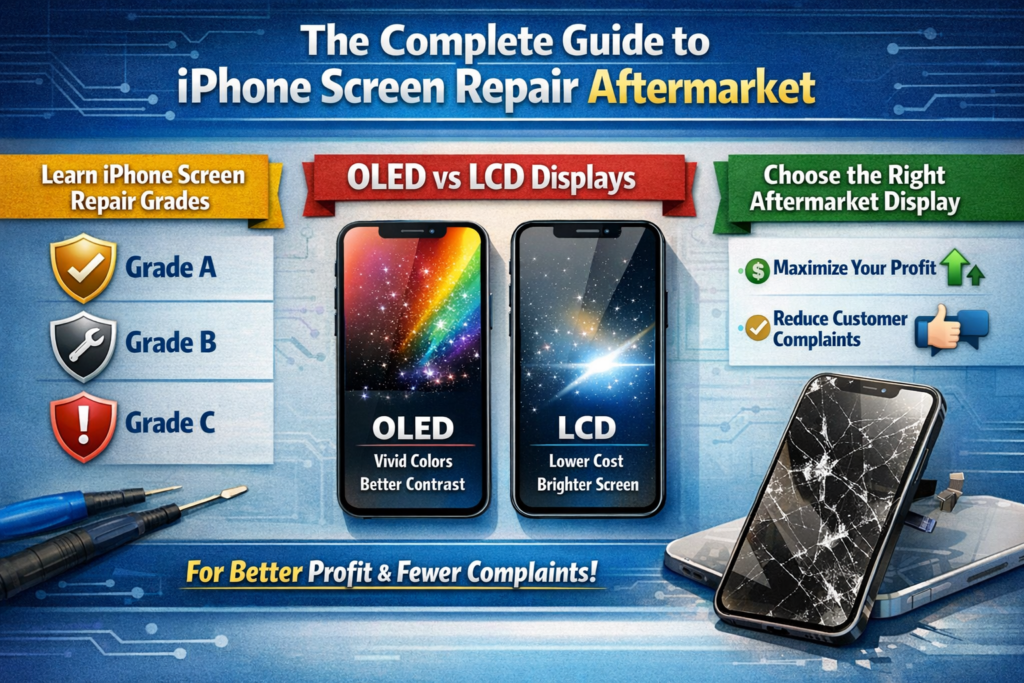
Principales différences entre LCD et OLED
| Fonctionnalité | LCD | Oled |
|---|---|---|
| Rétroéclairage | Requis | Pas nécessaire |
| Couleur noire | Grisâtre | Du vrai noir |
| Contraste | Limité | Infini |
| Épaisseur | Plus épais | Diluant |
| Coût | Inférieur | Plus haut |
Cette différence technologique définit tout sur le marché secondaire.
Cinq principales qualités d'écran d'iPhone de rechange
Entrons maintenant dans le véritable champ de bataille : la classification du marché secondaire.
1. Écrans tirés d'origine (OEM démonté)
Ce sont de véritables écrans Apple retirés des appareils usagés.
Pas de fabrication tierce. Aucun échange de composants.
Pourquoi ils sont premium:
- Précision parfaite des couleurs
- Niveaux de luminosité d'origine
- Ton vrai & Promotion entièrement prise en charge
- Compatibilité Face ID préservée
Ils offrent des performances de niveau usine.
Inconvénient? Coût élevé et offre limitée.
2. Écrans d'origine remis à neuf (Verre remplacé)
C'est ici que ça devient intéressant.
Les techniciens retirent le verre brisé d'un panneau d'origine et stratifient une nouvelle couche de verre.
La dalle interne OLED ou LCD reste d'origine.
Performance:
- Qualité d'affichage presque identique à celle de l'OEM
- Les performances tactiles dépendent de la qualité du verre
- True Tone généralement conservé
Pensez-y comme à réparer la « fenêtre » tout en conservant le moteur d’origine..
Prix: Inférieur à celui tiré par l'OEM, mais toujours premium.
3. Écrans d'origine testés par diagnostic
Ce sont des écrans originaux qui ont été testés et classés professionnellement..
Ils peuvent provenir de programmes de service officiels ou de centres de rénovation à grande échelle..
Les performances sont constantes et fiables, bien que des imperfections cosmétiques mineures puissent exister.
Cette catégorie offre un équilibre entre prix et fiabilité.
4. Écrans OLED tiers
Il s’agit du segment le plus compétitif du marché actuel.
Produit entièrement par des usines tierces.
Il existe deux types principaux:
OLED dur
Utilise des substrats rigides.
Caractéristiques:
- Légèrement plus épais
- Cadre inférieur plus large ("menton")
- Plus abordable
Performance:
- Couleur décente
- Luminosité modérée
- Durabilité inférieure à celle d'origine
Flexible (Doux) Oled
Utilise des substrats flexibles similaires aux panneaux d'origine d'Apple.
Avantages:
- Conception mince
- Lunette étroite
- Meilleure reproduction des couleurs
- Luminosité plus élevée
Les écrans OLED souples haut de gamme peuvent même prendre en charge True Tone après le transfert de données.
Mais même les écrans OLED souples de premier plan peuvent afficher:
- Léger changement de couleur aux angles extrêmes
- Risque de brûlure plus élevé
- Uniformité de faible luminosité inférieure
Avertissement du système? Oui, l'iPhone affichera probablement "Impossible de vérifier que cet iPhone dispose d'un véritable écran Apple".
5. Écran LCD tiers (Inucri / Tft) pour les modèles OLED
C'est l'option budgétaire.
Certains marchés de réparation remplacent les écrans OLED par des alternatives LCD pour réduire les coûts.
Compromis de performances:
- Luminosité inférieure
- Des couleurs délavées
- Mauvais angles de vision
- Pas de vrai ton
Cela fonctionne, mais c'est comme mettre des pneus économiques sur une voiture de sport.
Pour les modèles LCD natifs (comme iPhone 11), la qualité LCD tierce est plus mature et acceptable, bien que toujours inférieur à l'original.
Comparaison des performances de base
Simplifions.
| Grade | Couleur | Luminosité | Ton vrai | Durabilité | Prix |
|---|---|---|---|---|---|
| OEM tiré | Excellent | Excellent | Oui | Excellent | $$$$ |
| OEM remis à neuf | Excellent | Excellent | Oui | Très bien | $$$ |
| OLED doux | Très bien | Très bien | Partiel | Bien | $$ |
| OLED dur | Modéré | Modéré | Non | Modéré | $$ |
| Écran LCD Incell | Basique | Faible | Non | Basique | $ |
Une chose est claire: le prix reflète la performance.
Termes techniques importants que vous devez connaître
Technologie Incell
Incell intègre le toucher dans la couche LCD.
Dans le langage du marché secondaire, il fait généralement référence à des remplacements d'écran LCD à moindre coût.
Fonctionnalité True Tone
True Tone ajuste la température de couleur en fonction de la lumière ambiante.
Sans outils de transfert de données originaux, cette fonctionnalité ne fonctionnera pas sur la plupart des écrans tiers.
Compatibilité des puces IC
Le circuit intégré du pilote d'affichage contrôle la luminosité et la réponse tactile.
Les écrans haut de gamme peuvent permettre le transfert de circuits intégrés à partir des panneaux d'origine, améliorer la stabilité.
OLED dur vs OLED flexible
OLED flexible équivaut à un niveau supérieur.
Si un fournisseur ne peut pas le préciser clairement, c’est un signal d’alarme..
Stratégie de tarification pour les ateliers de réparation
Les magasins intelligents n’offrent pas une seule option. Ils proposent trois.
- Budget
- Standard
- Prime
Expliquez clairement les différences.
Les clients détestent plus les surprises que les prix élevés.
La transparence renforce la confiance.
Éviter les pièges des prix bas
Si le prix semble trop beau pour être vrai, c'est le cas.
Certains fournisseurs qualifient les OLED durs de « qualité originale ».
Posez des questions directes:
- Est-ce un OLED flexible?
- Est-ce qu'il prend en charge True Tone après le transfert?
- Quel est le niveau de luminosité?
Les détails séparent les professionnels des amateurs.
Conseils en matière d'approvisionnement pour les grossistes
Les modèles OLED dominent désormais le marché.
La demande de remplacement d'écrans LCD bas de gamme pour les appareils OLED diminue.
La stratégie d'inventaire doit se concentrer sur:
- OLED flexible
- OEM remis à neuf
- Sélectionnez le stock tiré OEM
Les remplacements Incell bon marché peuvent déplacer le volume, mais les marges sont minces et les plaintes plus nombreuses.
Réflexions finales pour prendre des décisions plus intelligentes
Le marché secondaire des écrans d'iPhone ne consiste pas seulement à acheter des pièces moins chères.
Il s’agit de comprendre la technologie, classement, performance, et les attentes des clients.
Pensez-y comme au vin. Il y a des bouteilles de table et des sélections vintage. Les deux sont buvables. Mais ils s'adressent à des publics différents.
Votre travail? Faire correspondre le produit au client.
Equilibrer budget et performances.
Et rappelez-vous : lors du remplacement de l'écran, vous en avez vraiment pour votre argent.
Conclusion
Le marché de la réparation d'écran iPhone est vaste, compétitif, et très technique. Des écrans tirés originaux aux options flexibles OLED et LCD Incell économiques, chaque catégorie sert un objectif différent. Pour les ateliers de réparation, proposer des options à plusieurs niveaux garantit une meilleure satisfaction client. Pour les grossistes, comprendre les différences de qualité garantit des marges plus saines et moins de rendements. À la fin, maîtriser les spécifications des écrans n'est pas seulement une connaissance technique, c'est une stratégie commerciale.
FAQ
1. L'OLED flexible est-il toujours meilleur que l'OLED dur?
Oui, dans la plupart des cas. L'OLED flexible offre une meilleure qualité d'affichage, conception plus fine, et des performances plus proches des écrans d'origine.
2. Les écrans tiers peuvent-ils prendre en charge True Tone?
Certains écrans OLED flexibles haut de gamme peuvent prendre en charge True Tone après avoir transféré les données d'affichage d'origine à l'aide d'outils spécialisés..
3. Pourquoi l'iPhone affiche-t-il un avertissement « affichage non authentique »?
Parce qu'Apple vérifie les numéros de série des écrans. La plupart des écrans tiers déclenchent cette notification.
4. Les écrans d'origine reconditionnés sont-ils fiables?
Si remis à neuf par un professionnel, ils conservent les panneaux d'affichage d'origine et offrent des performances proches de l'OEM.
5. Les ateliers de réparation devraient-ils stocker des écrans LCD Incell pour les modèles OLED?
Uniquement pour les marchés extrêmement sensibles aux prix. La satisfaction du client peut être inférieure à celle des remplacements OLED.