Los teléfonos inteligentes Xiaomi Redmi se han convertido en una de las opciones de telefonía móvil más populares en todo el mundo porque ofrecen un gran rendimiento., precios competitivos, y configuraciones de hardware impresionantes. Desde modelos básicos de la serie Redmi A hasta potentes dispositivos de la serie Redmi Note y Redmi K, Cada teléfono inteligente contiene docenas de componentes diseñados con precisión que trabajan juntos como un pequeño ecosistema electrónico.. Aunque los usuarios normalmente ven sólo la pantalla, camaras, y diseño exterior, El verdadero poder de un teléfono Redmi proviene del complejo hardware escondido en su interior..
Comprensión Componentes internos de Xiaomi Redmi es importante para los técnicos de reparación de teléfonos inteligentes, mayoristas, distribuidores, e incluso usuarios cotidianos que quieren saber cómo funcionan sus dispositivos. Cuando un teléfono Redmi experimenta problemas como una pantalla rota, fallo de carga, mala señal, calentamiento excesivo, o problemas de batería, Identificar el componente interno exacto involucrado puede ahorrar tiempo de reparación y reducir costos innecesarios..
En 2026, El hardware de los teléfonos inteligentes continúa avanzando hacia una mayor integración., mejora de la eficiencia energética, y diseños más inteligentes. Los modelos Xiaomi Redmi utilizan cada vez más procesadores avanzados, Pantallas AMOLED, estructuras de enfriamiento mejoradas, módulos de cámara de alta resolución, y diseños de placa base más fuertes. Para empresas involucradas en la venta al por mayor de repuestos para teléfonos móviles., Tener un conocimiento detallado de los componentes de Redmi les ayuda a elegir piezas de repuesto confiables y brindar mejores soluciones de reparación..
Esta guía completa explica los principales componentes internos de los teléfonos Xiaomi Redmi., incluyendo la placa base, ensamblaje de pantalla, sistema de batería, módulos de cámara, puertos de carga, cables flexibles, componentes de radiofrecuencia, sistemas de enfriamiento, sensores, y otro hardware importante.
Comprender la arquitectura del hardware interno de Xiaomi Redmi
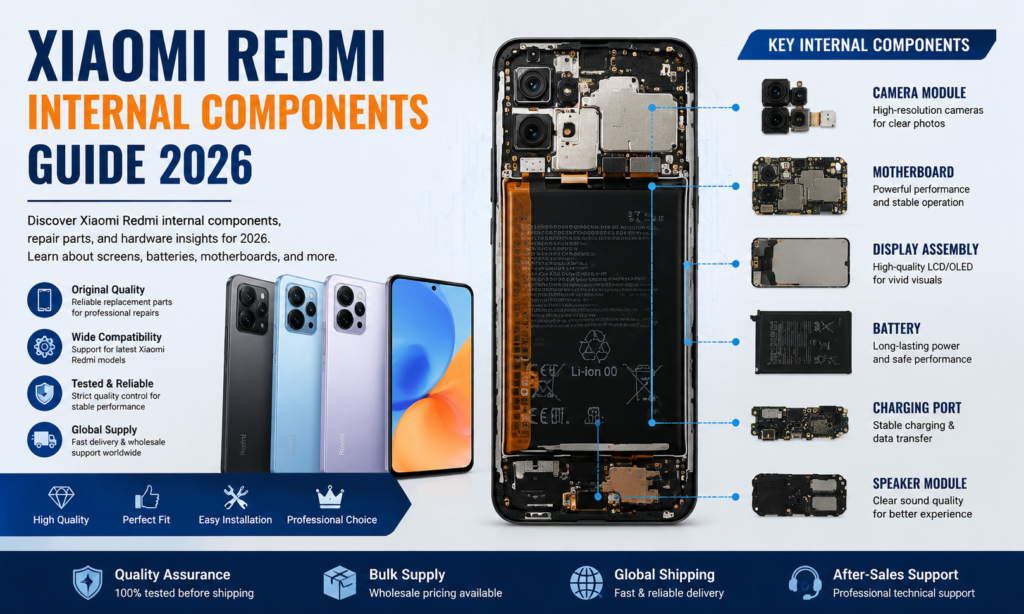
Un teléfono inteligente Xiaomi Redmi moderno no es simplemente una combinación de pantalla, batería, y cámara. Es un sistema cuidadosamente diseñado donde los componentes de hardware se comunican a través de señales eléctricas e instrucciones de software.. La placa base actúa como unidad de control central., mientras que otros módulos se conectan a través de cables flexibles, conectores, y circuitos integrados.
Cada teléfono Redmi sigue una estructura interna similar. La parte frontal suele contener el conjunto de la pantalla y el sistema táctil., mientras que el cuerpo interno alberga la placa base, batería, módulos de cámara, altavoces, sensores, y sistemas de antena. Los ingenieros deben organizar cuidadosamente estos componentes porque el espacio dentro de un teléfono inteligente es extremadamente limitado..
Un teléfono inteligente Redmi típico contiene:
- placa base principal
- Conjunto de pantalla
- Módulo de batería
- Sistema de cámara
- Componentes de audio
- tablero de carga
- Cables flexibles
- Componentes de comunicación RF
- Materiales de enfriamiento
- Sensores y módulos biométricos.
Cada componente tiene un rol específico.. Si una parte falla, puede afectar toda la experiencia del teléfono. Por ejemplo, un cable de pantalla dañado puede provocar que la pantalla parpadee, mientras que un IC de administración de energía dañado puede impedir que todo el teléfono se encienda.
Por qué es importante conocer los componentes de Redmi para las empresas mayoristas y de reparación
Para talleres de reparación y proveedores de repuestos., El conocimiento de los componentes afecta directamente la eficiencia empresarial.. Un cliente puede simplemente decir, “La pantalla de mi teléfono Redmi está rota,” pero el problema real podría estar relacionado con el panel LCD, capa táctil, pantalla IC, o cable flexible de conexión.
Los proveedores profesionales deben comprender las diferencias entre los originales., renovar, y componentes del mercado de accesorios. Por ejemplo, Las pantallas LCD de Xiaomi Redmi pueden parecer similares externamente pero difieren mucho en brillo, precisión del color, sensibilidad al tacto, y durabilidad.
Una pieza de repuesto confiable debe coincidir con las especificaciones originales., incluido:
- Compatibilidad correcta del modelo
- Diseño adecuado del conector
- Rendimiento estable
- Materiales de alta calidad
- Estándares de prueba confiables
Para compradores mayoristas, Comprender las estructuras internas también ayuda a evitar la compra de inventario incorrecto y mejora la satisfacción del cliente..
Placa base Redmi: El cerebro central del teléfono inteligente
El La placa base es el componente más importante dentro de los teléfonos Xiaomi Redmi.. Controla casi todas las funciones., Desde el procesamiento de aplicaciones hasta la gestión de señales de comunicación y distribución de energía..
A diferencia de las computadoras de escritorio, Las placas base de los teléfonos inteligentes son extremadamente compactas.. Se instalan varios chips en una pequeña PCB (Placa de circuito impreso), creando un sistema electrónico altamente integrado.
Procesador SoC, RAM, Almacenamiento, IC de banda base y administración de energía
El componente central de la placa base es el SoC (Sistema en chip). Los móviles Xiaomi Redmi utilizan procesadores de marcas como Qualcomm Snapdragon y MediaTek Dimensity o la serie Helio.
El SoC combina múltiples funciones:
- CPU para procesamiento de aplicaciones
- GPU para rendimiento gráfico
- Motor de IA para tareas inteligentes
- Procesador de señal de imagen para fotografía.
- Controlador de comunicación
Por ejemplo, un potente teléfono de la serie Redmi Note o Redmi K puede usar un chipset Snapdragon diseñado para el rendimiento de los juegos, mientras que los modelos Redmi básicos utilizan procesadores eficientes centrados en la duración de la batería y la asequibilidad..
La placa base también contiene:
RAM (Memoria de acceso aleatorio)
La RAM almacena temporalmente aplicaciones activas y datos del sistema.. Más RAM permite a los usuarios ejecutar múltiples aplicaciones sin problemas.
Almacenamiento flash
El almacenamiento interno utiliza tecnologías como UFS o eMMC. Almacena el sistema operativo., aplicaciones, fotos, vídeos, y archivos personales.
Chip de banda base
El procesador de banda base gestiona las redes de comunicaciones móviles., incluyendo conexiones 4G y 5G.
CI de administración de energía (PMIC)
El PMIC controla la distribución de voltaje en todo el teléfono.. Gestiona la entrega de energía al procesador., mostrar, cámara, y otros componentes.
Una falla en la placa base puede causar problemas graves, incluido:
- El teléfono no puede arrancar
- Sin señal de red
- Apagados aleatorios
- Problemas de carga
- Calentamiento excesivo
Porque la reparación de la placa base requiere tecnología avanzada, Muchos técnicos se centran en reemplazar módulos más pequeños, como pantallas., baterias, y tableros de carga.
Conjunto de pantalla Xiaomi Redmi: La ventana entre los usuarios y la tecnología
La pantalla es el componente con el que los usuarios interactúan con más frecuencia.. Los teléfonos Xiaomi Redmi utilizan diferentes tecnologías de visualización según el modelo, incluyendo paneles LCD y AMOLED.
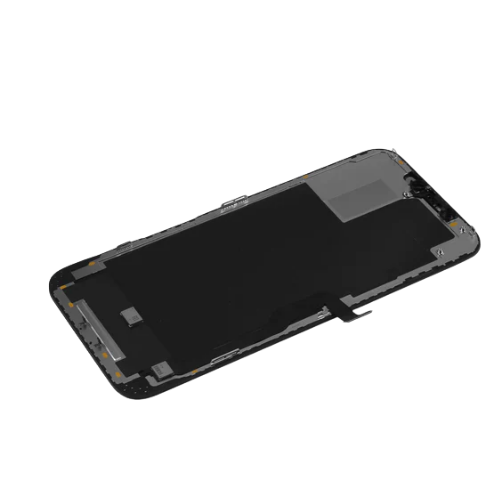
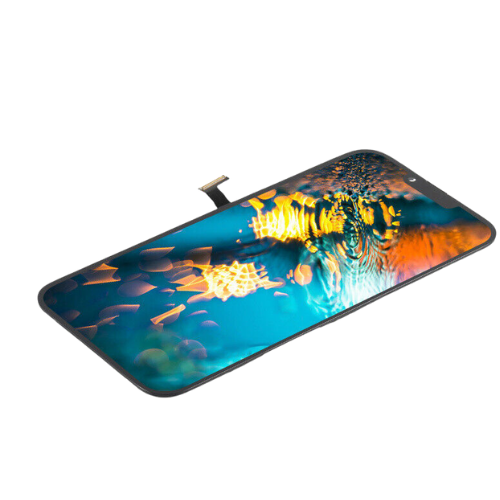
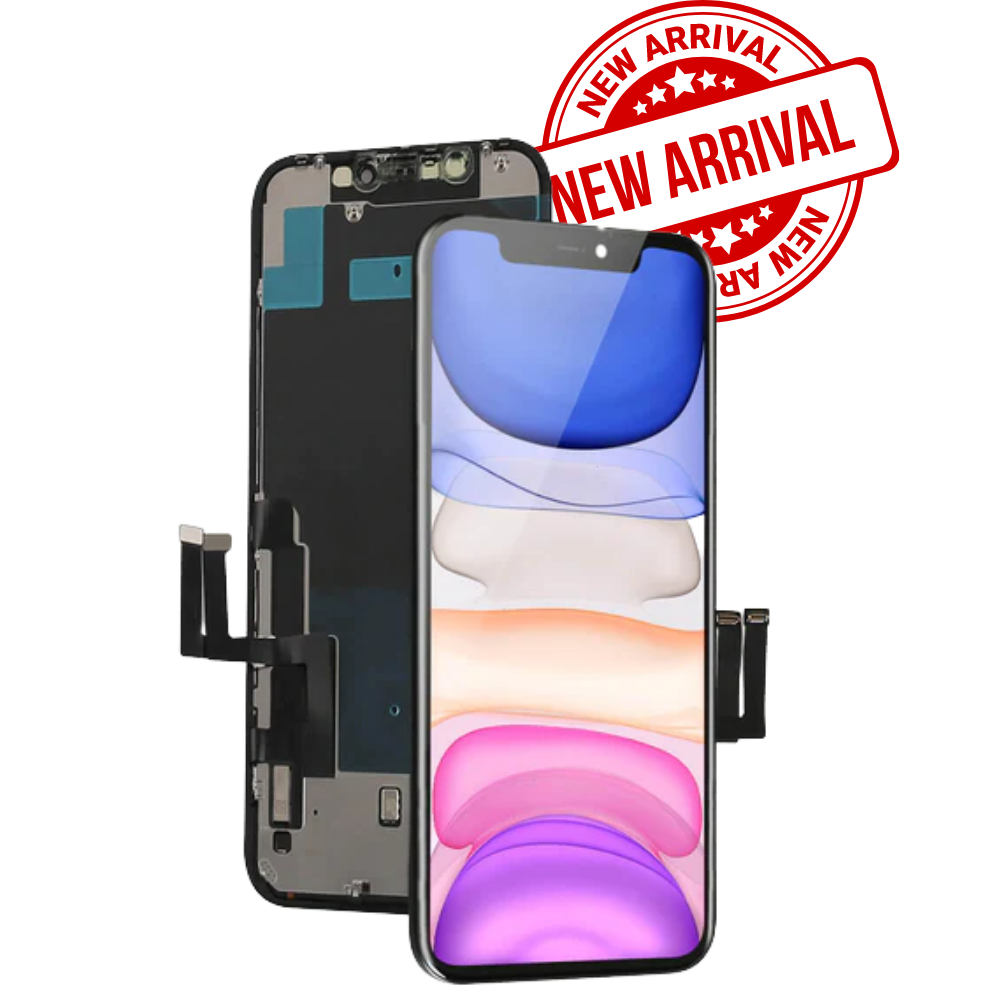
Un conjunto de pantalla completo no es solo un panel de pantalla. Incluye varias capas trabajando juntas..
Lcd, Oleado, Capa táctil, Retroiluminación y estructura de cable flexible
Un conjunto de pantalla Redmi generalmente contiene:
Panel de visualización
El panel crea imágenes y colores.. Los modelos económicos de Redmi suelen utilizar tecnología LCD, mientras que los modelos de gama alta suelen utilizar pantallas AMOLED.
Capa táctil
El digitalizador táctil detecta los movimientos de los dedos y los convierte en señales electrónicas..
Sistema de retroiluminación
Las pantallas LCD requieren un módulo de retroiluminación porque los píxeles de cristal líquido no pueden generar luz de forma independiente..
Cable flexible de pantalla
El cable flexible conecta el conjunto de la pantalla a la placa base.. Transfiere señales de imagen y comandos táctiles..
Las pantallas OLED ofrecen ventajas como:
- Mayor contraste
- Negros más profundos
- Menor consumo de energía
- Diseño más delgado
Las pantallas LCD siguen siendo populares porque proporcionan:
- Menores costos de producción
- Buena durabilidad
- Rendimiento estable
Para empresas de reparación de teléfonos móviles, La calidad de la pantalla LCD de Redmi es uno de los factores más importantes. Las pantallas de repuesto de mala calidad pueden tener problemas como:
- Bajo brillo
- Respuesta táctil débil
- Colores incorrectos
- Corta vida útil
Sistema de batería Redmi: Fuente de energía y protección de seguridad
La batería proporciona energía para cada operación del smartphone.. Los dispositivos Xiaomi Redmi utilizan principalmente baterías de polímero de iones de litio, que proporcionan una alta densidad de energía manteniendo un diseño delgado.
Celdas de batería de litio y tablero de protección de batería
Un módulo de batería Redmi incluye:
Celda de batería
La celda de la batería de litio almacena energía eléctrica..
Placa de circuito de protección (tarjeta de circuito impreso)
El tablero de protección controla la carga y previene situaciones peligrosas como:
- Sobrecarga
- Sobredescarga
- Cortocircuitos
- Temperatura excesiva
Los teléfonos Redmi modernos también incluyen software de administración de batería que monitorea los ciclos de carga y el estado de la batería..
Los problemas de batería se encuentran entre los problemas más comunes en la reparación de teléfonos inteligentes. Los síntomas incluyen:
- Drenaje rápido de la batería
- Apagado repentino
- Carga lenta
- Hinchazón de la batería
El uso de baterías de repuesto de alta calidad es esencial porque las celdas de baja calidad pueden reducir el rendimiento y crear riesgos de seguridad..
Módulo de cámara Redmi: El sistema de imágenes detrás de cada fotografía
El sistema de cámaras se ha convertido en uno de los puntos de venta más importantes de los teléfonos Xiaomi Redmi. Los dispositivos Redmi modernos pueden incluir múltiples módulos de cámara diseñados para diferentes situaciones fotográficas.
Cámara principal, Lente ultra gran angular, Sensores teleobjetivo y CMOS
Un sistema de cámara típico de Redmi puede incluir:
Cámara principal
La cámara principal proporciona la más alta calidad de imagen y normalmente contiene el sensor más grande..
Cámara ultra gran angular
Esta cámara captura escenas más amplias., útil para paisajes y fotografías de grupo.
Cámara teleobjetivo
Los modelos de gama alta pueden incluir teleobjetivos para zoom óptico.
Cámara frontal
La cámara selfie maneja el reconocimiento facial, videollamadas, y fotografía de retrato.
En el corazón de cada módulo de cámara se encuentra el Sensor de imagen CMOS. El sensor convierte la luz en señales digitales.. Los sensores más grandes generalmente capturan más luz y brindan un mejor rendimiento en condiciones de poca luz..
La calidad de la cámara depende de muchos factores.:
- Tamaño del sensor
- Calidad de la lente
- Algoritmo de procesamiento de imágenes
- Estabilización óptica
- Optimización de software
Componentes de audio: Altavoces, Sistema de auricular y micrófono
La calidad del sonido depende de varios componentes pequeños pero importantes..
Micrófonos con reducción de ruido y optimización de la calidad del audio
Los teléfonos Redmi suelen contener:
Orador principal
Ubicado en el marco inferior, proporciona salida de audio externa.
Altavoz auricular
Ubicado cerca de la parte superior del teléfono, permite a los usuarios escuchar llamadas telefónicas.
Sistema de micrófono
Se utilizan varios micrófonos para:
- llamadas de voz
- Grabación de vídeo
- Reducción de ruido
- Asistentes de voz
Muchos modelos de Redmi utilizan micrófonos secundarios para detectar el ruido ambiental y mejorar la claridad de las llamadas.
Puerto de carga y placa secundaria: La interfaz de conexión diaria
El sistema de carga es una de las partes más utilizadas de cualquier smartphone.
Puerto USB tipo C, Placa hija y circuito de carga
La mayoría de los teléfonos Redmi modernos utilizan un Interfaz de carga USB tipo C.
El conjunto de carga suele incluir:
- Conector USB tipo C
- PCB de carga
- Micrófono
- Contactos de antena
- Cables de conexión
Los problemas comunes del puerto de carga incluyen:
- Conexión floja
- Carga lenta
- Sin carga
- Pines del conector dañados
Reemplazar la subplaca de carga suele ser más fácil y económico que reparar la placa base..
Cables flexibles: Las conexiones ocultas dentro de los teléfonos Redmi
Los cables flexibles son conectores electrónicos delgados que permiten que diferentes módulos se comuniquen con la placa base..
Los cables flexibles comunes de Redmi incluyen:
- Cable flexible de pantalla
- Cable flexible de batería
- Cable flexible de cámara
- Flex del botón de encendido
- Flex del botón de volumen
aunque parezcan simples, estos cables son extremadamente importantes. Un cable flexible dañado puede interrumpir la comunicación entre componentes.
Componentes de radiofrecuencia y sistema de señal.
La comunicación móvil depende de un complejo hardware de RF.
Antenas, Wifi, Chips Bluetooth y RF
Los teléfonos Redmi contienen:
- antenas celulares
- módulos wifi
- circuitos bluetooth
- amplificadores de radiofrecuencia
- Chips de procesamiento de señales
Estos componentes permiten que el teléfono se conecte con:
- Redes móviles
- Enrutadores inalámbricos
- Dispositivos Bluetooth
- sistemas gps
Los problemas de mala señal a menudo están relacionados con daños en la antena o problemas con el circuito de RF..
Sistema de refrigeración Redmi: Manejo del calor durante el uso intensivo
Los teléfonos inteligentes de alto rendimiento generan calor durante el juego, cargando, y aplicaciones intensivas.
Película de grafito, Tecnología de refrigeración líquida VC y lámina de cobre
Las soluciones de refrigeración de Redmi pueden incluir:
Película de difusión de calor de grafito
Ayuda a distribuir el calor por todo el cuerpo del teléfono..
Lámina de cobre
Mejora la eficiencia de la transferencia de calor..
Cámara de refrigeración líquida VC
Los modelos Redmi de gama alta utilizan tecnología de cámara de vapor para alejar rápidamente el calor del procesador.
El enfriamiento efectivo mejora:
- Rendimiento de juego
- Vida útil de la batería
- Estabilidad del procesador
Botones, Módulos de huellas dactilares y componentes de sensores
Los componentes pequeños proporcionan funciones esenciales para el usuario..
Botón de encendido, Teclas de volumen, Huellas dactilares y sensores inteligentes
Los conjuntos de botones incluyen:
- Botón de encendido
- Teclas de volumen
- Interruptores flexibles
Las tecnologías de huellas dactilares incluyen:
Sensor de huellas dactilares lateral
Común en muchos modelos de Redmi.
Huella digital óptica debajo de la pantalla
Utilizado en dispositivos AMOLED premium.
Otros sensores incluyen:
- sensor de proximidad
- Sensor de luz ambiental
- Giroscopio
- Acelerómetro
Estos sensores admiten el ajuste automático de brillo, bloqueo de pantalla durante llamadas, detección de movimiento, y funciones de navegación.
Funciones de carga inalámbrica y hardware premium de Redmi
Las bobinas de carga inalámbrica suelen encontrarse en teléfonos inteligentes de gama alta. Permiten cargar sin conexión directa por cable.
El sistema de carga inalámbrica incluye:
- bobina de carga
- circuito de control
- Materiales de blindaje magnético
Aunque muchos modelos de Redmi se centran en la asequibilidad, Los dispositivos premium adoptan cada vez más tecnologías de carga avanzadas..
Cómo los componentes internos de Redmi influyen en la calidad de la reparación
La calidad de los componentes de repuesto afecta directamente los resultados de la reparación.. Una pantalla o batería barata puede reducir los costos de reparación inicialmente pero generar quejas de los clientes más adelante..
Las empresas de reparación profesionales deberían evaluar:
| Componente | Factores de calidad importantes |
|---|---|
| Mostrar | Brillo, precisión táctil, rendimiento del color |
| Batería | Capacidad, seguridad, ciclo de vida |
| Cámara | Calidad de los sensores, precisión de enfoque |
| Tablero de carga | Durabilidad del conector |
| Cable flexible | Estabilidad de la señal |
Los proveedores de repuestos confiables generalmente brindan procedimientos de prueba y garantías de calidad..
Elegir piezas de repuesto confiables para Xiaomi Redmi
Al comprar repuestos Redmi, los compradores deben considerar:
- Reputación del proveedor
- Estándares de prueba de productos
- Precisión de compatibilidad
- Política de garantía
- Atención al cliente
Para negocios mayoristas, Mantener un inventario estable de modelos populares de Redmi puede mejorar la competitividad del mercado..
Conclusión
Los teléfonos Xiaomi Redmi contienen una sofisticada combinación de componentes electrónicos que trabajan juntos para brindar comunicación diaria., entretenimiento, fotografía, y funciones inteligentes. Desde la placa base que controla todo el sistema hasta el conjunto de pantalla con el que los usuarios interactúan todos los días., cada parte juega un papel esencial.
Para técnicos de reparación, distribuidores, y mayoristas de repuestos para teléfonos móviles, comprender los componentes internos de Redmi ayuda a mejorar la selección de productos, precisión de reparación, y servicio al cliente. A medida que la tecnología de los teléfonos inteligentes continúa desarrollándose en 2026, Los dispositivos Redmi seguirán adoptando mejores procesadores, pantallas avanzadas, cámaras mejoradas, y diseños de hardware más inteligentes.
Saber lo que hay dentro de un teléfono Redmi no es solo un conocimiento técnico: es una ventaja valiosa en el creciente mercado de repuestos y reparación de teléfonos inteligentes..
Preguntas frecuentes sobre los componentes internos de Xiaomi Redmi
1. ¿Cuál es el componente más importante dentro de un teléfono Xiaomi Redmi??
La placa base es el componente más importante porque contiene el procesador., memoria, almacenamiento, chips de comunicación, y sistema de gestión de energía.
2. ¿Son intercambiables las pantallas LCD de Xiaomi Redmi y las pantallas AMOLED??
No. Las pantallas LCD y AMOLED utilizan estructuras diferentes, conectores, y sistemas de energía. Las piezas de repuesto deben coincidir exactamente con el modelo de Redmi..
3. ¿Qué piezas de Redmi se reemplazan con más frecuencia??
Las piezas de Redmi reemplazadas con más frecuencia incluyen pantallas, baterias, puertos de carga, camaras, y cables flexibles.
4. ¿Por qué mi teléfono Redmi se sobrecalienta mientras juego??
El sobrecalentamiento puede deberse a la carga del procesador, envejecimiento de la batería, pobre rendimiento de enfriamiento, o componentes internos dañados.
5. ¿Cómo pueden las empresas elegir piezas de repuesto Redmi confiables??
Las empresas deben trabajar con proveedores experimentados que proporcionen una compatibilidad precisa., inspección de calidad, suministro estable, y soporte postventa.