Γιατί έχει σημασία η κατανόηση των οθονών LCD
Όταν οι άνθρωποι αγοράζουν ένα smartphone, συνήθως προσέχουν τον επεξεργαστή, κάμερα, μπαταρία, ή χωρητικότητα αποθήκευσης. Εκπληκτικώς, ένα από τα πιο σημαντικά στοιχεία - η οθόνη - συχνά παραβλέπεται. Ωστόσο, η οθόνη είναι το μέρος με το οποίο αλληλεπιδράτε κάθε μέρα. Είτε διαβάζετε μηνύματα ηλεκτρονικού ταχυδρομείου, βλέποντας βίντεο, περιήγηση στα μέσα κοινωνικής δικτύωσης, ή παίζοντας παιχνίδια, Η οθόνη σας καθορίζει πόσο ευχάριστη και άνετη θα είναι η εμπειρία σας.
Παρόλο που οι οθόνες OLED έχουν γίνει ολοένα και πιο δημοφιλείς στα κορυφαία smartphone, Οι οθόνες LCD συνεχίζουν να κυριαρχούν σε πολλές προσιτές και μεσαίες συσκευές γιατί παρέχουν αξιόπιστη απόδοση, χαμηλότερο κόστος παραγωγής, και εξαιρετική αντοχή. Αναλυτές του κλάδου αναφέρουν ότι το OLED έχει ξεπεράσει 60% των αποστολών smartphone, αλλά οικονομικά τηλέφωνα LCn και την παγκόσμια αγορά επισκευών.
Ας εξερευνήσουμε 10 συναρπαστικά γεγονότα για τις οθόνες LCD των smartphone που πρέπει να γνωρίζει κάθε χρήστης.
Γεγονός #1 – Η οθόνη LCD δεν παράγει από μόνη της φως
Πολλοί άνθρωποι πιστεύουν ότι οι πολύχρωμες εικόνες σε μια οθόνη LCD προέρχονται απευθείας από τα ίδια τα pixel. Πράγματι, αυτό δεν είναι αλήθεια.
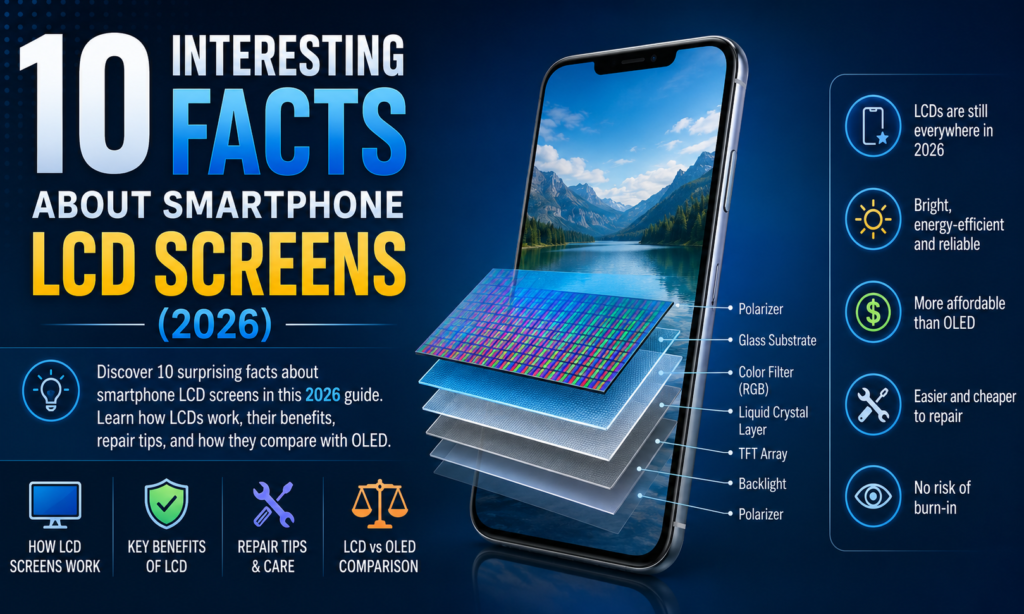
LCD σημαίνει Οθόνη υγρού κρυστάλλου. Σε αντίθεση με την τεχνολογία OLED, Τα εικονοστοιχεία LCD δεν μπορούν να εκπέμπουν φως ανεξάρτητα. Αντί, ένας ισχυρός οπίσθιος φωτισμός LED βρίσκεται πίσω από την οθόνη και λάμπει μέσα από εκατομμύρια κυψέλες υγρών κρυστάλλων. Αυτοί οι κρύσταλλοι συστρέφονται και περιστρέφονται για να ελέγχουν πόσο φως περνά από κάθε pixel, δημιουργώντας τις εικόνες που βλέπετε.
Πώς λειτουργεί ο οπίσθιος φωτισμός
Σκεφτείτε την LCD ως ένα παράθυρο με ρυθμιζόμενα στόρια. Ο οπίσθιος φωτισμός λειτουργεί σαν το φως του ήλιου έξω, ενώ οι υγροί κρύσταλλοι λειτουργούν σαν μικροσκοπικά στόρια παραθύρων που ανοίγουν και κλείνουν για να ελέγχουν τη φωτεινότητα και το χρώμα.
Επειδή η οθόνη LCD βασίζεται πάντα σε έναν οπίσθιο φωτισμό, Οι μαύρες περιοχές δεν είναι ποτέ εντελώς μαύρες. Αυτός είναι ένας λόγος που η OLED προσφέρει βαθιά φωτεινότητα και χαμηλότερο κόστος παραγωγής.
Γεγονός #2 – Η IPS LCD είναι πολύ καλύτερη από την παραδοσιακή TFT LCD
Δεν δημιουργούνται όλες οι οθόνες LCD ίσες.
Παλαιότερα smartphone που χρησιμοποιούνται συνήθως TFT LCD πάνελ, που ήταν φθηνά αλλά υπέφεραν από στενές γωνίες θέασης και ξεπλυμένα χρώματα. Τα σύγχρονα smartphone συνήθως χρησιμοποιούν IPS LCD (Εναλλαγή εντός αεροπλάνου) τεχνολογία, που βελτιώνει δραματικά την ποιότητα της εικόνας.
Γωνίες θέασης και ακρίβεια χρώματος
Τα πάνελ IPS LCD επιτρέπουν στους χρήστες να βλέπουν την οθόνη από σχεδόν οποιαδήποτε γωνία χωρίς σημαντική χρωματική παραμόρφωση. Παρέχουν επίσης ακριβέστερη αναπαραγωγή χρωμάτων, κάνοντας φωτογραφίες, βίντεο, και οι ιστότοποι φαίνονται πολύ πιο φυσικοί.
Σήμερα, Η IPS LCD έχει γίνει η τυπική τεχνολογία LCD για την αξιοπιστία των smartphones, και προσιτές τιμές εξαιρετικά καλά.
Γεγονός #3 – Η υψηλότερη ανάλυση δεν σημαίνει πάντα καλύτερη οθόνη
Πολλοί αγοραστές υποθέτουν αυτόματα ότι υψηλότερη ανάλυση ισοδυναμεί με καλύτερη οθόνη.
Ενώ Full HD+, 2Κ, και ακόμη και οι αναλύσεις 4K ακούγονται εντυπωσιακές, πυκνότητα εικονοστοιχείων (PPI) συχνά έχει μεγαλύτερη σημασία από την ακατέργαστη ανάλυση. Μόλις φτάσει ένα smartphone περίπου 400– 500 pixel ανά ίντσα, Τα μεμονωμένα εικονοστοιχεία καθίστανται σχεδόν αδύνατο να τα διακρίνει το ανθρώπινο μάτι κατά την κανονική χρήση.
Αντί να κυνηγάμε την υψηλότερη ανάλυση, οι καταναλωτές θα πρέπει επίσης να αξιολογήσουν:
| Χαρακτηριστικό | Γιατί έχει σημασία |
|---|---|
| Λάμψη | Καλύτερη ορατότητα σε εξωτερικούς χώρους |
| Ακρίβεια χρώματος | Περισσότερες φυσικές εικόνες |
| Αντίθεση | Βελτιωμένη εμπειρία θέασης |
| Ρυθμός ανανέωσης | Πιο ομαλή κύλιση |
| Αγγίξτε Απόκριση | Καλύτερη εμπειρία παιχνιδιού |
Μια ισορροπημένη εμπειρία usld οθόνης από το να έχετε απλώς περισσότερα pixel. citeturn0search5turn0search2
Γεγονός #4 – Η φωτεινότητα είναι πιο σημαντική από ό,τι πολλοί άνθρωποι συνειδητοποιούν
Έχετε δυσκολευτεί ποτέ να διαβάσετε το τηλέφωνό σας κάτω από το έντονο ηλιακό φως?
Το πρόβλημα συχνά δεν είναι η επίλυση - είναι φωτεινότητα οθόνης.
Κατανόηση Νιτς
Η φωτεινότητα μετριέται σε κόνιδες.
Γενικά:
- 400–500 nits = αποδεκτό σε εσωτερικούς χώρους
- 500–700 nits = καλή ορατότητα σε εξωτερικούς χώρους
- 800+ κόνιδες = εξαιρετική απόδοση στο ηλιακό φως
Οι σύγχρονες οθόνες IPS LCD μπορούν να επιτύχουν εντυπωσιακή διαρκή φωτεινότητα, καθιστώντας τα ιδιαίτερα πρακτικά για εργαζόμενους σε εξωτερικούς χώρους, Η παράδοση χρησιμοποιεί το τηλέφωνό τους σε άμεσο ηλιακό φως.
Γεγονός #5 – Οι οθόνες LCD δεν παρουσιάζουν μόνιμη καύση
Ένα από τα μεγαλύτερα πλεονεκτήματα της LCD είναι η αντοχή της σε καύση οθόνης.
Το Burn-in συμβαίνει όταν οι στατικές εικόνες παραμένουν ορατές μετά την εμφάνιση για μεγάλα χρονικά διαστήματα. Επειδή τα εικονοστοιχεία LCD βασίζονται σε κοινόχρηστο οπίσθιο φωτισμό και όχι σε φως που εκπέμπει μόνο του, Η μόνιμη καύση είναι εξαιρετικά σπάνια.
Αυτό καθιστά τις οθόνες LCD εξαιρετική επιλογή για χρήστες που εμφανίζουν συχνά:
- Πλοήγηση GPS
- Στατικοί πίνακες εργαλείων
- Επιχειρηματικές εφαρμογές
- Παρακολούθηση ασφαλείας
- Συστήματα σημείων πώλησης
Οι οθόνες OLED παρέχουν πλουσιότερο τρόπο διατήρησης της εικόνας υπό ορισμένες συνθήκες.
Γεγονός #6 – Ένα σπασμένο γυαλί δεν σημαίνει πάντα ότι η οθόνη LCD είναι σπασμένη
Πολλοί ιδιοκτήτες smartphone πανικοβάλλονται μετά την πτώση του τηλεφώνου τους.
Ευτυχώς, το μπροστινό τζάμι, ψηφιοποιητής αφής, και η οθόνη LCD είναι διαφορετικά εξαρτήματα.
Γυαλί έναντι LCD έναντι πάνελ αφής
Ένα κατεστραμμένο τηλέφωνο μπορεί να έχει:
| Συστατικό | Συμπτώματα |
|---|---|
| Μπροστινό τζάμι | Μόνο ρωγμές |
| Ψηφιοποιητής αφής | Το άγγιγμα σταματά να λειτουργεί |
| Οθόνη οθόνης | Μαύρα στίγματα, χρωματιστές γραμμές, καμία οθόνη |
Εάν μόνο το γυαλί έχει ραγίσει ενώ η οθόνη και το άγγιγμα παραμένουν κανονικά, Οι επισκευές ενδέχεται να κοστίζουν πολύ λιγότερο από την αντικατάσταση της πλήρους διάταξης οθόνης.
Οι επαγγελματίες τεχνικοί πάντα διαγιγνώσκουν ποιο στρώμα έχει αποτύχει πριν προτείνουν επισκευές.
Γεγονός #7 – Οι φθηνές οθόνες αντικατάστασης LCD μπορεί να διαφέρουν πολύ σε ποιότητα
Δεν προσφέρει κάθε οθόνη αντικατάστασης την ίδια απόδοση.
Οι χαμηλού κόστους οθόνες aftermarket ενδέχεται να υποφέρουν από:
- Χαμηλότερη φωτεινότητα
- Κακή βαθμονόμηση χρώματος
- Πιο αργή απόκριση αφής
- Υψηλότερη κατανάλωση ενέργειας
- Μικρότερη διάρκεια ζωής
Οι ανταλλακτικές οθόνες υψηλής ποιότητας aftermarket ή ποιότητας OEM προσφέρουν γενικά καλύτερη ανθεκτικότητα και εμπειρία χρήστη πολύ πιο κοντά στην αρχική οθόνη. Οι επαγγελματίες επισκευών συνιστούν σταθερά να επικεντρώνονται αποκλειστικά στην τιμή.
Γεγονός #8 – Η ζημιά από το νερό δεν μπορεί να σκοτώσει αμέσως μια οθόνη LCD
Πολλοί χρήστες πιστεύουν ότι εάν ένα τηλέφωνο εξακολουθεί να λειτουργεί αφού βραχεί, όλα είναι καλά.
Πράγματι, η υγρασία μπορεί να διαβρώσει αργά τους συνδέσμους της οθόνης, ολοκληρωμένα κυκλώματα, και εξαρτήματα οπίσθιου φωτισμού για ημέρες ή και εβδομάδες.
Τα κοινά προειδοποιητικά σημάδια περιλαμβάνουν:
- Οθόνη που τρεμοπαίζει
- Τυχαία μαύρα στίγματα
- Κάθετες γραμμές
- Ανομοιόμορφη φωτεινότητα
- Αποτυχία αφής
Το άμεσο στέγνωμα και ο επαγγελματικός έλεγχος αυξάνουν σημαντικά την πιθανότητα αποτροπής μόνιμης βλάβης.
Γεγονός #9 – Τα προστατευτικά οθόνης αποτρέπουν κυρίως τις γρατσουνιές
Ένα προστατευτικό σκληρυμένου γυαλιού είναι εξαιρετικά χρήσιμο — αλλά έχει περιορισμούς.
Προστατεύει από:
- Κλειδιά
- Νομίσματα
- Σωματίδια άμμου
- Καθημερινές γρατσουνιές
Ωστόσο, το δεν μπορεί να εγγυηθεί προστασία από ισχυρές κρούσεις. Μια σοβαρή πτώση μπορεί να ραγίσει την εσωτερική οθόνη LCD ακόμα κι αν το προστατευτικό οθόνης παραμένει άθικτο.
Η καλύτερη προστασία συνδυάζεται:
- σκληρυμένο γυαλί
- Θήκη τηλεφώνου ανθεκτική στους κραδασμούς
- Προσεκτικός χειρισμός
Γεγονός #10 – Οι καλές καθημερινές συνήθειες μπορούν να παρατείνουν τη διάρκεια ζωής της LCD
Οι οθόνες LCD είναι εκπληκτικά ανθεκτικές όταν συντηρούνται σωστά.
Οι απλές συνήθειες περιλαμβάνουν:
- Αποφύγετε την έκθεση του τηλεφώνου σε υπερβολική ζέστη.
- Κρατήστε τη θύρα φόρτισης στεγνή.
- Καθαρίστε την οθόνη με ένα πανί μικροϊνών.
- Αποφύγετε να κάθεστε στο τηλέφωνο.
- Χρησιμοποιήστε ποιοτικούς φορτιστές για να αποτρέψετε την ηλεκτρική αστάθεια.
- Αποθηκεύστε τη συσκευή σε προστατευτική θήκη.
Αυτές οι μικρές συνήθειες μπορούν να μειώσουν σημαντικά τις τυχαίες ζημιές και να παρατείνουν τη διάρκεια ζωής της οθόνης του smartphone σας.
LCD έναντι OLED: Γρήγορη σύγκριση
| Χαρακτηριστικό | IPS LCD | OLED |
|---|---|---|
| Πηγή φωτός | Οπίσθιος φωτισμός LED | Pixel που εκπέμπουν μόνοι τους |
| Μαύρο Επίπεδο | Καλός | Εξοχος |
| Φωτεινότητα εξωτερικού χώρου | Εξοχος | Εξοχος |
| Κίνδυνος εγκαυμάτων | Κανένας | Δυνατός |
| Κόστος επισκευής | Χαμηλότερος | Πιο ψηλά |
| Κόστος Παραγωγής | Χαμηλότερος | Πιο ψηλά |
| Αποδοτικότητα μπαταρίας | Σταθερός | Εξαρτάται από το Περιεχόμενο |
| Πάχος | Πιο παχύ | Λεπτότερος |
Ενώ η OLED κυριαρχεί στα premium smartphones, Η IPS LCD παραμένει μια εξαιρετική καθημερινή απόδοση. citeturn0search0turn0search1turn0search3
Σύναψη
Η τεχνολογία LCD των smartphone έχει εξελιχθεί δραματικά τις τελευταίες δύο δεκαετίες. Οι σημερινές οθόνες IPS LCD προσφέρουν ζωντανά χρώματα, ευρείες γωνίες θέασης, εξαιρετική φωτεινότητα, και αξιόπιστη απόδοση που ικανοποιεί εκατομμύρια χρήστες παγκοσμίως. Αν και η OLED συνεχίζει να επεκτείνεται σε κορυφαίες συσκευές, Η οθόνη LCD παραμένει μια βασική τεχνολογία για οικονομικά smartphone, εκπαιδευτικές συσκευές, επιχειρησιακός εξοπλισμός, και την παγκόσμια βιομηχανία επισκευής.
Η κατανόηση αυτών των δέκα γεγονότων βοηθά τους καταναλωτές να λαμβάνουν πιο έξυπνες αποφάσεις αγοράς, επιλέξτε οθόνες αντικατάστασης υψηλότερης ποιότητας, και να προστατεύουν καλύτερα τις συσκευές τους. Είτε αγοράζετε ένα νέο τηλέφωνο είτε επισκευάζετε ένα παλιό, Η γνώση του τρόπου λειτουργίας της τεχνολογίας LCD σάς επιτρέπει να εξισορροπείτε την απόδοση, αντοχή, και κοστίζει με σιγουριά.
Συχνές Ερωτήσεις
1. Είναι το IPS LCD καλύτερο από το TFT LCD?
Ναί. Το IPS LCD παρέχει ευρύτερες γωνίες θέασης, καλύτερη χρωματική ακρίβεια, και βελτιωμένη ποιότητα εικόνας σε σύγκριση με την παραδοσιακή TFT LCD.
2. Μπορεί οι οθόνες LCD να υποστούν καύση?
Το μόνιμο burn-in είναι εξαιρετικά ασυνήθιστο στις οθόνες LCD, επειδή χρησιμοποιούν ξεχωριστό οπίσθιο φωτισμό αντί για εικονοστοιχεία που εκπέμπουν μόνοι τους.
3. Γιατί οι οθόνες αντικατάστασης LCD είναι φθηνότερες από τις OLED?
Η κατασκευή LCD είναι πιο ώριμη και λιγότερο δαπανηρή, καθιστώντας τις επισκευές σημαντικά πιο προσιτές.
4. Μπορεί μια ραγισμένη οθόνη να έχει ακόμα λειτουργική οθόνη LCD?
Ναί. Μερικές φορές σπάει μόνο το μπροστινό τζάμι ενώ οι λειτουργίες LCD και αφής παραμένουν πλήρως λειτουργικές.
5. Πώς μπορώ να κάνω την οθόνη LCD μου να διαρκέσει περισσότερο?
Χρησιμοποιήστε μια ποιοτική θήκη τηλεφώνου, εγκαταστήστε προστασία από σκληρυμένο γυαλί, αποφύγετε την έκθεση στο νερό και τις ακραίες θερμοκρασίες, και καθαρίζετε τακτικά την οθόνη με ένα πανί από μικροΐνες.