Table of Contents
- Εισαγωγή: Why Mobile Phone Screen Materials Matter
- Understanding the Basic Structure of a Smartphone Screen
- TFT LCD: The Traditional Mobile Phone Display Technology
- IPS LCD: Better Viewing Angles and Color Performance
- OLED: The Evolution of Smartphone Display Technology
- AMOLED: Why Active-Matrix OLED Is So Popular
- Super AMOLED and Dynamic AMOLED: Advanced Samsung Display Technologies
- LTPO ΕΙΣΑΙ: The Future of Power-Efficient Smartphone Displays
- Other Display Technologies: Μίνι-LED, MicroLED, and Flexible OLED
- Mobile Phone Screen Materials Compared: Βασικές Διαφορές
- Mobile Phone Screen Material Ranking: Which Technology Is Best?
- Screen Durability, Διάρκεια ζωής, and Common Quality Problems
- How to Choose the Right Replacement Mobile Phone Screen
- Wholesale Mobile Phone Screen Sourcing: Ποιότητα, Τιμή, and Supplier Selection
- Μελλοντικές τάσεις στην τεχνολογία εμφάνισης smartphone
Εισαγωγή: Why Mobile Phone Screen Materials Matter
The smartphone display is one of the most important components of any mobile phone. It is the primary interface between users and their devices, influencing everything from visual experience and touch responsiveness to battery consumption and overall product value. Whether someone is purchasing a new smartphone, repairing a damaged device, or sourcing replacement screens for a wholesale business, understanding mobile phone screen materials is essential.
Over the past two decades, smartphone display technology has developed rapidly. Early mobile phones primarily used basic TFT LCD screens, which offered relatively simple color reproduction and limited viewing angles. As technology advanced, IPS LCD panels became popular because they provided better viewing angles and more consistent image quality.
The introduction of OLED technology marked another major milestone. Unlike traditional LCD screens, which require a backlight to illuminate pixels, OLED displays use self-emissive organic materials. Κάθε pixel παράγει το δικό του φως, allowing for deeper blacks, υψηλότερους λόγους αντίθεσης, thinner display structures, and more flexible designs.
Σήμερα, AMOLED, Super AMOLED, Δυναμική AMOLED, and LTPO OLED technologies are widely used in smartphones across different price segments. These technologies have improved brightness, ρυθμούς ανανέωσης, ενεργειακή απόδοση, ακρίβεια χρώματος, and display flexibility.
Ωστόσο, many consumers and mobile phone repair businesses still have questions:
- What is the difference between TFT LCD and IPS LCD?
- Είναι το OLED καλύτερο από το LCD?
- What makes AMOLED different from standard OLED?
- Is Super AMOLED better than regular AMOLED?
- Why are LTPO OLED screens considered advanced?
- Which mobile phone screen material offers the best overall performance?
- Which screen technology is most suitable for replacement and wholesale purchasing?
These questions are particularly important in the mobile phone repair and accessories industry. A screen that looks similar to the original may have significant differences in brightness, αναπαραγωγή χρώματος, ευαισθησία αφής, πάχος, κατανάλωση ρεύματος, και αντοχή.
Για χονδρεμπόρους, διανομείς, συνεργεία επισκευής, and importers, choosing the correct screen technology is not simply about finding the lowest price. It is about balancing product quality, αρμονία, manufacturing consistency, προσδοκίες των πελατών, and long-term profitability.
Another important consideration is that the terms used in the smartphone display industry do not always describe the same technical characteristics. Για παράδειγμα, OLED describes the light-emitting technology, while AMOLED describes the pixel-driving architecture. IPS refers to an LCD panel technology, while LTPO describes a backplane technology that enables more flexible refresh-rate management.
Understanding these distinctions helps buyers avoid confusion when comparing different products and communicating with suppliers.
This comprehensive guide explores the major types of mobile phone screen materials and display technologies, explains their advantages and disadvantages, and provides a practical ranking based on image quality, εκτέλεση, ενεργειακή απόδοση, αντοχή, and commercial value.
By the end of this article, readers will have a clearer understanding of smartphone display technology and will be better equipped to select suitable screens for personal use, mobile phone repairs, or wholesale distribution.
1. Understanding the Basic Structure of a Smartphone Screen
Before comparing different mobile phone screen materials, it is important to understand how a smartphone display is constructed.
A modern smartphone screen is not simply a single piece of glass. It is a combination of multiple layers, each performing a specific function.
Although the exact construction varies depending on the manufacturer and display technology, a typical smartphone display assembly may include the following components.
1.1 Γυαλί κάλυψης
The cover glass is the outermost protective layer of a smartphone screen. It protects the display panel from scratches, minor impacts, and everyday wear.
Common cover glass technologies include:
- Chemically strengthened glass.
- Aluminosilicate glass.
- Gorilla Glass.
- Ceramic-based glass composites.
The quality of the cover glass affects scratch resistance, impact resistance, διαφάνεια, and the overall appearance of the display.
It is important to distinguish cover glass from display material. A smartphone can use OLED or LCD technology while having a separate protective glass layer.
1.2 Αγγίξτε το Επίπεδο αισθητήρα
The touch sensor detects finger movements and converts them into electrical signals that the smartphone processor can interpret.
Most modern smartphones use capacitive touch technology. This technology detects changes in the electrical field when a finger touches the screen.
The touch sensor may be integrated into the display structure or manufactured as a separate layer.
Common configurations include:
- In-Cell: Touch sensors are integrated into the LCD panel structure.
- On-Cell: Touch sensors are positioned on top of the display panel.
- External Touch Layer: A separate touch panel is used in the display assembly.
These configurations affect display thickness, manufacturing complexity, απόδοση αφής, and replacement compatibility.
1.3 Πίνακας εμφάνισης
The display panel is the core component responsible for producing images.
Depending on the smartphone model, the panel may use:
- TFT LCD technology.
- IPS LCD technology.
- Τεχνολογία OLED.
- Τεχνολογία AMOLED.
- LTPO AMOLED technology.
The display panel determines important characteristics such as brightness, αντίθεση, αναπαραγωγή χρώματος, γωνίες θέασης, and response time.
1.4 Σύστημα οπίσθιου φωτισμού
LCD displays require a backlight because liquid crystals cannot generate light independently.
The backlight usually consists of LED light sources and optical components that distribute light across the display.
OLED and AMOLED displays do not require a conventional backlight system because their pixels generate light independently.
This fundamental difference explains why OLED displays can achieve deeper blacks and thinner panel structures. LG BE_FR+2
1.5 IC προγράμματος οδήγησης οθόνης
The display driver integrated circuit controls the electrical signals sent to the display pixels.
It helps manage:
- Image data transmission.
- Pixel brightness.
- Refresh timing.
- Display scanning.
- Color output.
A compatible display driver is essential for proper screen operation. Even if two replacement screens have similar dimensions, they may not be interchangeable because of differences in connectors, IC του προγράμματος οδήγησης, communication protocols, and firmware compatibility.
2. TFT LCD: The Traditional Mobile Phone Display Technology
TFT LCD stands for Thin-Film Transistor Liquid Crystal Display. It is one of the traditional technologies used in mobile phones and remains relevant in budget smartphones and replacement screen markets.
TFT LCD uses liquid crystals to control the amount of light passing through each pixel. Because liquid crystals do not produce light themselves, the display requires a separate backlight.
Each pixel is controlled by thin-film transistors, allowing the display to produce images and videos.
2.1 Advantages of TFT LCD
1. Affordable manufacturing costs
TFT LCD technology has an established manufacturing ecosystem. Its relatively mature production processes make it suitable for cost-sensitive smartphones and replacement screen products.
2. Σταθερή φωτεινότητα
LCD screens can maintain relatively consistent brightness because they use a backlight system.
3. No typical OLED burn-in
TFT LCD screens do not experience organic pixel degradation and image retention in the same way as OLED displays.
4. Suitable for budget replacement markets
For customers who prioritize affordability, TFT LCD replacement screens can provide a practical solution.
2.2 Disadvantages of TFT LCD
Παρά τα πλεονεκτήματά του, traditional TFT LCD technology has several limitations.
- Viewing angles may be narrower than those of IPS LCD and OLED.
- Black levels and contrast are generally inferior to OLED.
- The backlight system requires additional space.
- Power consumption can be relatively high, especially when displaying bright content.
- Color consistency may vary depending on panel quality.
2.3 Applications
TFT LCD technology is commonly associated with:
- Entry-level smartphones.
- Older smartphone models.
- Economical replacement displays.
- Budget-oriented repair solutions.
Για αγοραστές χονδρικής, TFT LCD screens can be attractive because of their competitive pricing and suitability for customers who do not require premium display performance.
3. IPS LCD: Better Viewing Angles and Color Performance
IPS stands for In-Plane Switching. It is a type of LCD technology designed to improve viewing angles and color consistency.
Unlike traditional LCD arrangements, IPS technology controls liquid crystal movement within the plane of the display. This allows the screen to maintain more consistent colors when viewed from different angles.
IPS LCD became popular in smartphones because it offers a good balance between visual performance, manufacturing cost, και αξιοπιστία.
3.1 Advantages of IPS LCD
Ευρείες γωνίες θέασης
IPS displays generally provide better viewing angles than traditional TN-style LCD panels. Users can view the screen from different directions without experiencing significant color distortion.
Good color reproduction
IPS technology can provide accurate and natural-looking colors when properly calibrated.
Stable image quality
IPS LCD panels generally offer consistent image quality and do not suffer from conventional OLED burn-in.
Ανταγωνιστική τιμολόγηση
IPS LCD manufacturing is relatively mature, making it an attractive option for budget and mid-range smartphone models.
3.2 Disadvantages of IPS LCD
IPS LCD still relies on a backlight, which creates several limitations.
- Black areas may appear dark gray rather than completely black.
- Contrast is generally lower than OLED.
- The display assembly can be thicker than comparable OLED panels.
- Backlight leakage may occur in some low-quality panels.
- Power consumption depends partly on the backlight and brightness level.
3.3 IPS LCD VS. TFT LCD
| Σύγκριση | Traditional TFT LCD | IPS LCD |
|---|---|---|
| Γωνίες θέασης | Generally narrower | Generally wider |
| Συνοχή χρώματος | Varies | Generally better |
| Αντίθεση | Μέτριος | Μέτριος |
| Black performance | Περιωρισμένος | Περιωρισμένος |
| Manufacturing cost | Χαμηλός | Χαμηλή έως μέτρια |
| Κίνδυνος εγκαυμάτων | No typical OLED burn-in | No typical OLED burn-in |
| Main applications | Τηλέφωνα προϋπολογισμού | Budget and mid-range phones |
It is worth noting that IPS is itself a type of TFT LCD. Επομένως, comparing TFT and IPS as completely separate technologies can be misleading. The distinction usually refers to the specific LCD panel architecture.
4. OLED: The Evolution of Smartphone Display Technology
Το OLED σημαίνει Organic Light-Emitting Diode.
It represents a major development in smartphone display technology because it changes the way light is generated.
Σε αντίθεση με τα πάνελ LCD, OLED displays do not require a conventional backlight. Each pixel contains organic light-emitting materials that produce light when electrical current passes through them.
When a pixel needs to display black, it can be switched off completely.
This creates several important advantages.
4.1 Πλεονεκτήματα της OLED
1. Excellent contrast ratio
OLED technology provides excellent contrast because individual pixels can turn off independently.
This makes black backgrounds appear truly black and creates a more immersive viewing experience.
2. Rich color performance
OLED panels can deliver vibrant colors and a wide color gamut.
Depending on the panel design and calibration, they can also provide highly accurate color reproduction.
3. Thin and lightweight construction
Without a conventional backlight assembly, OLED panels can be manufactured with thinner and lighter structures.
4. Γρήγορος χρόνος απόκρισης
OLED pixels can change their light output very quickly, making the technology suitable for high-refresh-rate displays and gaming applications.
5. Flexible display designs
Some OLED panels use flexible plastic substrates, enabling curved-edge smartphones and foldable devices.
4.2 Μειονεκτήματα της OLED
OLED technology also has limitations.
Κίνδυνος εγκαυμάτων
Organic light-emitting materials gradually degrade with use. If the same static content remains visible for extended periods, uneven pixel aging may result in permanent image retention or burn-in.
Higher manufacturing costs
OLED manufacturing generally involves more demanding production processes and material requirements than conventional LCD.
Potential color aging
Different organic subpixels can degrade at different rates, potentially affecting color balance over time.
Repair costs
OLED replacement screens can be more expensive than LCD alternatives, particularly for premium smartphones and flexible panels.
4.3 Where Is OLED Used?
OLED technology is widely used in:
- Premium smartphones.
- Flagship Android devices.
- High-end iPhones.
- Αναδιπλούμενα smartphones.
- High-performance mobile gaming devices.
For replacement screen distributors, OLED products are important because many premium smartphone models originally use OLED panels.
5. AMOLED: Why Active-Matrix OLED Is So Popular
AMOLED stands for Active-Matrix Organic Light-Emitting Diode.
AMOLED is not an entirely different light-emitting technology from OLED. Αντί, it refers to an OLED display that uses an active-matrix driving system to control its pixels.
In an active-matrix display, thin-film transistors and associated circuitry control individual pixels.
This architecture enables precise pixel control and makes high-resolution, high-refresh-rate smartphone displays practical.
5.1 Advantages of AMOLED
Excellent image quality
AMOLED displays provide deep blacks, strong contrast, και ζωηρά χρώματα.
Fast response performance
The technology is well suited to high-speed animations, τυχερό παιχνίδι, και αναπαραγωγή βίντεο.
Thin display construction
AMOLED panels do not require conventional LCD backlights, allowing thinner display designs.
Flexible manufacturing possibilities
AMOLED panels can be produced using flexible substrates, supporting curved and foldable smartphone designs.
Always-On Display support
Because individual pixels can be turned off, AMOLED technology is suitable for displaying limited information while keeping most of the screen dark.
5.2 Disadvantages of AMOLED
- More expensive than many conventional LCD solutions.
- Potential burn-in after prolonged use.
- Quality varies between manufacturers and panel grades.
- Some users may notice flicker at low brightness, depending on the dimming method.
- Replacement panels require careful compatibility verification.
5.3 OLED vs. AMOLED: Ποια είναι η διαφορά?
| Χαρακτηριστικό | OLED | AMOLED |
|---|---|---|
| Full name | Οργανική δίοδος εκπομπής φωτός | Οργανική δίοδος εκπομπής φωτός Active-Matrix |
| Light generation | Αυτοεκπεμπόμενα εικονοστοιχεία | Αυτοεκπεμπόμενα εικονοστοιχεία |
| Pixel control | Depends on driving architecture | Active-matrix control |
| Αντίθεση | Εξοχος | Εξοχος |
| Response time | Γρήγορα | Γρήγορα |
| Smartphone applications | Broad | Very common |
| Flexible design | Δυνατός | Δυνατός |
The most important point is that AMOLED is a type of OLED display. Most modern smartphone OLED panels use active-matrix driving technology.
Επομένως, AMOLED should not be interpreted as a completely separate technology competing directly with OLED. Gadgets 360+2
6. Super AMOLED and Dynamic AMOLED: Advanced Display Technologies
Samsung has introduced several branded display technologies based on AMOLED architecture.
Two commonly discussed terms are Super AMOLED and Dynamic AMOLED.
Although these names sound like entirely different screen materials, they are primarily descriptions of display implementations and feature sets.
6.1 Super AMOLED
Super AMOLED is a Samsung display technology that integrates touch functionality into the display panel structure.
This design helps reduce the number of separate layers and can improve screen thickness, ανταπόκριση στην αφή, and outdoor visibility.
Φόντα
- Integrated touch functionality.
- Thin display construction.
- Excellent contrast.
- Ζωντανά χρώματα.
- Good touch performance.
Μειονεκτήματα
- Higher replacement costs than many LCD panels.
- Potential OLED burn-in.
- Repair and manufacturing complexity.
- Quality depends on the specific panel generation.
6.2 Δυναμική AMOLED
Dynamic AMOLED is another Samsung branding term associated with advanced AMOLED displays.
Depending on the generation, these displays incorporate improvements in areas such as:
- Color reproduction.
- Απόδοση HDR.
- Λάμψη.
- Eye comfort features.
- Display power efficiency.
Dynamic AMOLED 2X is commonly associated with Samsung’s premium smartphone displays and high-refresh-rate capabilities.
Ωστόσο, it is important to understand that Dynamic AMOLED is not a completely new light-emitting material. It is an advanced AMOLED implementation.
6.3 Super AMOLED vs. Δυναμική AMOLED
| Χαρακτηριστικό | Super AMOLED | Δυναμική AMOLED |
|---|---|---|
| Core technology | AMOLED | AMOLED |
| Touch integration | Ολοκληρωμένος | Depends on implementation |
| Απόδοση χρώματος | Εξοχος | Advanced color features |
| HDR features | Εξαρτάται από το μοντέλο | Available on supported models |
| Applications | Smartphones | Premium smartphones |
| Technology category | AMOLED implementation | AMOLED branding and feature set |
For replacement screen wholesalers, the exact smartphone model and original display specifications matter more than the marketing name alone.
7. LTPO ΕΙΣΑΙ: Advanced Power-Efficient Smartphone Displays
Το LTPO σημαίνει πολυκρυσταλλικό οξείδιο χαμηλής θερμοκρασίας.
It is a backplane technology used in advanced OLED displays. It combines different thin-film transistor technologies to support more flexible display driving and adaptive refresh rates.
Unlike standard OLED, which describes how a display produces light, LTPO describes aspects of how the display’s pixels are electrically controlled.
7.1 Πώς λειτουργεί το LTPO
A smartphone screen refreshes its image many times per second.
Για παράδειγμα:
- 60Hz means the screen refreshes 60 φορές το δευτερόλεπτο.
- 90Hz σημαίνει 90 refreshes per second.
- 120Hz σημαίνει 120 refreshes per second.
Higher refresh rates generally provide smoother scrolling and animations, but they can increase power consumption.
LTPO technology allows compatible displays to adjust their refresh rates according to the displayed content.
Για παράδειγμα:
- Reading static text may require a very low refresh rate.
- Watching videos may use an intermediate refresh rate.
- Playing fast-paced games may require a higher refresh rate.
Some LTPO displays support refresh rates ranging from approximately 1Hz to 120Hz, although the actual operating range depends on the device and panel implementation. developer.huawei.com+1
7.2 Advantages of LTPO OLED
- Adaptive refresh-rate management.
- Potentially lower display power consumption.
- Smooth scrolling and animations.
- Support for advanced always-on display functions.
- Improved flexibility in premium smartphone display design.
7.3 Disadvantages of LTPO OLED
- More complicated panel manufacturing.
- Higher production costs.
- More demanding display driver and system integration.
- Not all LTPO displays offer identical refresh-rate ranges or power savings.
7.4 Applications
LTPO technology is commonly associated with premium smartphone displays and flagship devices.
Για χονδρεμπόρους, LTPO replacement panels may be relevant when supplying high-end smartphone repair markets.
Ωστόσο, LTPO capability should not be assumed from an AMOLED product description alone. Buyers should confirm the original specifications and replacement compatibility.
8. Other Smartphone Display Technologies: Μίνι-LED, MicroLED, and Flexible OLED
In addition to LCD and OLED, several other display technologies are attracting attention in the electronics industry.
Some are already commercially available in other display categories, while others are still developing for smartphone applications.
8.1 Μίνι-LED
Mini-LED is an advanced backlighting technology primarily used in LCD displays.
It uses thousands of much smaller LED light sources to provide more precise backlight control.
Compared with conventional LED-backlit LCD panels, Mini-LED can provide:
- Better local dimming.
- Improved contrast.
- Υψηλότερη μέγιστη φωτεινότητα.
- Καλύτερη απόδοση HDR.
- More precise light distribution.
Ωστόσο, Mini-LED is not a self-emissive pixel technology like OLED. It still relies on liquid crystals and a backlight.
Mini-LED is currently more common in tablets, φορητούς υπολογιστές, and televisions than in mainstream smartphones.
8.2 MicroLED
MicroLED is a display technology that uses microscopic inorganic light-emitting diodes to generate light directly.
Each pixel can produce its own light, eliminating the need for a conventional LCD backlight or organic OLED emissive materials.
Potential advantages include:
- Υψηλή φωτεινότητα.
- Excellent contrast.
- Γρήγοροι χρόνοι απόκρισης.
- Potentially long operational lifetimes.
- No conventional OLED organic-material burn-in mechanism.
Ωστόσο, MicroLED faces significant manufacturing challenges, especially when producing extremely small pixels with high uniformity and acceptable yields.
Για το λόγο αυτό, it has not yet become a mainstream smartphone replacement screen technology.
8.3 Ευέλικτη OLED
Flexible OLED uses flexible substrates, commonly polymer-based materials, instead of relying entirely on rigid glass.
This allows manufacturers to create:
- Curved smartphone screens.
- Edge displays.
- Αναδιπλούμενα smartphones.
- Thin and lightweight display assemblies.
Flexible OLED technology is particularly important in the foldable smartphone market.
Ωστόσο, flexible panels require careful engineering. Repeated folding, mechanical stress, protective film quality, and hinge design all influence long-term reliability.
8.4 Σκληρό OLED εναντίον. Μαλακό OLED
For the replacement screen industry, the distinction between hard OLED and soft OLED is especially important.
| Χαρακτηριστικό | Σκληρό OLED | Μαλακό OLED |
|---|---|---|
| Υπόστρωμα | Rigid glass-based construction | Flexible polymer-based construction |
| Ευκαμψία | Περιωρισμένος | Ψηλά |
| Πάχος | Generally thicker | Generally thinner |
| Edge design | Περιωρισμένος | Better support for curved designs |
| Manufacturing cost | Γενικά χαμηλότερα | Generally higher |
| Impact characteristics | Can be more vulnerable at rigid edges | Flexible substrate, but still requires protection |
| Typical applications | Economical OLED replacements | Premium and flexible OLED replacements |
A soft OLED replacement is often preferred when matching the original flexible display construction.
Ωστόσο, buyers should compare actual specifications, ποιότητα κατασκευής, and compatibility rather than assuming every soft OLED product is automatically superior.
9. Mobile Phone Screen Materials Compared: Βασικές Διαφορές
After understanding the major display technologies, we can compare them across several important performance indicators.
9.1 Comprehensive Comparison Table
| Τεχνολογία | Ποιότητα εικόνας | Αντίθεση | Γωνία θέασης | Απόδοση ισχύος | Κόστος Παραγωγής |
|---|---|---|---|---|---|
| TFT LCD | Basic to good | Μέτριος | Varies | Μέτριος | Χαμηλός |
| IPS LCD | Καλός | Μέτριος | Ευρύς | Μέτριος | Χαμηλό–Μεσαίο |
| OLED | Εξοχος | Εξοχος | Ευρύς | Content-dependent | Ψηλά |
| AMOLED | Εξοχος | Εξοχος | Ευρύς | Content-dependent | Ψηλά |
| Super AMOLED | Εξοχος | Εξοχος | Ευρύς | Content-dependent | Ψηλά |
| Δυναμική AMOLED | Εξοχος | Εξοχος | Ευρύς | Content-dependent | Ψηλά |
| LTPO AMOLED | Εξοχος | Εξοχος | Ευρύς | Potentially excellent | Ψηλά |
| Σκληρό OLED | Εξοχος | Εξοχος | Ευρύς | Content-dependent | Medium–High |
| Μαλακό OLED | Εξοχος | Εξοχος | Ευρύς | Content-dependent | Ψηλά |
| MicroLED | Potentially outstanding | Εξοχος | Ευρύς | Application-dependent | Πολύ ψηλά |
Σημείωμα: These are general technology-level comparisons, not guaranteed specifications. Actual performance depends on panel generation, ψήφισμα, λάμψη, διαμέτρηση, driving circuitry, and manufacturing quality.
9.2 Differences in Brightness
Brightness is an important consideration when using smartphones outdoors.
LCD displays can provide consistent full-screen brightness because of their backlight systems.
OLED displays can provide excellent peak brightness, especially in supported HDR scenarios, although their sustained full-screen brightness depends on panel design and thermal management.
Για αγοραστές οθόνης αντικατάστασης, it is important to compare measured brightness rather than relying solely on display technology labels.
9.3 Differences in Color Accuracy
Color performance depends on several factors:
- Panel materials.
- Subpixel structure.
- Έγχρωμα φίλτρα.
- Display calibration.
- Color management software.
- Manufacturing consistency.
OLED displays are often associated with vibrant colors, while IPS LCD panels can also deliver excellent color accuracy.
Επομένως, a high-quality IPS LCD screen can provide better color accuracy than a poorly manufactured OLED replacement.
9.4 Differences in Response Time
OLED pixels generally respond faster than LCD pixels because they generate light directly rather than relying on liquid crystal movement and a separate backlight.
This makes OLED technology particularly suitable for:
- Mobile gaming.
- Fast animations.
- High-refresh-rate applications.
- Αναπαραγωγή βίντεο.
Ωστόσο, refresh rate and response time are different measurements. A 120Hz LCD is not automatically slower in every practical scenario than a lower-quality OLED panel.
9.5 Differences in Power Consumption
Power consumption depends on screen brightness, displayed content, ρυθμός ανανέωσης, ψήφισμα, and panel architecture.
OLED displays can be particularly efficient when showing dark content because black pixels can be switched off.
LCD displays generally keep their backlights operating whenever the display is active.
LTPO OLED adds another advantage by allowing compatible panels to reduce refresh rates when high-speed updates are unnecessary.
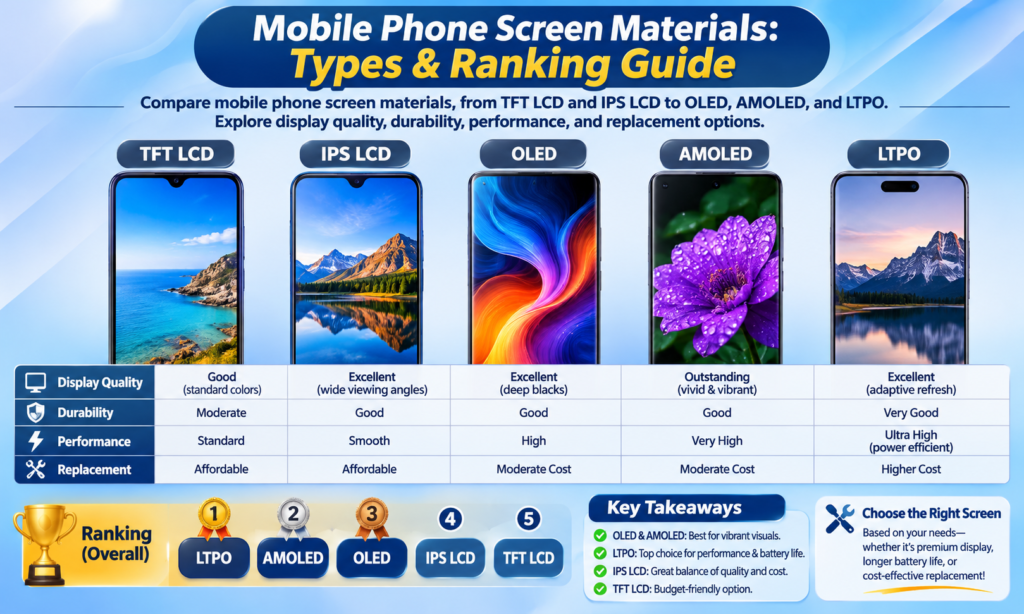
10. Mobile Phone Screen Material Ranking: Which Technology Is Best?
There is no single ranking that is suitable for every smartphone user or replacement screen buyer.
A premium OLED display may deliver better contrast and flexibility, while an IPS LCD replacement may offer better affordability and resistance to typical OLED burn-in.
To make the comparison more useful, the following ranking considers overall display capabilities, commercial maturity, and practical smartphone applications.
10.1 Overall Smartphone Display Technology Ranking
Top overall technology
1. LTPO AMOLED
LTPO AMOLED ranks first in this general premium-performance ranking because it combines OLED image quality with adaptive refresh-rate management.
Main advantages:
- Excellent contrast.
- Βαθιά μαύρα.
- High-end refresh-rate capabilities.
- Potentially improved power efficiency.
- Premium smartphone applications.
Το καλύτερο για: Flagship smartphones and premium replacement screen markets.
2. Δυναμική AMOLED
Dynamic AMOLED ranks highly because of its advanced display features and premium implementations.
Main advantages:
- Εξαιρετική απόδοση χρώματος.
- High-quality HDR capabilities on supported models.
- Strong contrast.
- High refresh-rate options on supported devices.
Το καλύτερο για: Premium Samsung smartphone displays.
3. Super AMOLED
Super AMOLED offers excellent image quality and an integrated touch-display design.
Main advantages:
- Βαθιά μαύρα.
- Rich colors.
- Thin construction.
- Απόδοση αφής με απόκριση.
Το καλύτερο για: Mid-range and premium smartphone displays.
4. Μαλακό OLED
Soft OLED is highly attractive in the replacement screen industry because it can reproduce flexible display designs and is often closer to the original construction of premium phones.
Main advantages:
- Flexible substrate.
- Thin construction.
- Support for curved designs.
- Premium visual performance.
Το καλύτερο για: Premium replacement screens and compatible flagship models.
5. Standard AMOLED
Standard AMOLED provides the main advantages of active-matrix OLED technology.
Main advantages:
- Υψηλή αντίθεση.
- Γρήγορη ανταπόκριση.
- Excellent viewing angles.
- Vibrant images.
Το καλύτερο για: Mid-range and premium smartphone displays.
6. Σκληρό OLED
Hard OLED provides OLED image quality with a more rigid construction and often lower manufacturing costs than soft OLED alternatives.
Main advantages:
- Excellent contrast.
- Βαθιά μαύρα.
- Competitive OLED replacement pricing.
Το καλύτερο για: Cost-conscious OLED replacement applications where the design is compatible.
7. IPS LCD
IPS LCD remains a practical technology because of its mature manufacturing ecosystem and competitive pricing.
Main advantages:
- Ευρείες γωνίες θέασης.
- Good color consistency.
- No typical OLED burn-in.
- Affordable replacement options.
Το καλύτερο για: Budget and mid-range smartphones.
8. Traditional TFT LCD
Traditional TFT LCD is an economical option for entry-level devices and older smartphone models.
Main advantages:
- Low production costs.
- Ώριμη τεχνολογία.
- Broad availability for certain older models.
Το καλύτερο για: Budget repairs and economical replacement requirements.
9. Mini-LED LCD
Mini-LED provides excellent backlight control and brightness potential, but it is not yet a mainstream smartphone replacement panel category.
Το καλύτερο για: Selected tablets, φορητούς υπολογιστές, and other larger displays.
10. MicroLED
MicroLED offers considerable theoretical and engineering advantages, but manufacturing complexity and cost currently limit its widespread smartphone adoption.
Το καλύτερο για: Emerging premium display applications and future development.
10.2 Which Screen Material Is Best for Different Requirements?
| Requirement | Recommended Technology |
|---|---|
| Best premium display experience | LTPO AMOLED |
| Excellent black levels | AMOLED / OLED |
| High-end Samsung display replacement | Model-specific Super AMOLED or Dynamic AMOLED |
| Flexible smartphone displays | Μαλακό OLED |
| Economical OLED replacement | Compatible Hard OLED |
| Budget replacement screens | IPS LCD |
| Low-cost older-model repairs | TFT LCD |
| Avoiding conventional OLED burn-in | IPS LCD |
| Adaptive refresh rate | LTPO ΕΙΣΑΙ |
Important purchasing advice: This ranking is a practical technology comparison, not a universal quality ranking for every screen model. The actual quality of a replacement display depends heavily on the manufacturer, υλικά, production processes, and quality-control standards.
11. Screen Durability, Διάρκεια ζωής, and Common Quality Problems
Display quality is not determined by appearance alone. Durability and long-term reliability are equally important.
For mobile phone repair shops and wholesale distributors, understanding common screen problems can help reduce product returns and improve customer satisfaction.
11.1 OLED Burn-In
OLED burn-in occurs when certain pixels age faster than others due to uneven usage.
Για παράδειγμα, a navigation bar, application logo, or static notification element may remain visible for long periods.
Με την πάροδο του χρόνου, uneven pixel degradation can produce permanent image retention.
Ways to reduce the risk include:
- Avoiding maximum brightness for extended periods.
- Using automatic brightness settings.
- Enabling screen timeout.
- Avoiding static images for excessive periods.
- Using dark mode where appropriate.
11.2 LCD Backlight Problems
LCD displays depend on backlight systems. Problems in these components can create visible defects.
Common symptoms include:
- Ανομοιόμορφη φωτεινότητα.
- Dark areas.
- Φωτεινά σημεία.
- Backlight leakage.
- Τρεμοπαίξιμο.
These problems may be associated with backlight components, οπτικές μεμβράνες, assembly quality, or electrical faults.
11.3 Dead Pixels and Stuck Pixels
A dead pixel is a pixel that no longer functions correctly.
A stuck pixel may remain illuminated in a particular color.
Possible causes include:
- Κατασκευαστικά ελαττώματα.
- Electrical damage.
- Physical pressure.
- Impact damage.
- Panel degradation.
High-quality manufacturing and effective inspection procedures help reduce these defects.
11.4 Touchscreen Failure
Touchscreen problems can occur even when the display image looks normal.
Τα τυπικά συμπτώματα περιλαμβάνουν:
- Περιοχές αφής που δεν ανταποκρίνονται.
- Ghost touching.
- Delayed touch response.
- Incorrect touch positioning.
- Intermittent touch failure.
Potential causes include damaged touch sensors, defective connectors, κακή συγκόλληση, incompatible driver circuits, or installation problems.
11.5 Screen Cracking and Physical Damage
Physical damage is one of the most common reasons smartphone users need replacement screens.
The severity of the damage depends on:
- Impact force.
- Glass thickness.
- Frame construction.
- Protective materials.
- Installation quality.
- Overall display assembly design.
A replacement display should be tested for both visual and touch functionality before installation.
11.6 How Long Does a Smartphone Screen Last?
There is no universal lifespan for all smartphone screens.
LCD and OLED panels have different aging characteristics. Their actual operational life depends on brightness, θερμοκρασία, usage patterns, ποιότητα κατασκευής, and environmental conditions.
Για χονδρεμπόρους, the most useful indicators are not theoretical lifespan figures but:
- Consistent production quality.
- Low defect rates.
- Reliable supplier testing.
- Traceable batches.
- Stable after-sales support.
12. How to Choose the Right Replacement Mobile Phone Screen
Choosing the correct replacement screen is essential for mobile phone repair businesses.
A screen may fit physically but still fail to work properly because of differences in display technology, connector design, touch circuitry, or software compatibility.
Here are the most important considerations.
12.1 Confirm the Exact Smartphone Model
Always confirm the exact phone model before purchasing a replacement screen.
Different versions of the same smartphone family may have different:
- Display dimensions.
- Connector positions.
- Display driver ICs.
- Ψήφισμα.
- Touch configurations.
- Frame structures.
A screen designed for one model should not automatically be assumed compatible with another model.
12.2 Confirm the Original Display Technology
Determine whether the original smartphone uses:
- TFT LCD.
- IPS LCD.
- OLED.
- AMOLED.
- LTPO AMOLED.
For premium phones, replacing an original OLED screen with an LCD alternative may reduce visual quality and change the device’s physical construction.
Some conversion products may be available, but compatibility and feature limitations must be verified.
12.3 Compare Display Resolution
Resolution refers to the number of pixels used to create an image.
Common smartphone resolutions include:
- HD: 1280 × 720 εικονοστοιχεία.
- Full HD: 1920 × 1080 εικονοστοιχεία.
- Full HD+: commonly 2400 × 1080 εικονοστοιχεία.
- QHD+: commonly around 3200 × 1440 εικονοστοιχεία.
The actual resolution varies by model.
A lower-resolution replacement screen may produce less detailed images, even when the screen size is identical.
12.4 Check Brightness and Color Performance
A good replacement screen should provide:
- Sufficient brightness.
- Consistent color reproduction.
- Uniform illumination.
- Appropriate white balance.
- Καλές γωνίες θέασης.
- Stable image quality.
Για οθόνες OLED, check black-level performance and color uniformity.
Για οθόνες LCD, pay particular attention to backlight consistency and brightness distribution.
12.5 Check Touch Sensitivity
Touchscreen performance directly affects user experience.
A suitable replacement screen should support:
- Accurate touch positioning.
- Ομαλή κύλιση.
- Λειτουργία πολλαπλής αφής.
- Consistent response across the entire panel.
- Reliable performance during normal use.
12.6 Evaluate Product Quality Grades
The replacement screen market includes products with different specifications and quality levels.
Depending on the supplier, product descriptions may include:
- Original service pack.
- Πρωτότυπο ανακαινισμένο.
- OEM-βαθμού.
- Premium aftermarket.
- Τυπικό aftermarket.
- Economical aftermarket.
These descriptions are not universally standardized. Buyers should request clear technical specifications and testing evidence rather than relying exclusively on product labels.
12.7 Consider Installation Compatibility
Before ordering, επαληθεύω:
- Συμβατότητα πλαισίου.
- Flex cable design.
- Connector position.
- Fingerprint sensor support.
- Proximity sensor configuration.
- Camera and earpiece openings.
- Special calibration requirements.
These details can prevent installation problems and unnecessary returns.
13. Wholesale Mobile Phone Screen Sourcing: Ποιότητα, Τιμή, and Supplier Selection
Για χονδρεμπόρους οθονών κινητών τηλεφώνων, διανομείς, εισαγωγείς, και επιχειρήσεις επισκευής, selecting the right supplier is a critical business decision.
A competitive supplier should offer more than attractive prices. Product quality, manufacturing consistency, delivery reliability, and technical support all influence long-term profitability.
13.1 Understand the Different Replacement Screen Categories
Before sourcing replacement screens, buyers should understand the differences between major product categories.
| Κατηγορία Προϊόντος | General Characteristics | Αγορά Στόχου |
|---|---|---|
| Γνήσιο Service Pack | Manufacturer-authorized service replacement, depending on availability | Premium repair market |
| Πρωτότυπο Ανακαινισμένο | Original panel restored with replacement external components where applicable | Quality-focused repair market |
| Μαλακό OLED | Ευέλικτη κατασκευή OLED | Premium replacement market |
| Σκληρό OLED | Rigid OLED construction | Cost-conscious OLED replacement market |
| Incell LCD | LCD with integrated touch functionality | Economical replacement market |
| Standard TFT LCD | Traditional LCD construction | Budget repair market |
The exact specifications and quality levels vary by supplier.
13.2 Why Product Consistency Matters
Για χονδρεμπόρους, inconsistent product quality can create serious business problems.
Για παράδειγμα, a batch of replacement screens may initially look satisfactory but contain differences in:
- Λάμψη.
- Θερμοκρασία χρώματος.
- Ευαισθησία αφής.
- Display uniformity.
- Flex ποιότητα καλωδίου.
- Adhesive bonding.
- Mechanical dimensions.
These differences can increase customer complaints and after-sales costs.
A reliable supplier should maintain consistent production standards across different batches.
13.3 Important Quality-Control Tests
Before purchasing in large quantities, ask whether the supplier performs the following inspections.
Έλεγχος εμφάνισης
Check for scratches, σκόνη, stains, visible defects, and assembly imperfections.
Display function testing
Verify that the screen displays images correctly and has no abnormal lines, τρεμοπαίζει, ή νεκρά pixel.
Δοκιμή λειτουργίας αφής
Test the entire touchscreen area, including edges and corners.
Δοκιμή φωτεινότητας
Check brightness uniformity and confirm that the screen meets the agreed specifications.
Connector inspection
Ensure that flex cables, συνδετήρες, and soldering points are properly manufactured.
Δοκιμή συμβατότητας
Confirm that the replacement screen works correctly with the specified smartphone model.
13.4 How to Evaluate a Screen Supplier
A professional supplier should be able to provide clear information about:
- Προδιαγραφές προϊόντος.
- Supported smartphone models.
- Product quality classifications.
- Inspection procedures.
- Διαθεσιμότητα δειγμάτων.
- Παραγωγική ικανότητα.
- Delivery lead times.
- Packaging standards.
- Πολιτικές εγγύησης.
- Υποστήριξη μετά την πώληση.
Do not evaluate suppliers only by unit price. A slightly more expensive product may offer better value if it significantly reduces defect rates and customer returns.
13.5 Sample Testing Before Bulk Orders
Ordering samples is one of the most effective ways to evaluate a new supplier.
A recommended process is:
- Select several representative smartphone models.
- Request samples from the supplier.
- Install the screens on compatible devices.
- Test brightness and color performance.
- Test touchscreen responsiveness.
- Check physical dimensions and connectors.
- Record any defects.
- Compare the results with your existing products.
- Confirm the specifications before bulk purchasing.
This process helps establish a more reliable purchasing standard.
13.6 Packaging and Transportation
Smartphone replacement screens are relatively delicate electronic components.
Professional packaging should protect against:
- Physical impact.
- Πίεση.
- Γρατσουνιές.
- Σκόνη.
- Υγρασία.
- Electrostatic discharge where applicable.
Για διεθνείς αποστολές χονδρικής, packaging quality and suitable transportation arrangements are particularly important.
14. Μελλοντικές τάσεις στην τεχνολογία εμφάνισης smartphone
Smartphone display technology continues to develop as manufacturers seek better image quality, lower energy consumption, thinner structures, and more durable products.
Several trends are expected to influence the mobile phone display industry.
14.1 Higher Refresh Rates
High-refresh-rate displays have become increasingly common in smartphones.
While traditional smartphones often used 60Hz displays, many modern devices support 90Hz or 120Hz.
Some gaming-oriented devices offer even higher refresh rates.
Τα πλεονεκτήματα περιλαμβάνουν:
- Πιο ομαλή κύλιση.
- More responsive animations.
- Improved gaming experiences.
- Better motion presentation.
Ωστόσο, higher refresh rates must be balanced against power consumption.
14.2 More Advanced LTPO Technology
LTPO development is expected to continue improving adaptive refresh-rate control.
Future improvements may focus on:
- More flexible refresh-rate ranges.
- Better low-frequency stability.
- Χαμηλότερη κατανάλωση ρεύματος.
- Improved brightness uniformity.
- More advanced display driver integration.
This technology will remain particularly relevant to premium smartphone displays.
14.3 Foldable Smartphone Displays
Foldable smartphones have created new opportunities for flexible OLED technology.
Manufacturers continue to improve:
- Folding mechanisms.
- Flexible substrates.
- Protective cover materials.
- Hinge structures.
- Display crease management.
- Repeated-folding durability.
As foldable devices develop, demand for specialized replacement display assemblies is also likely to increase.
14.4 Better Screen Durability
Screen durability remains a major concern for smartphone users.
Οι μελλοντικές εξελίξεις μπορεί να περιλαμβάνουν:
- Improved cover glass.
- More advanced protective coatings.
- Better flexible display materials.
- Improved bonding technology.
- More durable folding structures.
For replacement screen manufacturers, durability and consistent quality will remain important competitive factors.
14.5 MicroLED Development
MicroLED has the potential to provide high brightness, εξαιρετική αντίθεση, and long operational lifetimes.
Ωστόσο, mass production at smartphone pixel densities remains challenging.
Although MicroLED is an interesting future technology, OLED and LCD remain much more established choices for today’s smartphone replacement market.
14.6 More Sustainable Display Manufacturing
Environmental considerations are becoming increasingly important across the electronics supply chain.
Display manufacturers may focus more heavily on:
- Reducing material waste.
- Improving production yields.
- Optimizing energy consumption.
- Increasing component recycling.
- Developing more sustainable packaging.
These improvements can benefit both manufacturers and international distributors.
15. Frequently Asked Questions About Mobile Phone Screen Materials
Ε1. What is the best material for a mobile phone screen?
For premium smartphone display performance, LTPO AMOLED and advanced OLED implementations are among the strongest options.
They offer excellent contrast, βαθύ μαύροι, fast response, and advanced refresh-rate capabilities.
Ωστόσο, IPS LCD remains a good choice for affordable smartphones and cost-effective replacement screens.
Ε2. Is AMOLED better than IPS LCD?
In terms of contrast, μαύρα επίπεδα, and pixel response, AMOLED generally has an advantage.
IPS LCD can still provide excellent color accuracy, σταθερή φωτεινότητα, και ανταγωνιστική τιμολόγηση.
The best choice depends on the user’s requirements and the quality of the specific panel.
Ε33. Ποια είναι η διαφορά μεταξύ OLED και AMOLED?
OLED describes the organic light-emitting technology.
AMOLED describes an OLED display that uses an active-matrix system to control its pixels.
AMOLED is therefore a type of OLED.
Ε4. Is Super AMOLED better than regular AMOLED?
Super AMOLED is Samsung’s implementation of AMOLED technology with integrated touch functionality.
It can provide advantages in display construction and touch integration.
Ωστόσο, overall performance depends on the specific display generation and smartphone model.
Ε5. Is LTPO better than AMOLED?
LTPO is not a direct alternative to AMOLED.
LTPO is a backplane technology that can be used in AMOLED displays to support adaptive refresh rates and potentially improve power efficiency.
An LTPO AMOLED display combines both technologies.
Ε6. Which mobile phone screen is the cheapest?
Traditional TFT LCD and many IPS LCD panels are generally more affordable than premium OLED replacements.
Ωστόσο, actual prices depend on the smartphone model, μέγεθος οθόνης, όγκος παραγωγής, προμηθευτής, and product quality.
Ε7. Which screen is better for mobile phone repairs?
The best replacement screen is one that matches the original smartphone specifications as closely as possible.
For premium smartphones originally equipped with OLED displays, a compatible OLED replacement is generally preferable when maintaining the original display experience is important.
Για συσκευές προϋπολογισμού, IPS LCD or TFT LCD replacements may offer better commercial value.
Ε8. What is the difference between Hard OLED and Soft OLED?
Hard OLED uses a more rigid substrate, while Soft OLED uses a flexible substrate.
Soft OLED is generally more suitable for curved and flexible smartphone designs, while Hard OLED can provide a more economical replacement option for compatible models.
Ε9. Do OLED screens consume more battery power?
Όχι απαραίτητα.
OLED power consumption depends on the content being displayed. Dark content can consume less power because black pixels can be turned off.
LCD screens rely on a backlight, which operates independently of the brightness of individual image pixels.
Q10. Can an LCD screen replace an original AMOLED screen?
Some smartphones have compatible aftermarket LCD conversion screens, but not all devices support this option.
An LCD replacement may differ in thickness, λάμψη, απόδοση χρώματος, κατανάλωση ρεύματος, και λειτουργικότητα.
Always confirm model compatibility before purchasing.
Σύναψη: Choosing the Right Mobile Phone Screen Material
Mobile phone display technology has developed significantly, from traditional TFT LCD panels to advanced IPS LCD, OLED, AMOLED, and LTPO AMOLED displays.
Each technology has its own advantages, limitations, and suitable applications.
Για τους καταναλωτές, the best screen depends on visual preferences, smartphone usage, durability requirements, και προϋπολογισμού.
For mobile phone repair shops, διανομείς, και χονδρέμποροι, the decision involves additional considerations, including product compatibility, ποιότητα κατασκευής, τιμολόγηση, ποσοστά ελαττωμάτων, και αξιοπιστία προμηθευτή.
Here are the key takeaways:
- TFT LCD: An economical option for entry-level smartphones and budget repairs.
- IPS LCD: A practical balance between display quality, αξιοπιστία, και οικονομική προσιτότητα.
- OLED: Excellent contrast, βαθύ μαύροι, and fast response.
- AMOLED: Advanced OLED technology widely used in modern smartphones.
- Super AMOLED: An advanced AMOLED implementation with integrated touch functionality.
- Δυναμική AMOLED: Premium Samsung display technology with advanced display features.
- LTPO AMOLED: An advanced solution combining OLED image quality with adaptive refresh-rate technology.
- Μαλακό OLED: A flexible display solution suitable for premium replacement applications.
Τελικά, there is no universally perfect smartphone screen. The right choice depends on the original device specifications, αγορά-στόχος, quality expectations, and purchasing budget.
As smartphone display technology continues to advance, understanding the differences between screen materials will become increasingly important for mobile phone manufacturers, επαγγελματίες επισκευής, and international wholesale distributors.
For businesses involved in smartphone replacement screens and accessories, working with a reliable supplier is essential for maintaining product quality, ανταγωνιστική τιμολόγηση, and long-term customer relationships.
Looking for Reliable Mobile Phone LCD Screens and Accessories?
If you are a mobile phone screen wholesaler, διανομέας, εισαγωγέα, or repair business looking for reliable mobile phone LCD screens and mobile phone accessories, we welcome your inquiries.
We can discuss your product requirements, screen specifications, compatible smartphone models, quality expectations, and wholesale purchasing needs.
Contact Information
Sales Manager: Loly Jiang
ΗΛΕΚΤΡΟΝΙΚΗ ΔΙΕΥΘΥΝΣΗ: Mophoneparts@outlook.com
WhatsApp: +86 137 1130 8199
Contact us for mobile phone LCD screens, replacement displays, and mobile phone accessories.
We look forward to establishing long-term and mutually beneficial business relationships with customers and partners worldwide!
References and Further Reading
For readers interested in understanding display technologies in greater technical detail:
- SEC Filing – Display Technologies and OLED Manufacturing – Technical information about TFT-LCD and OLED technologies.
- Huawei Developer – LTPO-Based Low-Power Design – Explanation of LTPO technology and adaptive refresh rates.
- LG Display – Structure of OLED Panels – Comparison of conventional LCD and OLED structures.
- Gadgets 360 – AMOLED vs OLED vs LCD Smartphone Displays – Overview of smartphone display technologies.
- Android Authority – Display Technologies Explained – Introduction to LCD, OLED, and other display technologies.
Editorial note: The rankings in this article are based on general technology capabilities and practical market applications. Actual replacement screen quality varies by model, manufacturer, υλικά, and manufacturing standards.