Smartphone displays have transformed dramatically over the past decade. Remember when thick LCD screens dominated every mobile phone? Those days now feel ancient. In 2026, the spotlight belongs to AMOLED flexible displays, the technology powering flagship smartphones, foldable devices, gaming phones, and even futuristic stretchable screens. These displays are thinner, brighter, more energy-efficient, and visually stunning compared to traditional LCD panels. They are no longer just a premium feature reserved for expensive phones; they have become the heart of modern smartphone design.
Flexible AMOLED technology has become so influential that industry analysts report flexible AMOLED displays now power more than 57% of global smartphone shipments. Major manufacturers such as Samsung, Apple, Xiaomi, Motorola, and Honor are heavily investing in advanced OLED technologies to create thinner devices with immersive visuals and better battery performance. At the same time, innovations like LTPO refresh rate control, foldable panels, and sensor-integrated OLED displays are reshaping the future of mobile hardware.
What makes AMOLED flexible screens so special is not only their visual performance but also their internal structure. Unlike LCD screens that rely on bulky backlighting systems, AMOLED displays produce light directly from organic materials. This changes the entire architecture of the display stack. Every layer inside the panel has a specific role, from touch sensing and pixel control to flexibility and durability. Understanding this structure helps explain why today’s smartphones can bend, fold, curve, and even stretch while maintaining vivid image quality.
Understanding AMOLED Flexible Display Technology
What AMOLED Really Means
AMOLED stands for Active Matrix Organic Light Emitting Diode. That sounds technical, but the concept is actually pretty simple when broken down. “Organic Light Emitting Diode” means the screen uses organic compounds that emit light when electricity passes through them. Unlike LCD panels, AMOLED displays do not need a separate backlight. Every individual pixel lights itself independently. This is why black areas on AMOLED screens look truly black instead of grayish.
The “Active Matrix” part refers to the TFT transistor system controlling every pixel individually. Think of it like a massive traffic control network inside the display. Each pixel receives instructions independently, allowing fast refresh rates, smoother animations, and precise brightness control. This active matrix structure is one reason AMOLED screens excel in gaming and video playback.
Modern smartphones increasingly use flexible AMOLED displays instead of rigid OLED panels. Flexible AMOLED panels use plastic-based substrates rather than glass, enabling curved edges and foldable devices. According to Omdia research, flexible AMOLED technology is now dominating smartphone manufacturing because production costs are falling while performance improves.
The result feels almost magical in daily use. When you scroll through social media or watch HDR movies, colors appear richer, blacks look deeper, and motion feels fluid. It is similar to replacing an old fluorescent lamp with a modern cinematic projector. The experience simply becomes more immersive and natural.
Why Flexible Displays Replaced Traditional LCD Panels
LCD displays were once reliable workhorses of the smartphone industry, but they carried major limitations. LCD screens require a constant backlight behind the display layers. That makes them thicker, less power-efficient, and less capable of achieving deep black levels. Even when displaying black images, the backlight is still partially active.
Flexible AMOLED technology changed everything. Since each pixel generates its own light, the screen can turn off specific pixels entirely. This drastically improves contrast ratios and reduces power consumption, especially in dark mode interfaces. Smartphone makers quickly realized this technology also allowed thinner devices with curved edges and futuristic designs.
Another massive advantage is physical flexibility. LCD panels use rigid glass structures that cannot bend easily. AMOLED flexible panels use polyimide plastic substrates, enabling curved displays, foldable phones, and rollable concepts. Foldable smartphones like Samsung Galaxy Fold devices and Motorola Razr models would not exist without flexible OLED architecture.
The transition is happening quickly across the industry. Market reports show the AMOLED display market could grow from approximately USD 16.5 billion in 2025 to nearly USD 66 billion by 2033. That explosive growth reflects how consumers now prioritize immersive visuals, smoother refresh rates, and premium display experiences.
The Evolution of Smartphone Display Structures
From TFT LCD to OLED and AMOLED
The smartphone industry has evolved display technology in stages, almost like generations of transportation moving from bicycles to electric sports cars. Early mobile phones used simple monochrome LCDs. Then came TFT LCD technology, which introduced color accuracy and sharper images. For many years, TFT LCD dominated smartphones because it was affordable and reliable.
However, LCD panels had limitations. They consumed more power, struggled with contrast ratios, and required thick backlight systems. As mobile entertainment grew, users wanted richer visuals and better battery life. This demand pushed OLED technology into mainstream adoption.
OLED panels introduced self-emissive pixels, but AMOLED improved the concept further using active matrix transistor control. AMOLED became faster, more responsive, and suitable for high-resolution smartphones. Samsung aggressively promoted Super AMOLED displays, while Apple gradually shifted iPhones toward OLED technology as production matured.
Today’s flexible AMOLED panels are far more advanced than the first-generation OLED screens. They support HDR10+, adaptive refresh rates up to 144Hz, extremely high brightness levels, and low power consumption modes. Samsung Display recently demonstrated OLED technology capable of reaching 3,000 nits brightness while maintaining impressive color accuracy.
The display industry is moving rapidly toward foldable, stretchable, and sensor-integrated screens. What once seemed like science fiction is now appearing in commercial products.
The Rise of Foldable and Curved Screens
Flexible AMOLED displays opened the door for smartphone manufacturers to experiment with completely new form factors. Curved edge displays were the first visible example. Brands like Samsung and Huawei used flexible OLED panels to wrap displays around the edges of devices, creating an immersive “borderless” appearance.
Then foldable smartphones arrived. These devices use ultra-thin glass combined with flexible OLED layers to bend repeatedly without damaging the screen. It is almost like folding a sheet of glowing digital paper. Motorola, Samsung, Oppo, and Honor are now competing heavily in the foldable market, refining hinge durability and reducing crease visibility.
Industry analysts expect foldable AMOLED displays to remain one of the fastest-growing sectors in the display industry. Improvements in ultra-thin glass, flexible polymers, and hinge engineering continue to increase reliability.
The future could become even more fascinating. Stretchable displays shown at SID Display Week 2026 demonstrate how OLED panels may eventually expand and contract dynamically. Smartphones may eventually transform shape depending on user needs, blending mobile phones and tablets into one adaptive device.
Core Structure of an AMOLED Flexible Display
Cover Glass and Ultra-Thin Glass Layer
The outermost layer of a flexible AMOLED display is usually the cover glass or ultra-thin glass layer. This protects the internal OLED components from scratches, impacts, and environmental damage. Foldable devices often use specialized ultra-thin glass because traditional thick glass cannot bend repeatedly.
Ultra-thin glass is incredibly impressive from an engineering perspective. It is thin enough to flex slightly while still maintaining transparency and touch sensitivity. Manufacturers often combine this glass with protective polymer coatings for extra durability.
The challenge is balancing flexibility with strength. A smartphone display experiences constant tapping, swiping, and pressure throughout daily use. Engineers must ensure the top layer remains durable while still supporting folding or curved designs.
Touch Sensor Layer
Beneath the glass lies the touch sensor layer. This component detects finger movements and gestures. Modern AMOLED displays often integrate touch sensors directly into the display stack, reducing thickness and improving responsiveness.
Integrated touch technology helps manufacturers create slimmer smartphones with reduced bezels. It also improves display clarity because fewer separate layers mean less light scattering. Many modern flagship phones now use on-cell or in-cell touch integration for this reason.
Polarizer Layer
The polarizer layer reduces unwanted reflections and improves screen readability under bright sunlight. Without this layer, smartphone displays would appear washed out outdoors.
Some newer OLED technologies are experimenting with polarizer-free designs to improve energy efficiency further. Samsung’s recent OLED innovations demonstrated polarizer-free structures capable of higher brightness and lower power consumption.
Organic Emissive Layer
This is the heart of the AMOLED display. Organic emissive materials generate red, green, and blue light when electricity passes through them. Each pixel acts like a microscopic light source.
Because pixels emit their own light, AMOLED screens achieve near-infinite contrast ratios. Black pixels simply turn off completely. This creates the cinematic appearance users love when watching videos or gaming.
TFT Backplane Layer
The TFT backplane controls each individual pixel. Thin-film transistors act like switches regulating brightness and color output. Advanced AMOLED displays now use LTPO technology, which dynamically adjusts refresh rates to save battery life.
Flexible Substrate Layer
Traditional LCDs rely heavily on rigid glass substrates, but flexible AMOLED displays use polyimide plastic substrates. This flexible base layer enables curved edges, folding mechanisms, and lightweight construction.
Polyimide materials are heat-resistant, durable, and bendable. They represent one of the most critical innovations enabling foldable smartphones.
Driver IC and Display Circuit
The display driver IC functions like the brain of the screen. It processes image signals and controls pixel behavior. Faster and smarter driver IC systems improve refresh rates, reduce latency, and enhance gaming performance.
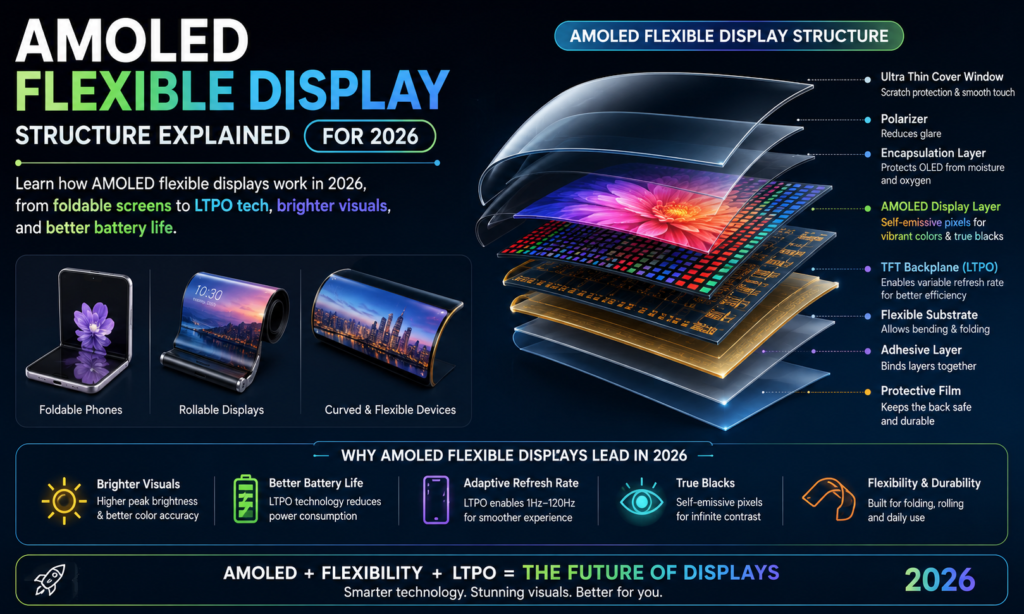
AMOLED Flexible Display Structure Diagram
Layer-by-Layer Structural Explanation
Here is a simplified structure diagram of a modern smartphone AMOLED flexible display:
| Layer | Function |
|---|---|
| Cover Glass / UTG | Protects display surface |
| Touch Sensor Layer | Detects finger input |
| Polarizer Layer | Reduces reflection |
| Encapsulation Layer | Protects OLED materials |
| Organic Emissive Layer | Produces RGB light |
| TFT Backplane | Controls pixel switching |
| Flexible Substrate | Enables bending/folding |
| Driver IC Circuit | Processes display signals |
This layered architecture allows AMOLED screens to remain thin, flexible, and visually powerful at the same time.
How Light Is Generated Without Backlighting
LCD screens function like windows blocking or filtering a backlight. AMOLED displays work differently. Each pixel is effectively a miniature lamp generating its own illumination. That means no separate backlight layer is needed.
This self-emissive structure improves efficiency and enables ultra-thin smartphone designs. It also allows precise local dimming because individual pixels can turn completely off. The visual difference becomes obvious when watching dark scenes in movies or using dark mode at night.
Advantages of AMOLED Flexible Screens
Better Contrast and Color Accuracy
One reason people instantly notice AMOLED displays is the dramatic contrast. Blacks appear truly black, not dark gray. Colors look vibrant and saturated without appearing dull.
Modern AMOLED panels support HDR content with exceptional dynamic range. Recent prototypes shown at SID Display Week 2026 demonstrated brightness levels up to 3,000 nits alongside wide BT.2020 color coverage.
This matters because smartphone displays are now central to entertainment, gaming, photography, and productivity. Consumers expect television-level quality inside a pocket-sized device.
Power Efficiency and Thin Design
AMOLED displays save power by turning off unused pixels. Dark mode interfaces consume noticeably less battery compared to LCD displays. This efficiency becomes especially valuable in smartphones where battery life is critical.
The absence of bulky backlights also allows thinner devices. Foldable smartphones would be nearly impossible using conventional LCD architecture.
Challenges and Weaknesses of AMOLED Flexible Displays
Burn-In and Green Line Issues
AMOLED displays are not perfect. Burn-in remains a known issue where static elements leave faint permanent marks over time. Navigation bars and status icons are common culprits.
Users have also reported “green line” issues affecting some OLED smartphones after extended use. Online discussions suggest high-refresh-rate AMOLED panels may experience higher failure risks under certain conditions.
Manufacturers continuously improve materials and durability to reduce these problems. Modern OLED panels last significantly longer than earlier generations.
Manufacturing Complexity and Cost
Flexible AMOLED manufacturing is extremely complicated. Producing defect-free foldable OLED panels requires advanced factories and precise engineering. Even microscopic contamination can ruin an entire panel.
This complexity increases production costs. Although AMOLED displays are becoming cheaper over time, they remain more expensive than traditional LCDs.
AMOLED Flexible Display Trends in 2026
Foldable Phones and Stretchable Displays
Foldable devices continue evolving rapidly. Motorola, Samsung, Honor, and Huawei are all refining flexible display technologies. Some prototypes now feature nearly invisible creases and improved hinge durability.
Stretchable OLED displays are also emerging. Samsung and LG recently showcased displays capable of dynamic shape changes for automotive and mobile applications.
The line between smartphone, tablet, and wearable device may eventually disappear entirely.
LTPO, 3000-Nit Brightness, and AI Display Technologies
Modern AMOLED displays increasingly use LTPO backplane technology for adaptive refresh rates. This allows displays to switch dynamically between 1Hz and 144Hz depending on usage.
Manufacturers are also integrating AI-driven brightness optimization and eye-comfort technologies. TCL’s new Nxtpaper AMOLED concept focuses heavily on reducing glare and blue light while maintaining OLED image quality.
Display technology is becoming smarter, not just brighter.
Future of Smartphone Flexible Display Technology
The future of smartphone displays looks incredibly ambitious. Flexible AMOLED panels are expected to become thinner, brighter, and more energy-efficient. Industry research predicts strong long-term growth for flexible OLED technology across smartphones, wearables, automotive systems, and smart devices.
We are likely moving toward devices with rollable screens, invisible cameras beneath the display, integrated health sensors, and adaptive form factors. Samsung’s Sensor OLED technology already demonstrates biometric sensing directly inside the display panel.
What feels exciting is how quickly these innovations move from laboratory concepts to commercial smartphones. Ten years ago, foldable displays seemed impossible. Today, they are available in retail stores worldwide.
Flexible AMOLED technology is not just changing how smartphones look. It is redefining what smartphones can become.
Conclusion
AMOLED flexible displays represent one of the most important breakthroughs in modern smartphone engineering. Their layered structure combines organic emissive materials, TFT backplanes, flexible substrates, and advanced driver circuits into a remarkably thin and powerful display system. Unlike traditional LCD panels, AMOLED screens generate light directly from individual pixels, delivering richer colors, deeper blacks, faster response times, and lower power consumption.
The rise of flexible AMOLED technology has enabled curved displays, foldable smartphones, and experimental stretchable devices that once belonged only in futuristic concept videos. Market trends show flexible OLED adoption continuing to expand rapidly as manufacturers refine durability, brightness, and efficiency.
At the same time, challenges such as burn-in, manufacturing costs, and durability remain important engineering hurdles. Yet the pace of innovation suggests these problems will continue improving year after year.
Smartphone displays are no longer simple screens. They have become dynamic, intelligent visual systems shaping the entire mobile experience. AMOLED flexible display technology sits at the center of that revolution.
FAQs
1. What is the difference between AMOLED and LCD displays?
AMOLED displays use self-emissive pixels that generate their own light, while LCD displays require a separate backlight. AMOLED screens provide deeper blacks, higher contrast, thinner designs, and better energy efficiency.
2. Why are flexible AMOLED displays important for foldable phones?
Flexible AMOLED displays use plastic-based substrates that can bend repeatedly without breaking. This flexibility allows smartphones to fold, curve, or roll while maintaining image quality.
3. What causes AMOLED screen burn-in?
Burn-in occurs when static images remain displayed for long periods, causing uneven aging of organic pixels. Navigation bars and always-on display elements are common causes.
4. Are AMOLED displays better for battery life?
Yes. AMOLED displays can save power because black pixels turn completely off. Dark mode interfaces especially improve battery efficiency on OLED devices.
5. What is LTPO technology in AMOLED displays?
LTPO is an advanced backplane technology allowing dynamic refresh rate adjustment. It helps smartphones switch between low and high refresh rates automatically, improving battery life and smoother performance.