Introduction
Depuis 2018, La gamme iPhone d’Apple a constamment redéfini la conception des smartphones et l’innovation en matière d’affichage. Dès l'introduction du Super Rétine HD panneaux de l'iPhone XS au Île dynamique et Écrans Promotion 120 Hz sur les modèles modernes, Apple a montré son engagement à équilibrer le style, fonctionnalité, et excellence visuelle.
Examinons en profondeur comment les iPhones ont évolué entre 2018 et 2025, dont certains prévisions futures qui reflètent les tendances du secteur et la trajectoire d’Apple.
Évolution de l'iPhone: Depuis 2018 à 2025
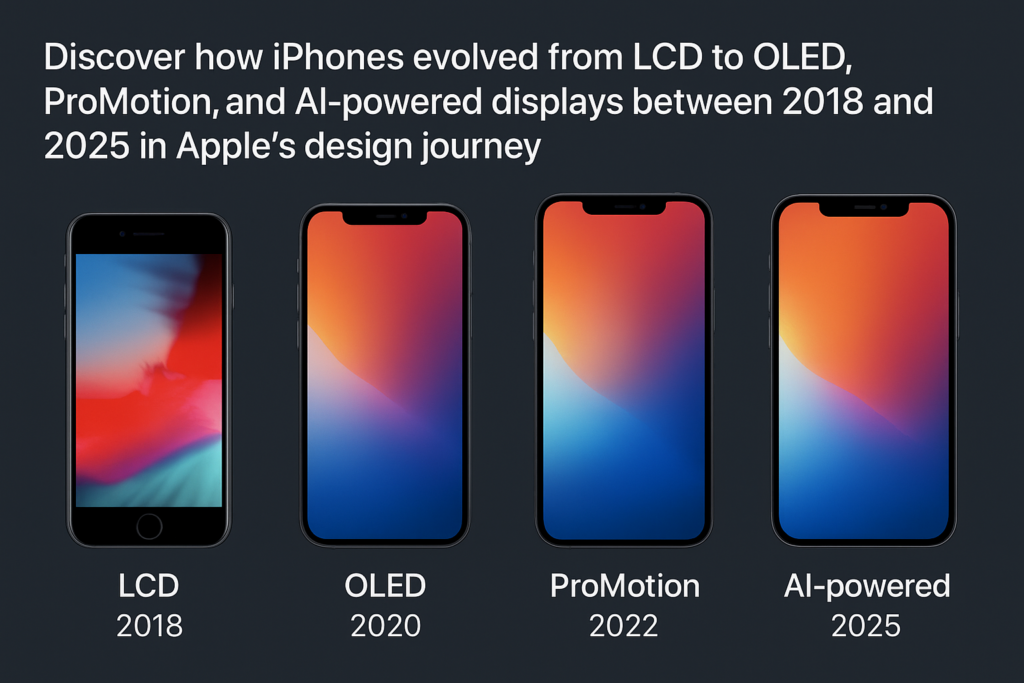
Entre 2018 et 2025, Apple est passé du LCD à l'OLED sur presque tous les modèles. Le Écrans LCD HD à rétine liquide a cédé la place à OLED Super Retina XDR, qui domine désormais la programmation. Le voyage comprend également des étapes importantes, telles que 5G, Promotion, Affichage permanent, et le passer à l'USB-C.
Par 2025, la gamme iPhone devrait atteindre un niveau de raffinement qui intègre Systèmes de caméras alimentés par l'IA, des écrans plus intelligents, et chipsets ultra performants.
Comprendre les technologies d'affichage d'Apple
LCD contre OLED
LCD (Affichage à cristaux liquides) a été utilisé dans les modèles précédents comme l'iPhone XR et SE. Oled (Diode électroluminescente organique), cependant, fournit des noirs plus profonds, meilleur contraste, et une efficacité améliorée, désormais standard sur les modèles phares d'Apple.
Super Retina HD et XDR
Apple a présenté Super Rétine HD dans 2018 et Super Rétine XDR dans 2019, offrant une luminosité et un contraste supérieurs. Le XDR (Plage dynamique extrême) la technologie améliore l'affichage du contenu HDR, offrant une reproduction des couleurs vives.
Promotion et affichage permanent
Technologie Promotion, apparaissant pour la première fois dans iPhone 13 Pro, permet un 120Taux de rafraîchissement en Hz—créer des animations et un défilement plus fluides. Plus tard, le Affichage permanent dans l'iPhone 14 La série Pro gardait les informations visibles même lorsque l'écran était inactif.
Présentation des modèles d'iPhone (2018–2023)
2018: La fracture OLED et LCD
Le iPhone XS, XSMax, et XR a marqué la double approche d’Apple : options OLED haut de gamme et LCD abordables. Les XR LCD à rétine liquide a séduit les utilisateurs soucieux de leur budget.
2019: Triple caméras et amélioration des performances
Le iPhone 11 Pro série apportée triple caméras et le Puce bionique A13, améliorant à la fois la photographie et la durée de vie de la batterie.
2020: 5Conception G et à bord plat
Apple est revenu aux bords plats avec le iPhone 12 série, apportant un conception rafraîchie, Bouclier en céramique, et 5Connectivité G. Les écrans OLED sont devenus la norme dans toute la gamme.
2021: ProMotion arrive sur iPhone
Le iPhone 13 Pro et Pro Max en vedette Présentoirs ProMotion, prenant en charge des taux de rafraîchissement de 120 Hz, idéal pour les joueurs et les créateurs de contenu.
2022: Révolution insulaire dynamique
Le iPhone 14 Pro la série a présenté le Île dynamique, remplacer l'encoche et proposer des notifications interactives. Le Affichage permanent et le Puce bionique A16 défini une nouvelle ère.
2023: Conception en titane et intégration USB-C
Le iPhone 15 Pro série introduite montures en titane, Ports USB-C, et un Bouton d'action personnalisable—un saut significatif en matière de conception et de fonctionnalité.
Modèles prédits (2024–2025)
2024: iPhone 16 Améliorations de la série
Les analystes du secteur prédisent que iPhone 16 Pro grandira jusqu'à 6.3 pouces, tandis que le Pro Max s'étend à 6.9 pouces. Apple peut également ajouter un bouton de capture dédié et améliorer les taux de rafraîchissement pour les modèles non-Pro.
2025: L'iPhone 17 Séries et au-delà
Le iPhone 17 s'aligner devrait affiner la technologie d’affichage avec OLED économes en énergie et éventuellement écrans à matrice de micro-lentilles. Apple pourrait également faire ses débuts Calibrage de l'affichage assisté par l'IA pour une fidélité visuelle améliorée.
Tableau complet des spécifications de l'iPhone (2018–2025)
Ci-dessous se trouve le tableau complet de style Excel résumant tous les modèles d'iPhone de 2018 à 2025:
| Modèle | Année de sortie | Type d'affichage & Spécifications | Dimensions (mm) | Remarques |
|---|---|---|---|---|
| iPhone XS | 2018 | 5.8″ Oled, Super Rétine HD, 2436×1125, 458 ppp | 143.6 x 70.9 x 7.7 | Discontinué |
| iPhone XS Max | 2018 | 6.5″ Oled, Super Rétine HD, 2688×1242, 458 ppp | 157.5 x 77.4 x 7.7 | Discontinué |
| iPhone XR | 2018 | 6.1″ LCD, Rétine liquide HD, 1792×828, 326 ppp | 150.9 x 75.7 x 8.3 | Discontinué |
| iPhone 11 | 2019 | 6.1″ LCD, Rétine liquide HD, 1792×828, 326 ppp | 150.9 x 75.7 x 8.3 | Discontinué |
| iPhone 11 Pro | 2019 | 5.8″ Oled, Super Rétine XDR, 2436×1125, 458 ppp | 144 x 71.4 x 8.1 | Discontinué |
| iPhone 11 Pro Max | 2019 | 6.5″ Oled, Super Rétine XDR, 2688×1242, 458 ppp | 158 x 77.8 x 8.1 | Discontinué |
| iPhone SE (22ème génération) | 2020 | 4.7″ LCD, Rétine HD, 1334×750, 326 ppp | 138.4 x 67.3 x 7.3 | |
| iPhone 12 Mini | 2020 | 5.4″ Oled, Super Rétine XDR, 2340×1080, 476 ppp | 131.5 x 64.2 x 7.4 | Discontinué |
| iPhone 12 | 2020 | 6.1″ Oled, Super Rétine XDR, 2532×1170, 460 ppp | 146.7 x 71.5 x 7.4 | |
| iPhone 13 Pro Max | 2021 | 6.7″ Oled, XDR, Promotion 120 Hz | 160.8 x 78.1 x 7.65 | Discontinué |
| iPhone 14 Pro | 2022 | 6.1″ Oled, XDR, Toujours actif, 2556×1179 | 147.5 x 71.5 x 7.85 | Île dynamique |
| iPhone 15 Pro | 2023 | 6.1″ Oled, XDR, Promotion, 2556×1179 | 146.6 x 70.6 x 8.25 | Titane, USB-C |
| iPhone 16 Pro | 2024* | 6.3″ Oled, XDR, Promotion | À déterminer | Prédit |
| iPhone 17 Pro Max | 2025* | 6.9″ Oled, XDR de nouvelle génération | À déterminer | Prédit |
(*Modèles prévus susceptibles de changer)
Tendances et observations clés
Évolution de la taille
Apple a progressivement augmenté la taille des écrans, passer de 5.8″ (iPhone XS) à un prévu 6.9″ (iPhone 17 Pro Max). Les modèles compacts comme la gamme « mini » ont été progressivement supprimés en raison de la faible demande..
Mises à niveau d'affichage
Depuis LCD à OLED, L’accent d’Apple s’est déplacé vers une meilleure luminosité, contraste, et efficacité énergétique. Le 120Taux de rafraîchissement en Hz et Fonctionnalité toujours active reflètent les efforts d’Apple vers une interactivité transparente.
Modifications des matériaux et de la conception
Montures en titane, lunettes plus fines, et une durabilité améliorée marquent le 15 Pro série. Les futurs modèles devraient réduire davantage l'épaisseur tout en préservant la durée de vie de la batterie..
Prédictions pour les futurs iPhones
Regarder vers l'avenir, Apple peut:
- Adopter Affichages microliques pour une luminosité inégalée.
- Intégrer Calibrage de l'affichage alimenté par l'IA.
- Introduire taux de rafraîchissement adaptatifs au-delà de 120 Hz.
- Avancer vers conceptions sans port par 2026.
L’évolution de l’iPhone reflète clairement l’ambition de fusion d’Apple technologie, talent artistique, et durabilité dans un seul appareil compact.
Conclusion
À partir de 2018 Débuts avec Super Retina au prochain Piloté par l'IA, modèles ultra performants de 2025, l'iPhone s'est transformé en une vitrine de l'excellence en ingénierie. Chaque modèle s'appuie sur le dernier, offrir aux utilisateurs plus intelligents, plus élégant, et une technologie plus durable.
FAQ
1. Quel iPhone a utilisé pour la première fois la technologie OLED?
Le iPhoneX (2017) introduit OLED, et par 2020, il est devenu standard sur la plupart des modèles.
2. Quand Apple a-t-il introduit les écrans ProMotion?
Dans 2021 avec le iPhone 13 Pro série.
3. Qu'est-ce qui fait l'iPhone 15 L’affichage du Pro est unique?
Il comporte un Super Retina XDR OLED, 120Promotion Hz, et cadre en titane pour une meilleure gestion de la chaleur.
4. Les spécifications de l’iPhone 2024-2025 sont-elles confirmées?
Pas encore – ils sont basés sur analyse de l’industrie et fuites crédibles.
5. Apple ramènera-t-il des iPhones plus petits?
Peu probable. Les données du marché montrent que les utilisateurs préfèrent écrans plus grands pour les médias et la productivité.