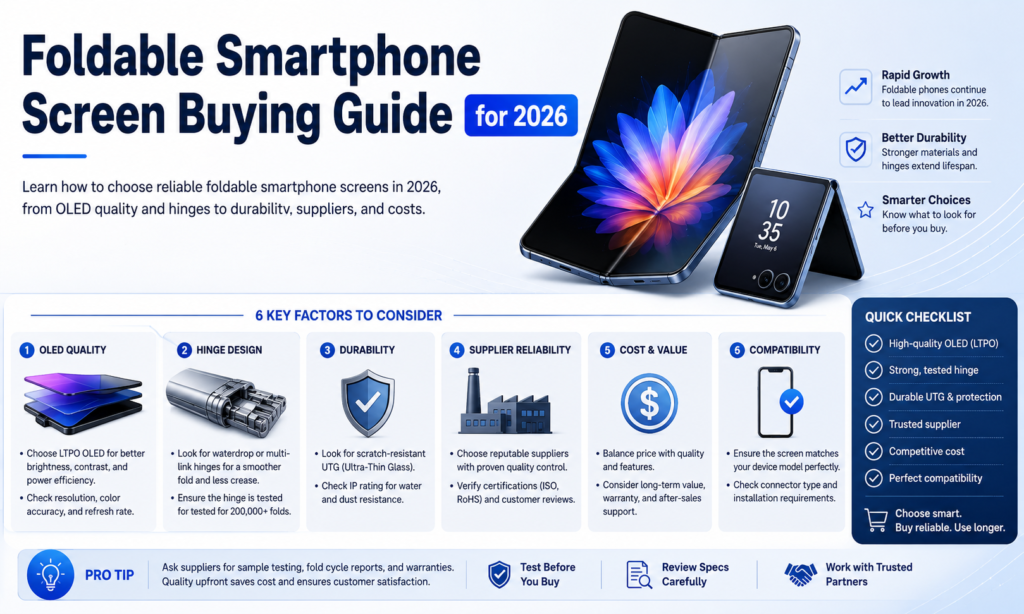
Ang mga napilo nga smartphone dili na mga eksperimento nga gadyet nga naglingkod sa luyo sa mga display sa bildo sa mga trade show. Sa 2026, sila paspas nga nahimong mainstream nga mga produkto nga makadani sa mga premium nga mga konsumidor ug mga tatak nga naka-focus sa teknolohiya. Ang merkado milambo gikan sa "makapaikag nga kabag-ohan" ngadto sa usa ka kaayo nga kompetisyon nga natad sa panggubatan diin ang kalig-on, kalidad sa pagpakita, bisagra engineering, ug ang kasaligan sa kadena sa suplay nagtino kung ang usa ka produkto molampos o mapakyas. Sumala sa bag-o nga mga taho sa industriya, foldable smartphone panginahanglan gilauman nga motubo sa kamahinungdanon sa 2026, labi na sa gipaabot nga pagsulod sa Apple sa foldable market.
Para sa mga procurement managers, mga tiggama sa smartphone, mga wholesaler, ug OEM pumapalit, pagpangita a flexible foldable screen mas komplikado kay sa pagpalit ug tradisyonal nga OLED panel. Ang usa ka foldable display dili lang usa ka screen. Kini usa ka komplikado nga stack sa mga materyales lakip ang mga layer sa OLED, ultra-nipis nga bildo, mga papilit, sistema sa koordinasyon sa bisagra, mga sensor sa paghikap, ug flexible substrates. Ang usa ka huyang nga punto sa kana nga stack makaguba sa tibuuk nga kasinatian sa tiggamit. Hunahunaa kini sama sa paghimo og usa ka maluho nga sports car — ang makina hinungdanon, apan mao usab ang suspension, ligid, ug pag-align sa chassis. Ang sama nga prinsipyo magamit sa foldable smartphones.
Ang mga pusta usab mas taas sa 2026 tungod kay ang mga konsumedor nahimong dili kaayo mapasayloon. Ang mga nag-unang nagsagop sa makausa midawat sa makita nga mga lukot, huyang nga bisagra, ug panagsa nga mga kapakyasan sa screen ingon nga presyo sa kabag-ohan. Karon, Gilauman sa mga pumapalit nga ang mga foldable mabuhi mga tuig sa adlaw-adlaw nga paggamit samtang nagpadayon ang usa ka premium nga hitsura. Busa ang mga desisyon sa pagpalit direkta nga nag-impluwensya sa mga gasto sa warranty, katagbawan sa kustomer, ug reputasyon sa brand. Ang dili maayo nga kalidad nga foldable display mahimo nga makatipig salapi, apan ang dugay nga pag-angkon sa pag-ayo makapapas sa mga ganansya sa madali.
Gisusi sa kini nga giya ang tanan nga kinahanglan mahibal-an sa mga pumapalit sa dili pa mopalit mga foldable screen sa smartphone 2026, lakip ang teknikal nga mga detalye, ebalwasyon sa supplier, pagsulay sa kasaligan, pagtuki sa gasto, ug umaabot nga mga uso sa merkado.
Ngano nga ang Foldable Screen Procurement Nahimong Mas Komplikado
Ang Paspas nga Pag-uswag sa Foldable nga mga Smartphone
Ang napilo nga industriya sa smartphone nakasinati og daghang pag-uswag sa miaging pipila ka tuig. Samsung, Huawei, Kadungganan, Motorola, Google, ug uban pang mga tatak nagbag-o sa mga foldable gikan sa mga aparato nga niche ngadto sa mailhan nga mga premium nga produkto. Gitagna karon sa mga analista ang paspas nga pagpalapad sa merkado tungod sa nipis nga mga disenyo, mas maayo nga mga bisagra, ug mas lig-on nga flexible OLED nga teknolohiya. Gisugyot usab sa mga panagna sa industriya nga mahimo’g makuha sa Apple ang hapit 20% sa foldable nga merkado sa smartphone pagkahuman sa pagsulod sa bahin.
Kini nga pag-uswag nagmugna og daghang presyur sa tibuuk nga kadena sa suplay. Ang mga tiggama karon nakigkompetensya alang sa kasaligan nga mga supplier sa panel, ultra-nipis nga bildo nga kapasidad, ug taas nga abot nga mga linya sa produksiyon sa OLED. Ang mga tim sa pagpamalit wala na magpili gikan sa daghang imbentaryo. Inay, kanunay silang nag-atubang sa kakulang sa suplay, taas nga lead time, ug pagkausab sa presyo. Sa pipila ka mga kaso, Ang mga tatak sa smartphone nag-lock sa ilang kaugalingon sa eksklusibo nga mga kasabutan sa supplier tungod kay ang mga alternatibong gigikanan dili makaabut sa kalidad nga mga sumbanan. Gipakita sa mga taho nga ang Apple mahimong maggikan sa mga foldable OLED panel nga eksklusibo gikan sa Samsung Display sa daghang mga tuig tungod sa mga limitasyon sa supplier.
Sa samang higayon, ang teknolohiya mismo paspas nga nag-uswag. Ang mga pumapalit kinahanglan nga magtimbang-timbang dili lamang sa karon nga pasundayag apan usab sa umaabot nga pagkaangay sa umaabot nga mga disenyo sama sa tri-fold nga mga smartphone ug ultra-thin foldable device.. Ang mga desisyon sa pagpalit nga gihimo karon mahimong makaapekto sa kompetisyon sa produkto sa daghang mga tuig. Ang pagpili sa sayup nga supplier mahimong magbilin sa mga tiggama nga natanggong sa mga karaan nga istruktura sa bisagra o makita nga mga isyu sa tupi samtang ang mga kakompetensya naglansad og mas advanced nga mga modelo.
Ang laing rason nga ang pagpalit nahimong mas komplikado mao ang pagkahibalo sa kustomer. Ang modernong mga konsumedor mas nakasabut sa foldable nga teknolohiya nga mas maayo kaysa ilang nabuhat pipila ka tuig ang milabay. Online nga mga review, mga pagsulay sa durability, ug ang mga diskusyon sa social media dali nga nagpadayag sa huyang nga mga bisagra, patay nga mga pixels, o mga problema sa crease. Ang mga kapakyasan sa kalig-on sa viral mahimong makadaot sa usa ka brand sa smartphone sulod sa mga adlaw. Busa ang mga tim sa pagpamalit nanginahanglan usa ka labi ka lawom nga pagsabut sa kasaligan sa engineering kaysa kaniadto.
Ngano nga ang Kalidad sa Screen Naghubit sa Kalampusan sa Produkto
Sa foldable smartphones, ang screen mao ang produkto. Ang tradisyonal nga mga smartphone usahay makabayad sa kasagaran nga mga pagpakita nga adunay lig-on nga mga kamera o mga processor. Ang mga foldable walay ingon niana nga kaluho. Ang flexible display mao ang kinauyokan nga punto sa pagbaligya, nagpasabot nga ang bisan unsang kahuyang mahimong mamatikdan dayon sa mga tiggamit.
Ang mga konsumedor kanunay nga nakig-uban sa foldable screen sa panahon sa pag-abli, panapos, doling, Multitasking, ug video playback. Ang usa ka dili maayo nga pagkadisenyo nga flexible nga OLED nga panel mahimo’g makahimo og makita nga mga tupi, dili patas nga kahayag, paghikap sa patay nga mga zone, o micro-cracks human sa balik-balik nga paggamit. Sa higayon nga ang mga tiggamit makamatikod niini nga mga isyu, ang pagsalig sa aparato dali nga mawala.
Ang bag-ong mga taho sa merkado nagpakita sa kalig-on ug pagkunhod sa tupi nagpabilin nga pinakadako nga prayoridad sa engineering sa industriya 2026. Daghan ang namuhunan sa mga tiggama sa mga sistema sa pagdumala sa stress, advanced adhesives, ug ultra-manipis nga mga istruktura sa bildo aron mapauswag ang kasaligan. Busa ang mga tim sa pagpamalit kinahanglan nga makasabut nga ang foldable screen sourcing dili na bahin sa pagpalit sa "usa ka panel." Naglakip kini sa pagtimbang-timbang sa tibuok mekanikal ug materyal nga ekosistema.
Ang usa ka maayo nga foldable screen kinahanglan nga maghatag daghang mga butang nga dungan:
- Taas nga durability
- Hapsay nga pagpilo nga aksyon
- Minimal nga crease visibility
- Lig-on nga tubag sa paghikap
- Kusog nga pagkamakanunayon sa kahayag
- Maayo kaayo nga performance sa kolor
- Kasaligang dugay nga operasyon
Ang pagbalanse niining tanan nga mga hinungdan lisud tungod kay ang pagpauswag sa usa ka kinaiya mahimong negatibo nga makaapekto sa lain. Pananglitan, ang pagdugang sa pagka-flexible usahay makapakunhod sa resistensya sa scratch. Ang pagpaayo sa tensiyon sa bisagra mahimong makadugang sa tensiyon sa OLED stack. Ang mga tim sa pagpalit kinahanglan nga mag-evaluate pag-ayo niini nga mga trade-off imbes nga mag-focus lamang sa presyo.
Pagsabot sa Flexible OLED Foldable Display Technology
Unsa ang Nakapalain sa Flexible OLED
Ang flexible nga teknolohiya sa OLED lahi sa sukaranan sa tradisyonal nga rigid display. Imbis nga gamiton ang mga substrate sa baso sa tibuuk nga istruktura, foldable OLED panels naggamit ug flexible nga mga materyales sama sa polyimide layers nga nagtugot sa pagduko nga dili dayon mabuak. Kini nga pagka-flexible makapahimo sa mga smartphone sa pagpilo sa sulod, sa gawas, o bisan daghang beses depende sa disenyo sa bisagra.
Ang pinakadako nga bentaha sa teknolohiya sa OLED mao nga ang matag pixel nagpagawas sa kaugalingon nga kahayag. Dili sama sa mga LCD screen, Ang mga panel sa OLED wala magkinahanglan daghang mga backlight, nagtugot sa mga tiggama sa paghimo sa mas nipis ug mas gaan nga mga asembliya sa display. Kini nga bentaha sa istruktura naghimo sa OLED nga gipalabi nga solusyon alang sa mga foldable smartphones.
Hinoon, ang pagka-flexible nagpaila sa seryoso nga mga hagit sa engineering. Ang matag pilo nagmugna og mekanikal nga stress sa daghang mga layer lakip ang OLED stack, mga sensor sa paghikap, mga papilit, protective coatings, ug ultra-nipis nga bildo. Sa paglabay sa panahon, Ang balikbalik nga kapit-os makamugna og delamination, patay nga mga pixels, o makita nga mga lukot.
Hunahunaa nga balik-balik nga gibawog ang usa ka paperclip. Sa kadugayan, Ang mikroskopikong kapit-os motipon hangtod nga ang metal mohuyang ug mabuak. Ang foldable OLED display nag-atubang sa susamang problema, gawas nga ang istruktura naglangkob sa labi ka labi ka delikado nga mga sapaw. Mao nga ang mga tim sa pagpamalit kinahanglan nga magtagad pag-ayo sa pagsulay sa siklo, materyal nga komposisyon, ug mga kapabilidad sa engineering sa supplier.
Ang Papel sa UTG ug CPI nga mga Materyal
Usa sa labing hinungdanon nga mga konsiderasyon sa pagpalit mao ang panalipod nga layer sa ibabaw sa OLED panel. Sa 2026, kadaghanan sa mga premium foldable smartphones gigamit Ultra-Nipis nga Salamin (PUBLIKASYON) kay sa mas daan nga plastic-only protection system.
Ang UTG nagtanyag daghang mga bentaha:
- Mas maayo nga scratch resistance
- Gipalambo nga premium nga pagbati
- Gipakunhod ang crease visibility
- Mas taas nga kalig-on sa istruktura
- Mas maayo nga optical nga katin-aw
Sa samang higayon, Ang UTG nagpabilin nga lisud kaayo sa paghimo. Ang bildo kinahanglan nga nipis nga igo aron makabalik-balik nga moliko samtang nagpabilin nga lig-on aron dili mabuak. Nanginahanglan usab ang mga supplier og mga advanced nga kemikal nga pagpalig-on ug mga teknolohiya sa pagputol aron maminusan ang mga bali sa ngilit.
Ang ubang mas mubu nga mga foldable naggamit gihapon ug CPI (Walay kolor nga Polyimide) protective layers imbes nga UTG. Ang CPI nagtanyag og mas dako nga pagka-flexible apan kasagaran nagsakripisyo sa premium nga pagbati ug scratch resistance. Ang mga pumapalit nga nagpunting sa mga high-end nga merkado kinahanglan nga mabinantayon nga magtimbang-timbang kung ang mga solusyon sa CPI nakab-ot ang mga gilauman sa mga konsumedor.
Ang kompetisyon tali sa mga supplier sa UTG nagkagrabe. Gisugyot sa mga taho ang mga kompanya sama sa Samsung Display, Corning, ug Lens Technology nag-invest pag-ayo sa sunod nga henerasyon nga ultra-thin glass development. Ang mga tim sa pagpamalit kinahanglan nga magmonitor niini nga mga kalamboan tungod kay ang gipaayo nga teknolohiya sa UTG mahimo’g madugangan ang kinabuhi sa produkto.
Ngano nga Hinge ang Importante Sama sa Display
Daghang walay kasinatian nga mga pumapalit ang hingpit nga nagpunting sa mga detalye sa panel samtang wala magtagad sa sistema sa bisagra. Usa kana ka dakong sayop. Sa foldable smartphones, ang bisagra ug display naglihok nga magkauban isip usa ka mekanikal nga ekosistema.
Bisan ang usa ka taas nga kalidad nga panel sa OLED mahimong mapakyas kung ang bisagra maghimo dili parehas nga pag-apod-apod sa presyur sa panahon sa pagpilo. Mga report gikan sa 2026 Ang pagpakita sa pagkakasaligan sa bisagra nagpabilin nga usa sa pinakadako nga teknikal nga mga hagit sa industriya.
Ang usa ka maayo nga sistema sa bisagra kinahanglan:
- Hupti ang makanunayon nga folding radius
- Pagmenos sa konsentrasyon sa stress
- Paglikay sa pagsulod sa abog
- Pagsiguro sa hapsay nga paglihok
- Likayi ang dili patas nga torque
Ang mga moderno nga premium foldables karon nag-anunsyo sa mga rating sa durability nga sobra 400,000 mga pilo. Daw impresibo kana, apan ang mga tim sa pagpamalit kinahanglan dili gyud modawat sa mga pag-angkon sa marketing nga wala’y detalyado nga mga taho sa pagsulay. Pangutan-a ang mga suppliers:
- Mga detalye sa radius sa pagpilo
- Mga kahimtang sa pagsulay sa temperatura
- Data sa pagsulay sa humidity
- Mga kahulugan sa kapakyasan
- Mga taho sa kalig-on sa torque
Kung wala kini nga kasayuran, ang mga numero sa kalig-on nahimong halos walay kahulogan.
Panguna nga Mga Kabangdanan sa Pagpamalit Kinahanglang Timbang-timbanga sa mga Mamalitay
Folding Cycle Durability Standards
Ang pagsulay sa kalig-on usa sa labing kritikal nga mga tsekpoynt sa pagpalit alang sa mga foldable screen sa smartphone. Kadaghanan sa mga premium nga supplier karon nag-anunsyo sa mga rating taliwala 200,000 ug 500,000 mga siklo sa pagpilo. Samtang kini nga mga numero daw makapasalig, ang pamaagi sa pagsulay labi ka hinungdanon kaysa sa numero sa ulohan mismo.
Ang ubang mga suppliers nagsulay ubos sa sulundon nga kahimtang sa laboratoryo nga adunay kontrolado nga temperatura ug humidity. Mga tiggamit sa tinuod nga kalibutan, hinoon, ibutyag ang mga gamit sa abog, kainit, bugnaw nga panahon, kapit-os, ug aksidente nga mga epekto. Usa ka foldable screen nga mabuhi 400,000 Ang mga limpiyo sa limpyo nga kwarto mahimong mas dali nga mapakyas sa adlaw-adlaw nga mga palibot.
Procurement teams should request complete reliability reports instead of simplified marketing brochures. Reliable suppliers usually provide:
- Environmental stress test data
- High-temperature bending results
- Low-temperature performance testing
- Impact resistance reports
- Touch functionality consistency analysis
It is also important to understand the failure criteria used during testing. Did the panel fail because of visible crease growth, brightness reduction, patay nga mga pixels, or touch malfunction? Different suppliers define “failure” differently, which can create misleading comparisons.
Crease Visibility and Stress Management
Consumers hate visible creases. Even though the industry has improved significantly, crease reduction remains one of the biggest engineering battles in foldable smartphone development.
Ang mga moderno nga supplier karon nagtutok pag-ayo sa mga sistema sa pagdumala sa stress imbes nga magsalig lamang sa mga mekaniko sa bisagra. Advanced nga mga adhesive, optimized nga gibag-on sa bildo, ug ang gipaayo nga materyal nga layering tanan makatabang sa pagpakunhod sa pagkaporma sa tupi.
Ang pipila ka importante nga mga pangutana sa pagpalit naglakip:
- Unsa ka makita ang crease ubos sa direktang kahayag?
- Naglawom ba ang crease sa paglabay sa panahon?
- Parehas ba ang kahayag sa tibuuk nga lugar nga napilo?
- Ang pagkasensitibo ba sa paghikap nagpabilin nga lig-on sa crease?
Ang mga premium nga brand labi nga nagbaligya sa teknolohiya nga "walay tupi" o "duol sa dili makita nga tupi" tungod kay kusganon nga gilangkit sa mga konsumedor ang visibility sa tupi sa kalidad sa produkto. Ang mga tim sa pagpamalit nga nagpunting sa mga premium nga merkado sa smartphone kinahanglan unahon ang mga supplier nga adunay lig-on nga mga solusyon sa pagdumala sa crease bisan kung mas taas ang gasto.
Kahayag, Pagkatukma sa kolor, ug Refresh Rate
Foldable screens must deliver flagship-level visual performance. Consumers spending premium prices expect excellent brightness, tin-aw nga kolor, and smooth refresh rates.
Modern foldable OLED panels commonly support:
- 120Hz refresh rate
- HDR compatibility
- High peak brightness
- Wide color gamut coverage
Hinoon, foldable displays face unique uniformity challenges because repeated bending can affect brightness consistency near the crease area. Procurement teams should therefore request long-term luminance stability data instead of evaluating only factory-new samples.
The best suppliers conduct accelerated aging tests to measure:
- Brightness degradation
- Color shift
- Burn-in nga pagsukol
- Touch response stability
Ignoring these factors can create serious warranty issues later.
Supplier Selection Strategy for Foldable Displays
Evaluating Manufacturing Yield Rates
Ang rate sa ani mao ang usa sa labing wala matagad nga mga hinungdan sa pagpalit sa industriya sa foldable display. Ang flexible nga paghimo sa OLED nagpabilin nga labi ka komplikado, ug ang dili maayo nga mga abot makamugna og dili managsama nga kalidad ug nalangan nga paghatod.
Ang usa ka supplier nga adunay ubos nga abot sa produksiyon mahimong makigbisog:
- Patay nga pixel frequency
- Mga depekto sa lamination
- Dili managsama nga performance sa pagpilo
- Mga risgo sa delamination
- Mga paglangan sa pagpadala
Gipakita sa mga taho nga ang pipila nga mga tiggama nag-atubang gihapon sa mga hagit sa ani sa napilo nga produksiyon sa OLED, nga direktang nakaapekto sa presyo ug pagkaanaa. Busa ang mga tim sa pagpamalit kinahanglan nga magtimbang-timbang dili lamang sa pagpakita sa pasundayag apan usab sa pagkahamtong sa paghimo.
Ang eksperyensiyadong mga suppliers kasagarang nagmintinar:
- Lig-on nga mga linya sa produksiyon
- Mas maayo nga pagkamakanunayon
- Mas lig-on nga pagkontrol sa kalidad
- Mas paspas nga lead time
Ang mga supplier nga mubu nga gasto mahimo’g sa sinugdan makita nga madanihon apan mahimo’g maghimo mga dagkong problema sa operasyon sa ulahi.
Kalig-on sa Kadena sa Suplay ug Oras sa Pagpangulo
Ang mapilo nga mga kadena sa suplay sa smartphone nagpabiling huyang 2026. High-end nga mga sangkap sama sa UTG, abante nga bisagra, ug flexible OLED nga mga materyales kanunay nga nag-atubang sa limitado nga kapasidad sa produksiyon.
Busa ang mga manedyer sa pagpamalit kinahanglan nga mag-analisar:
- Kapasidad sa produksiyon sa supplier
- Pagkuha sa hilaw nga materyal
- Geopolitical nga mga risgo
- Ang pagkaanaa sa backup nga supplier
- Mga oras sa pagpadala
Ang bag-o nga mga taho sa industriya nagpasiugda sa nagkadako nga kompetisyon alang sa foldable OLED nga kapasidad samtang daghang mga tatak ang mosulod sa merkado. Ang mga nalangan nga paghatud mahimong makabalda sa tibuuk nga mga iskedyul sa paglansad sa smartphone, paghimo sa kalig-on sa supply chain sama ka importante sa teknikal nga kalidad.
Mga Sertipikasyon ug Kasaligang mga Report
Ang kasaligan nga mga suppliers kinahanglan maghatag kompleto nga teknikal nga dokumentasyon lakip na:
- Mga sertipikasyon sa ISO
- Environmental compliance reports
- Reliability test results
- RoHS certifications
- Water resistance evaluations
Procurement teams should also request third-party testing whenever possible. Independent validation often reveals issues that internal supplier reports may overlook.
Common Procurement Risks Buyers Often Ignore
Delamination and Adhesive Failure
Adhesives play a surprisingly important role in foldable display performance. Industry experts now consider OCA (Optical Clear Adhesive) technology one of the key factors in crease reduction and long-term reliability.
Poor adhesive quality can cause:
- Bubble formation
- Layer separation
- Touch instability
- Optical distortion
- Pagsulud sa kaumog
Because foldable smartphones constantly flex during use, adhesive stress becomes much more severe than in traditional devices. Procurement teams should therefore evaluate adhesive durability very carefully.
Mga Problema sa Pag-align sa Bisagra
Ang gamay nga misaligned nga bisagra makamugna og dili patas nga pag-apud-apod sa presyur sa OLED panel. Sa paglabay sa panahon, kini mahimong mosangpot sa:
- Pagporma sa crack
- Paglawom sa crease
- Paghikap sa patay nga mga zone
- Structural deformation
Ang mga tim sa pagpamalit kinahanglan kanunay nga magsulay sa pagkamakanunayon sa bisagra sa daghang mga sample sa produksiyon imbis nga magtimbang-timbang lamang sa mga prototype sa engineering.
Mga Hagit sa Pagbatok sa Tubig ug Abog
Ang abog nagpabilin nga usa sa pinakadako nga kaaway sa mga foldable smartphones. Ang gagmay nga mga partikulo nga mosulod sa hinge area mahimong makadaot sa mga sulud sa sulud o maghimo mga punto sa presyur sa ilawom sa display.
Ang pagsukol sa tubig parehas nga mahagit tungod kay ang mga foldable device adunay mga naglihok nga mekanikal nga mga bahin. Kinahanglang mangayo ang mga tim sa pagpamalit:
- Dokumentasyon sa rating sa IP
- Pagsulay sa pagsukol sa abog
- Pagtuki sa pagpanalipod sa kaumog
Kung walay lig-on nga pagpanalipod sa kinaiyahan, Ang gasto sa pag-ayo mahimong motaas pag-ayo.
Pagkumpara sa Major Foldable Display Suppliers sa 2026
| Supplier | Pangunang mga Kalig-on | Mga kahuyang | Posisyon sa merkado |
|---|---|---|---|
| Gipakita ang Samsung | Advanced nga teknolohiya sa OLED, lig-on nga durability, premium nga kalidad | Taas nga presyo | Lider sa industriya |
| Teknolohiya sa BOE | Kompetisyon nga presyo, nagkadako nga kapasidad sa produksiyon | Mga kabalaka sa pagkamakanunayon sa paghatag | Paspas nga mitubo |
| Lg display | Kusog nga kahanas sa pagpakita, pagpalambo sa foldable investment | Mas gamay nga foldable nga presensya sa merkado | Mitumaw nga kakompetensya |
Ang Samsung Display karon nagdominar sa premium foldable OLED nga merkado tungod sa mga advanced nga kapabilidad sa paghimo niini ug napamatud-an nga durability performance.. Gisugyot sa mga taho bisan ang Apple mahimo’g magsalig pag-ayo sa mga foldable OLED panel sa Samsung.
Ang BOE nagpadayon sa agresibo nga pagpalapad, labi na sa China, pinaagi sa pagtanyag sa kompetisyon nga presyo ug pagdugang sa mapilo nga kapasidad sa produksiyon. Hinoon, Ang ubang mga tigpaniid sa industriya nagduhaduha gihapon sa dugay nga pagkamakanunayon sa kalig-on kon itandi sa Samsung.
Ang LG Display nagdugang usab nga pagpamuhunan sa foldable OLED development, bisan kung ang foldable smartphone nga presensya niini nagpabilin nga mas gamay kaysa sa Samsung.
Pag-analisar sa Gasto ug Pagplano sa Badyet sa Pagpamalit
Ngano nga Mas Magasto ang Foldable Panels
Ang mga foldable OLED display nagpabilin nga labi ka mahal kaysa tradisyonal nga mga screen sa smartphone tungod kay kinahanglan nila:
- Komplikado nga flexible substrates
- Pagproseso sa UTG
- Advanced nga mga adhesive
- Precision hinge integration
- Ubos nga abot sa paggama
Ang mga premium nga mapilo nga mga pasundayag mahimo’g daghang beses nga gasto kaysa sa naandan nga mga panel sa OLED. Busa ang mga tim sa pagpamalit nagkinahanglan og maayo nga pagplano sa badyet.
Natago nga mga Gasto Labaw sa Display Module
Daghang mga pumapalit ang nagpakaubos sa gitago nga mga gasto nga may kalabotan sa pagpilo sama sa:
- Pag-uswag sa bisagra
- Pagsulay sa kasaligan
- Mas taas nga rate sa pag-ayo
- Espesyal nga kagamitan sa asembliya
- Pagpuli sa proteksiyon nga pelikula
Kini nga mga sekondaryang gasto mahimong makaapekto sa kinatibuk-ang ganansya.
Umaabot nga Trend sa Foldable Display Procurement
Pag-uswag sa Pagpakita nga Wala’y Kulot
Ang lumba padulong sa tinuud nga wala’y tupi nga mga foldable paspas nga nagdali 2026. Ang mga kompanya nag-eksperimento sa:
- Bag-ong mga istruktura sa pag-apod-apod sa stress
- Gipaayo nga mga adhesive
- Liquid metal nga bisagra
- Dual-layer nga mga disenyo sa UTG
Ang mga taho sa industriya nagsugyot nga duol sa crease-free foldables mahimong mahimong komersiyal sa dili madugay.
Tri-Fold ug Multi-Fold Technology
Ang industriya naglihok na lapas sa tradisyonal nga mga foldable nga istilo sa libro. Ang Samsung ug uban pang mga tiggama nagpaila sa mga tri-fold nga mga aparato nga adunay daghang mga display ug mas komplikado nga mga sistema sa bisagra.
Kini nga uso makamugna sa hingpit nga bag-ong mga hagit sa pagpamalit nga naglambigit:
- Pagkontrol sa stress sa multi-axis
- Komplikado nga pag-synchronize sa bisagra
- Mas dako nga flexible nga mga istruktura sa OLED
- Advanced nga mga kinahanglanon sa durability
Ang mga tim sa pagpamalit nga nakasabut niining umaabot nga mga uso sa sayo mahimo’g makaangkon og hinungdanon nga mga bentaha sa kompetisyon.
Kataposan
Ang napilo nga mga screen sa smartphone nagrepresentar sa usa sa labing mahagiton nga mga kategorya sa pagpalit sa modernong consumer electronics. Ang mga pumapalit wala na mopalit og usa ka yano nga display panel - sila nangita og usa ka highly engineered system nga naghiusa sa OLED nga teknolohiya, ultra-nipis nga bildo, mga papilit, mekaniko sa bisagra, ug long-term durability engineering.
Sa 2026, ang mapilo nga merkado paspas nga nag-uswag samtang ang mga dagkong tatak nakigkompetensya aron makunhuran ang mga tupi, pagpalambo sa kasaligan, ug maghatag ug nipis nga mga disenyo. Busa ang mga tim sa pagpamalit kinahanglan nga magtimbang-timbang sa mga supplier nga labi pa sa presyo lamang. Pagsulay sa durability, kalidad sa bisagra, pagkamakanunayon sa abot, pagkamasaligan sa adhesive, ug kalig-on sa kadena sa suplay ang tanan adunay hinungdanon nga papel sa kalampusan sa produkto.
Ang mga kompanya nga nagmalampuson sa foldable smartphone procurement mao ang magtagad sa mga flexible display isip kompleto nga engineering ecosystem imbes nga mabaylo nga mga sangkap.. Sa usa ka merkado diin ang usa ka makita nga crease o hinge nga kapakyasan makadaot sa usa ka tibuuk nga reputasyon sa brand, Ang mabinantayon nga pagpili sa supplier dili na hinungdanon.
FAQS
1. Unsa ang labing hinungdanon nga hinungdan kung nagpalit mga foldable screen sa smartphone?
Ang kalig-on kasagaran ang labing kritikal nga hinungdan tungod kay ang mga foldable screen nakasinati og padayon nga mekanikal nga stress sa adlaw-adlaw nga paggamit. Ang mga pumapalit kinahanglan nga mag-evaluate sa mga report sa folding cycle, pagkakasaligan sa bisagra, ug crease kalig-on pag-ayo.
2. Ngano nga mas maayo ang UTG kaysa sa mga patong sa pagpanalipod sa plastik?
Ang Ultra-Thin Glass nagtanyag og mas maayo nga scratch resistance, gipauswag ang kalidad sa optical, ug usa ka mas premium nga pagbati kon itandi sa plastic-based CPI layers. Nakatabang usab kini sa pagpakunhod sa makita nga giladmon sa tupi.
3. Kinsa nga kompanya ang nanguna karon sa foldable OLED nga merkado?
Ang Samsung Display nagpabilin nga nanguna sa merkado tungod sa advanced nga kapabilidad sa paghimo niini, durability performance, ug dako nga mapilo nga kapasidad sa produksiyon sa OLED.
4. Ngano nga mahal kaayo ang mga foldable screen sa smartphone?
Ang mapilo nga mga display nanginahanglan komplikado nga proseso sa paghimo, abante nga mga materyales, ubos nga abot sa produksyon, ug tukma kaayo nga engineering. Kini nga mga hinungdan makadugang sa gasto.
5. Posible ba ang mga foldable nga smartphone nga wala’y tupi?
Ang industriya nagkaduol sa duol nga walay tupi nga mga disenyo pinaagi sa gipaayo nga pagdumala sa stress, advanced adhesives, na-optimize nga mga istruktura sa UTG, ug mas maayo nga hinge engineering. Daghang mga tiggama nagsulay na niini nga mga teknolohiya.