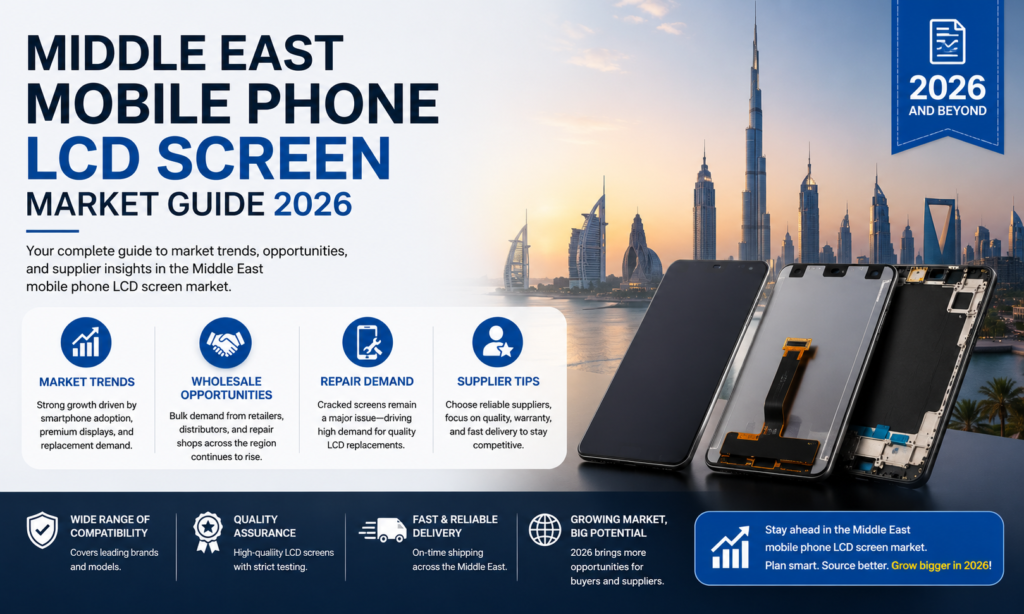
Understanding the Middle East Mobile Device Market
The Middle East smartphone market has become one of the world’s most dynamic consumer electronics markets. Countries such as Saudi Arabia, the United Arab Emirates (UAE), Qatar, Kuwait, Oman, Iraq, and Bahrain continue to invest heavily in digital infrastructure, e-commerce, smart cities, and mobile connectivity. These developments have significantly increased smartphone ownership while creating strong demand for mobile phone LCD screens, repair parts, and mobile accessories.
Recent industry research indicates that smartphone demand remains resilient despite temporary fluctuations in consumer spending. Omdia reported that the Middle East smartphone market experienced strong shipment growth during 2025, driven primarily by upgrades from entry-level devices to affordable 5G smartphones and mid-range models. Saudi Arabia remains the region’s largest smartphone market, while the UAE continues to benefit from tourism, premium retail, and strong promotional campaigns.
For wholesalers, distributors, and repair businesses, this represents an exciting opportunity. Unlike mature markets where smartphone ownership has largely plateaued, the Middle East continues to experience both new smartphone adoption and high replacement demand. Every new smartphone sold eventually creates future demand for replacement LCD screens, batteries, charging ports, cameras, and protective accessories. The repair ecosystem therefore grows alongside smartphone sales rather than competing against them.
Another factor driving market expansion is the region’s young and technology-oriented population. Consumers actively follow flagship launches from Apple, Samsung, Xiaomi, HONOR, OPPO, vivo, Huawei, and Google Pixel, while many budget-conscious buyers choose mid-range Android devices. As smartphone usage becomes central to work, education, banking, and entertainment, protecting and repairing these devices becomes increasingly important.
Why the Middle East Is Becoming a Global Smartphone Hub
Several powerful trends explain why the Middle East has become one of the fastest-growing regions for mobile phone parts and accessories.
The first is high smartphone penetration. Gulf Cooperation Council (GCC) countries have some of the world’s highest smartphone adoption rates. Consumers frequently upgrade to newer models while older devices enter the second-hand market. This creates a healthy ecosystem for refurbishment companies and repair shops that specialize in replacing broken displays and damaged components.
The second driver is government investment in digital transformation. Saudi Arabia’s Vision 2030, Dubai’s Smart City initiatives, and similar national programs encourage widespread adoption of digital services, increasing dependence on smartphones for daily activities. Businesses, students, travelers, and tourists all rely heavily on mobile devices, making screen repair services more valuable than ever.
Tourism also plays an important role. Millions of visitors travel annually to Dubai, Abu Dhabi, Riyadh, Doha, and other regional destinations. Broken smartphone screens during travel create immediate demand for local repair centers, which in turn require reliable suppliers of high-quality replacement LCD and OLED screens.
Cross-border trade further strengthens the market. Dubai, in particular, serves as a distribution hub connecting Asia, Africa, and Europe. Many wholesalers import smartphone LCD screens and accessories into the UAE before redistributing products throughout the Middle East and North Africa (MENA) region.
Key Countries Driving Market Growth
Although the Middle East is often viewed as one market, each country offers different business opportunities.
| Country | Market Characteristics | Main Opportunities |
|---|---|---|
| Saudi Arabia | Largest smartphone market | LCD replacement, premium accessories |
| UAE | Regional trading hub | Wholesale distribution, refurbishment |
| Iraq | Rapid smartphone growth | Affordable LCD screens |
| Qatar | High purchasing power | Premium phone accessories |
| Kuwait | Strong retail sector | Original-quality repair parts |
| Oman | Growing repair industry | Mid-range smartphone components |
Saudi Arabia continues to dominate smartphone shipments due to its large population and expanding digital economy. Consumers increasingly purchase premium smartphones while maintaining older devices for secondary use. This trend fuels consistent demand for replacement displays, batteries, charging flex cables, and camera modules.
The UAE, meanwhile, serves as the Middle East’s international electronics marketplace. Large importers, exporters, and distributors operate from Dubai, supplying retailers across neighboring countries. International buyers often attend trade exhibitions in Dubai to establish partnerships with Chinese manufacturers specializing in mobile phone parts.
Emerging markets such as Iraq also deserve attention. Omdia data shows exceptionally strong shipment growth in Iraq, supported by expanding retail channels and increasing affordability of Android smartphones. These markets often prioritize cost-effective replacement LCD screens over expensive original manufacturer repairs, creating excellent opportunities for wholesale suppliers.
Smartphone Market Trends in 2026
Today’s Middle Eastern smartphone market reflects changing consumer preferences rather than simple population growth.
Consumers increasingly seek better value instead of simply purchasing the most expensive flagship phones. Affordable 5G smartphones have become particularly attractive because they provide premium features at competitive prices. Manufacturers have expanded their mid-range product portfolios, allowing consumers to enjoy high-refresh-rate displays, fast charging, improved cameras, and larger batteries without paying flagship prices.
At the same time, premium smartphones remain highly desirable in affluent markets like Saudi Arabia, the UAE, and Qatar. Apple and Samsung continue to attract consumers willing to invest in flagship devices, while Chinese brands steadily increase market share by offering excellent specifications at lower prices.
This diversity benefits the repair industry because every price segment requires replacement components. Premium phones typically need high-quality OLED replacement displays, whereas budget and mid-range devices generate substantial demand for cost-effective LCD assemblies. Repair shops that maintain inventory across multiple brands can therefore serve a much broader customer base.
Industry forecasts also suggest continued expansion of the wider Middle East & Africa mobile accessories market, which generated approximately US$7.6 billion in 2025 and is projected to reach US$12.8 billion by 2033, representing a CAGR of approximately 6.8%. This sustained growth reflects increasing smartphone ownership, expanding e-commerce, and rising consumer interest in premium accessories.
Wholesale Business Opportunities
The Middle East has become one of the most attractive destinations for companies involved in mobile phone LCD screens, replacement parts, and mobile accessories. As smartphone ownership continues to rise across Gulf Cooperation Council (GCC) countries and neighboring markets, wholesalers have an opportunity to serve a diverse customer base that includes repair shops, distributors, retailers, refurbishment companies, and e-commerce sellers. Unlike markets where growth has slowed, the Middle East still combines increasing smartphone adoption with a thriving repair industry, creating sustained demand for high-quality replacement components.
Another major advantage is the region’s strategic location. Cities such as Dubai function as international trading hubs connecting Asia, Europe, and Africa. Products imported from China can be redistributed efficiently to Saudi Arabia, Kuwait, Qatar, Oman, Bahrain, Iraq, Jordan, and North African countries. This logistics network shortens delivery times and enables businesses to maintain competitive inventory levels.
For wholesalers entering the region, success depends on offering more than competitive pricing. Buyers increasingly expect suppliers to provide complete product documentation, strict quality control, fast shipping, flexible minimum order quantities (MOQs), and responsive after-sales service. Establishing long-term partnerships rather than focusing on one-time transactions helps build trust and repeat business. Many successful Chinese manufacturers now support their Middle Eastern partners with customized packaging, private labeling, multilingual product information, and technical assistance, creating additional value beyond the product itself.
Why Global Buyers Source LCD Screens from China
China remains the world’s largest manufacturing center for mobile phone LCD screens, OLED displays, and smartphone accessories. The country’s mature supply chain, advanced production technology, and efficient logistics allow manufacturers to deliver consistent quality while maintaining competitive prices.
Shenzhen, often referred to as the global hub for mobile phone components, is home to thousands of suppliers specializing in LCD assemblies, OLED panels, touch screens, batteries, charging ports, cameras, and other repair parts. Buyers from the Middle East frequently source directly from Shenzhen because they can access a broad product range, compare quality grades, and consolidate shipments from multiple suppliers into a single order.
Chinese manufacturers also invest heavily in research and development, enabling them to produce replacement displays that closely match the original specifications of leading smartphone brands. Whether customers require Original Service Pack, OEM Quality, Soft OLED, Hard OLED, or Incell LCD screens, experienced suppliers can provide solutions for nearly every major smartphone model.
Another important advantage is manufacturing scalability. Large factories can fulfill high-volume wholesale orders while maintaining stable production schedules and quality consistency. This capability is particularly valuable for distributors supplying multiple countries across the Middle East, where demand can fluctuate during seasonal promotions, back-to-school campaigns, and holiday shopping periods.
Quality Control and Supplier Selection
Choosing the right supplier is one of the most important decisions for wholesalers and repair businesses. A lower purchase price may seem attractive, but inconsistent quality can lead to customer complaints, warranty claims, and damage to a company’s reputation.
Reliable manufacturers implement comprehensive quality control procedures throughout production. These typically include incoming material inspection, touch sensitivity testing, display brightness measurement, color calibration, dead-pixel inspection, flex cable verification, and final functional testing before shipment. Many factories also perform drop tests, aging tests, and packaging inspections to ensure products arrive safely after international transportation.
When evaluating suppliers, buyers should consider the following factors:
| Evaluation Criteria | Why It Matters |
|---|---|
| Product Quality | Reduces warranty claims |
| Testing Procedures | Ensures reliable performance |
| Certifications | Demonstrates manufacturing standards |
| Inventory Availability | Supports fast delivery |
| Warranty Policy | Builds customer confidence |
| Technical Support | Assists with installation and troubleshooting |
| Packaging Quality | Prevents shipping damage |
| Export Experience | Simplifies customs and logistics |
Professional suppliers often provide detailed product images, compatibility information, testing videos, and inspection reports before shipment. This transparency helps buyers make informed purchasing decisions and reduces the likelihood of misunderstandings after delivery.
For companies serving the Middle Eastern market, working with ISO-certified manufacturers that follow standardized production processes can significantly improve long-term business performance.
Future Market Outlook
The outlook for the Middle East mobile phone LCD screen and accessories market remains highly positive. Smartphone penetration continues to increase, while consumers are holding onto their devices longer than in previous years. This combination naturally expands the repair market, as more users choose to replace damaged screens and worn components instead of purchasing new smartphones immediately.
The continued rollout of 5G networks will also stimulate device upgrades. As consumers adopt newer smartphones, older devices are likely to enter the second-hand and refurbishment markets, creating additional demand for replacement displays, batteries, and other spare parts. Refurbishment businesses are expected to play an increasingly important role in extending product life cycles and supporting sustainable consumption.
Artificial intelligence is another emerging trend shaping the industry. AI-powered smartphones require advanced displays with higher brightness, improved color accuracy, and lower power consumption. While flagship devices increasingly adopt premium OLED technologies, LCD screens will remain essential for budget and mid-range models that dominate shipment volumes in many Middle Eastern markets.
E-commerce is expected to continue transforming wholesale and retail distribution. Buyers now compare suppliers based not only on price but also on delivery speed, online support, warranty services, and digital product catalogs. Manufacturers that invest in professional websites, multilingual customer service, and efficient logistics will be better positioned to expand their market share.
Looking toward 2030, businesses that prioritize quality, innovation, and customer relationships are likely to benefit from sustained market growth. Companies capable of supplying complete solutions—including replacement LCD screens, OLED displays, accessories, and technical support—will be well positioned to meet the evolving needs of distributors and repair professionals across the region.
Emerging Technologies
Several technologies are expected to reshape the smartphone repair industry over the coming years:
- Flexible OLED displays will become more common as foldable smartphones gain popularity.
- LTPO display technology will continue improving battery efficiency in flagship devices.
- Eco-friendly packaging and recyclable materials will become increasingly important as sustainability initiatives expand.
- AI-assisted quality inspection will improve manufacturing consistency and reduce production defects.
- Faster charging standards will create additional demand for compatible accessories such as GaN chargers, USB-C cables, and high-capacity power banks.
Wholesalers that stay ahead of these technological trends can expand their product portfolios and remain competitive in an evolving marketplace.
Business Opportunities Through 2030
The coming years present significant opportunities for manufacturers, distributors, and repair service providers. Demand is expected to remain strong across several areas:
- Premium OLED replacement screens for flagship smartphones
- Cost-effective LCD displays for budget devices
- Original-quality spare parts for refurbishment companies
- Fast-charging accessories and wireless charging products
- Protective accessories such as tempered glass and rugged phone cases
- Private-label and OEM manufacturing services for regional distributors
Companies that combine competitive pricing with consistent product quality, efficient logistics, and responsive customer support will be best positioned to build long-term partnerships in the Middle East.
Conclusion
The Middle East has established itself as one of the world’s most promising markets for mobile phone LCD screens, OLED replacement displays, and mobile accessories. Rapid smartphone adoption, expanding digital infrastructure, and a growing repair culture have created strong demand for high-quality replacement parts across countries such as Saudi Arabia, the UAE, Qatar, Kuwait, Oman, and Iraq.
At the same time, changing consumer behavior is reshaping the industry. Customers increasingly value affordable repairs, premium-quality components, and reliable after-sales support. This trend creates substantial opportunities for wholesalers capable of supplying a complete range of LCD screens, OLED displays, batteries, chargers, cables, phone cases, and other essential accessories.
As technology continues to evolve, businesses that invest in innovation, strict quality control, and long-term customer relationships will be well positioned to succeed. Whether you are a distributor, importer, repair shop, or refurbishment company, the Middle East offers a dynamic marketplace with significant growth potential for years to come.
Frequently Asked Questions
1. Which Middle Eastern countries have the highest demand for smartphone LCD screens?
Saudi Arabia, the United Arab Emirates, Iraq, Qatar, Kuwait, and Oman are among the largest markets due to high smartphone penetration and expanding repair industries.
2. Are OLED replacement screens becoming more popular than LCD screens?
Yes. OLED demand is growing rapidly for flagship smartphones, while LCD screens continue to dominate the budget and mid-range repair market.
3. Why do Middle Eastern wholesalers source from China?
Chinese manufacturers offer competitive pricing, comprehensive product portfolios, advanced manufacturing capabilities, reliable quality control, and efficient global logistics.
4. Which mobile accessories sell best in the Middle East?
Fast chargers, USB-C cables, tempered glass screen protectors, phone cases, wireless earbuds, power banks, and MagSafe-compatible accessories are among the fastest-growing categories.
5. What should buyers consider when selecting an LCD screen supplier?
Important factors include product quality, testing procedures, certifications, warranty policies, packaging standards, inventory availability, technical support, and export experience.