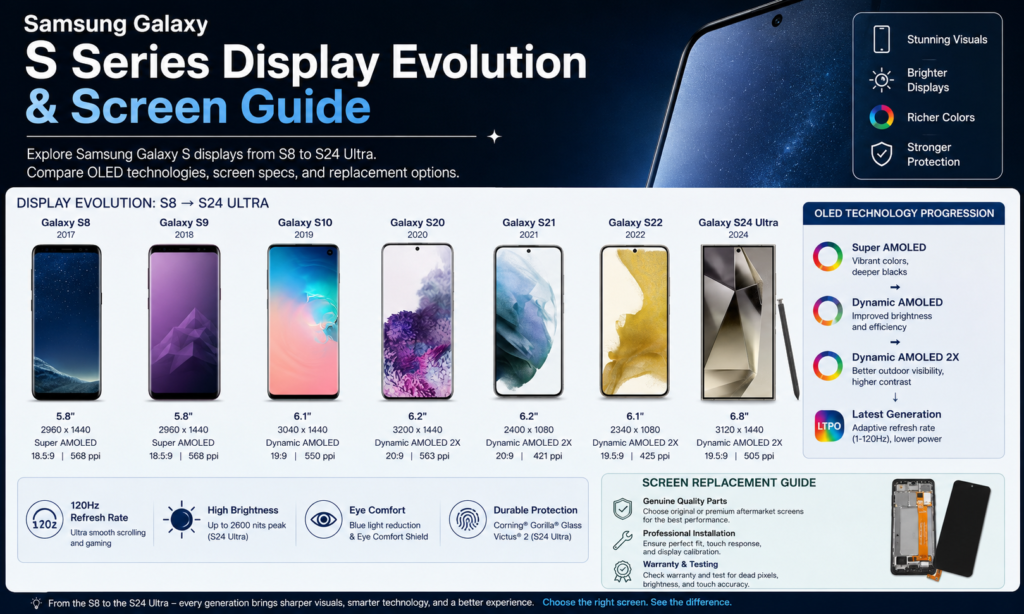
Samsung har konsekvent varit en av världens ledande smartphonetillverkare, och den Galaxy S-serien representerar företagets flaggskepp för smartphones. Sedan lanseringen av Galaxy S8 i 2017, Samsung har förvandlat smartphone-displayteknik från traditionell Super AMOLED paneler till mycket avancerade Dynamic AMOLED 2X skärmar med adaptiva uppdateringsfrekvenser, exceptionell ljusstyrka, och branschledande färgnoggrannhet.
Galaxy S8 markerade en stor vändpunkt i smarttelefondesign. Dess Infinity Display introducerade ultratunna ramar och en fantastisk böjd OLED-skärm som snabbt blev riktmärket för premium smartphones. Galaxy S8 hade en 5,8-tums Super AMOLED-skärm med en upplösning på 2960 × 1440 pixlar och en pixeltäthet på ungefär 570 PPI. På den tiden, den levererade en av de skarpaste och mest livfulla skärmarna som finns på smartphonemarknaden.
Sedan dess, Samsung har släppt flera generationer av Galaxy S-enheter, var och en förbättrar bildkvaliteten, varaktighet, ljusstyrka, uppdateringsfrekvenser, och energieffektivitet. I dag, original Samsung OLED-skärmar är mycket eftertraktade inom reparations- och renoveringsbranschen eftersom de fortsätter att erbjuda överlägsen beröringskänslighet, färgåtergivning, och hållbarhet jämfört med många eftermarknadsalternativ.
Komplett Samsung Galaxy S-seriens modelllista efter Galaxy S8
Galaxy S9 och S10-serien
Efter framgången med Galaxy S8, Samsung lanserade Galaxy S9 och S9 Plus i 2018. Dessa modeller behöll Infinity Display-konceptet samtidigt som de förbättrade ljusstyrkan, kameraprestanda, och stereoljudfunktioner.
Galaxy S10-familjen introducerade flera nya modeller:
- Galaxy S10e
- Galaxy S10
- Galaxy S10 Plus
- Galaxy S10 5G
S10-serien innehöll Samsungs första generation av Dynamisk AMOLED displayer och introducerade ultraljudsfingeravtryckssensorer inbäddade under skärmen. Detta representerade ett betydande steg framåt inom displayteknik och användarupplevelse.
Galaxy S20 och S21-serien
I 2020, Samsung bytte namn på sortimentet från S11 till S20, anpassa produktnamnen till releaseåret.
Galaxy S20-familjen ingår:
| Modell | Visningstyp | Uppdateringshastighet |
|---|---|---|
| Galaxy S20 | Dynamic AMOLED 2X | 120Hz |
| Galaxy S20+ | Dynamic AMOLED 2X | 120Hz |
| Galaxy S20 Ultra | Dynamic AMOLED 2X | 120Hz |
Införandet av 120Hz uppdateringshastigheter dramatiskt förbättrad rullningsjämnhet, spelprestanda, och övergripande lyhördhet.
S21-sortimentet fortsatte att förfina Dynamic AMOLED 2X-tekniken samtidigt som strömeffektiviteten och ljusstyrkan förbättrades.
Galaxy S22 och S23-serien
S22-serien kom med förbättrad LTPO-teknik, gör det möjligt för skärmar att dynamiskt justera uppdateringshastigheter och spara batteri.
S23-uppställningen visades:
- Galaxy S23
- Galaxy S23+
- Galaxy S23 Ultra
Samsung optimerad skärmljusstyrka, synlighet utomhus, och färgkalibrering. S23 Ultra blev särskilt populär bland professionella användare på grund av dess kombination av produktivitetsfunktioner och förstklassig skärmkvalitet.
Galaxy S24 Series and Beyond
Galaxy S24-familjen representerar för närvarande en av Samsungs mest avancerade smartphonegenerationer.
Galaxy S24 Ultra funktioner:
| Specifikation | Galaxy S24 Ultra |
|---|---|
| Displaystorlek | 6.8-tum |
| Visningstyp | Dynamic AMOLED 2X |
| Upplösning | 3120 × 1440 |
| Uppdateringshastighet | 1-120Hz Adaptiv |
| Högsta ljusstyrka | Fram till 2600 nits |
| HDR-stöd | HDR10+ |
Samsungs officiella specifikationer framhäver S24 Ultras Dynamic AMOLED 2X-panel, adaptiv uppdateringsfrekvens på 120Hz, och Quad HD+-upplösning.
Samsung Smartphone Display Teknikutveckling
Super AMOLED-teknik
Samsungs Super AMOLED displayer blev kända för att leverera djupa svarta, levande färger, och utmärkt effekteffektivitet. Till skillnad från traditionella LCD-skärmar som kräver bakgrundsbelysning, OLED-teknik gör att varje pixel kan avge sitt eget ljus.
Galaxy S8 använde en Super AMOLED-panelmätning 5.8 tum med HDR-stöd och en upplösning på 2960 × 1440 pixlar. Den här tekniken gav enastående kontrastförhållanden och hjälpte till att etablera Samsung som ledande inom mobilskärmsinnovation.
En stor fördel med Super AMOLED-teknik är lägre strömförbrukning vid visning av mörkt innehåll. Eftersom svarta pixlar förblir helt avstängda, batterieffektiviteten förbättras avsevärt.
Dynamisk AMOLED-teknik
Samsung introducerade Dynamisk AMOLED med Galaxy S10-serien. Denna teknik förbättrade färgnoggrannheten, minskade skadliga utsläpp av blått ljus, och förbättrad HDR-prestanda.
Dynamiska AMOLED-skärmar levereras:
- Bättre färgprecision
- Högre ljusstyrka
- Förbättrad ögonkomfort
- Förbättrat HDR-innehållsstöd
För användare som konsumerar videor, spelinnehåll, och sociala medier, Dynamiska AMOLED-skärmar gav en mer realistisk tittarupplevelse.
Dynamisk AMOLED 2X-teknik
Dynamic AMOLED 2X representerar Samsungs senaste flaggskeppsteknologi.
Moderna Galaxy S24-enheter använder Dynamic AMOLED 2X-paneler med:
- Adaptiva uppdateringshastigheter från 1Hz till 120Hz
- Maximal ljusstyrka når 2600 nits
- Stöd för HDR10+
- LTPO-teknik
- Förbättrad sikt utomhus
Samsungs flaggskeppsskärmar fortsätter att sätta industristandarder för ljusstyrka och effektivitet. Galaxy S24 Ultras dynamiska AMOLED 2X-skärm uppnår betydligt högre ljusstyrka än tidigare generationer samtidigt som den bibehåller utmärkt strömhantering.
Samsung Galaxy S Series Jämförelse av skärmspecifikationer
Displaystorlek Evolution
Skärmstorlekarna har ökat stadigt under åren.
| Modell | Skärmstorlek |
|---|---|
| Galaxy S8 | 5.8″ |
| Galaxy S10 | 6.1″ |
| Galaxy S20 Ultra | 6.9″ |
| Galaxy S23 Ultra | 6.8″ |
| Galaxy S24 Ultra | 6.8″ |
Konsumenter förväntar sig nu större skärmar för streaming, spelande, och multitasking. Samsung har lyckats öka skärmstorleken samtidigt som den behåller bekväm ergonomi genom tunnare ramar.
Upplösning och pixeldensitet
Samsung har konsekvent levererat QHD+-skärmar på många flaggskeppsenheter.
Galaxy S8 innehöll en anmärkningsvärd 570 PPI-densitet, medan moderna Galaxy Ultra-enheter bibehåller exceptionell skärpa på ungefär 500 PPI. Trots något lägre pixeltäthet, nyare skärmar ger bättre ljusstyrka, uppdateringsfrekvenser, och övergripande bildkvalitet.
Förbättringar av uppdateringsfrekvensen
En av de största skärmframstegen har varit teknik för uppdateringsfrekvens.
| Generation | Uppdateringshastighet |
|---|---|
| Galaxy S8 | 60Hz |
| Galaxy S20 | 120Hz |
| Galaxy S24 Ultra | 1-120Hz Adaptiv |
Skillnaden mellan 60Hz och 120Hz känns som att uppgradera från en vanlig väg till en ny asfalterad motorväg. Allt verkar smidigare och mer responsivt.
Samsungs LTPO-teknik tillåter att uppdateringsfrekvenser dynamiskt justeras baserat på innehåll, förbättra batteritiden utan att offra användarupplevelsen.
Ljusstyrka och HDR -prestanda
Ljusstyrkan har förbättrats dramatiskt sedan Galaxy S8.
| Modell | Högsta ljusstyrka |
|---|---|
| Galaxy S8 | Runt 540 nits |
| Galaxy S24 Ultra | Fram till 2600 nits |
Denna ökning gör moderna Galaxy-telefoner mycket lättare att använda i direkt solljus. HDR-innehåll gynnas också av högre kontrast och större dynamiskt omfång.
Original Samsung skärmtyper förklaras
Original Service Pack-skärmar
Original Service Pack-skärmar är fabrikstillverkade Samsung-skärmar som distribueras via auktoriserade reparationskanaler.
Kännetecken inkluderar:
- Original OLED-panel
- Original beröringslager
- Original rammontering
- Fabriksfärgkalibrering
Dessa skärmar ger prestanda närmast en helt ny enhet och anses allmänt vara det högsta ersättningsalternativet.
Original Dragskärmar
Original dragna skärmar kommer från begagnade enheter.
Tekniker tar försiktigt bort fungerande displayer från donatortelefoner och återanvänder dem vid reparationer.
Fördelar inkluderar:
- Äkta Samsung OLED-panel
- Original beröringskänslighet
- Lägre pris än Service Pack-skärmar
Kvaliteten beror på donatorenhetens tillstånd.
Renoverade OLED-skärmar
Renoverade skärmar använder original Samsung OLED-paneler med ersättningsglas.
Vid renovering:
- Trasigt glas tas bort.
- Original OLED förblir intakt.
- Nytt glas är laminerat.
- Vakuumbindning återställer utseendet.
Dessa displayer erbjuder ofta utmärkt värde när de renoveras av erfarna fabriker.
Eftermarknads OLED-skärmar
Eftermarknads OLED-skärmar tillverkas av tredjepartsleverantörer.
Förmånerna inkluderar:
- Lägre kostnad
- Bredare tillgänglighet
Potentiella nackdelar inkluderar:
- Lägre ljusstyrka
- Olika färgkalibrering
- Minskad hållbarhet
- Variabel beröringsprestanda
Reparationsverkstäder erbjuder ofta eftermarknads-OLEDs som budgetalternativ.
Incell LCD-ersättningsskärmar
För vissa Samsung-modeller, leverantörer erbjuder Incell LCD-skärmar.
Fast betydligt billigare, LCD-ersättningar har flera nackdelar:
- Lägre kontrastförhållande
- Minskad ljusstyrka
- Högre strömförbrukning
- Tjockare displaystruktur
- Sämre svartnivåer
Många professionella reparationsföretag rekommenderar OLED-ersättningar när det är möjligt för att bevara den ursprungliga användarupplevelsen.
Original Samsung Screen Identification Guide
Fysiska inspektionsmetoder
Att identifiera en original Samsung-skärm kräver noggrann inspektion.
Nyckelindikatorer inkluderar:
- Konsekventa OLED-svartnivåer
- Jämn ljusstyrka
- Exakt färgåtergivning
- Responsiv touch-prestanda
- Korrekt fingeravtryckssensorkompatibilitet
Original Samsung OLED-skärmar uppvisar vanligtvis överlägsen kantlikformighet och jämnare animationer.
Reparationstekniker använder ofta specialiserad testmjukvara för att verifiera displayens äkthet och identifiera utbyteshistorik.
Visningskvalitetsindikatorer
Flera prestandafaktorer hjälper till att bestämma skärmkvaliteten:
| Indikator | Original OLED | Eftermarknad OLED | LCD |
|---|---|---|---|
| Svarta nivåer | Perfekt | Mycket bra | Begränsad |
| Ljusstyrka | Excellent | Måttlig | Lägre |
| Touch Response | Excellent | Bra | Måttlig |
| Effekteffektivitet | Excellent | Bra | Lägre |
| Fingeravtrycksstöd | Full | Partiell | Ofta begränsad |
När man jämför skärmar sida vid sida, original Samsung OLED-skärmar ger vanligtvis rikare färger, djupare svarta, och mer naturlig bildåtergivning.
Marknadstrender för skärmbyte inom 2026
Reparationsbranschen för smartphones fortsätter att expandera när konsumenterna håller enheterna längre.
Många Galaxy S8, S9, S10, S20, S21, S22, och S23-enheter förblir aktiva på globala marknader, skapa stor efterfrågan på ersättningsskärmar. Renoverade OLED-skärmar har blivit särskilt populära eftersom de balanserar prisvärdhet och prestanda.
Branschproffs föredrar allt oftare original OLED-renovering framför komplett panelbyte. Detta tillvägagångssätt minskar elektroniskt avfall samtidigt som Samsungs förstklassiga skärmkvalitet bevaras.
Marknadens efterfrågan är särskilt stark bland:
- Mobila verkstäder
- Renovering fabriker
- Grossistdistributörer
- Försäkringsreparatörer
- Elektronikåtervinnare
Eftersom flaggskeppspriserna på smartphones fortsätter att stiga, professionell skärmrenovering har blivit en viktig del av ekosystemet för mobila enheter.
Att välja rätt Samsung-skärmbyte
Att välja rätt ersättningsskärm beror på din budget och kvalitetsförväntningar.
Om maximal prestation är ditt mål, en Original Samsung Service Pack-skärm är fortfarande det bästa alternativet. Dessa skärmar levererar ljusstyrka på fabriksnivå, färgnoggrannhet, beröringskänslighet, och hållbarhet.
För verkstäder som söker en balans mellan kostnad och kvalitet, renoverade original OLED-skärmar ger ofta det högsta värdet. De behåller den äkta Samsung OLED-panelen samtidigt som de sänker ersättningskostnaderna avsevärt.
Konsumenter med begränsad budget kan överväga eftermarknads OLED-skärmar. Även om de i allmänhet fungerar bra för dagligt bruk, de kanske inte helt matchar ljusstyrkan, färgkonsistens, eller lång livslängd för original Samsung-paneler.
LCD-ersättningar bör vanligtvis reserveras för budgetreparationer eftersom de i grunden förändrar premium OLED-upplevelsen som Galaxy S-smarttelefoner är kända för.
Slutsats
Samsung Galaxy S-serien har genomgått en anmärkningsvärd utveckling sedan lanseringen av Galaxy S8. Från den ursprungliga Super AMOLED Infinity Display till dagens Dynamic AMOLED 2X-teknik, Samsung har konsekvent tänjt på gränserna för innovation för smartphoneskärmar.
Galaxy S8 introducerade en revolutionerande design med en 5,8-tums Super AMOLED-panel, medan moderna enheter som Galaxy S24 Ultra har adaptiva 120Hz Dynamic AMOLED 2X-skärmar som kan nå 2600 nits av ljusstyrka. Dessa framsteg har förändrat hur användare interagerar med smartphones i arbetet, underhållning, fotografi, och spel.
För reparationsföretag, grossister, och renovatörer, förstå skillnaderna mellan original Service Pack-skärmar, drog OLED, renoverade OLED, eftermarknads OLED, och LCD-ersättningar är viktiga. Att välja rätt display påverkar inte bara reparationskvaliteten utan påverkar också direkt kundnöjdheten och enhetens livslängd.
Vanliga frågor
1. Vilken skärmtyp använder Samsung Galaxy S8?
Samsung Galaxy S8 använder en 5,8-tums Super AMOLED display med en upplösning på 2960 × 1440 pixlar och HDR-stöd.
2. Vad är skillnaden mellan Super AMOLED och Dynamic AMOLED?
Dynamisk AMOLED förbättrar färgnoggrannheten, HDR-prestanda, minskning av blått ljus, och övergripande skärmeffektivitet jämfört med tidigare Super AMOLED-teknik.
3. Är en renoverad OLED-skärm original?
Ja. En renoverad OLED-skärm behåller vanligtvis den ursprungliga Samsung OLED-panelen samtidigt som den ersätter skadat glas och återställer funktionaliteten.
4. Vilken Samsung Galaxy-modell har den ljusaste skärmen?
Galaxy S24 Ultra kan uppnå toppljusnivåer på upp till 2600 nits, vilket gör den till en av Samsungs ljusaste smartphone-skärmar.
5. Är eftermarknads OLED-skärmar värda att köpa?
Eftermarknads OLED-skärmar kan vara en kostnadseffektiv lösning, men de kanske inte helt matchar ljusstyrkan, färgnoggrannhet, beröringskänslighet, och hållbarheten för original Samsung-skärmar.