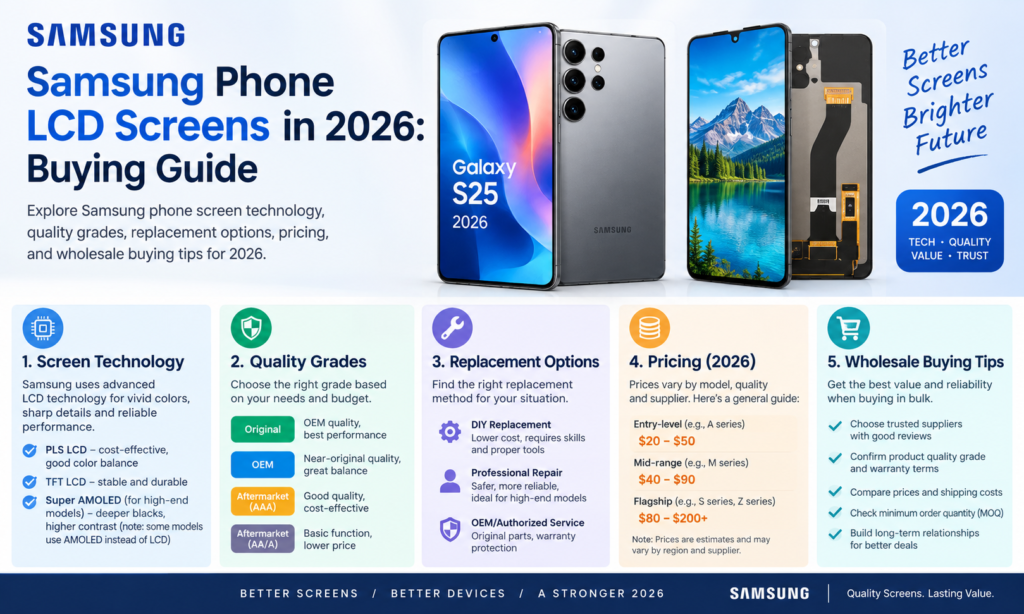
2026 Ang Samsung Phone Screen Market Overview
Ang Samsung nagpabilin nga usa sa labing hinungdanon nga mga ngalan sa global nga industriya sa pagpakita sa smartphone, apan naghisgot bahin sa "Samsung LCD screens" sa 2026 nanginahanglan usa ka hinungdanon nga kalainan: daghang modernong Galaxy nga mga telepono ang wala na mogamit ug tradisyonal nga LCD panel. Inay, Ang Samsung anam-anam nga gibalhin ang portfolio sa smartphone niini OLED ug AMOLED nga mga teknolohiya, ilabi na sa iyang premium nga Galaxy S ug Galaxy Z nga mga pamilya ug sa kadaghanan sa Galaxy A range. Ang kaugalingon nga pagreport sa negosyo sa Samsung nag-ingon nga ang OLED nag-asoy sa gibanabana 51% sa global nga smartphone-panel market sa 2025, gikan sa 50.7% sa 2024, samtang ang kompanya nagpadayon sa pagpahimutang sa kaugalingon ingon usa ka nanguna nga mobile OLED supplier.
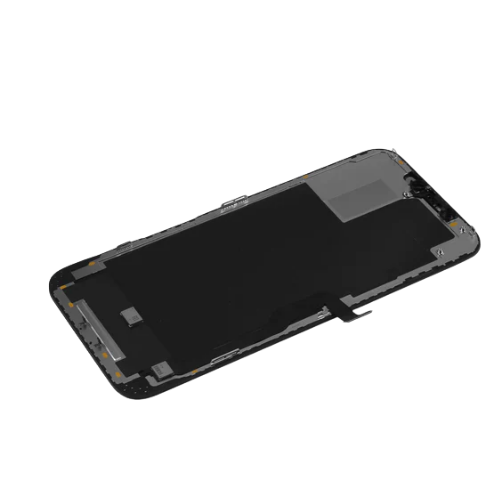
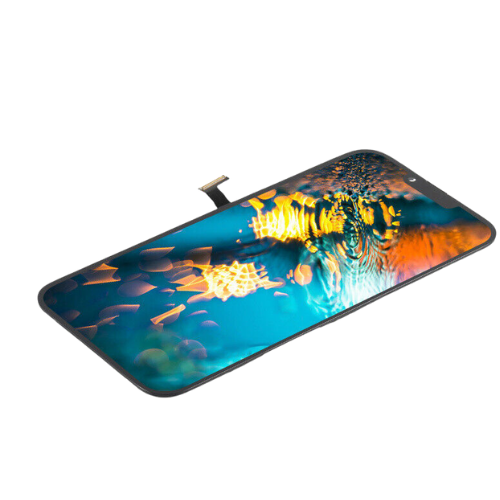
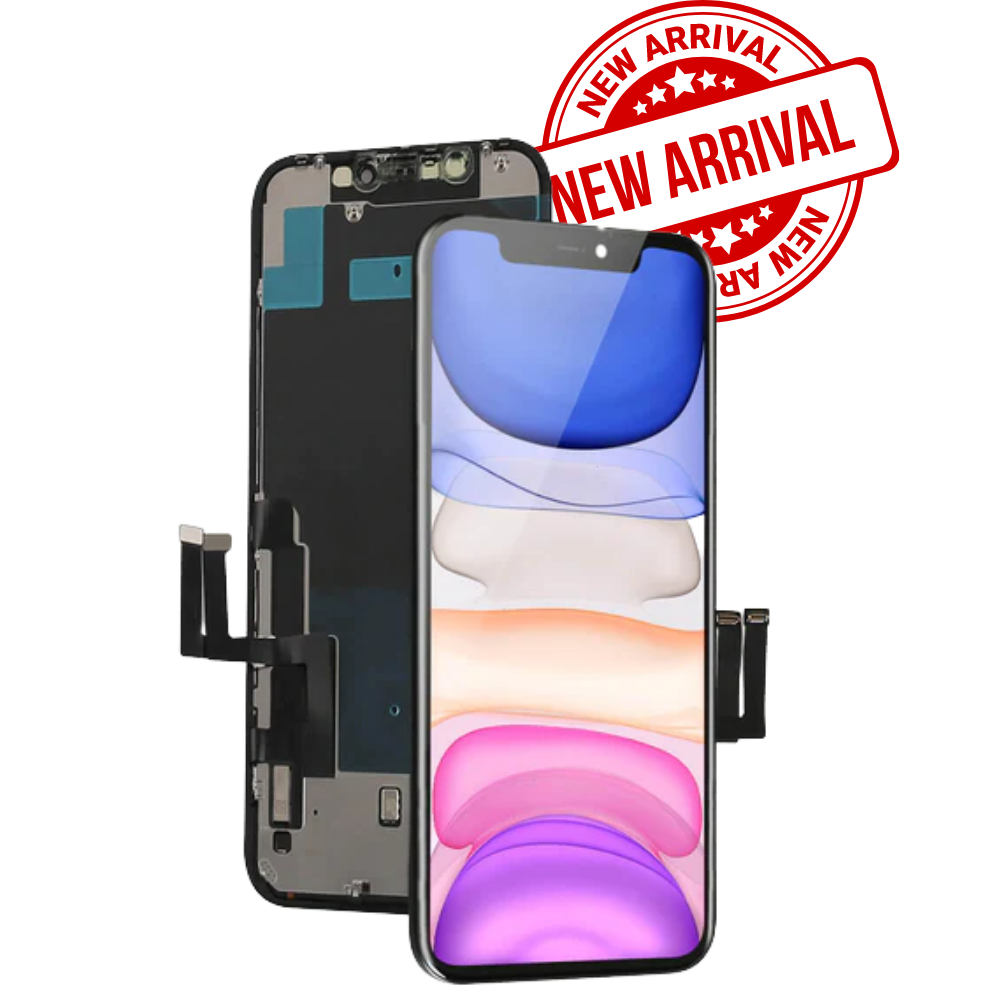
Kana nga pagbalhin nagbag-o sa paagi sa pag-ayo sa mga tindahan, mga distributor, mga wholesaler, ug ang mga end user kinahanglan maghunahuna bahin sa kapuli nga mga screen sa 2026. Ang usa ka screen nga gi-anunsyo sa yano ingon usa ka "Samsung LCD" mahimo nga usa ka AMOLED nga kapuli, estrikto nga OLED, flexible nga OLED, o aftermarket LCD pagkakabig, depende sa modelo sa Galaxy. Alang sa usa ka negosyo nga namalit nga mga puli nga gipakita, ang kalainan dili kosmetiko. Ang teknolohiya sa panel makaapekto sa kahayag, itom nga lebel, Refresh rate, gibag-on, paghikap performance, kinaiya sa baterya, kalig-on, presyo, ug katagbawan sa kustomer. Mahimo usab nga mahibal-an kung ang usa ka puli tan-awon ug gibati nga duol sa orihinal nga gipakita sa pabrika o naglihok lamang ingon usa ka kapuli nga mas barato. Sa 2026, kana nga kalainan nahimong labi ka hinungdanon tungod kay ang pagtaas sa gasto sa sangkap sa smartphone nag-awhag sa mga tiggama ug mga supplier nga mangita alang sa mas barato nga mga solusyon sa pagpakita. Gitagna ni Omdia nga ang mga pagpadala sa global nga smartphone AMOLED mokunhod 2026 taliwala sa mas taas nga presyo sa memorya ug mas huyang nga panginahanglan, uban ang pagbutang niini sa Abril nga forecast 2026 AMOLED nga mga pagpadala sa gibanabana 778 milyon nga units.
Ngano nga Gigamit sa Samsung ang AMOLED Imbes sa Tradisyonal nga LCD
Ang tradisyonal nga teknolohiya sa LCD nagsalig sa usa ka backlight nga nagdan-ag sa liquid-crystal layer, samtang ang OLED pixels makamugna og kaugalingong kahayag. Kini nga sukaranan nga kalainan naghatag sa AMOLED nga nagpakita sa daghang mga bentaha nga mohaum sa modernong mga smartphone sa Galaxy ilabi na nga maayo. Ang indibidwal nga OLED pixels mahimong hingpit nga ma-off, paghimo og lawom nga mga itom ug taas nga kalainan nga wala magkinahanglan og bulag nga backlight. Gitugotan usab sa teknolohiya ang mga tiggama nga maghimo labi ka manipis nga mga asembliya sa pagpakita ug gisuportahan ang labi ka pig-ot nga mga bezel ug kurbado o nabag-o nga mga hinungdan nga porma nga makita sa mga premium nga smartphone.. Ang Samsung karon nga estratehiya sa pagpakita sa Galaxy nagpakita niini nga direksyon, uban sa kompanya nga gipasiugda ang taas nga rate sa pag-refresh, hataas nga kahayag, gipaayo nga pagproseso sa imahe, ug pinasahi nga mga istruktura sa pagpakita imbes nga mobalik sa naandan nga LCD isip panguna nga teknolohiya alang sa mga premium nga telepono.
Para sa mga negosyo sa pag-ayo, hinoon, ang pulong Mulo kinahanglan dili awtomatik nga isipon nga garantiya sa orihinal nga kalidad. Ang kapuli nga merkado adunay lainlaing mga grado, mga tinubdan sa paggama, ug mga configuration sa assembly. Ang usa ka taas nga grado nga kapuli mahimo’g magbag-o sa kadaghanan sa biswal nga pasundayag sa orihinal nga telepono, samtang ang usa ka mas barato nga panel mahimong magpakita sa mga kalainan sa temperatura sa kolor, kahayag, Houch Sensitivity, anggulo sa pagtan-aw, konsumo sa kuryente, o refresh-rate nga kinaiya. Kini ang hinungdan ngano nga ang usa ka propesyonal nga pumapalit kinahanglan nga magtimbang-timbang sa tibuuk nga asembliya sa screen kaysa sa pagpalit nga lunsay sumala sa labing ubos nga presyo sa yunit. Ang usa ka kustomer sa Samsung Galaxy mahimong wala mahibal-an ang teknikal nga kalainan tali sa OLED, Mulo, ug LCD, pero makabantay dayon sila kung mura na ug dim ang replacement screen, adunay dili kasagaran nga mga kolor, dili maayo nga tubag sa paghikap, o lahi ang paggawi panahon sa pag-scroll. Sa praktikal nga mga termino, ang display mao ang bintana sa telepono sa operating system, busa ang pag-ilis niini sa usa ka ubos nga panel makahimo sa usa ka maayo kaayo nga galamiton nga mobati nga barato.
Ang Samsung Galaxy S Series Nagpakita sa 2026
Ang Ang serye sa Galaxy S nagrepresentar sa premium nga teknolohiya sa pagpakita sa smartphone sa Samsung, ug ang 2026 Gipakita sa henerasyon sa Galaxy S26 kung unsa ka layo ang paglihok sa kompanya lapas sa tradisyonal nga LCD. Ang karon nga impormasyon sa produkto sa Samsung nagpaila sa Galaxy S26 Ultra nga adunay 6.9-pulgada nga display nga adunay hangtod sa 120Hz refresh rate ug peak nga kahayag hangtod sa hangtod. 2,600 nits. Gipasiugda usab sa Samsung ang usa ka Hardware-based nga Privacy Display sa S26 Ultra nga nagpugong sa epektibo nga anggulo sa pagtan-aw aron makatabang nga mapugngan ang mga tawo sa duol nga makakita sa sensitibo nga sulud.
Para sa mga pumapalit sa screen replacement, kini nga mga detalye naghimo usa ka dakong hagit: dili tanang kapuli nga panel makahimo sa pagkopya sa orihinal nga kasinatian. Ang usa ka sukaranan nga screen sa aftermarket mahimo nga pisikal nga mohaum sa telepono apan lahi gihapon sa kahayag, Kamatuuran sa kolor, tubag sa paghikap, Refresh rate, o anggulo sa pagtan-aw. Ang S26 Ultra's Privacy Display naghimo niini nga mas espesyal tungod kay ang privacy function gisagol sa display hardware kaysa usa ka yano nga external privacy film.. Ang pagtangtang sa iFixit sa S26 Ultra nakit-an usab nga ang agianan sa pag-ayo sa pagpakita labi nga gipangayo bisan pa sa pipila ka mga positibo nga bahin sa pag-ayo sa bisan diin sa aparato..
| Kategoriya sa telepono sa Samsung | Kasagaran nga direksyon sa pagpakita sa 2026 | Pag-ilis nga prayoridad |
|---|---|---|
| Ang punoan nga punoan sa Galaxy S | Premium nga AMOLED/OLED | Orihinal o taas nga grado nga OLED |
| Galaxy S Ultra | Advanced nga AMOLED / OLED nga adunay espesyal nga mga bahin | Labing taas nga kalidad nga compatible nga asembliya |
| Galaxy Z Puto | Flexible nga OLED | Espesyal nga foldable OLED |
| Galaxy Z Flip | Flexible nga OLED | Espesyal nga foldable OLED |
| Galaxy A mid-range | Ang AMOLED/OLED nagkadaghan | Ang piho nga modelo sa OLED/OLED-compatible nga solusyon |
| Karaan/badyet nga mga modelo sa Galaxy | LCD o OLED depende sa henerasyon | Kumpirma ang orihinal nga tipo sa panel sa dili pa mag-order |
Ang Samsung Galaxy A Series ug ang Nagbag-o nga Display Supply Chain
Ang pamilya sa Galaxy A ilabi na nga makapaikag alang sa 2026 replacement-screen nga merkado tungod kay ang Samsung nagbalanse sa performance, retail nga presyo, gasto sa component, ug pagka-flexible sa supply-chain. Mga report sa 2026 nagpakita nga ang Samsung mahimong maggikan sa daghang mga OLED panel gikan sa mga supplier sa China alang sa pipila ka umaabot nga mga aparato sa Galaxy A ug FE, nga ang pagkunhod sa gasto usa ka hinungdanon nga panukmod. Usa ka taho nagkutlo sa usa ka order sa palibot 15 milyon nga OLED panel gikan sa China Star Optoelectronics Technology alang sa pipila ka umaabot nga mga modelo sa Galaxy.
Importante kini nga kalamboan tungod kay ang mga pulong Screen sa Samsung nga telepono ug Display panel nga hinimo sa Samsung mahimong mas maghulagway sa duha ka lain-laing mga butang. Ang usa ka Galaxy smartphone mahimong gidisenyo, tipunon, branded, ug gibaligya sa Samsung samtang naggamit ug display panel nga gigama sa laing display supplier. Para sa mga wholesaler, nagmugna kini og mga oportunidad ug komplikasyon. Daghang mga supplier ang makadugang sa pagkaanaa sa panel ug mahimo’g makunhuran ang gasto sa pag-ilis, apan kini usab naghimo sa kalidad nga klasipikasyon nga mas importante. Ang mga pumapalit kinahanglan nga magtagad sa gigikanan sa panel, teknolohiya, kahayag, resolusyon, Refresh rate, paghikap performance, pagkaangay sa frame, ug mga pamaagi sa pagkontrol sa kalidad imbis nga maghunahuna nga ang matag screen nga adunay usa ka Samsung-compatible nga numero sa modelo adunay parehas nga mga detalye.
LCD vs OLED vs AMOLED alang sa Samsung Screen Replacement
Kung nagpalit ug mga kapuli nga screen sa Samsung, ang una nga pangutana kinahanglan unsa nga teknolohiya ang tinuod nga gigamit sa orihinal nga telepono? LCD, Pormel, ug AMOLED dili mabaylo tungod lang kay silang tanan makapakita sa Android. Ang LCD nagkinahanglan og backlight, samtang ang OLED nagpatunghag kahayag sa lebel sa pixel, paghimo sa usa ka sukaranan nga lahi nga optical nga istruktura. Ang AMOLED mao ang pagpatuman sa Samsung sa aktibong-matrix nga OLED nga teknolohiya ug kaylap nga nakig-uban sa modernong Galaxy smartphones.
Alang sa mas karaan nga mga modelo sa Samsung nga orihinal nga gipadala nga adunay mga panel sa LCD, ang usa ka puli sa LCD mahimong usa ka makatarunganon ug ekonomikanhon nga pagpili. Alang sa usa ka modelo sa Galaxy nga orihinal nga gidisenyo sa palibot sa AMOLED, hinoon, ang pag-ilis sa display sa usa ka pagkakabig sa LCD mahimong magpaila sa mga pagkompromiso sa gibag-on, kalainan, itom nga lebel, kahayag, gahum kinaiya, ug kinatibuk-ang hitsura. Ang ubang mga kostumer sa pag-ayo mahimong modawat sa mga pagkompromiso tungod kay ang presyo mao ang ilang panguna nga kabalaka, samtang ang uban nagdahom nga ang ilang kapuli tan-awon nga duol sa pabrika screen kutob sa mahimo. Mao nga ang usa ka propesyonal nga kinutlo kinahanglan nga tin-aw nga mailhan ang tipo sa panel imbes nga mogamit dili klaro nga mga termino sama sa "taas nga kalidad" o "orihinal nga kalidad." Ang usa ka transparent nga supplier kinahanglan nga mosulti sa mga pumapalit kung ang produkto orihinal, gibira, giayo, OEM nga grado, aftermarket nga OLED, o LCD pagkakabig.
Orihinal, Gibira, Gi-refurbished ug Aftermarket nga Samsung Screens
Ang kapuli nga merkado kasagaran adunay daghang mga kalidad nga kategorya, ug ang pagsabot niini makapugong sa mahal nga mga sayop. Anang orihinal nga bag-ong screen assembly kasagaran nagrepresentar sa labing duol nga tugma sa pabrika component, bisan ang pagkaanaa ug presyo mahimong magkalainlain sa modelo. Arte gibira nga screen gikuha gikan sa laing device ug mahimong tinuod, apan ang kahimtang niini nagdepende sa gigikanan nga telepono ug sa miaging paggamit. Arte giayo nga screen kasagaran naglakip sa pagbawi o pag-ilis sa pipila ka mga sangkap sa usa ka gigamit nga display assembly, samtang an screen sa aftermarket gigama nga independente ug mahimong gikan sa maayo kaayo hangtod sa kabus depende sa supplier ug proseso sa produksiyon.
Ang husto nga pagpili nagdepende sa kustomer ug sa negosyo sa pag-ayo. Ang usa ka premium nga tindahan sa pag-ayo nga nagserbisyo sa mga kostumer nga gusto nga hapit sa orihinal nga pasundayag mahimong mas gusto ang tinuod o labing taas nga grado nga giayo nga mga asembliya. Ang usa ka taas nga volume nga sentro sa pag-ayo nga nakigkompetensya pag-ayo sa presyo mahimo’g mag-stock sa daghang mga marka sa aftermarket. Ang mga mamamakyaw makahimo og mas mapuslanong hanay sa produkto pinaagi sa pagbulag sa mga produkto ngadto sa tin-aw nga gihubit nga mga kategoriya imbes nga ibaligya ang tanan ubos sa usa ka generic nga "Samsung LCD" nga label. Ang labing malampuson nga estratehiya sa pagpangita dili kinahanglan nga pagpangita sa labing barato nga panel; kini mao ang pagpangita sa labing ubos nga kinatibuk-ang gasto nga nakab-ot gihapon sa gipaabot nga lebel sa kalidad.
Panguna nga Mga Pagsusi sa Kalidad Sa Dili pa Mopalit ug Mga Kapuli nga Screen sa Samsung
Ang usa ka maayo nga Samsung screen inspeksyon kinahanglan nga labaw pa sa pagsusi kon ang display turns. Ang mga propesyonal nga pumapalit kinahanglan nga susihon ang panel alang sa mga patay nga pixel, abnormal nga pagpanganak sa kolor, dili patas nga kahayag, paghikap sa patay nga mga zone, HEHT HOUCH, pagkasunog-sa, paghawid sa imahe, mga depekto sa linya, mga problema sa backlight sa mga produkto sa LCD, ug pisikal nga kadaot sa palibot sa frame o flex cable. Sa mga produkto nga AMOLED, Ang mga pumapalit kinahanglan usab nga magtagad sa tint, pagkakita, itom nga lebel nga pamatasan, Ang pagkamakanunayon nga pagkamakanunayon, ug kung husto ba ang paggawi sa panel sa lainlain nga rate sa pag-refresh.
Para sa bulk orders, Ang pagkontrol sa kalidad mahimong labi ka hinungdanon tungod kay ang gamay nga porsyento sa depekto mahimo’g mahimo’g usa ka dako nga pagkawala sa pinansya kung mopalit og gatusan ka mga yunit.. Ang usa ka supplier kinahanglan nga maghatag usa ka piho nga pamaagi sa pag-inspeksyon ug usa ka klaro nga palisiya sa warranty sa wala pa ibutang ang order. Ang mga negosyo sa pag-ayo kinahanglan usab nga sulayan ang hinungdanon nga mga gimbuhaton sama sa pagkaangay sa fingerprint kung mahimo, proximity-sensor nga kinaiya, Kuwalisasyon, pagpahiangay nga kahayag, ug ipakita ang tubag pagkahuman sa pag-install. Ang usa ka screen nga moagi sa usa ka yano nga "siga" nga pagsulay dili kinahanglan nga usa ka madawat sa komersyo nga kapuli. Hunahunaa ang proseso sa pag-inspeksyon isip usa ka filter: mas mabinantayon ka nga magsala sa umaabot nga imbentaryo, ang mas diyutay nga mga reklamo sa kustomer makaabot sa imong counter sa pag-ayo.
Samsung Screen Replacement Presyo sa 2026
Walay usa ka Samsung LCD screen nga presyo alang sa 2026 tungod kay ang mga gasto sa pag-ilis magkalainlain kaayo sa modelo, teknolohiya sa panel, kalidad nga grado, tigsuplay, rehiyon, ug kung ang produkto gibaligya ingon nga usa ka hubo nga panel o usa ka kompleto nga asembliya. Ang usa ka premium nga Galaxy S Ultra nga display mahimong mogasto sa daghang mga pilo nga labaw pa sa usa ka sukaranan nga kapuli nga screen alang sa usa ka mas daan nga badyet nga modelo sa Galaxy. Ang mga foldable display usa ka lain nga kategorya sa hingpit tungod kay ang flexible nga pagtukod sa OLED ug mga kinahanglanon sa espesyal nga asembliya makahimo sa pagpuli nga labi ka komplikado ug mahal.. Bag-o nga pagtuki sa pag-ayo sa Samsung 2026 Ang mga flagship device nag-ilustrar usab kon sa unsang paagi ang display construction makaimpluwensya sa kalisud sa pag-ayo, dili lang ang presyo sa panel mismo.
| Kategoriya sa screen | Relatibong gasto | Tipikal nga pumapalit | Pangunang konsiderasyon |
| Panguna nga pagpuli sa LCD | $ | Pag-ayo sa badyet | Ubos nga gasto |
| Standard nga aftermarket nga OLED | $$ | Mahunahunaon sa presyo nga repair shop | Balanse sa presyo ug kalidad |
| Taas nga grado nga OLED | $$$ | Propesyonal nga pag-ayo | Mas maayo nga visual performance |
| Orihinal / premium nga asembliya | $$$$ | Premium nga pag-ayo | Labing duol nga kasinatian sa pabrika |
| Napilo nga OLED nga asembliya | $$$$+ | Espesyal nga pag-ayo | Komplikado nga pagtukod ug pag-instalar |
Tungod kay ang mga presyo sa pakyawan nagbag-o sa suplay, edad sa modelo, exchange rates, logistik, ug pagkaanaa sa panel, buyers should request current quotations rather than relying on an old price list. Sa 2026, rising component costs are also putting pressure on smartphone manufacturers and display suppliers, which means market prices can move faster than they did during more stable periods. Omdia specifically identifies rising memory costs and broader supply-chain pressures as factors influencing smartphone and AMOLED procurement decisions in 2026.
2026 Trends in Samsung Replacement Screen Wholesale
The wholesale market is becoming more segmented. Instead of one generic replacement product for each model, suppliers increasingly compete through different grades, lakip ang orihinal, giayo, premium aftermarket OLED, standard aftermarket OLED, and lower-cost LCD alternatives where technically feasible. Kini nga pagbahin-bahin naghatag sa mga tindahan sa pag-ayo nga labi ka dali tungod kay mahimo nila nga ipares ang screen sa badyet sa kustomer kaysa magtanyag usa ra ka produkto.
Ang laing importante nga uso mao ang diversification sa supplier. Ang kaugalingong display nga negosyo sa Samsung nagpabilin nga dakong puwersa, apan ang mga taho bahin sa Samsung nga nagkuha dugang nga kapasidad sa OLED gikan sa mga tiggama sa China nagpakita kung giunsa ang mga kadena sa suplay sa pagpakita nahimong labi ka dali. Para sa mga wholesaler, kini mahimong magpasabot nga mas dako nga pag-access sa kompetisyon nga mga produkto sa OLED, apan nagpasabot usab kini nga gikinahanglan ang mas lig-on nga mga sistema sa pagkontrol sa kalidad. Kung daghang mga pabrika ang naghimo og parehas nga mga produkto, ang supplier nga makahatag ug lig-on nga kalidad, tukma nga pagkaangay sa modelo, makanunayon nga pagputos, paspas nga pag-ilis sa mga depekto nga mga yunit, ug kasaligan nga logistik mahimong mas bililhon kaysa supplier nga nagtanyag sa labing ubos nga inisyal nga kinutlo.
Foldable Samsung Screens: Usa ka Espesyalista 2026 Merkado
Ang mga pamilya sa Galaxy Z Fold ug Z Flip sa Samsung nagduso sa mga display sa smartphone sa usa ka hingpit nga lahi nga kategorya. Imbis nga usa ka naandan nga rigid panel, Ang mga foldable nga telepono naggamit sa mga flexible nga istruktura sa OLED nga gidisenyo aron tugotan ang balik-balik nga pagduko. Naghimo kana og bag-ong mga hagit sa pag-ayo tungod kay ang display dili lang usa ka patag nga sangkap; kini kabahin sa usa ka mabinantayon nga engineered nga sistema nga naglambigit sa flexible panel, proteksiyon nga mga lut-od, mekanismo sa bisagra, bayanan, ug kaubang mga sangkap.
Ang Galaxy Z Fold 8 Ulot, gipagawas sa 2026, naghulagway sa premium nga katapusan niini nga merkado nga adunay 8-pulgada nga sulod nga OLED nga display ug 6.5-pulgada nga gawas nga screen. Gipakita usab sa aparato kung ngano nga ang pag-ayo sa foldable-screen mas komplikado kaysa pag-ilis sa usa ka naandan nga display sa slab-phone. Ang sayo nga pagsusi sa pagkaayo sa iFixit naghatag sa Fold 8 usa ka temporaryo nga marka sa 4/10 ug gipasiugda ang mga kabalaka bahin sa pagkaayo nga may kalabotan sa bisagra ug basura. Para sa mga wholesaler, kini nagpasabut nga ang mga foldable nga mga screen sa Samsung kinahanglan nga tagdon ingon usa ka espesyal nga kategorya sa produkto kaysa usa ka bahin nga kapuli sa Galaxy.
Unsaon Pagpili sa Samsung Screen Supplier sa 2026
Ang pagpili sa usa ka supplier kinahanglan magsugod sa transparency sa produkto. Pangutan-a kung unsa ang gipasabut sa supplier sa orihinal, Om, giayo, Aftermarket, Pormel, Mulo, o LCD. Dayon pangutana kon giunsa pagsulay ang matag screen, unsa ang madawat nga depekto nga rate, unsa nga panahon sa warranty magamit, ug giunsa pagdumala ang mga depektosong produkto. Ang usa ka supplier nga tin-aw nga nagtubag niini nga mga pangutana kasagaran mas dali nga magtrabaho kaysa usa nga nagpadala lamang sa usa ka mubu nga presyo nga wala’y teknikal nga kasayuran.
Ang ikaduha nga hinungdan mao ang pagkamakanunayon. Ang usa ka maayo kaayo nga sample dili garantiya nga ang sunod 100 Ang mga yunit molihok nga parehas. Sa wala pa ibutang ang usa ka dako nga order, Ang mga negosyo sa pag-ayo kinahanglan nga magsulay sa mga sample gikan sa aktwal nga batch sa produksiyon kung mahimo. Susiha ang kahayag, hikapon, bulok, Refresh rate, angay, kalidad sa frame, flex-cable nga pagtukod, ug pagkaangay sa piho nga modelo sa Samsung. Maalamon usab ang pagtipig sa mga rekord sa mga numero sa batch ug mga rate sa depekto tungod kay kini nga impormasyon makatabang sa pag-ila sa nagbalikbalik nga mga problema ug naghatag sa supplier og konkretong ebidensya kung adunay mahitabo nga panaglalis sa kalidad..
Samsung Screen Logistics ug Mga Risgo sa Packaging
Ang usa ka taas nga kalidad nga display mahimo gihapon nga usa ka dili maayo nga pagpalit sa negosyo kung kini moabut nga nadaot. Ang mga screen sa smartphone sensitibo nga mga sangkap, ug ang pagputos kinahanglang manalipod sa bildo nga nawong, flex cable, konektor, ug frame batok sa shock, kapit-os, pagkurog, kaumog, ug dili husto nga stacking. Ang dinaghan nga mga kargamento kinahanglan nga mogamit sa angay nga indibidwal nga panalipod inubanan sa lig-on nga gawas nga mga karton, ug ang mga suppliers kinahanglan nga klaro nga magbulag sa lain-laing mga modelo ug mga grado aron makunhuran ang mga sayup sa bodega.
Para sa mga internasyonal nga pumapalit, Ang paagi sa pagpadala makaapekto usab sa kinatibuk-ang gasto sa pagtugpa. Ang ekspres nga pagpadala sa kasagaran madanihon alang sa dinalian nga pag-ilis sa imbentaryo tungod kay kini makapakunhod sa oras sa stock-out, samtang ang kargamento sa kahanginan o hiniusa nga kargamento mahimo’g mas masabtan alang sa daghang mga order. Ang labing barato nga presyo sa yunit dili kinahanglan nga labing barato nga pagpalit pagkahuman sa pagpadala, kostumbre, depekto nga mga yunit, pag-repack, ug gilakip ang mga gasto sa pagpuli. Ang usa ka mapuslanon nga pormula sa pagpalit yano ra: gasto sa yuta = gasto sa produkto + kargamento + mga katungdanan/buwis + gasto sa inspeksyon + gipaabot nga gasto sa depekto + gasto sa pagdumala. Ang pagtan-aw sa tibuok nga equation makatabang sa mga wholesaler nga itandi ang mga suppliers nga mas maalamon.
Ang Kaugmaon sa Samsung Phone Nagpakita sa Labaw pa 2026
Ang panukiduki sa pagpakita sa Samsung nagsugyot nga ang sunod nga henerasyon sa mga screen sa smartphone magpunting sa labi pa sa pagdugang sa resolusyon. Sa MWC 2026, Gipakita sa Samsung Display ang LEAD 2.0 teknolohiya, nga adunay gikataho nga prototype nga kahayag nga moabot hangtod sa kataas 5,000 nits ug mga disenyo nga gitumong sa paghiusa sa taas nga kahayag, lig-on nga kolor performance, ug pig-ot kaayo nga mga bezel. Samtang, Ang komersyal nga Galaxy S26 Ultra sa Samsung nagpakita na sa direksyon padulong sa espesyal nga pag-andar sa pagpakita pinaagi sa hiniusa nga Pagpakita sa Pagkapribado.
Kini nagsugyot nga ang umaabot nga kapuli nga merkado mahimong labi nga espesyalista. Ang usa ka yano nga "pag-ilis sa screen" mahimong kinahanglan nga magpreserbar sa mga advanced nga bahin sama sa pagpugong sa pagkapribado, mapahiangay nga pag-refresh, taas nga kahayag nga kinaiya, biometric compatibility, ubos nga gahum nga operasyon, ug sopistikado nga mga function sa paghikap. Para sa mga repair shop ug wholesaler, kana nagpasabut nga ang teknikal nga kahibalo mahimong usa ka bentaha sa kompetisyon. Ang mga negosyo nga nagpadayon sa pagtratar sa matag pasundayag ingon mabaylo nga baso mahimong maglisud, samtang kadtong nakasabut sa arkitektura sa panel, kalidad nga mga grado, pagsulay, ug ang pagkaangay nga espesipiko sa modelo mahimong mas maayo nga posisyon aron maserbisyohan ang mga kustomer.
Checklist sa Pagpalit sa Samsung LCD Screen alang sa mga Repair Shop
Sa wala pa mag-order sa Samsung nga kapuli nga mga screen sa 2026, ang usa ka negosyo sa pag-ayo mahimong mogamit sa mosunod nga checklist:
- Kumpirma ang eksakto nga Samsung nga modelo ug rehiyonal nga variant.
- Tinoa kung ang orihinal nga screen LCD, Pormel, Mulo, o flexible nga OLED.
- Pangutana kung ang gipuli orihinal, gibira, giayo, OEM nga grado, o aftermarket.
- Kumpirma ang resolusyon, Refresh rate, kahayag, paghikap performance, ug frame configuration.
- Sulayi ang mga sampol sa wala pa ibutang ang daghang mga order sa pakyawan.
- Pangutana bahin sa mga patay nga pixel, mga depekto sa paghikap, pagkasunog-sa, Mga Isyu sa Kolor, ug madawat nga depekto rates.
- Kumpirma ang garantiya sa supplier ug palisiya sa pagpuli.
- Susiha ang kalidad sa packaging sa dili pa ipadala ang internasyonal.
- Kalkulahin ang kompleto nga gasto sa pagtugpa kay sa pagkumpara sa presyo sa yunit lamang.
- Itago ang lainlaing mga marka sa kalidad nga klaro nga gimarkahan sa imbentaryo.
Ang usa ka propesyonal nga proseso sa pagpalit dili kaayo bahin sa pagpangita sa usa ka mahiwagang "labing maayo nga Samsung screen" ug labi pa bahin sa pagpares sa husto nga produkto sa husto nga kustomer. Ang usa ka repair shop mahimong magkinahanglan ug ekonomikanhon nga solusyon alang sa mas karaan nga modelo sa Galaxy A, samtang ang usa ka kustomer nga nag-ayo sa usa ka punoan nga S Ultra mahimo’g magdahum nga usa ka kapuli nga nagpreserbar sa orihinal nga kasinatian sa biswal. Ang pagtratar sa duha ka mga trabaho nga managsama kung diin nagsugod ang daghang mga sayup sa pagpangita.
Kataposan
Ang merkado sa screen sa telepono sa Samsung sa 2026 dili na tukma nga gihulagway nga usa ka merkado sa LCD. Ang tradisyonal nga LCD nagpabilin nga may kalabutan alang sa pipila ka mga tigulang ug badyet nga mga himan, apan Ang AMOLED ug OLED nagdominar sa direksyon sa modernong teknolohiya sa pagpakita sa smartphone sa Samsung, ilabi na sa mga premium nga Galaxy device ug foldables. Ang pinakabag-o nga mga produkto sa Samsung nagpakita sa usa ka tin-aw nga pagtuon sa taas nga refresh rate, hataas nga kahayag, nipis nga mga bezels, flexible nga mga display, pagpaandar sa pagkapribado, ug gipaayo nga kahusayan sa kuryente, samtang ang mga forecast sa industriya nagpunting sa usa ka mas komplikado 2026 merkado nga giporma sa mga gasto sa sangkap, mas huyang nga pagtubo sa pagpadala sa AMOLED, ug nagkadako nga kompetisyon nga panel sourcing.
Para sa mga repair shop ug wholesaler, ang pinakadako nga leksyon kay simple: ayaw pagpalit ug Samsung replacement screen base sa pulong LCD, ang labing ubos nga presyo, o pag-angkon sa generic nga kalidad sa supplier. Ilha ang orihinal nga teknolohiya sa pagpakita, itandi ang mga puli nga grado, mga sample sa pagsulay, pagtimbang-timbang sa proseso sa pagkontrol sa kalidad sa supplier, ug kuwentaha ang kinatibuk-ang gasto sa pagtugpa. Samtang ang Samsung nagpadayon sa pagduso sa advanced nga teknolohiya sa OLED ug ang third-party panel sourcing nahimong mas komon sa pipila ka mga tier sa produkto, ang kapuli nga merkado lagmit nga maghatag daghang mga kapilian-apan dugang nga mga oportunidad alang sa kalidad nga kalibog. Ang mga negosyo nga nakasabut sa mga kalainan naa sa labing lig-on nga posisyon aron mahimo ang kapuli sa screen sa Samsung nga usa ka kasaligan ug mapuslanon nga kategorya sa produkto.
FAQS
1. Ang mga Samsung nga telepono ba naggamit gihapon sa mga LCD screen sa 2026?
Oo, pipila ka Samsung nga mga telepono ug mas karaan nga mga modelo sa Galaxy makagamit gihapon sa teknolohiya sa LCD, apan ang modernong smartphone portfolio sa kompanya mibalhin pag-ayo ngadto sa OLED ug AMOLED. Ang mga premium nga modelo sa Galaxy S ug Z lig-ong nakasentro sa mga advanced nga teknolohiya sa OLED, samtang ang eksaktong panel nga teknolohiya sa Galaxy A ug budget devices nagdepende sa modelo ug henerasyon.
2. Mas maayo ba ang AMOLED kaysa LCD alang sa pag-ayo sa telepono sa Samsung?
Sa kinatibuk-an, Nagtanyag ang AMOLED og mas lawom nga mga itom, mas taas nga kalainan, nipis nga pagtukod, ug mas maayong suporta alang sa mga premium nga disenyo sa smartphone. Hinoon, Ang mga puli nga screen sa AMOLED kasagaran mas mahal, ug dili tanang aftermarket AMOLED panel mohaum sa kalidad sa orihinal. Ang labing kaayo nga kapilian nagdepende sa modelo sa telepono, mga gilauman sa kustomer, ug budget sa pag-ayo.
3. Giunsa nako mahibal-an kung ang usa ka kapuli nga screen sa Samsung maayo ang kalidad?
Sulayi ang labaw pa kay sa kung kini naka-on. Susiha ang kahayag, Kolor, Kuwalisasyon, patay nga mga pixels, Refresh rate, pagtan-aw sa mga anggulo, pag-andar sa fingerprint kung mahimo, flex-cable nga kalidad, angay sa frame, ug mga timailhan sa pagkasunog o mga depekto sa imahe. Para sa wholesale nga pagpalit, kanunay nga pagsulay sa mga sampol ug paghimo og usa ka tin-aw nga warranty ug depekto-pagbalik nga kasabutan uban sa supplier.
4. Ngano nga ang mga Samsung flagship replacement screens mahal kaayo?
Ang mga flagship display naggamit ug mas abante nga mga teknolohiya ug mahimong maglakip sa taas nga refresh rate, hataas nga kahayag, espesyal nga protective layer, integrated biometric functions, o uban pang mga bahin sa hardware. Ang mga mapilo nga modelo mas komplikado tungod kay nagkinahanglan sila og flexible OLED assemblies ug espesyal nga konstruksyon. Kini nga mga hinungdan nagdugang sa paggama, pagpangita, ug gasto sa pag-ayo.
5. Unsa ang kinahanglan nga pangitaon sa mga wholesaler sa pagpalit sa mga screen sa Samsung sa kadaghanan?
Ang mga wholesaler kinahanglan nga mag-focus sa makanunayon nga kalidad, tukma nga pagkaangay sa modelo, kasaligan nga suplay, transparent nga grado sa produkto, mga pamaagi sa inspeksyon, suporta sa warranty, pagputos, ug kinatibuk-ang gasto sa pagtugpa. Ang usa ka gamay nga mas taas nga presyo nga screen nga adunay usa ka ubos nga rate sa depekto mahimong labi ka labi ka ganansya kaysa usa ka mas barato nga produkto nga nagpatunghag kanunay nga pagbalik ug mga reklamo sa kustomer.