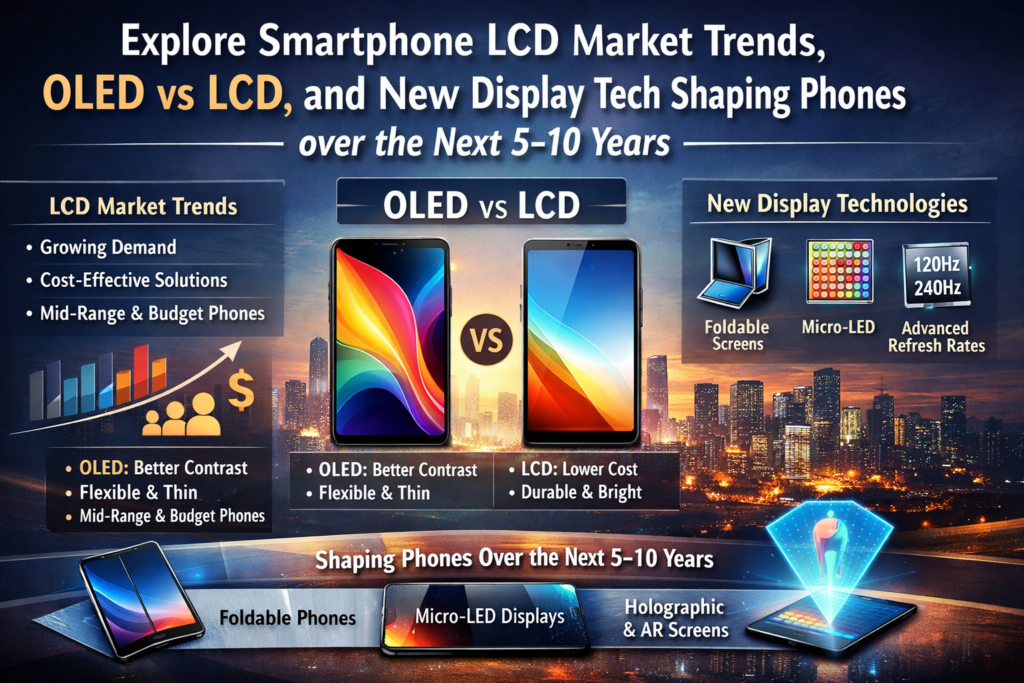
Εισαγωγή στην αγορά εμφάνισης smartphone
Γιατί οι οθόνες smartphone έχουν μεγαλύτερη σημασία από ποτέ
Ας είμαστε ειλικρινείς - η οθόνη του smartphone σας είναι βασικά το παράθυρό σας στον ψηφιακό κόσμο. Από την παρακολούθηση εκπομπών μέχρι το doom-scrolling αργά το βράδυ, όλα ρέουν μέσα από αυτό το λαμπερό ορθογώνιο. Καθώς αυξάνονται οι προσδοκίες των χρηστών, Η ποιότητα της οθόνης έχει γίνει ένα σημαντικό πεδίο μάχης για τις μάρκες smartphone.
Εξέλιξη από LCD σε προηγμένες τεχνολογίες οθόνης
Μια φορά κι έναν καιρό, Οι οθόνες LCD κυβέρνησαν τον κόσμο των smartphone. Ήταν προσιτές, αξιόπιστος, και εύκολο στη μαζική παραγωγή. Αλλά ως ζήτηση για λεπτότερα τηλέφωνα, βαθύτερα μαύρα, και η καλύτερη απόδοση ισχύος αυξήθηκε, νέες τεχνολογίες προβολής μπήκαν στο προσκήνιο.
Επισκόπηση της παγκόσμιας αγοράς LCD Smartphone
Τρέχον Μέγεθος Αγοράς και Παράγοντες Ανάπτυξης
Παρά το θόρυβο γύρω από το OLED, Οι οθόνες LCD εξακολουθούν να κυριαρχούν σε μεγάλο μέρος της αγοράς smartphone, ειδικά σε συσκευές εισαγωγικού και μεσαίου επιπέδου. Το χαμηλότερο κόστος παραγωγής και οι σταθερές αποδόσεις διατηρούν την οθόνη LCD σχετική, ακόμη και όταν η καινοτομία επιταχύνεται αλλού.
Βασικές Περιφέρειες Μεταποίησης και Τάσεις Εφοδιαστικής Αλυσίδας
Κίνα, Κορέα, και Αναδυόμενες Αγορές
Η Κίνα παραμένει ο μεγαλύτερος κόμβος παραγωγής LCD στον κόσμο, ενώ η Νότια Κορέα πρωτοστατεί στην καινοτομία OLED. Εν τω μεταξύ, οι αναδυόμενες αγορές επενδύουν σε μεγάλο βαθμό στην κατασκευή οθονών για να μειώσουν την εξάρτηση και να ενισχύσουν τις αλυσίδες εφοδιασμού.
Κατανόηση της τεχνολογίας LCD στα Smartphones
Πώς λειτουργούν οι οθόνες LCD
Οι οθόνες LCD βασίζονται σε έναν οπίσθιο φωτισμό που λάμπει μέσα από υγρούς κρυστάλλους για τη δημιουργία εικόνων. Απλός, αποτελεσματικός, και αποδεδειγμένο—κάπως σαν ένας αξιόπιστος παλιός κινητήρας που εξακολουθεί να κάνει τη δουλειά του.
Πλεονεκτήματα και περιορισμοί των οθονών LCD
Κόστους αποδοτικότητας και μαζικής υιοθέτησης
Η μεγαλύτερη δύναμη της LCD είναι η προσιτή τιμή. Ωστόσο, Οι περιορισμένες αναλογίες αντίθεσης και η υψηλότερη κατανάλωση ενέργειας σε σύγκριση με την OLED το συγκρατούν στις premium συσκευές.
Επεξήγηση τεχνολογίας OLED
Τι κάνει το OLED διαφορετικό από το LCD
Τα εικονοστοιχεία OLED εκπέμπουν το δικό τους φως, εξαλείφοντας την ανάγκη για οπίσθιο φωτισμό. Αυτό δίνει τη δυνατότητα στους αληθινούς μαύρους, πιο λεπτά σχέδια, και καλύτερη ενεργειακή απόδοση—ειδικά όταν εμφανίζεται σκοτεινό περιεχόμενο.
AMOLED vs Flexible OLED
Απόδοση ισχύος και οπτική απόδοση
Τα εύκαμπτα πάνελ OLED επιτρέπουν κυρτά και αναδιπλούμενα σχέδια, ανοίγοντας πόρτες σε φουτουριστικούς παράγοντες μορφής τηλεφώνου με τους οποίους η LCD απλά δεν μπορεί να ταιριάξει.
LCD vs OLED Competitive Landscape
Κόστος, Εκτέλεση, και Σύγκριση Απόδοσης
Η LCD κερδίζει στη σταθερότητα κόστους και παραγωγής, ενώ η OLED παίρνει την κορωνίδα στην οπτική απόδοση. Είναι μια κλασική αντιστάθμιση μεταξύ προσιτής τιμής και premium εμπειρίας.
Στρατηγικές υιοθέτησης επωνυμίας
Mid-range vs Flagship Smartphones
Τα περισσότερα κορυφαία smartphone έχουν αγκαλιάσει πλήρως την OLED, ενώ η οθόνη LCD παραμένει δημοφιλής σε οικονομικά μοντέλα.
Ανταγωνισμός αγοράς μεταξύ LCD και OLED
Πόλεμοι τιμών και επέκταση χωρητικότητας
Οι κατασκευαστές οθονών είναι κλειδωμένοι σε έναν αγώνα σκακιού τιμολόγησης, διευρύνοντας την ικανότητα προσπαθώντας να διατηρήσει τα περιθώρια.
Επιπτώσεις στους κατασκευαστές smartphone
Τάσεις διαφοροποίησης προμηθευτών
Οι επωνυμίες προμηθεύονται πλέον οθόνες από πολλούς προμηθευτές για τον μετριασμό του κινδύνου και τον έλεγχο του κόστους.
Επισκόπηση τεχνολογίας αναδιπλούμενης οθόνης
Τι είναι οι αναδιπλούμενες οθόνες
Οι πτυσσόμενες οθόνες χρησιμοποιούν ευέλικτη τεχνολογία OLED, επιτρέποντας στα τηλέφωνα να λυγίζουν χωρίς να σπάνε—σαν ένα ψηφιακό αριστούργημα origami.
Τεχνικές προκλήσεις και θέματα ανθεκτικότητας
Εμπόδια υιοθεσίας από τους καταναλωτές
Μειώστε την ορατότητα, αντοχή, και οι υψηλές τιμές εξακολουθούν να περιορίζουν τη μαζική υιοθέτηση.
Επιρροή των αναδιπλούμενων οθονών στην αγορά των smartphone
Νέοι Παράγοντες Μορφής και Περιπτώσεις Χρήσης
Τα πτυσσόμενα θολώνουν τη γραμμή μεταξύ τηλεφώνων και tablet, προσφέροντας υπερδυνάμεις πολλαπλών εργασιών.
Επίπτωση κόστους στην Εφοδιαστική Αλυσίδα Εμφάνισης
Μακροπρόθεσμες δυνατότητες αγοράς
Καθώς βελτιώνονται οι αποδόσεις, Τα πτυσσόμενα θα μπορούσαν να μετακινηθούν από την πολυτέλεια στο mainstream.
Τεχνολογία Mini-LED και ο ρόλος της
Mini-LED vs Παραδοσιακή LCD
Το Mini-LED βελτιώνει την οθόνη LCD χρησιμοποιώντας χιλιάδες μικροσκοπικά LED για καλύτερη τοπική μείωση της φωτεινότητας.
Πλεονεκτήματα σε φωτεινότητα και αντίθεση
Γιατί το Mini-LED είναι ακόμα εξειδικευμένο στα smartphones
Οι περιορισμοί χώρου και το κόστος περιορίζουν την υιοθέτηση Mini-LED στα τηλέφωνα, αν και λάμπει σε tablet και φορητούς υπολογιστές.
Επεξήγηση τεχνολογίας Micro-LED
Τι είναι το Micro-LED
Το Micro-LED χρησιμοποιεί μικροσκοπικά LED που εκπέμπουν φως ξεχωριστά, συνδυάζοντας τα καλύτερα OLED και LCD.
Βασικά πλεονεκτήματα έναντι των OLED και LCD
Κατασκευαστικές Προκλήσεις
Η μαζική παραγωγή παραμένει το μεγαλύτερο εμπόδιο, διατηρώντας το Micro-LED κυρίως σε εργαστήρια προς το παρόν.
Μελλοντικές επιπτώσεις των Micro-LED στα smartphone
Χρονοδιάγραμμα για την εμπορική υιοθέτηση
Η ευρεία υιοθέτηση smartphone μπορεί να απέχει ακόμη χρόνια.
Δυνατότητα διακοπής της αγοράς προβολής
Προσδοκίες μείωσης κόστους
Μόλις πέσει το κόστος, Το Micro-LED θα μπορούσε να επαναπροσδιορίσει τα πρότυπα οθόνης.
Τάσεις καινοτομίας που διαμορφώνουν οθόνες smartphone
Υψηλότεροι ρυθμοί ανανέωσης και LTPO
Η πιο ομαλή κύλιση και οι προσαρμοστικοί ρυθμοί ανανέωσης γίνονται στάνταρ.
Κάμερες και αισθητήρες κάτω από την οθόνη
Βελτιώσεις ενεργειακής απόδοσης
Κάθε νέα γενιά στοχεύει να συμπιέζει περισσότερη διάρκεια ζωής της μπαταρίας από κάθε pixel.
Αειφορία και Περιβαλλοντικές Θεωρήσεις
Κατανάλωση Ενέργειας και Αποτύπωμα Άνθρακα
Η κατασκευή οθονών είναι ενεργοβόρα, ωθώντας τις επωνυμίες προς πιο πράσινες λύσεις.
Ανακύκλωση και Καινοτομία Υλικών
Πράσινη Βιομηχανική Πρωτοβουλίες
Η βιωσιμότητα δεν είναι πλέον προαιρετική - είναι ανταγωνιστικό πλεονέκτημα.
Μελλοντικές προοπτικές της αγοράς εμφάνισης smartphone
Σύγκλιση τεχνολογίας
Το μέλλον πιθανότατα ανήκει σε υβριδικές λύσεις που συνδυάζουν πολλαπλές τεχνολογίες.
Πώς φαίνονται τα επόμενα 5-10 χρόνια
Ευκαιρίες για κατασκευαστές και επωνυμίες
Αυτοί που εξισορροπούν την καινοτομία, κόστος, και η βιωσιμότητα θα οδηγήσει την επόμενη εποχή.
Σύναψη
Η αγορά οθονών smartphone βρίσκεται σε ένα συναρπαστικό σταυροδρόμι. Η οθόνη LCD παραμένει η ραχοκοκαλιά της οικονομικής τιμής, Η OLED καθορίζει τις premium εμπειρίες, και αναδυόμενες τεχνολογίες όπως πτυσσόμενες οθόνες, Μίνι-LED, και Micro-LED υπόσχονται να αναδιαμορφώσουν το μέλλον. Καθώς η καινοτομία επιταχύνεται, ο ανταγωνισμός θα ενταθεί — αλλά ένα πράγμα είναι σίγουρο: η οθόνη θα συνεχίσει να είναι η καρδιά και η ψυχή της εμπειρίας smartphone.
Συχνές ερωτήσεις
1. Θα εξαφανιστούν οι οθόνες LCD από τα smartphone?
Οχι. Η οθόνη LCD θα παραμείνει δημοφιλής σε συσκευές προϋπολογισμού και μεσαίας κατηγορίας λόγω του πλεονεκτήματος κόστους της.
2. Γιατί προτιμάται η OLED για ναυαρχίδες smartphone?
Το OLED προσφέρει καλύτερη αντίθεση, πιο λεπτό σχέδιο, και βελτιωμένη απόδοση ισχύος.
3. Είναι τα πτυσσόμενα τηλέφωνα το μέλλον των smartphone?
Έχουν ισχυρές δυνατότητες, αλλά οι ανησυχίες για το υψηλό κόστος και την ανθεκτικότητα εξακολουθούν να περιορίζουν την υιοθέτηση.
4. Πότε θα χρησιμοποιηθεί το Micro-LED σε smartphone?
Η εμπορική υιοθέτηση είναι πιθανόν αρκετά χρόνια μακριά λόγω των προκλήσεων της κατασκευής.
5. Ποια τεχνολογία οθόνης είναι η πιο βιώσιμη?
OLED και μελλοντικές τεχνολογίες Micro-LED δείχνουν καλύτερες δυνατότητες μακροπρόθεσμης ενεργειακής απόδοσης.