Understanding the Meaning of 拆机屏幕
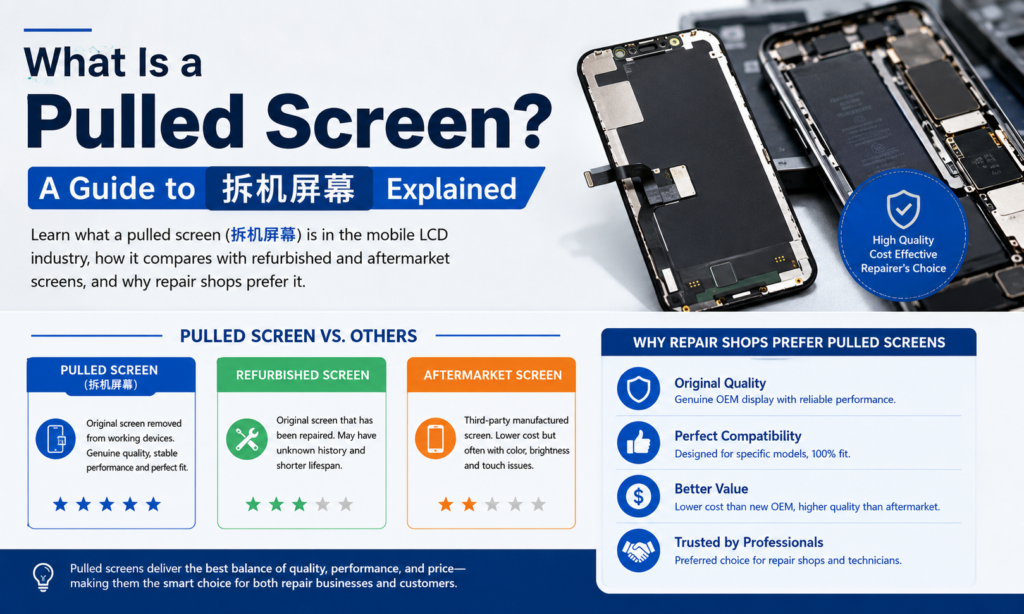
If you’ve spent any time around mobile phone repair factories, wholesale spare-parts markets, or repair shop counters in Shenzhen, Guangzhou, or even online B2B platforms, chances are you’ve heard the term “拆机屏幕” thrown around a lot. Literally translated from Chinese, it means “disassembled screen”—but in the mobile display industry, most people call it a pulled screen.
So what exactly is it?
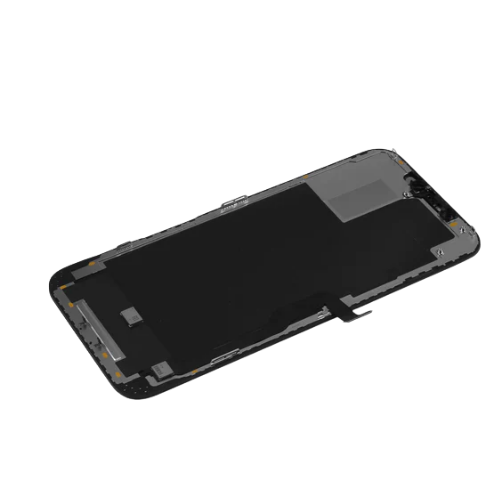
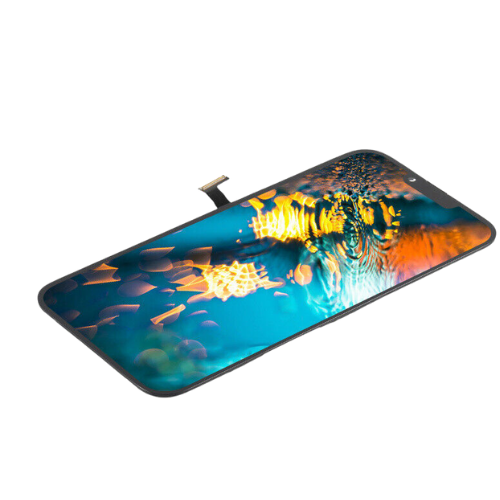
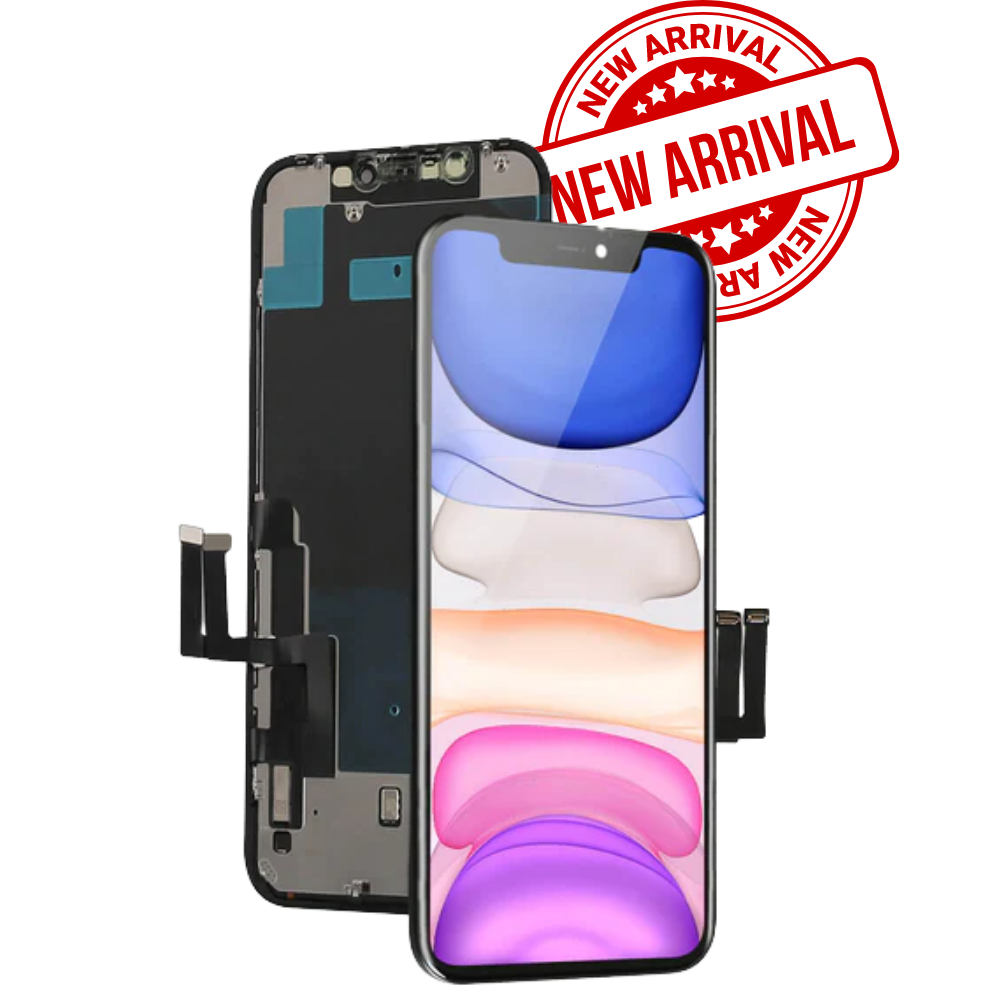
A pulled screen is an original smartphone display removed from a used or damaged phone. The phone itself might have had motherboard damage, battery issues, housing damage, or other non-screen-related problems, while the display remained usable. Technicians carefully remove that original display assembly, test it, grade it, and resell it into the repair market.
Think of it like salvaging a perfectly good engine from a crashed car. The vehicle may be totaled, but the engine still runs beautifully. That’s essentially what a pulled screen is. The screen already lived one life inside a phone, got removed, and now gets a second life in another repair.
This term is especially common in China because China is one of the world’s biggest hubs for smartphone refurbishment, display recycling, and replacement parts distribution. Repair shops often separate screens into categories such as:
| Screen Type | Meaning | Original Manufacturer Part | Condition |
|---|---|---|---|
| Pulled Screen (拆机屏) | Removed from used phone | Yes | Used |
| Refurbished Screen | Original panel with replaced glass | Yes | Repaired |
| OEM New Screen | Factory new original | Yes | New |
| Aftermarket Screen | Third-party copy | No | New |
That distinction matters more than many buyers realize.
Why the term is common in China’s phone repair industry
China’s mobile repair ecosystem moves incredibly fast. Millions of damaged smartphones enter recycling and refurbishment channels every year. Some become donor devices. Others are stripped into reusable components.
Displays are among the most valuable parts.
Since modern smartphone screens are expensive—especially OLED panels—recovering them makes strong economic sense. A cracked-back iPhone with a working OLED display still holds significant value. Rather than scrap it, wholesalers recover the screen and sell it.
That’s why “拆机屏” became such standard industry language.
Pulled screen vs refurbished screen vs aftermarket screen
People often mix these up.
A pulled screen is original and untouched, simply removed from another phone.
A refurbished screen usually means the original OLED or LCD panel was preserved, but broken top glass was replaced through lamination and refurbishment.
An aftermarket screen is newly produced by a third-party manufacturer and is not original to the brand.
That difference changes everything—from brightness to touch response to color accuracy.
Where Pulled Screens Come From
Pulled screens don’t magically appear in warehouses. They come from a surprisingly large and sophisticated secondary device supply chain.
Salvaged from used phones
The most common source is donor phones.
These devices may have:
- dead motherboards
- water damage
- damaged charging IC
- bent frames
- bad batteries
- locked devices
- carrier blacklist issues
But the screen still works.
Technicians separate the display, run functional testing, and if it passes inspection, it enters inventory.
Recovered from trade-in and refurbishment channels
The refurbished smartphone market keeps growing globally.
Counterpoint Research reported the global refurbished smartphone market grew 5% year-over-year in 2024, with Apple increasing its share to 56%.
That growth feeds directly into the pulled-screen market.
More trade-ins mean more used phones entering processing centers. More used phones mean more recoverable original displays.
Industry analysts also estimate the pre-owned smartphone market generated around $83 billion in revenue recently, making reused components increasingly valuable.
Why Repair Shops Prefer Pulled Screens
Original display quality
This is the biggest reason.
A pulled screen is still the brand’s original display.
That means:
- original brightness
- original OLED contrast
- factory color calibration
- native refresh behavior
- original touch IC
- correct sensor cutouts
- proper bezel size
Compared with many aftermarket alternatives, the difference can feel night and day.
A cheap aftermarket LCD often feels like listening to a compressed MP3. A pulled original screen feels like listening to the studio master.
You notice it immediately.
Better compatibility with Face ID, fingerprint, and touch
Compatibility is another major advantage.
Modern displays are deeply integrated with software and hardware:
- Face ID flex alignment
- under-display fingerprint sensors
- ambient light sensor windows
- True Tone calibration
- touch controller firmware
Using an original pulled screen reduces compatibility surprises.
Repair communities continue to report that original or pulled screens generally behave more predictably than low-cost aftermarket replacements, especially on OLED flagship models.
Quality Grading of Pulled Screens
Not every pulled screen is equal.
That’s why suppliers grade them.
A-Grade
Usually means:
- no scratches or very minor wear
- no dead pixels
- no burn-in
- full touch function
- excellent cosmetic appearance
These command premium pricing.
B-Grade
May include:
- light scratches
- minor pressure marks
- tiny cosmetic wear
Functionality remains good.
Screens with burn-in or minor defects
OLED burn-in is common.
Especially with:
- status bar shadows
- keyboard ghosting
- TikTok UI burn
- navigation bar retention
These sell cheaper and often go into budget refurb devices.
Always ask suppliers for:
- burn-in photos on white background
- black screen test
- touch grid test
- brightness test
- True Tone or fingerprint verification
Pulled Screen vs New OEM Screen
A brand-new OEM screen is ideal—but expensive.
Pulled screens exist because of that price gap.
| Feature | Pulled Screen | OEM New Screen |
|---|---|---|
| Original manufacturer part | Yes | Yes |
| Previously used | Yes | No |
| Price | Lower | Higher |
| Cosmetic wear | Possible | None |
| Performance | Very close to original | Original |
For many repair shops, the choice comes down to economics.
If OEM new costs $150 and a tested pulled screen costs $95, many customers choose the pulled option.
Pulled Screen vs Aftermarket LCD
This comparison is where things get interesting.
Brightness, color, and touch performance
Aftermarket screens can vary wildly.
Some are decent.
Some are terrible.
Recent repair industry buying guides note that aftermarket OLEDs often achieve roughly 85–90% color accuracy versus original displays, while lower-end replacement LCDs can drop much lower depending on quality tier.
Common differences include:
- lower brightness
- cooler whites
- poorer blacks
- thicker bezels
- laggy touch
- reduced refresh smoothness
Pulled original screens usually outperform them.
Long-term durability
Durability can also favor pulled screens.
Why?
Because the original panel was designed specifically for that phone by the manufacturer.
Aftermarket parts sometimes cut costs on:
- glass strength
- flex cable quality
- adhesives
- IC quality
That doesn’t mean every aftermarket screen is bad.
But consistency is harder to guarantee.
Risks Buyers Should Know Before Purchasing
Pulled screens are excellent—but not risk-free.
Hidden damage and burn-in
Potential issues include:
- OLED burn-in
- touch dead spots
- lifted frame
- weakened flex
- prior repair damage
- pressure marks
Good suppliers will disclose these.
Bad suppliers won’t.
Supplier reliability
This matters almost more than the screen itself.
Buy from vendors who provide:
- QC videos
- warranty
- return policy
- grading standards
- real photos
- serialized labeling
Without that, buying pulled screens can feel like buying mystery boxes.
And nobody likes expensive surprises.
How to Identify a High-Quality Pulled Screen
Here’s a practical inspection checklist buyers use.
Inspection checklist
Before buying:
- verify model number
- test brightness uniformity
- check dead pixels
- inspect flex cable
- inspect connector pins
- test touch across full panel
- inspect OLED burn-in on white screen
- inspect scratches under direct light
- verify Face ID or fingerprint compatibility
- request warranty terms
If possible, ask for video testing.
A quick test video often tells more than ten product photos.
Market Trends in 2025–2026 for Pulled Smartphone Screens
The pulled-screen business is riding a larger industry wave.
Consumers are keeping phones longer.
Repairing instead of replacing.
Buying refurbished instead of new.
That shifts demand toward reusable original parts.
Industry data shows global refurbished smartphone sales continued rising into 2025, growing around 3–5% year-over-year, even while new-device growth remained slower in many markets.
That trend supports demand for:
- pulled screens
- original housings
- used camera modules
- reclaimed batteries
- refurbished displays
Sustainability plays a role too.
A reused screen means:
- less e-waste
- lower manufacturing demand
- lower repair cost
- longer device lifespan
In many ways, pulled screens sit right at the intersection of repairability, affordability, and sustainability.
Conclusion
The term “拆机屏幕”, or pulled screen, is one of the most important concepts in the smartphone repair display industry.
It’s simple on paper: an original display removed from another device.
But in practice, it represents a massive global ecosystem built around repair, reuse, and extending the life of electronics.
For repair shops, pulled screens offer a sweet spot between price and quality.
For customers, they often provide a better viewing experience than cheaper aftermarket copies.
For the industry, they help keep millions of displays out of landfills and back in people’s hands.
If you’re buying replacement smartphone screens—especially for iPhone, Samsung, or other premium models—understanding what a pulled screen is can save money, improve repair quality, and help you avoid buying the wrong part.
And sometimes, the best screen isn’t the newest one.
It’s the original one getting a second chance.
FAQs
1. Is a pulled screen original?
Yes. A pulled screen is an original manufacturer screen removed from a used device.
2. Is a pulled screen better than an aftermarket screen?
Usually yes. Pulled screens generally offer better brightness, color, and touch performance because they are original.
3. Does a pulled screen mean it has been repaired?
Not necessarily. It may simply have been removed from another phone. That’s different from a refurbished screen.
4. Can pulled screens have burn-in?
Yes. Especially OLED pulled screens. Always inspect before buying.
5. Why are pulled screens cheaper than OEM new screens?
Because they are used. Even though they are original, prior use lowers their resale price.