In der Welt der Smartphone-Herstellung und -Reparatur, Der Großeinkauf von LCD-Bildschirmen kann sich ein wenig wie ein Einkauf auf einem riesigen Elektronikbasar anfühlen. Alles sieht glänzend aus, Jeder Anbieter verspricht „Top-Qualität“.,“ und die Schlagworte fliegen wie Konfetti umher. Aber wenn Sie jemals eine Lieferung Bildschirme ausgepackt haben, die nicht den Erwartungen entsprachen?, Sie wissen bereits, wie schmerzhaft diese Fehler sein können. Dieser Leitfaden soll Ihnen diese Kopfschmerzen ersparen, indem er Sie durch die wichtigsten Punkte führt, die Sie beim Kauf von Smartphone-LCDs in großen Mengen vermeiden sollten.
Einführung in die LCD-Massenbeschaffung
Der Kauf eines Telefonbildschirms ist einfach. Tausend zu kaufen ist ein ganz anderes Spiel. Wenn Sie in die Massenbeschaffung einsteigen, Kleine Qualitätsunterschiede werden zu großen finanziellen Risiken. Ein kleiner Defekt, multipliziert mit Hunderten von Einheiten, kann schnell zu massiven Retouren führen, Kundenbeschwerden, und beschädigter Ruf.
Deshalb ist es weitaus wichtiger zu verstehen, worauf es bei einem LCD-Panel wirklich ankommt, als auffälligen Verkaufsbeschreibungen zu vertrauen.
Warum Marketing-Schlagwörter Käufer irreführen können
Wörter wie „Ultra HD,„„Super klar,„ oder „Wide Color“ klingen beeindruckend, aber sie bedeuten in realer technischer Hinsicht oft sehr wenig. Diese Ausdrücke sind nicht standardisiert. Das „Ultra HD“ einer Fabrik könnte das Basis-HD-Panel einer anderen Fabrik sein.
Sich auf diese vagen Etiketten zu verlassen ist, als würde man ein Auto kaufen, weil der Verkäufer sagt, es sei „superschnell“, ohne jemals die Leistung zu nennen.
„Ultra HD“ bei LCD-Displays verstehen
True Ultra HD bezieht sich auf die 4K-Auflösung. Aber auf dem Smartphone-LCD-Markt, Der Begriff wird oft allgemein verwendet, um alles zu beschreiben, was schärfer als der Durchschnitt aussieht. Viele Anbieter kleben dieses Etikett auf ein 1080p-Panel, nur weil es erstklassig klingt.
Stattdessen sollten Sie auf die tatsächliche Pixelauflösung und Pixeldichte achten (PPI). Diese Zahlen lügen nicht.
Die Wahrheit hinter der Behauptung „Wide Color Gamut“.
„Große Farbskala“ klingt erstaunlich, allerdings ohne Zahlen wie sRGB- oder DCI-P3-Abdeckung, es ist bedeutungslos. Ein Panel könnte zwar einen breiten Farbraum beanspruchen, aber nur Reichweite 70% des Standardfarbraums, Dadurch wirken die Farben verwaschen.
Fragen Sie immer nach Farbskala-Prozentsätzen, keine Marketingslogans.
Warum technische Spezifikationen wichtiger sind als Etiketten
Spezifikationen sind Ihr Realitätscheck. Sie sagen Ihnen, was der Bildschirm tatsächlich kann, Nicht das, was der Verkäufer von Ihnen erwartet. Aktualisierungsrate, Helligkeit, Kontrastverhältnis, und Dimmmethode sind die Grundpfeiler einer echten Anzeigequalität.
Wenn diese in einem Produktblatt fehlen, Das ist eine rote Fahne, die direkt vor Ihnen weht.
Aktualisierungsrate: Der übersehene Leistungsfaktor
Ein 60-Hz-Bildschirm und ein 120-Hz-Bildschirm sehen auf dem Papier möglicherweise ähnlich aus, aber im täglichen Gebrauch, Sie haben das Gefühl, dass Welten voneinander entfernt sind. Höhere Bildwiederholraten machen das Scrollen flüssiger und die Touch-Reaktion flüssiger.
Bei Großeinkäufen, Viele kostengünstige LCDs werden stillschweigend auf 60 Hz heruntergestuft, selbst wenn das ursprüngliche Telefonmodell 90 Hz oder 120 Hz unterstützt. Dieses Missverhältnis kann dazu führen, dass Kunden unzufrieden sind und das Gefühl haben, dass etwas nicht stimmt.
Helligkeitsstufen und Sichtbarkeit im Freien
Die Helligkeit wird in Nits gemessen. Ein Bildschirm mit 300 Nissen können in Innenräumen gut aussehen, aber draußen unter Sonnenlicht, es wird fast unleserlich. Die Bildschirme von Premium-Smartphones übertreffen in der Regel die Leistung 500 Nissen, manchmal erreichen 800 oder mehr.
Wenn Sie LCDs zum Weiterverkauf oder zur Reparatur kaufen, Panels mit geringer Helligkeit führen schnell zu Beschwerden.
Dimmtechnologie und Augenkomfort
Bei der Helligkeitssteuerung geht es nicht nur darum, wie hell ein Bildschirm wird, sondern auch darum, wie er gedimmt wird. Billige Panels verwenden häufig grobe Dimmmethoden, die zu Augenbelastung und Flackern führen, vor allem bei geringer Helligkeit.
Hier kommt die Dimmtechnologie ins Spiel.
Erklärung von PWM vs. DC-Dimmung
PWM (Pulsweitenmodulation) Steuert die Helligkeit durch schnelles Flackern der Hintergrundbeleuchtung. Manche Menschen reagieren darauf empfindlich und verspüren Kopfschmerzen oder Augenermüdung. DC-Dimmung, auf der anderen Seite, Passt die Spannung für eine sanftere Helligkeitssteuerung an.
Bei Großeinkäufen, Low-End-LCDs setzen fast immer auf günstiges PWM mit niedriger Frequenz, was für Benutzer unangenehm sein kann.
Auflösung vs. reale Schärfe
Die Auflösung ist nur ein Teil der Geschichte. Zwei Bildschirme mit derselben Auflösung können sehr unterschiedlich aussehen, wenn einer über ein besseres Subpixel-Layout verfügt, schärfere Filter, und hochwertigere Hintergrundbeleuchtung.
Aus diesem Grund können billige LCDs verschwommen oder weich aussehen, selbst wenn sie technisch gesehen „Full HD“ sind.
Einschränkungen bei Low-End-LCD-Panels
Budget-LCDs sparen Abstriche. Möglicherweise verwenden sie Hintergrundbeleuchtungen von geringerer Qualität, schwächere Farbfilter, und weniger präzise Ausrichtung. Dies führt zu ungleichmäßiger Helligkeit, stumpfe Farben, und langsamere Reaktionszeiten.
In großen Mengen, Diese Schwächen werden schmerzlich offensichtlich.
Was ist Bildschirmkörnigkeit und warum ist sie wichtig?
Körnigkeit ist die sandartige Textur, die man manchmal sieht, insbesondere auf weißen oder hellen Hintergründen. Dies geschieht, wenn die Pixelstruktur oder die Streuung des Hintergrundlichts schlecht ist.
Dafür sind Low-End-LCD-Panels berüchtigt. Dadurch sieht der Text unscharf aus und die wahrgenommene Qualität wird beeinträchtigt, Auch wenn die Auflösung auf dem Papier gut aussieht.
So erkennen Sie eine schlechte Panelqualität bei Großbestellungen
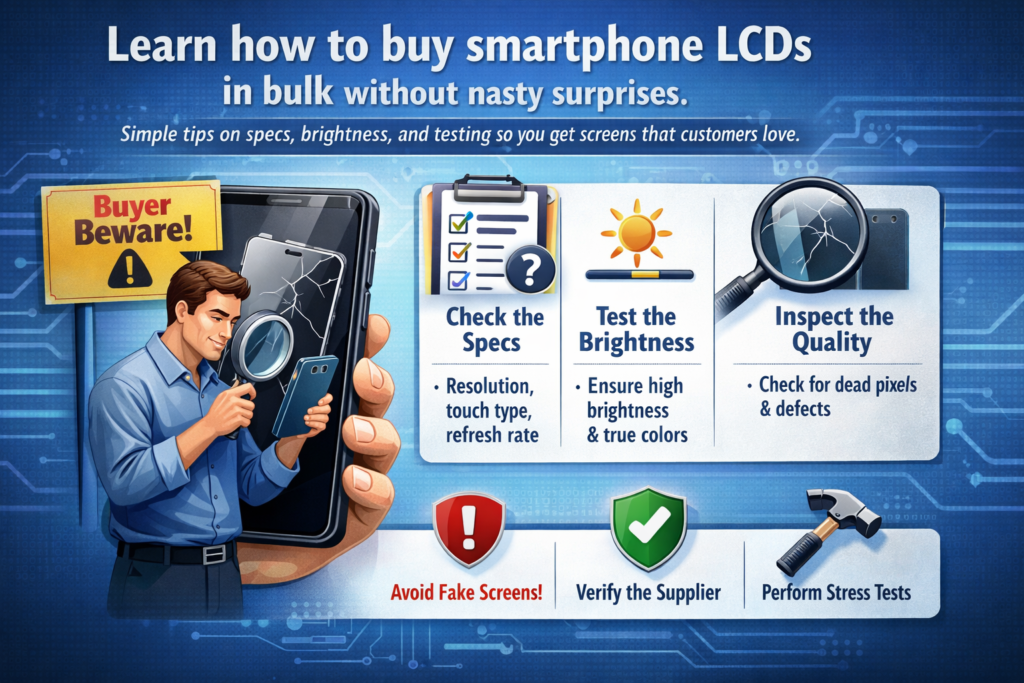
Vertraue niemals Fotos allein. Fordern Sie physische Proben an. Testen Sie sie bei verschiedenen Helligkeitsstufen. Weiß anzeigen, grau, und einfarbige Bildschirme, um Körnigkeit zu erkennen, ungleichmäßige Beleuchtung, und Farbverschiebungen.
Wenn ein Lieferant die Zusendung von Mustern verweigert, Das ist dein Stichwort, wegzugehen.
Intelligente Verifizierungsmethoden vor dem Kauf
Verwenden Sie einfache Test-Apps, um die Bildwiederholfrequenz zu überprüfen, Helligkeit, und Farbgenauigkeit. Vergleichen Sie den Beispielbildschirm direkt mit einem Original-OEM-Display. Unterschiede fallen sofort auf.
Betrachten Sie diesen Schritt als Ihre Versicherungspolice.
Wichtige Fragen an LCD-Lieferanten
Fragen Sie nach:
- Exakte Auflösung und PPI
- Aktualisierungsrate
- Helligkeit (Nissen)
- Abdeckung des Farbraums
- Dimmmethode
Wenn sie nicht klar antworten können, Sie kennen ihr eigenes Produkt wahrscheinlich nicht – oder Schlimmeres, Sie wissen es und wollen nicht, dass du es weißt.
Aufbau langfristiger Lieferantenbeziehungen
Sobald Sie einen Lieferanten gefunden haben, der ehrliche Spezifikationen und gleichbleibende Qualität bietet, bleib bei ihnen. Langfristige Beziehungen bedeuten oft bessere Preise, bessere Qualitätskontrolle, und weniger Überraschungen.
In diesem Geschäft, Vertrauen ist mehr wert als ein etwas günstigerer Stückpreis.
Abschluss
Beim Massenkauf von Smartphone-LCD-Bildschirmen geht es nicht darum, den niedrigsten Preis oder die ausgefallensten Schlagworte zu jagen. Es geht darum, echte technische Parameter wie die Bildwiederholfrequenz zu verstehen, Helligkeit, Dimmen, und Panelqualität. Ignorieren Sie vage Marketingbegriffe, Testen Sie die Proben sorgfältig, und achten Sie genau auf die Körnigkeit und die Einschränkungen des Low-End-Panels. Wenn Sie es tun, Sie vermeiden kostspielige Fehler und bauen eine Lieferkette auf, auf die Sie sich tatsächlich verlassen können.
FAQs
1. Sind „Ultra HD“-LCD-Bildschirme immer von hoher Qualität??
NEIN. Der Begriff wird oft locker verwendet. Überprüfen Sie immer die tatsächliche Auflösung und den PPI.
2. Why does refresh rate matter for LCDs?
It affects smoothness and touch response, which users notice immediately.
3. What causes graininess on LCD screens?
Poor pixel structure and low-quality backlight diffusion in cheap panels.
4. Is high brightness really important?
Ja, especially for outdoor visibility and user satisfaction.
5. Should I always request samples before bulk buying?
Absolut. Samples reveal problems no specification sheet will show.