Introduction aux technologies d'affichage des smartphones
Pourquoi la technologie d'emballage LCD est importante
Quand on parle d’écrans de smartphone, ils se concentrent généralement sur des mots à la mode comme OLED, Amoufré, ou IPS. Mais voilà : ce qui se passe dans les coulisses est tout aussi important.. L'un des aspects les plus négligés mais cruciaux d'un écran est comment la puce du pilote d'affichage est connectée au panneau. C'est là DENT (Puce sur le verre) et COF (Puce sur film) entrer en jeu.
Pensez à l'écran de votre téléphone comme à une ville. Les pixels sont les bâtiments, mais le Driver IC est le système de contrôle du trafic, diriger les signaux pour que tout fonctionne correctement. Si la connexion entre le contrôleur et l’écran n’est pas efficace, vous rencontrerez des problèmes comme le décalage, luminosité inégale, voire panne d'écran.
Les smartphones modernes s'orientent vers des designs plus minces, lunettes plus étroites, et une meilleure durabilité. Et devinez quoi? La technologie d'emballage – COG ou COF – influence directement tous ces facteurs. Selon des informations récentes sur l'industrie, ces deux technologies déterminent des choses comme rapport écran/corps, coût, fiabilité, et complexité de fabrication .
Donc, si vous vous êtes déjà demandé pourquoi certains téléphones ont des cadres ultra-fins alors que d'autres ont des zones de « menton » visibles, tu es sur le point de découvrir la vraie raison.
Le rôle du pilote IC dans les écrans
Avant de plonger dans COG et COF, comprenons rapidement le CI de pilote (Circuit intégré du pilote d'affichage). Cette petite puce est essentiellement le cerveau derrière votre écran. Il convertit les signaux du processeur du téléphone en sortie visuelle, éclairant les pixels, contrôler la luminosité, et assurer des taux de rafraîchissement fluides.
Sans cette puce, votre écran ne serait qu'une feuille de verre sans vie.
La façon dont ce circuit intégré est attaché à l'écran définit si un écran utilise Technologie COG ou COF. Et cette petite différence? Cela a des implications énormes sur les performances, durabilité, et conception.
Qu'est-ce que le COG (Puce sur le verre)?
Comment fonctionne la technologie COG
DENT, ou Puce sur le verre, est l'une des technologies d'affichage les plus traditionnelles et les plus utilisées. Dans cette méthode, le Le circuit intégré du pilote est directement collé sur le substrat en verre du panneau LCD en utilisant un matériau appelé film conducteur anisotrope (ACF) .
Imaginez coller une petite puce directement sur la surface de la vitre de l'écran.. C'est essentiellement ce que fait COG. Il n'y a pas de couches supplémentaires, pas de câbles flexibles entre les deux, juste un, connexion compacte.
Cette configuration réduit le nombre de composants et simplifie le processus de fabrication. Cela raccourcit également le chemin du signal entre la puce et l'écran., ce qui peut améliorer le temps de réponse et réduire les interférences.
Principales caractéristiques des écrans COG
La technologie COG se distingue par sa simplicité et son efficacité. Parce que la puce est montée directement sur le verre:
- Il réduit l'épaisseur globale en éliminant les couches supplémentaires
- Il réduit les coûts de production grâce à moins de composants
- Cela améliore la durabilité car il y a moins de pièces flexibles
En fait, les rapports de fabrication suggèrent que COG peut réduire l'espace d'emballage d'environ 30% et réduire considérablement les coûts de production .
Cependant, cette simplicité s'accompagne de compromis, surtout en ce qui concerne la flexibilité de conception et la taille du cadre, que nous explorerons sous peu.
Qu'est-ce que le COF (Puce sur film)?
Comment fonctionne la technologie COF
COF, ou Puce sur film, adopte une approche plus avancée. Au lieu de fixer le circuit intégré du pilote directement sur le verre, la puce est d'abord montée sur un film souple (généralement en polyimide). Ce film est ensuite connecté au panneau d'affichage .
Pensez-y comme si vous placiez le cerveau de l'écran sur un câble ruban flexible plutôt que directement sur l'écran.. Ce ruban peut se plier, pli, ou même être caché derrière l'écran.
Et cette flexibilité? Cela change la donne.
Principales caractéristiques des écrans COF
La technologie COF est tout au sujet liberté de conception et esthétique moderne. Parce que la puce repose sur un film flexible:
- Le film peut être plié derrière l'écran
- La zone visible du cadre est considérablement réduite
- Il permet des conceptions de smartphones proches du « plein écran »
C'est pourquoi la plupart des smartphones phares utilisent aujourd'hui la technologie COF. Il permet aux fabricants de réaliser cadres ultra-fins et rapports écran/corps plus élevés .
Cependant, cette conception avancée introduit également des coûts plus élevés et des processus de fabrication plus complexes.
Différences fondamentales entre COG et COF
Différences structurelles
Au niveau le plus élémentaire, la différence se résume à où le circuit intégré du pilote est placé:
- DENT: Directement sur le verre
- COF: Sur un film souple relié au verre
Cette différence structurelle affecte tout, de la durabilité aux possibilités de conception..
Comparaison des performances
COG fournit souvent meilleure stabilité et fiabilité en raison de sa structure rigide. Avec moins de composants et des chemins de signal plus courts, cela réduit le risque d'échec de connexion et d'interférence de signal.
COF, d'autre part, excelle dans conception et intégration. Sa structure flexible permet des aménagements plus avancés mais peut être légèrement plus fragile lors de la fabrication ou de la réparation.
Conception et impact du cadre
C'est ici que les choses deviennent intéressantes.
COF permet aux fabricants de pliez la puce derrière l'écran, résultant en des lunettes extrêmement fines. DENT, cependant, nécessite de l'espace sur le verre pour placer la puce, ce qui conduit souvent à un bas du menton visible.
En fait, some screens using COG technology can be à propos 2 mm smaller in display area due to chip placement .
So if you’re chasing that sleek, aspect bord à bord, COF est clairement en avance.
Advantages of COG Technology
Rentabilité
COG is the king of affordability. Its simpler structure means:
- Lower manufacturing costs
- Des délais de production plus rapides
- Des taux de rendement plus élevés
This is why it’s commonly used in budget smartphones and industrial displays.
Reliability and Stability
Because there are no flexible components, Les écrans COG sont plus robustes. Ils ont tendance à mieux fonctionner dans des conditions difficiles telles que l’humidité et les changements de température..
Certains tests montrent même COG displays maintaining up to 99.8% brightness consistency under extreme conditions, outperforming COF in durability scenarios .
Advantages of COF Technology
Cadres ultra-fins
COF’s biggest advantage is design. Il permet:
- Des frontières plus étroites
- Rapports écran/corps plus élevés
- Esthétique visuelle haut de gamme
C'est pourquoi les téléphones phares de marques comme Samsung ou OPPO s'appuient fortement sur COF.
Flexibilité et design moderne
Le film flexible permet des conceptions innovantes, y compris les écrans incurvés ou pliables. Cela ouvre essentiellement la voie à l’avenir des smartphones.
Inconvénients du COG par rapport au COF
Limites du COG
COG est aux prises avec les exigences de conception moderne:
- Des lunettes plus épaisses
- Flexibilité limitée
- Apparence moins premium
Limites du COF
COF, tout en étant avancé, vient avec des compromis:
- Coût de production plus élevé
- Une fabrication plus complexe
- Composants flexibles fragiles
Applications du monde réel
Smartphones économiques vs produits phares
- DENT → Téléphones économiques, appareils industriels
- COF → Smartphones phares, modèles haut de gamme
Cette distinction explique pourquoi les téléphones moins chers ont souvent des cadres plus épais.
Différences sur le marché de la réparation
Dans le secteur de la réparation, Les écrans COF sont souvent plus proches des conceptions originales d'usine, tandis que les écrans COG sont utilisés comme remplacements rentables.
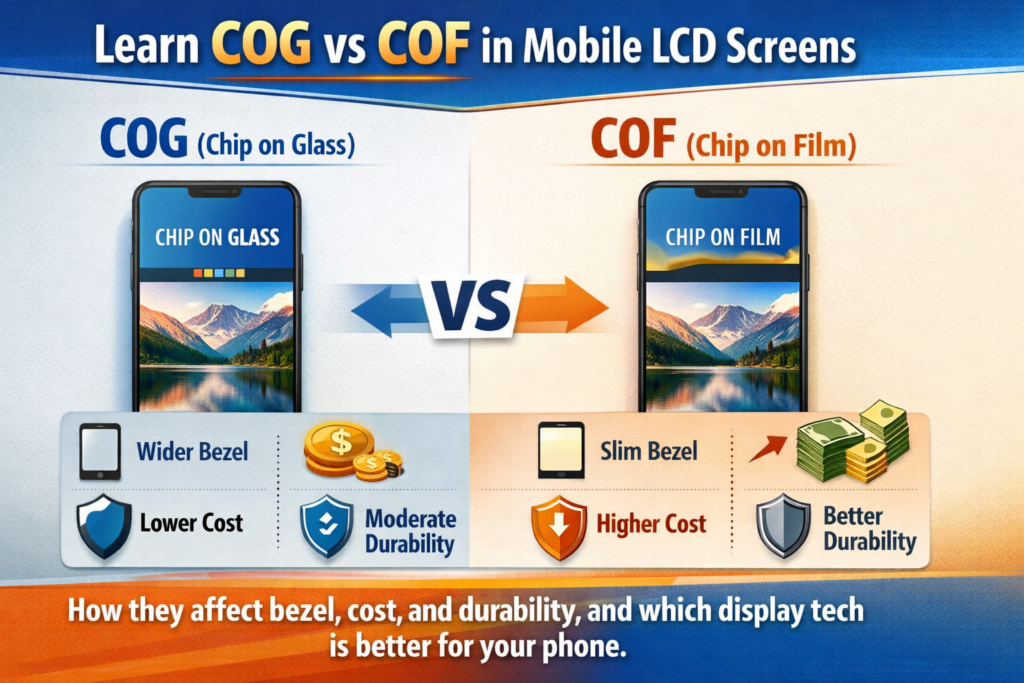
Tableau de comparaison: COG VS COF
| Fonctionnalité | DENT (Puce sur le verre) | COF (Puce sur film) |
|---|---|---|
| Position de la puce | Sur verre | Sur film souple |
| Coût | Inférieur | Plus haut |
| Taille du cadre | Plus large | Ultra-mince |
| Flexibilité | Rigide | Flexible |
| Durabilité | Plus haut | Modéré |
| Application | Appareils économiques | Smartphones phares |
Lequel devriez-vous choisir?
Le choix entre COG et COF dépend de ce que vous appréciez le plus.
Si tu tiens à coût et durabilité, COG est un choix solide. C'est fiable, abordable, et fait le travail sans complexité inutile.
Mais si tu es tout à fait d'accord conception, esthétique, et une technologie de pointe, COF est clairement le gagnant. C’est ce qui donne aux smartphones modernes un aspect élégant et futuriste.
Conclusion
COG et COF peuvent ressembler à du jargon technique, mais ils jouent un rôle énorme dans l'apparence et les performances de votre smartphone. On se concentre sur simplicité et fiabilité, tandis que l'autre repousse les limites de conception et innovation.
Alors que les smartphones continuent d'évoluer vers des conceptions flexibles et sans cadre, COF devient la technologie dominante. Toujours, COG reste pertinent, en particulier sur les marchés sensibles aux coûts.
Comprendre cette différence vous offre un avantage caché, que vous achetiez un téléphone, en réparer un, ou recherche de pièces d'affichage.
FAQ
1. Le COF est-il meilleur que le COG?
COF est meilleur pour le design et les cadres fins, tandis que COG est meilleur en termes de coût et de durabilité.
2. Pourquoi les téléphones phares utilisent-ils COF?
Parce qu'il permet des cadres ultra fins et des conceptions plein écran modernes.
3. COG est-il plus fiable que COF?
Oui, généralement, le COG est plus stable en raison du nombre réduit de composants flexibles.
4. Puis-je remplacer un écran COF par un écran COG?
Oui, mais l'apparence peut différer, surtout la taille de la lunette.
5. Ce qui est moins cher, COG ou COF?
Le COG est nettement moins cher en raison d'une fabrication plus simple.