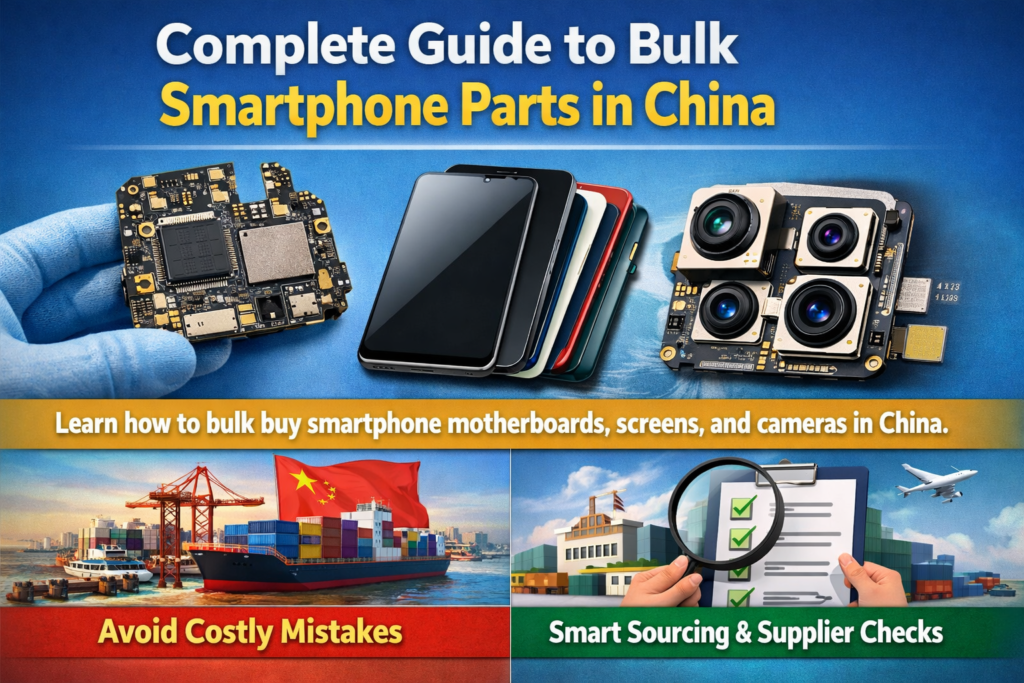
Wenn Sie in der globalen Telefonreparatur tätig sind, Sanierung, oder Montagebetrieb, Seien wir ehrlich – China ist nicht nur eine Option. Es ist das Schlachtfeld.
Und mittendrin? Shenzhen.
Von SoC-Prozessoren bis hin zu Kameramodulen, von OLED-Bildschirmen bis hin zu Lithiumbatterien, Alles fließt durch Chinas riesiges Elektronik-Ökosystem. Aber hier ist der Haken: Chance und Risiko liegen nebeneinander.
Wie beschaffen Sie sich also intelligent?? Wie Sie teure Fehler vermeiden?
Lassen Sie es uns Schritt für Schritt aufschlüsseln.
Warum China das globale Zentrum für die Beschaffung von Smartphone-Komponenten ist
Die Kraft des industriellen Ökosystems von Shenzhen
Wenn Sie durch die Elektronikmärkte von Shenzhen schlendern, werden Sie schnell feststellen, dass dies nicht nur ein Marktplatz ist. Es ist ein Ökosystem.
Chiphändler, PCB-Fabriken, Sieblaminatoren, Batteriehersteller, Modulintegratoren – alles im Umkreis weniger Kilometer.
Diese Dichte erzeugt Geschwindigkeit. Es entsteht ein Preiswettbewerb. Es schafft Flexibilität.
In vielen Fällen, Sie können alle Komponenten für ein Smartphone innerhalb eines Bezirks beschaffen.
Das ist keine Bequemlichkeit. Das ist Hebelwirkung.
Vorteil bei der Beschaffung aus einer Hand
Brauchen Sie Mainboards, Bildschirme, Kameras, und Batterien?
Anstatt sich mit vier Ländern und fünf Frachtlinien zu befassen, Sie können die Beschaffung in einer Region konsolidieren. Das reduziert die Kommunikationsreibung, Komplexität der Logistik, und Kosten.
Zeit ist Geld – insbesondere auf Reparatur- und Sanierungsmärkten.
Geschwindigkeit, Flexibilität, und MOQ-Vorteile
Im Gegensatz zu traditionellen Herstellern in anderen Regionen, Chinesische Lieferanten akzeptieren oft extrem niedrige Mindestbestellmengen.
Manchmal sogar 1 Stück.
Das bedeutet, dass Sie vor der Skalierung testen können. Experimentieren Sie, bevor Sie sich verpflichten.
Es ist wie ein Date vor der Ehe – klug und strategisch.
Strategische Planung vor dem Kauf
Bevor Sie Lieferanten kontaktieren, Pause.
Fragen Sie sich:
- Reparieren Sie?
- Renovierung?
- Geräte von Grund auf bauen?
Abhängig von der Antwort ändert sich Ihre Strategie dramatisch.
Definieren Sie Ihr Geschäftsmodell
Werkstätten legen Wert auf Kompatibilität und schnellen Austausch.
Refurbisher konzentrieren sich auf die kosmetische Qualität und den Zustand der Batterie.
Monteure benötigen eine stabile Chipversorgung und Stücklistenkonsistenz.
Klarheit spart Geld.
Verstehen Sie die Qualitätserwartungen Ihres Marktes
Sind Ihre Kunden preissensibel oder qualitätssensibel??
Wenn sie „ursprüngliche Erfahrung“ verlangen,„Sie können keine minderwertigen Kopierschirme liefern.
Wenn sie Wert auf Erschwinglichkeit legen, Hochwertige Ersatzteile könnten ausreichen.
Kennen Sie Ihr Publikum.
Budgetplanung und Risikobewertung
Core components like SoC and motherboards carry higher financial risk.
Screens and batteries carry higher warranty risk.
Allocate your capital accordingly.
Core Computing & Storage Components (The Brain & Memory)
This is where mistakes become expensive.
Motherboards (PCBA) Procurement Strategy
Motherboards are high-value and complex.
Bestätigen Sie immer:
- 100% function testing
- No water damage history
- No board-level repairs unless declared
Even minor issues can cascade into device failure.
SoC Processors (CPU) – Risks & Verification
Brand-new branded SoCs are rarely accessible unless you are an authorized buyer.
Most market supply includes:
- Pull-out chips
- Re-balled chips
- “Tray new” chips
Always request small test quantities before scaling.
RAM & Rom (Flash-Speicher)
Compatibility is everything.
Even slight mismatches in firmware or speed ratings can cause boot failure.
Wie man Pull-Out-Chips von neuen Chips unterscheidet
Suchen:
- Re-Balling-Markierungen
- Unebene Lötpads
- Inkonsistenzen bei der Lasermarkierung
Vertrauen – aber überprüfen.
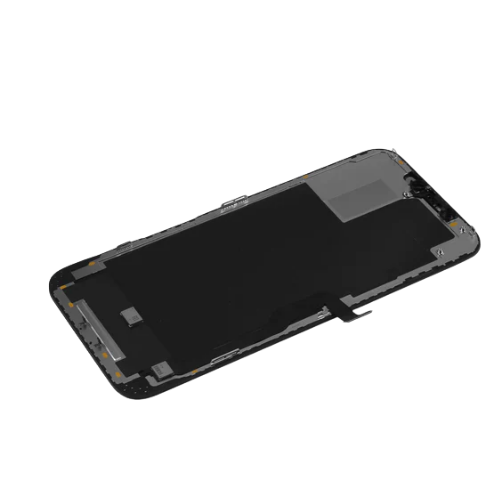
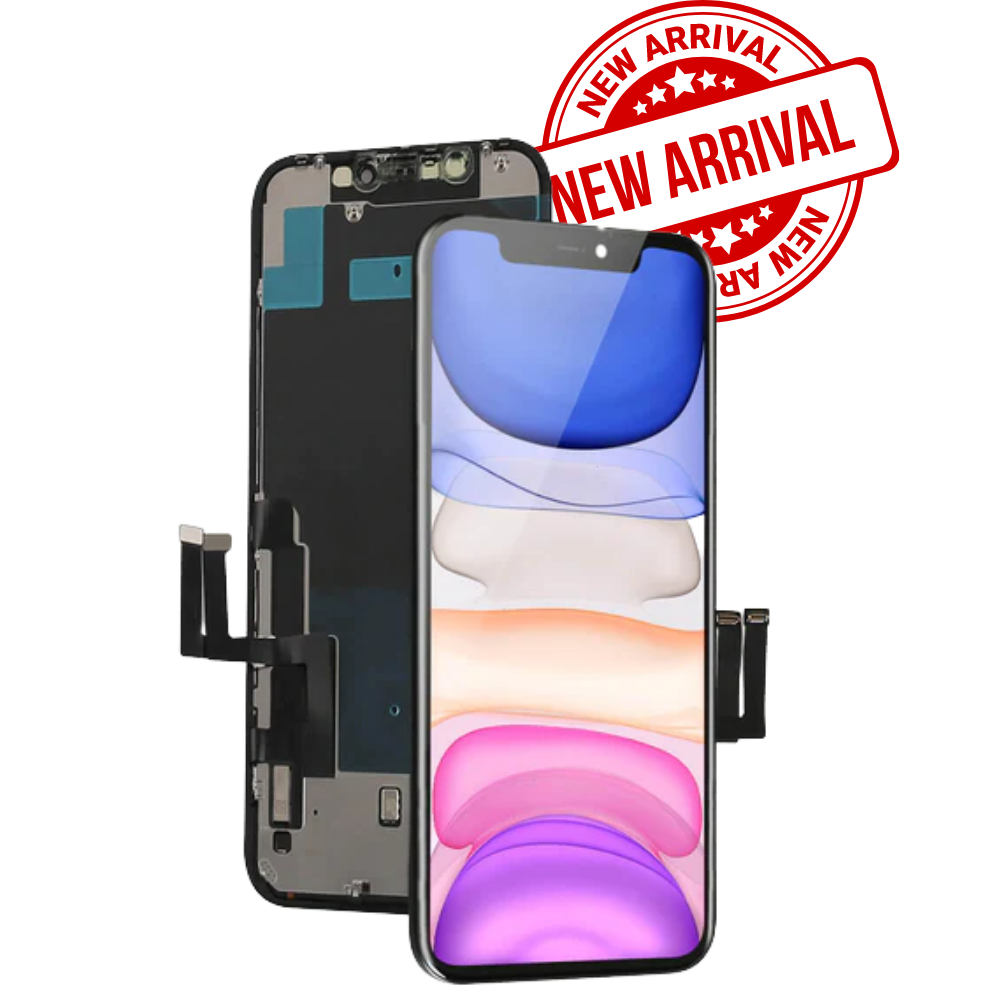
Anzeige & Berühren Sie Komponenten (Das Gesicht des Telefons)
Dies ist die weltweit am meisten nachgefragte Reparaturkomponente.
LCD vs. OLED – Was sollten Sie wählen??
OLED bietet einen besseren Kontrast und einen dünneren Formfaktor.
LCD ist billiger und langlebiger.
Wenn Ihre Kunden Spitzenqualität erwarten – OLED.
Wenn Ihr Markt budgetorientiert ist, funktioniert LCD.
Originalbildschirm vs. High-Copy-Bildschirm
Originale Pull-Screens:
- Beste Farbgenauigkeit
- Höherer Preis
- Begrenztes Angebot
Hochkopierbildschirme:
- Niedrigere Kosten
- Leichte Leistungslücke
- Höheres Margenpotenzial
Bringen Sie Gewinn und Reputation ins Gleichgewicht.
Berühren Sie die IC- und Treiber-IC-Anpassung
Die Touch-Reaktionsfähigkeit hängt stark von der IC-Kompatibilität ab.
Passt nicht zusammen, und es kommt zu Geisterberührungen oder toten Zonen.
Bestätigen Sie immer die Firmware-Ausrichtung.
Bildschirmbewertungssystem erklärt
A-Klasse: Keine Kratzer, perfekte Darstellung
B-Klasse: Kleinere kosmetische Mängel
C-Klasse: Sichtbare Abnutzung
Definieren Sie die Einstufung in Verträgen klar.
Kamera & Akustische Module (Die Sinne)
Struktur des Kameramoduls
Zu den Kameramodulen gehören:
- Sensor
- Linse
- Flexkabel
- Treiberschnittstelle
Die Pixelanzahl ist nicht alles. Die Sensorgröße ist wichtig.
Deep-Sensing-Module
Wird in 3D-Erkennungssystemen verwendet.
Höhere Kosten. Softwareabhängig.
Quelle nur, wenn Ihr Board dies unterstützt.
Lautsprecher & Mikrofone
Testen Sie auf:
- Tonverzerrung
- Volumenkonsistenz
- Hintergrundgeräusche
Kleines Bauteil. Große Kundenbeschwerden.
Leistung & Konnektivitätskomponenten (Energie & Signal)
Batteriezertifizierung & Sicherheitskonformität
Gehen Sie hier keine Kompromisse ein.
Immer anfordern:
- UN38.3
- Sicherheitsdatenblatt
- CE/RoHS bei Bedarf
Bei einem Batterieausfall geht es nicht nur um Garantie, sondern auch um Haftung.
USB-C-Ladeanschlüsse
Überprüfen:
- Pin-Ausrichtung
- Lötstärke
- Datenunterstützungsfunktion
Billige Häfen scheitern schnell.
Antennen (W-lan / 4G / 5G)
Die Signalleistung hängt von der Designgenauigkeit ab.
FPC-Antennen bieten eine bessere Leistung als einfache Metallkontakte.
Die HF-Anpassung ist wichtiger als der Preis.
Vibrationsmotoren & Kleinteile
Testen Sie die Vibrationsstärke und den Geräuschpegel.
Billige Motoren fühlen sich schwach an und beeinträchtigen die Wahrnehmung des Benutzers.
Präzisionsstrukturteile
SIM-Kartenfächer
Übereinstimmen:
- Farbe
- Material
- Toleranzpräzision
Selbst eine Abweichung von 0,1 mm führt zu Ausrichtungsproblemen.
Testen Sie die Proben vor der Massenproduktion.
So bewerten und wählen Sie zuverlässige Lieferanten aus
Online-Plattform-Screening-Metriken
Schauen Sie über die Bewertungen hinaus.
Konzentrieren Sie sich auf:
- Pünktliche Lieferquote
- Reaktionsgeschwindigkeit
- Wiederholungskaufpreis
Zahlen offenbaren Muster.
Beispielteststrategie
Bestellen Sie 2–5 Muster pro SKU.
Prüfen:
- Leistung
- Kompatibilität
- Stabilität
Überspringen Sie diesen Schritt niemals.
Fabrikaudits
Wenn die Lautstärke es rechtfertigt, Fabriken besuchen.
Beobachten:
- Produktionslinien
- QC-Prozesse
- Lagerbedingungen
Sehen schafft Selbstvertrauen.
Logistik, Zahlung & Einhaltung
Versandarten im Vergleich
Luftfracht: Schnell, teuer
Seefracht: Langsam, billig
Kurier: Ideal für Proben
Ordnen Sie Dringlichkeit und Budget zu.
Sichere Zahlungspraktiken
Verwenden:
- Handelssicherung
- Firmenkonten
- Sichere Zahlungsgateways
Vermeiden Sie persönliche Überweisungen.
Vorschriften für den Batterieversand
Batterien gelten als Gefahrgut.
Bestätigen Sie die Unterlagen vor dem Versand.
Incoterms verstehen
Verantwortung klären:
- FOB
- CIF
- DDP
Vermeiden Sie Missverständnisse.
Schritt-für-Schritt-Aktionsplan für den Großeinkauf
Schritt 1 – Marktforschung
Analysieren Sie Preistrends.
Vergleichen Sie zumindest 5 Lieferanten.
Schritt 2 – Lieferantenauswahl
Auswahlliste basierend auf Daten- und Kommunikationsqualität.
Schritt 3 – Probenvalidierung
Testen Sie gründlich.
Simulieren Sie reale Einsatzbedingungen.
Schritt 4 – Pilotenbefehl
Beginnen Sie mit kontrollierter Masse.
Überwachen Sie die Fehlerrate.
Schritt 5 – Langfristige Partnerschaft
Verhandeln:
- Stabile Preise
- Prioritätsvergabe
- Garantievereinbarungen
Starke Beziehungen bedeuten eine stabile Versorgung.
Letzte Gedanken: Aufbau einer nachhaltigen Lieferkette in China
Beim Massenkauf von Smartphone-Kernkomponenten in China geht es nicht nur darum, den niedrigsten Preis zu erzielen.
Es geht darum, ein System aufzubauen.
Ein System, in dem:
- Tests sind Routine
- Das Risiko wird berechnet
- Qualität ist definiert
- Lieferanten sind Partner
Denken Sie langfristig.
Wenn es richtig gemacht wird, China wird nicht nur zu Ihrem Beschaffungsziel, sondern auch zu Ihrem Wettbewerbsvorteil.
Abschluss
China bietet unübertroffene Möglichkeiten für die Beschaffung interner Smartphone-Komponenten in großem Maßstab. Aber der Erfolg hängt von der Vorbereitung ab, Testen, Lieferantenbewertung, und Compliance-Bewusstsein. Durch die Kombination strategischer Planung mit strukturierten Validierungsprozessen, Sie können kostengünstig bauen, zuverlässig, und skalierbare Lieferkette, die Ihr Unternehmen weltweit stärkt.
FAQs
1. Ist es sicher, Smartphone-Motherboards in großen Mengen aus China zu kaufen??
Ja, wenn Sie zunächst Muster testen und die Glaubwürdigkeit des Lieferanten sorgfältig prüfen.
2. Wie kann ich vermeiden, generalüberholte Chips zu kaufen, die als Neuware verkauft werden??
Überprüfen Sie die Lotkugeln, Markierungen überprüfen, und führen Sie immer Leistungstests durch.
3. Welche Zertifizierungen sind für Smartphone-Akkus obligatorisch??
UN38.3 und MSDS sind für den internationalen Versand unerlässlich.
4. Sind OLED-Bildschirme immer besser als LCD??
Nicht immer. OLED bietet eine bessere Optik, kostet aber mehr.
5. Wie reduziere ich das Risiko bei meiner ersten Großbestellung??
Beginnen Sie mit kleinen Pilotaufträgen und skalieren Sie nach der Qualitätsvalidierung schrittweise.