Einführung
Seit 2018, Die iPhone-Reihe von Apple hat Smartphone-Design und Display-Innovation konsequent neu definiert. Von der Einführung des Super Retina HD Panels im iPhone XS zum Dynamische Insel Und ProMotion 120-Hz-Displays bei modernen Modellen, Apple hat sein Engagement für einen ausgewogenen Stil unter Beweis gestellt, Funktionalität, und visuelle Exzellenz.
Lassen Sie uns tief in die Entwicklung der iPhones eintauchen 2018 Und 2025, darunter einige Zukunftsprognosen die Branchentrends und die Entwicklung von Apple widerspiegeln.
iPhone-Entwicklung: Aus 2018 Zu 2025
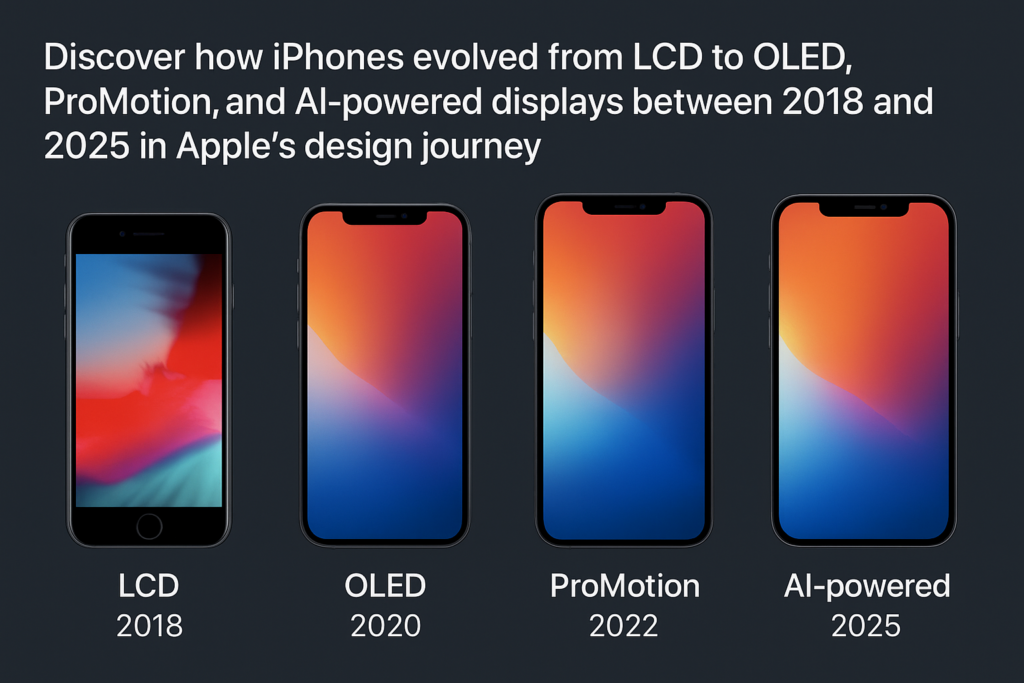
Zwischen 2018 Und 2025, Apple hat bei fast allen Modellen von LCD auf OLED umgestellt. Der Flüssige Retina HD-LCDs gab nach Super Retina XDR OLEDs, die nun das Lineup dominieren. Die Reise umfasst auch wichtige Meilensteine – wie z 5G, Förderung, Always-On-Display, und die Wechseln Sie zu USB-C.
Von 2025, Es wird erwartet, dass die iPhone-Reihe einen Grad an Verfeinerung erreicht, der integriert ist KI-gestützte Kamerasysteme, Intelligentere Displays, Und ultraeffiziente Chipsätze.
Verständnis der Display-Technologien von Apple
LCD vs. OLED
LCD (Flüssigkristallanzeige) wurde in früheren Modellen wie dem iPhone XR und SE verwendet. OLED (Organische lichtemittierende Diode), Jedoch, sorgt für tiefere Schwarztöne, besserer Kontrast, und verbesserte Effizienz – jetzt Standard in den Flaggschiffmodellen von Apple.
Super Retina HD und XDR
Apple eingeführt Super Retina HD In 2018 Und Super Retina XDR In 2019, bietet überragende Helligkeit und Kontrast. Der XDR (Extremer Dynamikumfang) Technologie verbessert die Anzeige von HDR-Inhalten, sorgt für eine lebendige Farbwiedergabe.
Promotion und Always-On-Display
ProMotion-Technologie, erscheint erstmals in der iPhone 13 Pro, ermöglicht a 120Hz-Bildwiederholfrequenz– Erzeugen flüssigerer Animationen und Scrollen. Später, Die Always-On-Display im iPhone 14 Bei der Pro-Serie blieben die Informationen auch dann sichtbar, wenn der Bildschirm inaktiv war.
Übersicht der iPhone-Modelle (2018–2023)
2018: Die OLED- und LCD-Kluft
Der iPhone XS, XS max, Und XR markiert Apples dualen Ansatz – Premium-OLED und erschwingliche LCD-Optionen. Die XRs Flüssiges Retina-LCD sprach preisbewusste Benutzer an.
2019: Dreifache Kameras und Leistungssteigerung
Der iPhone 11 Pro Serie gebracht Dreifachkameras und die A13 Bionic-Chip, Verbesserung sowohl der Fotografie als auch der Akkulaufzeit.
2020: 5G- und Flat-Edge-Design
Apple kehrte mit dem zu flachen Kanten zurück iPhone 12 Serie, ein bringen aufgefrischtes Design, Keramikschild, Und 5G-Konnektivität. OLED-Displays wurden in der gesamten Produktpalette zum Standard.
2021: ProMotion kommt auf das iPhone
Der iPhone 13 Pro Und Pro Max vorgestellt ProMotion-Displays, Unterstützt Bildwiederholraten von 120 Hz – ideal für Gamer und Content-Ersteller.
2022: Dynamische Inselrevolution
Der iPhone 14 Pro Serie stellte die vor Dynamische Insel, Ersetzen der Kerbe und Anbieten interaktiver Benachrichtigungen. Der Always-On-Display und die A16 Bionic-Chip definierte eine neue Ära.
2023: Titan-Design und USB-C-Integration
Der iPhone 15 Pro Serie vorgestellt Titanrahmen, USB-C-Anschlüsse, und a anpassbare Aktionsschaltfläche– ein bedeutender Design- und Funktionalitätssprung.
Vorhergesagte Modelle (2024–2025)
2024: iPhone 16 Serienverbesserungen
Branchenanalysten gehen davon aus, dass die iPhone 16 Pro wird wachsen 6.3 Zoll, während die Pro Max erweitert sich auf 6.9 Zoll. Apple fügt möglicherweise auch eine hinzu spezielle Aufnahmetaste und Verbesserung der Bildwiederholraten für Nicht-Pro-Modelle.
2025: Das iPhone 17 Serie und darüber hinaus
Der iPhone 17 ausrichten soll die Display-Technologie weiter verfeinern energieeffiziente OLEDs und möglicherweise Mikrolinsen-Array-Displays. Apple könnte ebenfalls sein Debüt geben KI-gestützte Displaykalibrierung für eine verbesserte visuelle Wiedergabetreue.
Vollständige iPhone-Spezifikationstabelle (2018–2025)
Unten ist die umfassende Tabelle im Excel-Stil Zusammenfassung aller iPhone-Modelle von 2018 Zu 2025:
| Modell | Erscheinungsjahr | Anzeigetyp & Spezifikationen | Abmessungen (mm) | Notizen |
|---|---|---|---|---|
| iPhone XS | 2018 | 5.8″ OLED, Super Retina HD, 2436×1125, 458 ppi | 143.6 X 70.9 X 7.7 | Auslaufmodell |
| iPhone XS Max | 2018 | 6.5″ OLED, Super Retina HD, 2688×1242, 458 ppi | 157.5 X 77.4 X 7.7 | Auslaufmodell |
| iPhone XR | 2018 | 6.1″ LCD, Flüssiges Retina HD, 1792×828, 326 ppi | 150.9 X 75.7 X 8.3 | Auslaufmodell |
| iPhone 11 | 2019 | 6.1″ LCD, Flüssiges Retina HD, 1792×828, 326 ppi | 150.9 X 75.7 X 8.3 | Auslaufmodell |
| iPhone 11 Pro | 2019 | 5.8″ OLED, Super Retina XDR, 2436×1125, 458 ppi | 144 X 71.4 X 8.1 | Auslaufmodell |
| iPhone 11 Pro Max | 2019 | 6.5″ OLED, Super Retina XDR, 2688×1242, 458 ppi | 158 X 77.8 X 8.1 | Auslaufmodell |
| iPhone SE (2nd Gen) | 2020 | 4.7″ LCD, Retina HD, 1334×750, 326 ppi | 138.4 X 67.3 X 7.3 | |
| iPhone 12 Mini | 2020 | 5.4″ OLED, Super Retina XDR, 2340×1080, 476 ppi | 131.5 X 64.2 X 7.4 | Auslaufmodell |
| iPhone 12 | 2020 | 6.1″ OLED, Super Retina XDR, 2532×1170, 460 ppi | 146.7 X 71.5 X 7.4 | |
| iPhone 13 Pro Max | 2021 | 6.7″ OLED, XDR, Promotion 120 Hz | 160.8 X 78.1 X 7.65 | Auslaufmodell |
| iPhone 14 Pro | 2022 | 6.1″ OLED, XDR, Immer aktiv, 2556×1179 | 147.5 X 71.5 X 7.85 | Dynamische Insel |
| iPhone 15 Pro | 2023 | 6.1″ OLED, XDR, Förderung, 2556×1179 | 146.6 X 70.6 X 8.25 | Titan, USB-C |
| iPhone 16 Pro | 2024* | 6.3″ OLED, XDR, Förderung | Noch offen | Vorhergesagt |
| iPhone 17 Pro Max | 2025* | 6.9″ OLED, XDR der nächsten Generation | Noch offen | Vorhergesagt |
(*Änderungen der vorhergesagten Modelle vorbehalten)
Trends und wichtige Beobachtungen
Größenentwicklung
Apple hat die Bildschirmgrößen schrittweise vergrößert, Umzug von 5.8″ (iPhone XS) zu einem vorhergesagten 6.9″ (iPhone 17 Pro Max). Kompaktmodelle wie die „Mini“-Linie wurden aufgrund der geringen Nachfrage ausgemustert.
Upgrades anzeigen
Aus LCD zu OLED, Apples Fokus verlagerte sich auf eine bessere Helligkeit, Kontrast, und Energieeffizienz. Der 120Hz-Bildwiederholfrequenz Und Always-On-Funktion spiegeln Apples Bestreben nach nahtloser Interaktivität wider.
Material- und Designänderungen
Titanrahmen, dünnere Lünetten, und verbesserte Haltbarkeit zeichnen das aus 15 Pro Serie. Zukünftige Modelle werden voraussichtlich die Dicke weiter reduzieren und gleichzeitig die Batterielebensdauer beibehalten.
Vorhersagen für zukünftige iPhones
Blick nach vorn, Apple kann:
- Adoptieren microLED-Anzeigen für unvergleichliche Helligkeit.
- Integrieren KI-gestützte Displaykalibrierung.
- Einführen adaptive Bildwiederholraten über 120 Hz.
- Bewegen Sie sich in Richtung Portlose Designs von 2026.
Die Entwicklung des iPhones spiegelt deutlich Apples Fusionsambitionen wider Technologie, Kunst, und Nachhaltigkeit in einem kompakten Gerät.
Abschluss
Ab 2018 Super Retina-Debüt zum Kommenden KI-gesteuert, ultraeffiziente Modelle von 2025, Das iPhone hat sich zu einem Schaufenster technischer Exzellenz entwickelt. Jedes Modell baut auf dem letzten auf, Benutzern intelligentere Angebote bieten, schlanker, und nachhaltigere Technologie.
FAQs
1. Welches iPhone verwendete erstmals die OLED-Technologie??
Der iPhone X (2017) OLED eingeführt, und von 2020, Es wurde bei den meisten Modellen zum Standard.
2. Wann hat Apple ProMotion-Displays eingeführt??
In 2021 mit dem iPhone 13 Pro Serie.
3. Was macht das iPhone 15 Das Display von Pro ist einzigartig?
Es verfügt über eine Super Retina XDR OLED, 120Hz ProMotion, Und Titanrahmen für ein besseres Wärmemanagement.
4. Sind die iPhone-Spezifikationen für 2024–2025 bestätigt??
Noch nicht – sie basieren auf Branchenanalysen und glaubwürdige Leaks.
5. Wird Apple kleinere iPhones zurückbringen??
Unwahrscheinlich. Marktdaten zeigen, dass Benutzer bevorzugen größere Displays für Medien und Produktivität.