Einführung
Wieder rein 2018, Redmi war immer noch eine stolze Untermarke Xiaomi, bekannt für seinen unschlagbaren Mix aus Preis und Leistung. Es war noch keine eigenständige Marke – dieser Wechsel erfolgte ein Jahr später –, aber es schlug bereits große Wellen auf dem globalen Smartphone-Markt.
Dies war ein Jahr, in dem Redmi ist wirklich erwachsen geworden, Bereitstellung von Smartphones mit solider Verarbeitungsqualität, fähige Kameras, und zuverlässige Leistung, alles bunt verpackt, budgetfreundliche Pakete. Und ja – jedes einzelne war mit einem ausgestattet LCD-Display, bleibt seinem kostenbewussten Publikum treu.
Redmis Markenidentität in 2018
In 2018, Redmis Mission war klar: Angebot „maximaler Wert zum minimalen Preis.“ Funktioniert immer noch im Xiaomi-Ökosystem, Redmi konzentrierte sich auf Telefone der Mittelklasse und der Einstiegsklasse, während sich Xiaomis Flaggschiff-Mi-Serie um das High-End-Publikum kümmerte.
Die Aufstellung war bewusst einfach gehalten – ohne Spielereien, Kein unnötiger Luxus – nur leistungsstarke Smartphones, die sich jeder leisten kann. Diese Strategie baute Vertrauen auf, insbesondere in Märkten wie Indien, China, und Südostasien.
Display-Technologie in 2018
Redmis 2018 Aufstellung hatte Eines gemeinsam: LCD-Bildschirme. Während AMOLED-Panels bei Flaggschiff-Telefonen an Bedeutung gewannen, Redmi entschied sich, dabei zu bleiben LCD aufgrund seiner bewährten Zuverlässigkeit und geringeren Produktionskosten.
Der Schritt machte Sinn: AMOLED-Panels waren teuer, und Redmis Ziel war es, das beste Erlebnis zu bieten, ohne den Geldbeutel zu beschädigen. Das LCD bot immer noch helle Bilder, genaue Farben, und solide Sicht im Freien – gut genug für Millionen von Benutzern.
Vollständige Modellliste von 2018
Hier ist eine Aufschlüsselung von Redmis wesentlich 2018 Modelle, ihre Anzeigearten, und Farben weltweit verfügbar:
| Modell | Veröffentlichungsdatum | Anzeigetyp | Farben |
|---|---|---|---|
| Redmi Note 5 Pro (Global) | Febr 2018 | LCD | Schwarz, Blau, Gold, Roségold |
| Redmi Note 5 (Global) | Febr 2018 | LCD | Schwarz, Blau, Gold, Roségold |
| Redmi Note 5 AI-Dual-Kamera (China) | Beschädigen 2018 | LCD | Schwarz, Gold, Roségold, Magisches Blau |
| Redmi 6 | Jun 2018 | LCD | Schwarz, Blau, Gold, Roségold |
| Redmi 6A | Jun 2018 | LCD | Schwarz, Blau, Gold, Roségold |
| Redmi 6 Pro | Sept 2018 | LCD | Schwarz, Blau, Gold, Sakura-Rosa |
| Redmi S2 / Y2 | Mai 2018 | LCD | Schwarz, Gold, Roségold, Silbergrau |
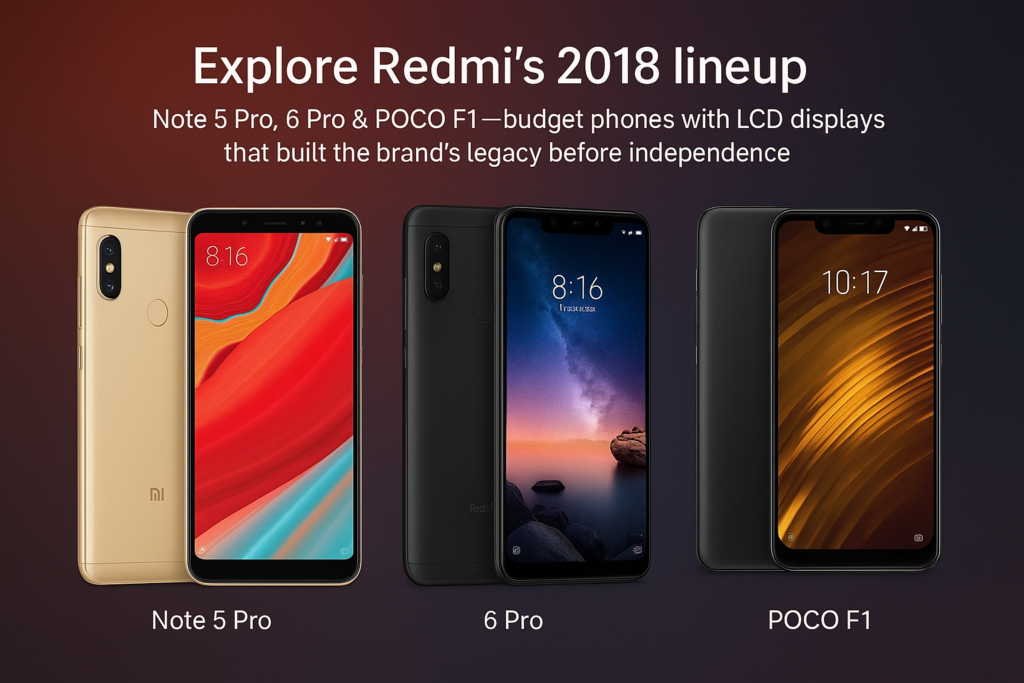
| KLEINE F1 (POCOPHONE F1) | Aug 2018 | LCD | Graphitschwarz, Stahlblau, Rosso Rot |
Redmi Note 5 / Notiz 5 Pro-Serie
Der Redmi Note 5 Serie war der globale Superstar des Jahres 2018. Den Spitznamen „Budget-Allrounder“ erhielt es, weil es durchweg ausgewogene Spezifikationen bietet.
- Prozessor: Löwenmaul 636
- Anzeige: 5.99-Zoll LCD-Vollbild (18:9 Seitenverhältnis)
- Höhepunkte: Zwei Rückfahrkameras mit erweitertem Porträtmodus, großer Akku, und reibungslose MIUI-Optimierung
- Farben: Eine Mischung aus eleganten Tönen wie Schwarz, Blau, Gold, und Roségold
Die Notiz 5 Pro wurde vor allem in Indien zu einer Ikone, Umsatzrekorde aufstellen und mittlere Erwartungen neu definieren.
Redmi 6 Serie
Der Redmi 6 ausrichten ersetzte das Vorjahresmodell Redmi 5 Familie, Der Schwerpunkt liegt auf Erschwinglichkeit und Alltagszuverlässigkeit.
Redmi 6 und 6A
Beide Modelle verwendet MediaTek-Prozessoren (P22 und A22) um die Preise niedrig zu halten und gleichzeitig zuverlässige Leistung für die täglichen Aufgaben zu bieten.
- Anzeige: 5.45-Zoll LCD mit 18:9 Seitenverhältnis
- Design: Kompakt und gebogen, Perfekt für die Einhandbedienung
- Farben: Schwarz, Blau, Gold, Roségold
Redmi 6 Pro
Der Redmi 6 Pro war das erste Redmi-Telefon mit einem Notch-Display, Übernahme der 19:9 Designtrend, der durch Flaggschiff-Telefone populär gemacht wird.
- Anzeige: 5.84-Zoll-LCD mit einer Kerbe
- Prozessor: Löwenmaul 625
- Farben: Schwarz, Blau, Gold, Sakura-Rosa
Es wurde sofort ein Hit bei jungen Nutzern, die modernes Design wollten, ohne Spitzenpreise zu zahlen.
Redmi S2 / Redmi Y2
Zielgruppe sind Selfie-Liebhaber, Die Redmi S2 (China) Und Redmi Y2 (Indien) Gemeinsame identische Spezifikationen, aber unterschiedliches Branding für jeden Markt.
- Hervorheben: 16MP AI-Frontkamera mit weichem LED-Blitz
- Anzeige: 5.99-Zoll-LCD
- Prozessor: Löwenmaul 625
- Farben: Schwarz, Gold, Roségold, Silbergrau
Dieses Modell erfreute sich wegen seiner kameraorientierten Anziehungskraft besonders bei jungen Frauen und Social-Media-Erstellern großer Beliebtheit.
POCO F1 – Der Flaggschiff-Killer
Der KLEINE F1 (oder POCOPHONE F1) verdient besondere Erwähnung. Technisch gesehen unter der neuen Untermarke POCO von Xiaomi, Es teilte die Leistungs-DNA von Redmi zu einem unschlagbaren Preis.
- Prozessor: Löwenmaul 845 – derselbe Chip, der in verwendet wird 2018 Flaggschiffe
- Anzeige: 6.18-Zoll-LCD
- Farben: Graphitschwarz, Stahlblau, und Rosso Red
Es schockierte die Branche, indem es erstklassige Leistung zum halben Preis der Flaggschiffe von Samsung und Apple lieferte. Es war ein klares Zeichen für die Zukunft – die zukünftige Redmi-K-Serie verdankte einen Großteil ihrer Philosophie diesem Biest.
Trends anzeigen in 2018
Jeder 2018 Auf das Redmi-Gerät wurde vertraut LCD-Panels. Während viele Konkurrenten begannen, sich mit AMOLED zu beschäftigen, Redmi hat die Dinge praktisch gehalten. LCDs waren langlebig, erschwinglich, und von den Herstellern gut verstanden.
Das Ergebnis? Gleichbleibende Qualität bei allen Modellen. Benutzer erhielten helle Displays, ordentlicher Kontrast, und präzise Farbwiedergabe – ideal für ihre Preisklasse.
Farbphilosophie von Redmi in 2018
2018 war, als Redmi anfing, damit zu experimentieren jugendlichere und ausdrucksstärkere Farben. Jenseits des klassischen Schwarz und Gold, wir haben gesehen magisches Blau, Sakura-Rosa, und Rossorot Betreten Sie die Aufstellung.
Redmi erkannte, dass Telefone zu Lifestyle-Accessoires geworden waren, nicht nur Gadgets. Die Farbpalette spiegelte Optimismus wider, Individualität, und ein Hauch von Verspieltheit – besonders in Märkten wie Indien und Südostasien.
Global vs. China-Varianten
Während die Hardware dazwischen global Und China-Versionen blieb ähnlich, einige subtile Unterschiede fielen auf:
- Software: Globale Modelle werden mit Google Play und MIUI Global ROM ausgeliefert, während China-Modelle MIUI China ohne Google-Dienste hatten.
- Kamera-Tuning: Je nach Marktrückmeldung können sich die Verarbeitungsstile leicht unterscheiden.
- Farboptionen: Bestimmte Farbtöne (wie Magic Blue) waren exklusiv für China.
Diese Variationen machten die globale Strategie von Redmi äußerst anpassungsfähig.
Strategische Highlights von 2018
- Komplett-LCD-Produktreihe: Die Kostenkontrolle blieb König.
- Kamerasprung: Redmi Note 5 Pro bedeutete eine enorme Verbesserung in der Porträtfotografie.
- Leistungsvorsprung: Selbst Einsteigermodelle liefen dank intelligenter Prozessorauswahl flüssig.
- Designentwicklung: Von traditionellen Lünetten bis hin zu Kerben, Redmi hat sich schnell weiterentwickelt.
Zusammen, Diese Meilensteine bereiteten Redmi auf seine größte Transformation vor: die Markenunabhängigkeit 2019.
Wie 2018 Den Weg für die Unabhängigkeit von Redmi geebnet
Redmis 2018 Die Besetzung zeigte ihre Reife. Es war klar, dass Redmi es gebaut hatte eigene Identität– anders als Xiaomis Flaggschiff-Image, aber ebenso stark im Einfluss.
Als Redmi Anfang offiziell eine unabhängige Marke wurde 2019, Der Grundstein war bereits gelegt. Der Notiz 5, 6 Pro, Und S2 hatte das Potenzial von Redmi bewiesen, den Mittelklassebereich weltweit zu dominieren.
Abschluss
2018 war ein entscheidendes Jahr für Redmi. Die Marke blieb ihren Grundprinzipien treu:Erschwinglichkeit, Zuverlässigkeit, und Leistung– beim Experimentieren mit Farbe und Design. Obwohl jedes Telefon verwendet wird LCD-Anzeigen, Die Innovation von Redmi glänzte durch Softwareoptimierung, Kameraverbesserung, und kühne Ästhetik.
Das Erbe von 2018 hallt immer noch in modernen Redmi-Telefonen wider – ein Beweis dafür, dass auch ohne AMOLED, Sie können in der Smartphone-Welt immer noch glänzen.
FAQs
1. Warum verwendete Redmi nur LCD-Bildschirme? 2018?
Um die Preise niedrig zu halten und eine gleichbleibende Qualität sicherzustellen, Redmi blieb in diesem Jahr bei allen Modellen bei LCD-Panels.
2. Welche 2018 Das Redmi-Telefon hatte die beste Kamera?
Der Redmi Note 5 Pro war mit seinem Dual-Kamera-Setup und dem erweiterten Porträtmodus führend.
3. Was war das farbenfrohste Redmi-Telefon überhaupt? 2018?
Der POCO F1s Rosso Red Und Redmi 6 Pro’s Sakura Pink stachen als die lebendigsten Optionen hervor.
4. Habe welche gemacht 2018 Redmi-Telefone verfügen über AMOLED-Displays?
NEIN. Redmi hat AMOLED erst eingeführt 2020 mit ausgewählten Modellen der K-Serie und Note.
5. Warum ist 2018 wichtig für die Geschichte von Redmi?
Es war das letzte Jahr, bevor Redmi eine unabhängige Marke wurde, die Voraussetzungen für den zukünftigen Erfolg schaffen.