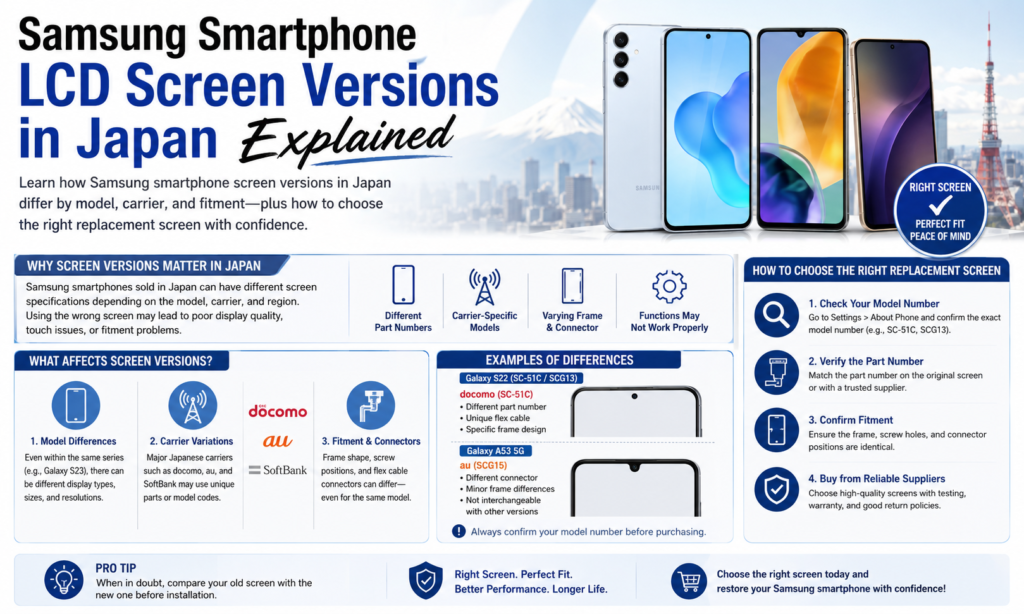
Warum Samsung-Bildschirmversionen in Japan unterschiedlich sind
Wenn Sie in der mobilen Reparatur arbeiten, Telefonsanierung, oder Bildschirmgroßhandel, Japan-Markt Samsung-Smartphone-Displays kann sich wie eine Puzzle-Box anfühlen. Auf den ersten Blick, Ein in Japan verkauftes Galaxy S23 sieht fast genauso aus wie ein in Korea verkauftes, Europa, oder die USA. Das gleiche schöne Display. Gleiche Größe. Gleiches erstklassiges Gefühl in der Hand. Aber sobald man das Telefon öffnet – oder mit der Beschaffung von Ersatzteilen beginnt – werden die Unterschiede schnell sichtbar.
Da wird es interessant.
Japan hatte schon immer ein einzigartiges Smartphone-Ökosystem. Träger mögen NTT Docomo, au (KDDI), und gelegentlich hat SoftBank in der Vergangenheit Samsung Galaxy-Geräte speziell für den lokalen Markt angepasst. Damit sind Modellnummern gemeint, Firmware, Carrier-Branding, und manchmal unterscheiden sich interne Komponenten von globalen Versionen. Für Reparaturbetriebe, insbesondere Bildschirmlieferanten, Das ist wichtiger, als den meisten Menschen klar ist.
Auf den offiziellen japanischen Support-Seiten von Samsung werden die Reparaturpreise weiterhin nach dem genauen Modell für den japanischen Markt aufgeführt, mit separater Handhabung, je nachdem, ob es sich bei dem Telefon um eine Mobilfunkanbieterversion oder eine SIM-freie Version des Herstellers handelt. Das allein sagt Ihnen etwas Wichtiges: Samsung behandelt viele japanische Galaxy-Varianten unabhängig innerhalb des Service-Ökosystems.
Wenn Sie also Bildschirme nur basierend auf dem „Galaxy S23-Display“ bestellen,„Vielleicht spielen Sie bereits.
Und niemand spielt gerne mit Inventar.
Japans Carrier-gesteuerter Smartphone-Markt
Im Gegensatz zu vielen Regionen, in denen entsperrte Telefone dominieren, Japan entwickelte sich rund um Carrier-spezifische Hardware. Jahrelang, Der Kauf eines Galaxy-Telefons bedeutete oft den Kauf direkt über Docomo oder au.
Durch diese Betreiberbeziehung wurden lokalisierte Geräteversionen erstellt, z:
- SC-51D
- SCG19
- SC-53B
- SCV42
An einen Verbraucher, diese sehen aus wie zufällige Buchstaben.
An einen Reparaturtechniker, Diese Buchstaben entscheiden darüber, ob der Bildschirm passt – oder ob er zu einem teuren Restposten wird.
Japanische Trägerversionen enthalten oft:
- einzigartige Firmware
- Träger-Startbildschirme
- spezifische Netzwerkoptimierung
- regionale Zertifizierungszeichen
- leicht unterschiedliche Rahmenaufbauten
Manchmal ist das Bildschirmpanel selbst identisch.
Manchmal ist nur das OLED identisch, aber der Rahmen unterscheidet sich.
Manchmal verschiebt sich die Anordnung des Flexkabels gerade so weit, dass es zu Installationsproblemen kommt.
Dieses kleine Detail kann aus einer 30-minütigen Reparatur dreistündige Kopfschmerzen machen.
Regionale Modellnummern und Hardwarevarianten
Das Benennungssystem von Samsung wird viel einfacher, wenn Sie wissen, wie man es liest.
Beispiele:
| Gerät | Globales Modell | Docomo Japan | in Japan |
|---|---|---|---|
| Galaxy S23 | SM-S911B | SC-51D | SCG19 |
| Galaxy S24 | SM-S921B | SC-51E | SCG25 |
| Galaxy Z Fold5 | SM-F946B | SC-55D | SCG22 |
| Galaxy S10 | SM-G973F | SC-03L | SCV41 |
Gleiche Telefonfamilie.
Unterschiedliche interne Referenz.
Unterschiedlicher Servicebestand.
Dies ist bei der Beschaffung am wichtigsten:
- Anzeigebaugruppen
- Mittelrahmen angebrachte Bildschirme
- Touch-Digitalisierer
- Display-Flex-Anschlüsse
Es reicht nicht aus, nur nach dem Namen der Galaxy-Serie zu kaufen.
Modellcode ist wichtig.
Stets.
Samsung Display-Technologie verstehen
Oft wird nach „Ersatz des Samsung-LCD-Bildschirms“ gesucht,„Aber hier ist der lustige Teil:
Die meisten modernen Samsung-Telefone – insbesondere in Japan – verwenden kein herkömmliches LCD.
Sie nutzen Amoliert.
Und ja, Diese Unterscheidung ist sehr wichtig.
AMOLED vs. OLED vs. LCD erklärt
Halten wir es einfach.
Stellen Sie sich Bildschirmtechnologie wie die Beleuchtung eines Raumes vor.
LCD ist, als würde man mit einer Taschenlampe durch farbiges Glas leuchten.
Sie haben immer eine Hintergrundbeleuchtung.
Die Pixel selbst erzeugen kein Licht.
OLED funktioniert anders.
Jedes Pixel leuchtet einzeln.
Keine Taschenlampe dahinter.
Nur Millionen winziger unabhängiger Lichter.
Amoliert ist Samsungs fortschrittliche OLED-Version.
Es bietet:
- tiefere Schwarztöne
- höherer Kontrast
- dünnere Konstruktion
- geringerer Stromverbrauch
- sattere Farbwiedergabe
Der charakteristische Galaxy-Look?
Dieses superschwarze Schwarz, wenn der Bildschirm ausgeschaltet ist?
Das ist AMOLED.
Community-Diskussionen über Samsung-Reparaturen weisen weiterhin darauf hin, dass Original-Ersatzdisplays von Samsung weiterhin AMOLED- statt LCD-Displays sind, während viele kostengünstigere Ersatzteile LCD-Ersatzteile mit geringerer Qualität und geringerer Leistung verwenden.
Warum Samsung hauptsächlich AMOLED-Panels verwendet
Samsung Display ist einer der weltweit größten OLED-Hersteller.
Also natürlich, Samsung-Handys zeigen diese Stärke.
Die meisten Galaxy-Geräte auf dem japanischen Markt – von der Flaggschiff-S-Serie bis hin zu Fold- und Flip-Modellen – verwenden:
- Dynamisches AMOLED
- Dynamisches AMOLED 2X
- Super AMOLED
Aktuelle offizielle japanische Reparaturpreisseiten enthalten eine Liste mit Ersatzgeräten für Geräte wie Galaxy S24, S25, Und S26 Familien, Alles basiert auf der AMOLED-Display-Technologie von Samsung.
Für Reparaturwerkstätten, Das bedeutet, dass Original-Bildschirmersatzteile im Vergleich zu iPhone-LCD-Ersatzteilen tendenziell teurer sind.
Das ist normal.
Es ist die Technologie.
Die wichtigsten in Japan verkauften Samsung-Telefonversionen
Lassen Sie uns nun die tatsächlichen Versionen aufschlüsseln, die Sie am häufigsten in Reparatur- und Großhandelskanälen sehen.
Docomo-Versionen
Docomo war in der Vergangenheit der stärkste Carrier-Partner von Samsung in Japan.
Diese sind auf dem Gebrauchtmarkt äußerst verbreitet.
Beispiele hierfür sind:
- SC-02H
- SC-03L
- SC-51A
- SC-51D
- SC-53E
Beispiele für gängige Modellbenennungen
Galaxy S7 Edge:
- Global: SM-G935
- Docomo Japan: SC-02H
Galaxy S23:
- Global: SM-S911
- Docomo Japan: SC-51D
Diese Versionen haben möglicherweise die gleiche Displaygröße, unterscheiden sich jedoch in der Rahmen- oder Servicebaugruppencodierung.
unter Versionen
Der au/KDDI-Markt ist ebenfalls groß.
Häufige Beispiele:
- SCV33
- SCV41
- SCG19
- SCG25
Die Reparaturkompatibilität liegt oft in der Nähe von Docomo, aber niemals davon ausgehen.
Überprüfen Sie immer:
- Position des Display-Anschlusses
- Rahmenbefestigungslöcher
- Sensorplatzierung
- Klebelayout
Überlegungen zur Kompatibilität
Ein Bildschirm könnte:
- richtig einschalten
- Bild richtig anzeigen
…aber trotzdem scheitern, weil:
- Näherungssensor ist nicht ausgerichtet
- Der Fingerabdrucksensor kalibriert sich nicht
- Rahmenclips stimmen nicht überein
- Die Positionierung der wasserdichten Dichtung ist unterschiedlich
Aus diesem Grund sortieren professionelle Reparaturanbieter ihren Lagerbestand in der Regel nach dem genauen japanischen Modellcode und nicht nur nach „Galaxy S24“.
SIM-freie Japan-Versionen
Samsung Japan verkauft auch werkseitig entsperrte Geräte.
Diese tragen normalerweise Modellnummern wie:
- SM-S918Q
- SM-S921Q
- SM-F946Q
Auf den aktuellen japanischen Support-Seiten von Samsung sind diese SIM-freien Modelle der Herstellermarke separat zu den Reparaturpreisen aufgeführt.
Diese werden immer wichtiger, da der Markt für entsperrte Telefone in Japan ständig wächst.
Unterschiede zwischen japanischen Samsung-Bildschirmen
Dies ist der Bereich, der Reparaturwerkstätten am meisten am Herzen liegt.
Denn hier entstehen Gewinne – oder Renditen.
Unterschiede bei den Flexanschlüssen
Flex-Unterschiede können Folgendes umfassen::
- unterschiedliche Steckerlänge
- gefaltete Kabelführung
- unterschiedliche Pad-Platzierung
- zusätzliche Abschirmung
Eine Fehlanpassung des Steckers macht die gesamte Baugruppe unbrauchbar.
Auch wenn das Panel selbst in Ordnung ist.
Deshalb listen viele Großhändler auf:
- Nur OLED
- OLED + berühren
- OLED mit Rahmen
- OLED-Vollmontage
als separate SKUs.
Unterschiede bei der Rahmenmontage
Dies ist das größte versteckte Problem.
Die OLED selbst könnte universell sein.
Der Rahmen ist möglicherweise nicht vorhanden.
Zu den häufigsten Unterschieden gehören::
- Position der Schraubenlöcher
- Ausschnitte für die Antennenhalterung
- seitliche Knopfplatzierung
- Ausrichtung des Lautsprechernetzes
- Platzierung der NFC-Komponenten
Beim Kauf von gerahmten Baugruppen ohne Überprüfung des Versionscodes passieren viele Fehler.
Unterschiede in Helligkeit und Bildwiederholfrequenz
Allgemein, Die Display-Spezifikationen bleiben in allen Regionen sehr ähnlich.
Beispielsweise werden die neuesten Modelle der japanischen Galaxy-S-Serie weiterhin mit ausgeliefert:
- 120Hz-Bildwiederholfrequenz
- HDR-Unterstützung
- hohe Spitzenhelligkeit
- Je nach Modell QHD- oder FHD+-Auflösung
Informationen zur Markteinführung des Galaxy S23 Japan bestätigten die gleichen 120-Hz-AMOLED-Spezifikationen, die weltweit zu finden sind.
Daher bleibt die Leistung normalerweise konstant.
Die mechanische Kompatibilität ist das größere Problem.
Auswahl des richtigen Ersatzbildschirms für Samsung-Telefone auf dem japanischen Markt
Beim Kauf eines Samsung-Displays für Geräte auf dem japanischen Markt kommt es nicht nur auf den Preis an.
Es geht um Risikomanagement.
OEM vs. Pulled vs. Generalüberholt vs. Aftermarket
Hier ist der schnelle Vergleich.
| Typ | Qualität | Preis | Empfohlen |
|---|---|---|---|
| OEM-Original | Exzellent | Hoch | Am besten |
| Gezogener Bildschirm | Exzellent | Mittelhoch | Sehr gut |
| Überholtes OLED | Gut | Medium | Gut |
| Aftermarket-LCD | Untere | Niedrig | Nur Budget |
OEM: Brandneues Original Samsung.
Gezogen: Von Originaltelefonen entfernt.
Renoviert: Originales OLED mit ausgetauschtem Glas.
Aftermarket: Bildschirm zum Kopieren von Drittanbietern.
Für Galaxy-Geräte auf dem japanischen Markt, zurückgezogen und OEM bleiben in der Regel die sicherste Wahl.
Häufige Fehler, die Reparaturwerkstätten vermeiden sollten
Die häufigsten Fehler?
Kauf nur mit Telefonnummer.
Suffixcodes werden ignoriert.
Vorausgesetzt, alle Bildschirme der S-Serie sind identisch.
Gerahmte Baugruppen ohne Prüfung bestellen.
Docomo ohne Tests mit globalen Beständen mischen.
Der sicherere Arbeitsablauf sieht so aus:
- Bestätigen Sie die Modellnummer in den Einstellungen oder auf dem Etikett auf der Rückseite
- Bestätigen Sie die genaue Trägerversion
- Servicecode abgleichen
- Match-Frame/No-Frame-Version
- Testen Sie vor der vollständigen Installation
Fünf zusätzliche Minuten hier können später wochenlange Retouren einsparen.
Abschluss
Die Bildschirme von Samsung-Smartphones auf dem japanischen Markt sind ähnlich genug, um Vertrauen zu schaffen – und unterschiedlich genug, um teure Fehler zu verursachen.
Das macht sie schwierig.
Wenn Sie eine mobile Reparaturwerkstatt sind, Teilehändler, Sanierer, oder Großhandelskäufer, Der Schlüssel ist einfach:
Kaufen Sie niemals allein aufgrund des Namens Galaxy.
Überprüfen Sie immer:
- vollständige Modellnummer
- Trägerversion
- Rahmenkonfiguration
- OLED-Typ
- Anschlussbelegung
Der japanische Markt von Samsung wächst weiterhin sowohl mit Mobilfunkanbietern als auch mit SIM-freien Galaxy-Geräten, Das bedeutet, dass die Nachfrage nach einer präzisen Beschaffung von Ersatzdisplays weiter steigen wird.
Und im Reparaturgeschäft, Genauigkeit übertrifft immer die Geschwindigkeit.
Ein korrekter Bildschirm bringt Gewinn.
Der falsche Bildschirm wird zum Inventar, das niemand haben möchte.
Das ist das ganze Spiel.
FAQs
1. Unterscheiden sich japanische Samsung Galaxy-Bildschirme von globalen Versionen??
Manchmal ja. Das OLED-Panel kann das gleiche sein, aber Rahmenmontage, Flexkabel-Layout, oder trägerspezifische Komponenten können je nach Modell unterschiedlich sein.
2. Verwenden Samsung-Telefone in Japan LCD oder AMOLED??
Die meisten in Japan verkauften modernen Samsung-Telefone verwenden Amoliert, kein LCD.
3. Können Docomo- und au Galaxy-Bildschirme austauschbar sein??
Manchmal – aber nicht immer. Überprüfen Sie vor der Bestellung immer den genauen Modellcode.
4. Was ist der sicherste Ersatzbildschirm für japanische Samsung-Telefone??
OEM-Original- oder Original-Ziehscheiben sind im Allgemeinen die sichersten und zuverlässigsten.
5. Warum sind Samsung-Ersatzbildschirme in Japan teuer??
Denn bei echten Samsung AMOLED-Panels handelt es sich um Premium-Komponenten mit integrierten Touch- und Display-Baugruppen, oft als komplette Module verkauft.