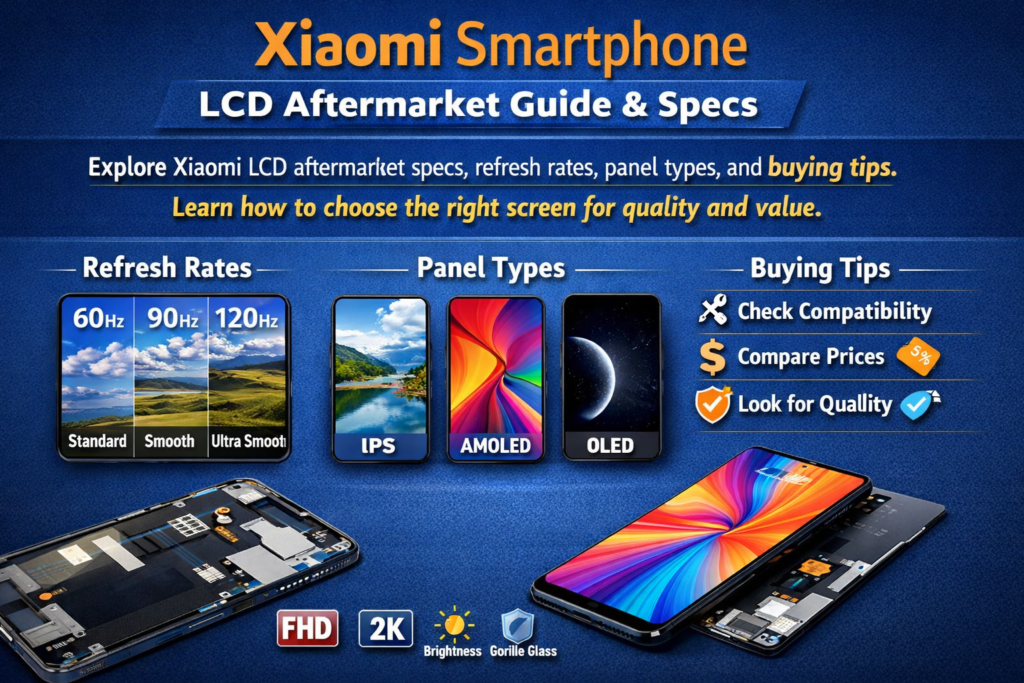
Einleitung – Wenn OLED zum Mainstream wird, LCD bedient immer noch Millionen
Der Wechsel von LCD zu AMOLED bei Xiaomi-Geräten
In den letzten Jahren, Die Smartphone-Display-Technologie hat sich rasant weiterentwickelt. Xiaomis Mittelklasse- und Flaggschiff-Geräte sind größtenteils auf AMOLED-Panels umgestiegen, Bietet tiefere Schwarztöne, höhere Kontrastverhältnisse, und schlankere Designs. Wenn Sie sich die neuesten Produkteinführungen ansehen, LCD scheint fast vergessen zu sein.
Aber hier ist die Wendung: Vergessen in neuen Geräten bedeutet nicht, dass es im wirklichen Leben vergessen wird.
Warum LCD-Bildschirme im Reparaturmarkt immer noch wichtig sind
Millionen von Xiaomi- und Redmi-Telefonen, die mit LCD-Displays ausgestattet sind, sind immer noch im täglichen Gebrauch. Geräte der Redmi-Note-Serie und der Redmi-Einstiegsnummernserie dienen weiterhin den Schülern, Arbeiter, und preisbewusste Benutzer weltweit.
Und wenn diese Bildschirme kaputt gehen? Das Aftermarket-LCD-Ökosystem tritt in Aktion.
Da wird es interessant.
Überblick über die LCD-Aftermarket-Landschaft von Xiaomi
Marktnachfrage wird durch ältere Redmi-Modelle angetrieben
Der Aftermarket existiert, weil die Nachfrage vorhanden ist. Beliebte Modelle wie ältere Redmi Note- und Xiaomi-Einstiegstelefone verfügen über eine riesige installierte Basis. Auch Jahre nach der Veröffentlichung, Die Reparaturnachfrage ist weiterhin stark.
Der Austausch eines Displays ist oft günstiger als der Kauf eines neuen Telefons. Für viele Benutzer, Das ist Grund genug.
Wichtige Lieferkettenquellen
Aftermarket-LCD-Bildschirme von Xiaomi stammen in der Regel aus drei Hauptquellen:
- Original gezogene Bildschirme
- Überholte gepresste Siebe
- Markenkompatible Montagebildschirme
Jede Stufe hat ihre eigene Preislogik, technisches Profil, und Risikoniveau.
Kategorien für Aftermarket-LCD-Bildschirme
Originalbildschirme (Gezogen / Fabriklecks)
Diese kommen den Werksspezifikationen am nächsten.
Sie könnten herkommen:
- Defekte Telefone zerlegt
- Fabriküberschuss
- Leckage am Fließband
Die Spezifikationen entsprechen dem Originaldesign:
- Gleiche Auflösung (HD+ oder FHD+)
- Gleiche Bildwiederholfrequenz (60Hz / 90Hz / 120Hz)
- Gleicher Touch-IC
- Gleiche Helligkeitsbewertung
Der Nachteil? Begrenzte Verfügbarkeit und hohe Preise.
Überholte gepresste Bildschirme
Dies sind die „Sweet Spots“ des Marktes.
So werden sie hergestellt:
- Das Original-LCD-Panel bleibt erhalten.
- Das zerbrochene Außenglas wird entfernt.
- Eine neue Glasschicht wird laminiert.
Das Display bleibt original, Also:
- Die Auflösung bleibt unverändert.
- Die Farbwiedergabe bleibt auf Werksniveau.
- Die Bildwiederholfrequenz bleibt erhalten.
Jedoch, Die Qualität der Laminierung variiert. Es kann zu leichten Dickenzuwächsen und geringfügigen Unterschieden bei der Haptik kommen.
Marken-Montagebildschirme (Kompatible Bildschirme)
Dies ist die Kategorie mit dem größten Volumen.
Diese Bildschirme werden mit zusammengebaut:
- LCD-Zellen von Drittanbietern
- Haushalts-Hintergrundbeleuchtungseinheiten
- Unabhängige Treiber-ICs
- Aftermarket-Flexkabel
Sie sind darauf ausgelegt, kompatibel zu sein – nicht identisch.
Hier beginnen sich die technischen Daten erheblich zu unterscheiden.
Grundlegende technische Spezifikationen erklärt
Lassen Sie uns die Parameter aufschlüsseln, die wirklich wichtig sind.
Panelmaterialien – a-Si vs. LTPS
Leistungsunterschiede
da ich (Amorphes Silizium):
- Niedrigere Kosten
- Höherer Stromverbrauch
- Begrenzte hochauflösende Unterstützung
LTPS (Polykristallines Niedertemperatursilizium):
- Höhere Elektronenmobilität
- Unterstützt FHD+-Auflösung
- Geeignet für 90 Hz oder 120 Hz
- Bessere Helligkeitsregelung
Für Xiaomi-Modelle der Mittelklasse mit High-Refresh-LCD-Panels, LTPS ist unerlässlich. Ohne es, Reibungsloses Scrollen wird zur Marketing-Fiktion.
Kosten- und Marktpositionierung
a-Si-Panels dominieren den Einstiegsersatz. LTPS-Panels zielen auf Mittelklassemodelle ab und erzielen höhere Preise.
Auflösungsstandards – HD+ vs. FHD+
Die Auflösung muss genau mit der Motherboard-Konfiguration übereinstimmen.
- HD+ (720P): Häufig bei Redmi-Einstiegsgeräten.
- FHD+ (1080P): Standard für die Redmi Note-Serie.
Verkäufer minderwertiger Qualität geben manchmal Panels mit niedriger Auflösung als höher auf. Sie können dies erkennen, indem Sie die Textschärfe überprüfen – unscharfe Kanten verraten eine geringere Pixeldichte.
Bildwiederholfrequenz – 60 Hz vs. 90 Hz vs. 120 Hz
Mittlerweile wird eine hohe Bildwiederholrate erwartet – selbst bei preisgünstigen Telefonen.
Für Aftermarket-Bildschirme:
- 60Hz-Panels sind am günstigsten.
- 90Hz-Panels erfordern einen kompatiblen Treiber-IC.
- 120Hz-Panels erfordern eine schnellere Reaktionszeit von Flüssigkristallen (≤25 ms typisch).
Billige 120-Hz-Angaben führen häufig zu Geisterbildern oder Bewegungsunschärfe.
Wenn sich das Scrollen wie das Ziehen eines schweren Vorhangs anfühlt, anstatt wie Seide, Du weißt, dass etwas nicht stimmt.
Berühren Sie IC und Abtastrate
LCD-Panels sind dicker als OLED, Dadurch wird die Touch-Integration komplexer.
Gemeinsame Lösungen:
- In-Cell-Touch
- TDDI (Touch- und Display-Treiberintegration)
Die Original-Touch-Abtastraten können 180 Hz oder 240 Hz erreichen. Nachrüstbildschirme der unteren Preisklasse können auf 120 Hz sinken, Auswirkungen auf die Reaktionsfähigkeit beim Spielen haben.
Für Gamer, dieser Unterschied ist spürbar.
Flexkabelschnittstellen und Versionskompatibilität
Das ist entscheidend.
Sogar innerhalb desselben Xiaomi-Modells, Verschiedene Chargen können Platten von unterschiedlichen Lieferanten verwenden. Die Definitionen für Flexkabel variieren.
Die Installation der falschen Version kann dazu führen:
- Anomalien anzeigen
- Flackern
- Kein Bild
- Sogar Motherboard-Schäden
Das Zuordnen der richtigen Version ist nicht optional, sondern obligatorisch.
Leistungsunterschiede zwischen Original- und Aftermarket-LCD-Bildschirmen
Helligkeit und Sichtbarkeit im Freien
Originale Xiaomi-LCD-Bildschirme können 450–600 Nits erreichen.
Aftermarket-Montagebildschirme liegen oft im Bereich von 350–450 Nits.
Unter Sonnenlicht, Dieser Unterschied ist wichtig.
Farbgenauigkeit und Kalibrierung
Originalbildschirme sind werkseitig kalibriert.
Aftermarket-Bildschirme werden häufig angezeigt:
- Leichter Blaustich
- Gelbliches Weiß
- Inkonsistente Graustufen
Die Farbkalibrierung kostet Geld. Haushaltsgremien überspringen es.
Dicke und Rahmenanpassung
Aftermarket-Bildschirme können aus diesem Grund 0,2–0,5 mm dicker sein:
- Glastoleranz
- Klebeschichten
Dies kann die Rahmenabdichtung und die Rahmensymmetrie beeinträchtigen.
Stromverbrauch und thermisches Verhalten
Die Treiber-IC-Optimierung ist unterschiedlich.
Aftermarket-Panels verbrauchen bei voller Helligkeit möglicherweise etwas mehr Strom. Im Laufe der Zeit, Dies wirkt sich auf die Akkulaufzeit aus.
Häufige Risiken im Aftermarket-LCD-Markt
Auflösungsbetrug
Panels mit niedriger Auflösung werden als FHD+ verkauft. Vor der Installation immer testen.
Probleme mit minderwertigen Touch-ICs
Zu den Symptomen gehören::
- Geisterberührungen
- Verzögerte Reaktion
- Zufällige Sprünge während des Spielens
Inkompatible Batch-Versionen
Gehen Sie niemals allein aufgrund des Modellnamens von einer Kompatibilität aus.
So lesen Sie ein Aftermarket-Spezifikationsblatt
LCD-Qualität (A / Panels der Güteklasse B)
- A-Klasse: Keine toten Pixel, keine Staubflecken.
- B-Klasse: Kleinere kosmetische Mängel.
Berühren Sie Lösungstyp
Fragen:
- Original-IC oder kompatibler IC?
- Abtastrate bestätigt?
Glas- und Laminiertechnik
- Vollständige Laminierung bevorzugt
- 2.5D Prüfung der Glaskrümmung
- Verfügbarkeit einer oleophoben Beschichtung
Garantiebedingungen
Typische Abdeckung:
- 3–6 Monate
- Anzeigemängel
- Berührungsfehler
Bestätigen Sie, was ausgeschlossen ist.
Praktischer Kaufratgeber für Werkstätten und Heimwerker
Wählen Sie zwischen Kosten und Qualität
Wenn das Telefon es wert ist $100, Installation eines $60 Premium-Bildschirm macht wenig Sinn. Passen Sie die Reparaturkosten an den Gerätewert an.
Identifizieren der High-Refresh-Unterstützung
Testen Sie in den Systemeinstellungen. Aktivieren Sie den 120-Hz-Modus und überprüfen Sie die Glätte.
Testen vor der endgültigen Installation
Stets:
- Bildschirm extern anschließen
- Helligkeit testen
- Überprüfen Sie die Berührungsecken
- Näherungssensor überprüfen
Versiegeln Sie niemals vor dem Testen.
Markttrends und Zukunftsaussichten
AMOLED-Dominanz in neuen Xiaomi-Modellen
Neue Xiaomi-Flaggschiffe verwenden zunehmend AMOLED-Panels. Die Präsenz von LCD in Neuerscheinungen nimmt ab.
Hortung und Reproduktion von LCD-Panels
Da die Produktion langsamer wird, Zulieferer horten alte LCD-Glasbestände. Einige Fabriken versuchen Reproduktionsläufe für stark nachgefragte ältere Modelle.
Langfristige Marktschrumpfung oder -stabilisierung?
Auf Dauer, Der LCD-Ersatzteilmarkt wird schrumpfen, da ältere Geräte aus dem Verkehr gezogen werden. Aber es wird nicht über Nacht verschwinden.
Es wird sich zu einer Nische entwickeln – kleiner, spezialisierter, und qualitätsorientierter.
Abschluss
Der LCD-Ersatzteilmarkt von Xiaomi ist kein verblassender Schatten der Vergangenheit – er ist ein lebendiges Ökosystem, das von der Nachfrage geprägt ist, Wirtschaft, und technische Anpassung.
Panel-Materialien verstehen, Bildwiederholraten, Touch-ICs, und Kompatibilität ist unerlässlich. Ohne dieses Wissen, Der Austausch eines Bildschirms wird zum Glücksspiel.
Aber mit den richtigen Informationen?
Es wird zu einer kalkulierten Entscheidung, die die Kosten ausgleicht, Qualität, und Langlebigkeit.
In einer Welt, die auf der Suche nach AMOLED-Perfektion ist, Das LCD verrichtet leise seine Arbeit. Und manchmal, Zuverlässigkeit ist wichtiger als Trend.
FAQs
1. Lohnt sich der Austausch eines Xiaomi-LCD-Bildschirms??
Wenn das Telefon immer noch einwandfrei funktioniert und die Ersatzkosten angemessen sind, Ja. Für Geräte mit geringem Wert, Bewerten Sie das Kostenverhältnis zwischen Reparatur und Gerät.
2. Kann ein Aftermarket-LCD 120 Hz ordnungsgemäß unterstützen??
Ja, aber nur, wenn geeignete LTPS-Panels und ein kompatibler Treiber-IC verwendet werden. Billigversionen täuschen es oft vor.
3. Warum sieht mein Ersatzbildschirm weniger hell aus??
Aftermarket-Hintergrundbeleuchtungsmodule haben im Vergleich zu Original-Werksbildschirmen typischerweise eine geringere Leuchtdichte.
4. Wie kann ich überprüfen, ob die Auflösung mit dem Original übereinstimmt??
Überprüfen Sie die Textschärfe und überprüfen Sie die Anzeigeinformationen mithilfe von Diagnose-Apps.
5. Sind generalüberholte Presssiebe zuverlässig??
Ja, wenn es von seriösen Fabriken verarbeitet wird. Da die LCD-Zelle original bleibt, Die Anzeigequalität liegt normalerweise nahe am Werksstandard.