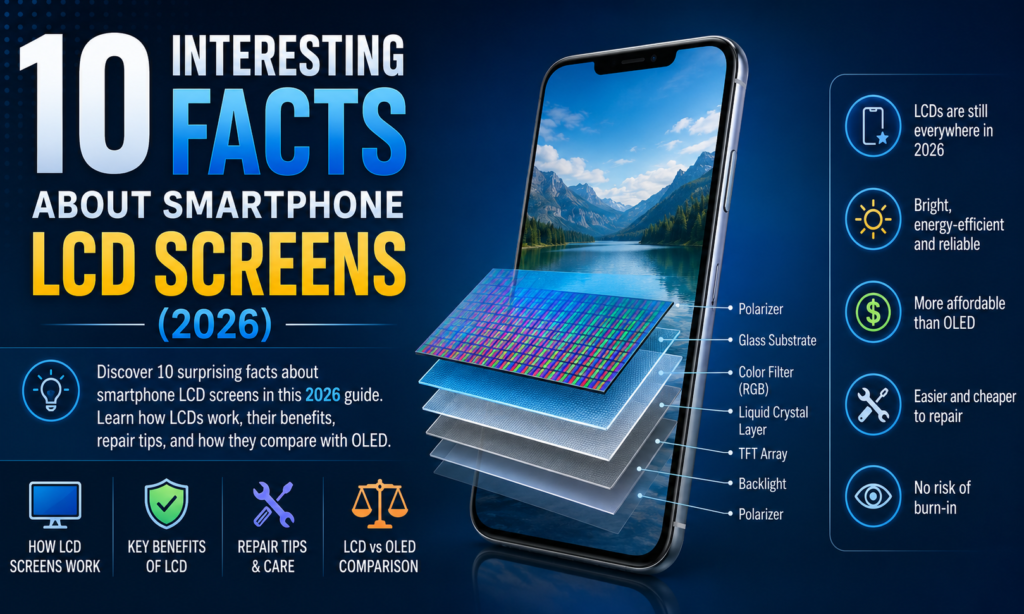
Waarom het begrijpen van LCD-schermen belangrijk is
Als mensen een smartphone kopen, ze letten meestal op de processor, camera, batterij, of opslagcapaciteit. Verrassend, een van de belangrijkste componenten, het beeldscherm, wordt vaak over het hoofd gezien. Toch is het scherm het onderdeel waarmee u elke dag communiceert. Of u nu e-mails leest, video's kijken, surfen op sociale media, of spelletjes spelen, uw beeldscherm bepaalt hoe plezierig en comfortabel uw ervaring zal zijn.
Hoewel OLED-schermen steeds populairder zijn geworden in vlaggenschip-smartphones, LCD-schermen blijven veel betaalbare en middenklasse apparaten domineren omdat ze betrouwbare prestaties leveren, lagere productiekosten, en uitstekende duurzaamheid. Industrieanalisten melden dat OLED de concurrentie heeft overtroffen 60% van smartphoneverzendingen, maar LCn-budgettelefoons en de wereldwijde reparatiemarkt.
Laten we het verkennen 10 fascinerende feiten over LCD-schermen van smartphones dat elke gebruiker zou moeten weten.
Feit #1 – LCD produceert zelf geen licht
Veel mensen denken dat de kleurrijke beelden op een LCD-scherm rechtstreeks uit de pixels zelf komen. Eigenlijk, dat is niet waar.
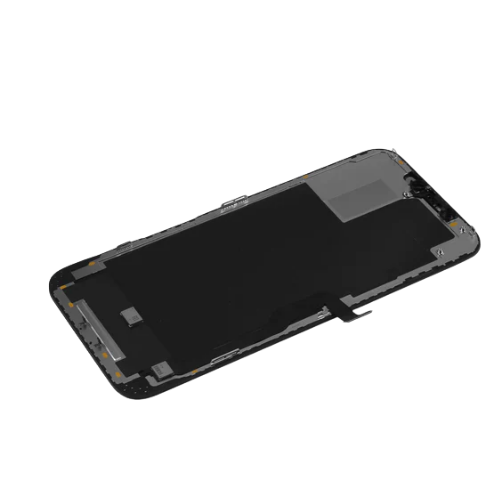
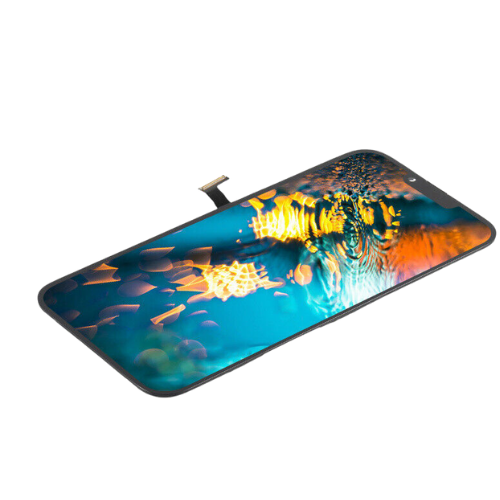
LCD staat voor Vloeibare kristalweergave. In tegenstelling tot OLED-technologie, LCD-pixels kunnen niet zelfstandig licht uitstralen. In plaats van, achter het scherm zit een krachtige LED-achtergrondverlichting die door miljoenen vloeibare kristalcellen schijnt. Deze kristallen draaien en roteren om te bepalen hoeveel licht door elke pixel gaat, het creëren van de afbeeldingen die u ziet.
Hoe de achtergrondverlichting werkt
Beschouw het LCD-scherm als een raam met verstelbare jaloezieën. De achtergrondverlichting fungeert als zonlicht buiten, terwijl de vloeibare kristallen functioneren als kleine jaloezieën die open en dicht gaan om de helderheid en kleur te regelen.
Omdat LCD altijd afhankelijk is van achtergrondverlichting, zwarte gebieden zijn nooit helemaal zwart. Dit is één van de redenen waarom OLED een diepe helderheid en lagere productiekosten levert.
Feit #2 – IPS LCD is veel beter dan traditioneel TFT LCD
Niet alle LCD-schermen zijn gelijk.
Oudere smartphones worden vaak gebruikt TFT-LCD panelen, die goedkoop waren, maar last hadden van smalle kijkhoeken en vervaagde kleuren. Moderne smartphones gebruiken dit doorgaans IPS-LCD (Schakelen in het vlak) technologie, wat de beeldkwaliteit dramatisch verbetert.
Kijkhoeken en kleurnauwkeurigheid
Met IPS LCD-panelen kunnen gebruikers het scherm vanuit vrijwel elke hoek bekijken zonder noemenswaardige kleurvervorming. Ze zorgen ook voor een nauwkeurigere kleurweergave, foto's maken, video's, en websites zien er veel natuurlijker uit.
Vandaag, IPS LCD is de standaard LCD-technologie geworden voor de betrouwbaarheid van smartphones, en betaalbaarheid zeer goed.
Feit #3 – Een hogere resolutie betekent niet altijd een betere weergave
Veel kopers gaan er automatisch van uit dat een hogere resolutie gelijk staat aan een beter scherm.
Terwijl Full HD+, 2K, en zelfs 4K-resoluties klinken indrukwekkend, pixeldichtheid (PPI) is vaak belangrijker dan de ruwe resolutie. Zodra een smartphone ongeveer bereikt 400–500 pixels per inch, individuele pixels worden tijdens normaal gebruik bijna onmogelijk te onderscheiden voor het menselijk oog.
In plaats van de hoogste resolutie na te streven, consumenten moeten ook evalueren:
| Functie | Waarom het ertoe doet |
|---|---|
| Helderheid | Beter zicht buitenshuis |
| Kleurnauwkeurigheid | Meer natuurlijke beelden |
| Contrast | Verbeterde kijkervaring |
| Vernieuwingsfrequentie | Soepeler scrollen |
| Aanraakreactie | Betere game-ervaring |
Een gebalanceerde weergave-ervaring dan alleen maar meer pixels. citeturn0search5turn0search2
Feit #4 – Helderheid is belangrijker dan veel mensen beseffen
Heeft u ooit moeite gehad om uw telefoon te lezen in fel zonlicht??
Het probleem is vaak niet de oplossing, maar die helderheid van het scherm.
Neten begrijpen
Helderheid wordt gemeten in neten.
Algemeen:
- 400–500 nits = acceptabel binnenshuis
- 500–700 nits = goed zicht naar buiten
- 800+ neten = uitstekende zonlichtprestaties
Moderne IPS LCD-schermen kunnen een indrukwekkende aanhoudende helderheid bereiken, waardoor ze bijzonder praktisch zijn voor buitenwerkers, bezorger gebruikt zijn telefoon regelmatig in direct zonlicht.
Feit #5 – LCD-schermen ondervinden geen permanente inbranding
Een van de grootste voordelen van LCD is de weerstand tegen scherm inbranden.
Inbranden treedt op wanneer statische beelden zichtbaar blijven nadat ze gedurende lange tijd zijn weergegeven. Omdat LCD-pixels afhankelijk zijn van een gedeelde achtergrondverlichting in plaats van zelfuitstralend licht, permanente inbranding is uiterst zeldzaam.
Dit maakt LCD-schermen een uitstekende keuze voor gebruikers die vaak beeldschermen gebruiken:
- GPS-navigatie
- Statische dashboards
- Zakelijke toepassingen
- Beveiligingsmonitoring
- Point-of-sale-systemen
OLED-schermen bieden onder bepaalde omstandigheden een rijkere beeldretentie.
Feit #6 – Een gebroken glas betekent niet altijd dat het LCD-scherm kapot is
Veel smartphonebezitters raken in paniek nadat ze hun telefoon hebben laten vallen.
Gelukkig, het voorglas, touch-digitizer, en LCD-paneel zijn verschillende componenten.
Glas versus LCD versus aanraakpaneel
Mogelijk is een beschadigde telefoon beschadigd:
| Onderdeel | Symptomen |
|---|---|
| Voorglas | Alleen scheuren |
| Touch-digitizer | Aanraking werkt niet meer |
| LCD-paneel | Zwarte vlekken, gekleurde lijnen, geen weergave |
Als alleen het glas gebarsten is terwijl het scherm en de aanraking normaal blijven, reparaties kunnen aanzienlijk minder kosten dan het vervangen van het volledige beeldscherm.
Professionele technici stellen altijd vast welke laag defect is voordat ze reparaties aanbevelen.
Feit #7 – Goedkope vervangende LCD-schermen kunnen sterk verschillen in kwaliteit
Niet elk vervangend scherm biedt dezelfde prestaties.
Goedkope aftermarket-displays kunnen hier last van hebben:
- Lagere helderheid
- Slechte kleurkalibratie
- Langzamere aanrakingsreactie
- Hoger stroomverbruik
- Kortere levensduur
Vervangingsschermen van premium aftermarket- of OEM-kwaliteit bieden over het algemeen een betere duurzaamheid en een gebruikerservaring die veel dichter bij het originele scherm ligt. Reparatieprofessionals adviseren consequent om zich uitsluitend op de prijs te concentreren.
Feit #8 – Waterschade zal een LCD mogelijk niet onmiddellijk doden
Veel gebruikers denken dat als een telefoon nog steeds werkt nadat hij nat is geworden, alles is in orde.
Eigenlijk, vocht kan de beeldschermconnectoren langzaam aantasten, geïntegreerde schakelingen, en achtergrondverlichtingscomponenten gedurende dagen of zelfs weken.
Veelvoorkomende waarschuwingssignalen zijn onder meer:
- Flikkerend scherm
- Willekeurige zwarte vlekken
- Verticale lijnen
- Ongelijkmatige helderheid
- Aanraakfout
Onmiddellijk drogen en professionele inspectie vergroten de kans op het voorkomen van blijvende schade aanzienlijk.
Feit #9 – Screenprotectors voorkomen vooral krassen
Een beschermer van gehard glas is uiterst nuttig, maar heeft beperkingen.
Het beschermt tegen:
- Sleutels
- Munten
- Zanddeeltjes
- Dagelijkse krassen
Echter, Het kan geen bescherming tegen sterke schokken garanderen. Een zware val kan het interne LCD-paneel nog steeds doen barsten, zelfs als de schermbeschermer intact blijft.
De beste bescherming combineert:
- Gehard glas
- Schokbestendig telefoonhoesje
- Zorgvuldige omgang
Feit #10 – Goede dagelijkse gewoonten kunnen de levensduur van LCD-schermen verlengen
LCD-schermen zijn verrassend duurzaam als ze goed worden onderhouden.
Eenvoudige gewoonten omvatten:
- Stel de telefoon niet bloot aan extreme hitte.
- Houd de oplaadpoort droog.
- Maak het display schoon met een microvezeldoekje.
- Vermijd aan de telefoon te zitten.
- Gebruik kwaliteitsladers om elektrische instabiliteit te voorkomen.
- Bewaar het apparaat in een beschermhoes.
Deze kleine gewoontes kunnen accidentele schade aanzienlijk verminderen en de levensduur van het scherm van uw smartphone verlengen.
LCD vs OLED: Snelle vergelijking
| Functie | IPS-LCD | OLED |
|---|---|---|
| Lichtbron | LED-achtergrondverlichting | Zelf uitstralende pixels |
| Zwart niveau | Goed | Uitstekend |
| Buitenhelderheid | Uitstekend | Uitstekend |
| Risico op inbranden | Geen | Mogelijk |
| Reparatiekosten | Lager | Hoger |
| Productiekosten | Lager | Hoger |
| Batterij-efficiëntie | Stabiel | Afhankelijk van de inhoud |
| Dikte | Dikker | Dunner |
Terwijl OLED premium smartphones domineert, IPS LCD blijft een uitstekende, betrouwbare dagelijkse prestatie. citeturn0search0turn0search1turn0search3
Conclusie
De LCD-technologie van smartphones is de afgelopen twintig jaar dramatisch geëvolueerd. De huidige IPS LCD-schermen bieden levendige kleuren, brede kijkhoeken, uitstekende helderheid, en betrouwbare prestaties die miljoenen gebruikers wereldwijd tevreden stellen. Hoewel OLED zich blijft uitbreiden naar vlaggenschipapparaten, LCD blijft een essentiële technologie voor budget-smartphones, educatieve apparaten, zakelijke apparatuur, en de mondiale reparatie-industrie.
Door deze tien feiten te begrijpen, kunnen consumenten slimmere aankoopbeslissingen nemen, kies vervangende schermen van hogere kwaliteit, en hun apparaten beter beschermen. Of je nu een nieuwe telefoon koopt of een oude repareert, Als u weet hoe LCD-technologie werkt, kunt u de prestaties in evenwicht brengen, duurzaamheid, en kosten met vertrouwen.
Veelgestelde vragen
1. Is IPS LCD beter dan TFT LCD?
Ja. IPS LCD-scherm biedt bredere kijkhoeken, betere kleurnauwkeurigheid, en verbeterde beeldkwaliteit vergeleken met traditionele TFT LCD.
2. Kunnen LCD-schermen inbranden??
Permanent inbranden is uiterst ongebruikelijk op LCD-schermen, omdat ze een afzonderlijke achtergrondverlichting gebruiken in plaats van zelfuitstralende pixels.
3. Waarom zijn LCD-vervangingsschermen goedkoper dan OLED??
LCD-productie is volwassener en goedkoper, waardoor reparaties aanzienlijk betaalbaarder worden.
4. Kan een gebarsten scherm nog steeds een werkend LCD-scherm hebben??
Ja. Soms breekt alleen het voorglas terwijl de LCD- en touchfuncties volledig operationeel blijven.
5. Hoe kan ik ervoor zorgen dat mijn LCD-scherm langer meegaat??
Gebruik een kwaliteitstelefoonhoesje, installeer gehard glasbescherming, vermijd blootstelling aan water en extreme temperaturen, en maak het display regelmatig schoon met een microvezeldoekje.