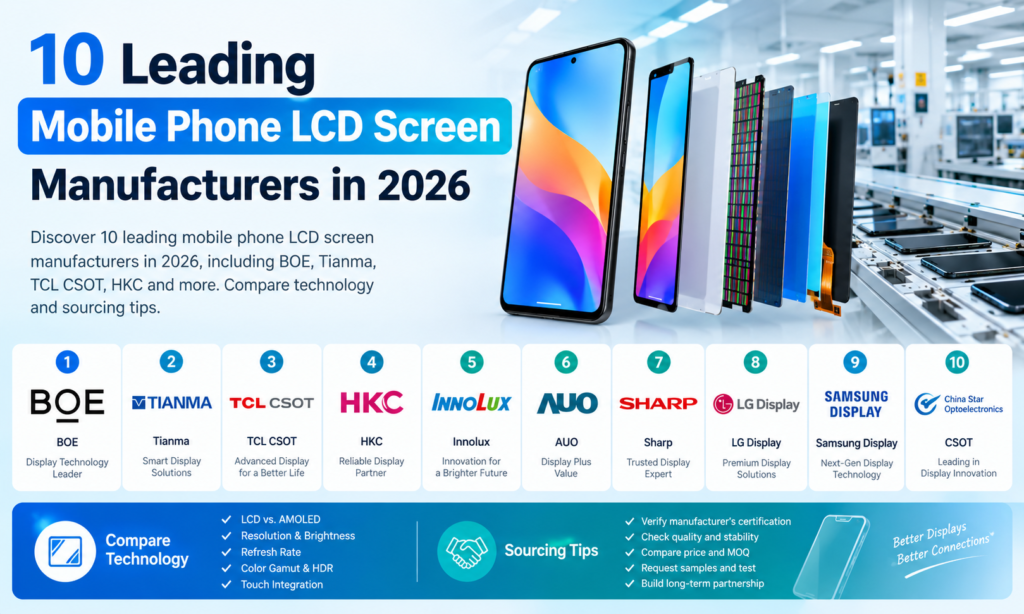
The mobile phone display industry is no longer simply a race to produce brighter and sharper screens. In 2026, fabrikanten van smartphones, repair distributors, wholesalers and aftermarket screen suppliers are dealing with a much more complicated display market, waar a-Si LCD-scherm, LTPS-LCD, AMOLED, flexible OLED and advanced backplane technologies all compete for different segments. At the premium end, OLED continues to dominate flagship smartphones, while LCD remains highly relevant for entry-level devices, older smartphone models, replacement screens and price-sensitive markets. TrendForce estimates that 2026 smartphone LCD panel shipments, including a-Si LCD and LTPS LCD, will total around 1.33 miljard eenheden, representing approximately 59% of global smartphone panel shipments.
That makes choosing the right mobile phone LCD screen manufacturer particularly important for wholesalers and repair businesses. A manufacturer may have enormous production capacity but not necessarily offer the specific panel technology, model dekking, quality consistency or customization capability you need. Insgelijks, a company known primarily for OLED may still be an important part of the broader smartphone display supply chain but may not be the best choice if your business specifically requires inexpensive LCD replacement panels.
This guide examines 10 major mobile phone display manufacturers with significant relevance to LCD, OLED or smartphone display production. The list is not presented as a rigid ranking because manufacturers specialize in different technologies and market segments. In plaats van, it is designed as a practical reference for buyers who want to understand the companies behind the panels and make better sourcing decisions.
How the Mobile Phone Display Market Is Changing
The smartphone display market has changed dramatically over the past decade. Older smartphones relied heavily on conventional a-Si TFT-LCD panels, while LTPS LCD became popular for devices requiring higher pixel density, thinner designs and improved performance. AMOLED then expanded rapidly into mid-range and flagship smartphones because of its excellent contrast, thin structure and ability to support flexible designs.
The interesting part is that LCD has not simply disappeared. It has moved into a different role. Instead of being the obvious technology for every smartphone, LCD is increasingly concentrated in entry-level smartphones, selected mid-range models, industriële apparaten, replacement markets and cost-sensitive applications. TrendForce reported that LCD remained stable in entry-level smartphones and replacement markets during 2025, even as AMOLED demand continued to grow.
Tegelijkertijd, China’s display manufacturers have become increasingly important. In 2024, global smartphone panel shipments reached about 2.157 miljard eenheden, according to TrendForce, with BOE shipping approximately 613 million panels. TrendForce also expected BOE to remain the leading supplier in 2025.
The market therefore looks less like a single road and more like a highway with several lanes. Samsung Display is exceptionally strong in AMOLED, BOE competes across LCD and OLED, TCL CSOT has expanded its smartphone LCD presence, Tianma maintains a broad portfolio, and other manufacturers occupy important regional or technology niches.
LCD Still Matters in the Smartphone and Repair Markets
If you only look at flagship smartphones, you might assume LCD has almost disappeared. That would be misleading. The installed base of older smartphones is enormous, and every damaged smartphone creates potential demand for a replacement display.
This is particularly important for LCD screen wholesalers and aftermarket distributors. A phone model launched several years ago may continue to be repaired for many more years, especially in emerging markets where consumers often keep devices longer. Repair shops therefore need reliable replacement panels even when the original smartphone manufacturer’s newest products have moved entirely toward OLED.
LCD also remains attractive when the purchasing priority is cost. A good LCD module can provide acceptable brightness, kleurweergave, touch performance and durability at a substantially different price point from premium OLED alternatives. Voor groothandelaars, this creates opportunities in Africa, Latijns-Amerika, het Midden-Oosten, South Asia and other price-sensitive markets.
LCD versus. AMOLED: What Buyers Should Know
LCD and AMOLED are not simply different versions of the same product. They use fundamentally different display architectures. An LCD normally requires a backlight, while AMOLED pixels generate their own light. This gives AMOLED advantages in black levels, contrast and thinness, while LCD can remain attractive for cost, availability and certain durability or replacement applications.
| Functie | LCD | AMOLED |
|---|---|---|
| Achtergrondverlichting | Vereist | Not required |
| Black level | Depends on backlight system | Pixel-level black |
| Typical cost | Vaak lager | Often higher |
| Burn-in risk | Generally not a characteristic concern | Possible depending on panel and usage |
| Flexibiliteit | More limited | Excellent for flexible designs |
| Replacement market | Very strong | Growing rapidly |
| Entry-level smartphone use | Sterk | Increasing |
| Flagship smartphone use | Beperkt | Dominant |
Voor kopers, the important lesson is simple: do not choose a manufacturer only because it produces a technologically advanced display. Choose according to your target phone models, doelmarkt, required quality level and expected purchasing volume.
Hoe we de top hebben geselecteerd 10 Fabrikanten
The manufacturers in this article were selected based on a combination of smartphone display production, LCD capability, OLED capability, manufacturing scale, technology development, international market presence and relevance to mobile-device displays. The list includes both Chinese and international manufacturers because the global display supply chain is highly interconnected.
Current industry data supports the importance of several companies on this list. In Q2 2026, TrendForce reported that BOE shipped approximately 146 million smartphone panels for a 26.1% marktaandeel, while Samsung Display shipped around 90 miljoen, TCL CSOT approximately 84 miljoen, HKC around 13% share and Tianma approximately 12.4%.
These figures also demonstrate why “LCD manufacturer” En “smartphone display manufacturer” should not be treated as identical terms. Some companies have significant LCD production but are expanding into OLED, while others are now much more heavily weighted toward OLED.
Production Scale, Technology and Market Reach
When evaluating a manufacturer, buyers should look beyond the company name. A large manufacturer may have excellent panel technology but may not sell finished replacement assemblies directly to small wholesalers. Another manufacturer may provide the panel itself, while a separate module company handles the touch layer, kader, IC, flex cable and final assembly.
Om deze reden, the manufacturer’s position in the supply chain matters just as much as its reputation.
1. BOE-technologie
BOE Technology is arguably the most important name to understand when discussing the modern Chinese smartphone display industry. The company has developed extensive capabilities across a-Si LCD-scherm, LTPS-LCD, AMOLED and other advanced display technologies. BOE states that its display business operates numerous panel production lines across multiple Chinese locations and that its products cover smartphones, tabletten, laptops, auto-displays, VR/AR and other applications.
BOE’s scale is particularly impressive. TrendForce reported that BOE shipped approximately 613 million smartphone panels in 2024, maintaining the leading position among smartphone panel suppliers. In Q2 2026, it again ranked first with approximately 146 million smartphone panels shipped and a 26.1% deel.
One reason BOE is particularly interesting for wholesale buyers is its broad technology portfolio. It is not dependent on only one display category. The company has experience with conventional LCD, higher-performance LTPS LCD and OLED technologies, allowing it to serve different smartphone generations.
For buyers sourcing replacement screens, BOE-related panels can be attractive where original or high-grade replacement specifications are required. Echter, it is important to distinguish between an original panel manufactured by BOE and an aftermarket module assembled by a third-party supplier using a BOE panel. Those products are not automatically equivalent.
2. Samsung-scherm
Samsung Display is one of the world’s most influential display manufacturers, although its current smartphone business is heavily associated with AMOLED rather than conventional LCD. This distinction matters when creating a list of mobile phone screen manufacturers. Samsung Display remains essential to the smartphone display ecosystem, but buyers specifically searching for low-cost LCD replacement panels should not assume that Samsung Display is the same type of supplier as an LCD-focused Chinese panel manufacturer.
Samsung Display has maintained a powerful position in smartphone OLED. TechInsights reported that Samsung Display held the leading position in smartphone display panel revenue share in Q4 2025, met meer dan 52% deel. UBI Research also reported that Samsung maintained a 44.4% share of smartphone AMOLED shipments in Q1 2026.
For the aftermarket, Samsung’s importance comes partly from the huge installed base of Galaxy smartphones. Older Galaxy models continue to generate replacement-screen demand, creating a large ecosystem of original, gerenoveerd, pulled and aftermarket modules.
If your business is focused specifically on Samsung LCD replacement screens, Echter, carefully verify the actual panel source and screen technology before purchasing. A distributor may use “Samsung quality” as a marketing phrase without meaning the screen was manufactured by Samsung Display.
3. TCL CSOT
TCL CSOT, the display panel business associated with TCL, has become an increasingly important player in the global smartphone panel industry. Its strengths include both LCD and OLED technologies, with LCD particularly important in cost-sensitive smartphone segments and replacement applications.
The company’s growth has become especially visible in recent shipment data. TrendForce reported that TCL CSOT shipped approximately 84 million smartphone panels in Q2 2026, representing more than 15% of the global market. The company benefited significantly from increased LCD smartphone panel shipments from its T9 production line.
This is significant for wholesale buyers because it demonstrates that modern LCD demand has not disappeared. In plaats van, large manufacturers are optimizing production for the segments where LCD remains commercially attractive.
CSOT is therefore worth watching if you source Android smartphone LCD panels, especially for high-volume models where price competitiveness and manufacturing scale are important.
Another advantage is TCL CSOT’s broad display ecosystem. The company is not limited to one screen size or one smartphone brand. Its technology portfolio extends across smartphones, tabletten, monitoren, televisions and automotive displays, giving it substantial experience with different panel architectures.
4. Tianma Micro-elektronica
Tianma is one of the strongest names in the Chinese display industry and deserves particular attention from anyone sourcing mobile phone LCD screens. The company has a broad portfolio covering a-Si TFT-LCD, LTPS TFT-LCD and AMOLED, among other technologies.
Tianma’s official smartphone portfolio specifically lists LTPS TFT-LCD and AMOLED products, with features such as high brightness, narrow bezels, low power consumption and wide color gamut.
Its recent market performance also demonstrates why it remains relevant. TrendForce reported that Tianma shipped approximately 69 million smartphone panels in Q2 2026, giving it about 12.4% marktaandeel. The company also benefited from increased a-Si LCD shipments.
Tianma’s technology development is not limited to smartphone OLED. In 2026, the company continued showcasing LCD innovations while also developing advanced AMOLED products. It even received the SID Display Week 2026 People’s Choice Award for a Best LCD-Based Technology entry.
Voor kopers, Tianma is particularly interesting because it combines high-volume manufacturing with long-term display engineering experience. If you are sourcing LCD modules for specific phone models, verifying panel origin, exact resolution, touch technology and module construction remains essential.
5. HKC
HKC has become another significant Chinese display panel manufacturer, particularly in LCD. Its presence is important because the company demonstrates how China’s display industry has developed substantial production capacity beyond the largest traditional names.
According to TrendForce’s Q2 2026 smartphone panel analysis, HKC ranked fourth with approximately 13% marktaandeel, with a-Si LCD accounting for the majority of its smartphone panel shipments.
This makes HKC especially relevant to buyers who prioritize LCD availability and cost efficiency. The company is also active across larger display categories, meaning its production expertise extends beyond smartphone panels.
For an aftermarket buyer, the key consideration is not simply whether HKC is a major panel manufacturer. You should determine whether your supplier is offering an actual HKC panel, a compatible panel from another manufacturer or a completed aftermarket module assembled using mixed components.
That distinction can significantly affect brightness, aanraakreactie, color consistency and reliability.
6. LG-scherm
LG Display is another global display giant with extensive experience in LCD and OLED technologies. Echter, like Samsung Display, its position in the smartphone market today is much more strongly associated with OLED than conventional smartphone LCD.
TechInsights ranked LG Display among the leading smartphone display panel suppliers in 2025, following Samsung Display and BOE in several quarterly analyses.
LG Display’s inclusion in this list is therefore more appropriate from the perspective of global mobile display manufacturing rather than as a recommendation for low-cost LCD replacement sourcing.
Voor kopers, this distinction prevents a common mistake: assuming that every famous smartphone display manufacturer is equally accessible to aftermarket wholesalers. Large panel manufacturers generally sell to major device manufacturers and system integrators rather than small repair businesses.
Vervolgens, a wholesaler looking for replacement screens may need to work through specialized distributors or module assemblers rather than contacting the panel manufacturer directly.
7. Visiox
Visionox is a major Chinese display manufacturer particularly recognized for AMOLED-technologie. The company’s position is increasingly important as smartphone manufacturers transition from traditional LCD toward OLED.
Visionox operates flexible AMOLED production facilities in several Chinese locations, including Gu’an and Hefei, and continues investing in OLED and Micro-LED technologies.
Although Visionox is not the first company most buyers would associate with conventional LCD, it belongs on a modern list of leading mobile display manufacturers because the definition of a smartphone “screen manufacturer” has evolved.
UBI Research reported that Visionox accounted for 10.7% of global smartphone OLED shipments in Q1 2026, op van 9.3% in Q1 2025.
Voor groothandelaars, Visionox is particularly relevant when the product portfolio includes OLED-vervangingsschermen in addition to LCD. A supplier capable of offering multiple panel technologies can sometimes simplify procurement, especially when a buyer carries replacement parts for dozens or hundreds of smartphone models.
8. Innolux
Innolux, based in Taiwan, is another established flat-panel manufacturer with long-standing experience in TFT-LCD technology. The company is particularly relevant to buyers looking at the broader Asian display manufacturing ecosystem.
Innolux has historically supplied display products across many applications, inclusief mobiele apparaten, monitoren, automotive systems and consumer electronics. Its strength is closely associated with advanced LCD manufacturing and large-scale display production.
For mobile-phone screen buyers, Innolux can be relevant when sourcing TFT-LCD panels and specialized display components. Echter, as with other major panel makers, the availability of a specific smartphone panel depends heavily on the model, production generation and supply-chain channel.
One advantage of a manufacturer such as Innolux is its long experience with panel engineering. Buyers looking for stable manufacturing quality should pay attention not only to the brand printed on the panel but also to the panel’s production process, bestuurder IC, touch architecture and module assembly.
9. AUO
AUO, or AUO Corporation, is another major Taiwanese display manufacturer with extensive TFT-LCD experience. The company has developed mobile-device display solutions using a-Si TFT-LCD, LTPS and other display technologies.
AUO’s own mobile-device materials describe LCD applications focused on narrow bezels, breed kleurengamma, high refresh rates and refined display quality. Its historical smartphone portfolio also included high-resolution LTPS LCD panels and in-cell touch designs.
One interesting point for buyers is that AUO explicitly states that it is a TFT-LCD panel manufacturer and does not directly provide replacement services to individual end users. In plaats van, end users are directed to distributors or service channels.
This illustrates a broader sourcing principle: the original panel manufacturer and the company selling a replacement screen are often completely different businesses.
If you are a wholesaler, AUO can be relevant as an upstream technology and panel source, while your actual purchasing relationship may be with a module manufacturer, distributor or specialized screen supplier.
10. OF (EverDisplay-optronica)
EverDisplay-optronica, commonly known as OF, is a Chinese display manufacturer best known for AMOLED and mobile-display technologies. It is another example of how the smartphone screen market is moving beyond traditional LCD.
EDO has developed mobile display technologies for smartphones and other consumer electronics and is part of the broader Chinese effort to increase domestic display manufacturing capabilities.
While buyers looking specifically for basic a-Si LCD panels may have more direct reasons to consider BOE, TCL CSOT, Tianma or HKC, EDO becomes more interesting when the purchasing requirement includes AMOLED smartphone displays.
A modern mobile-phone screen sourcing strategy should therefore avoid treating LCD and OLED as completely separate industries. Many major manufacturers now operate across several technologies, and smartphone brands frequently shift models from LCD to OLED as product positioning changes.
How to Choose a Mobile Phone LCD Screen Manufacturer
Selecting a manufacturer is only the first step. For a wholesaler, the more important question is whether the actual screen module meets the requirements of your customers.
A good supplier should be able to provide clear information about the panel source, weergavetechnologie, oplossing, helderheid, touch structure, aansluiting, driver IC and module configuration. If the supplier cannot answer basic technical questions, a low price may not be a bargain.
Kwaliteit, Verenigbaarheid, MOQ and QC
Voordat u een grote bestelling plaatst, compare suppliers using a consistent checklist:
| Buying Factor | What to Check | Waarom het ertoe doet |
|---|---|---|
| Panel origin | BOE, Tianma, CSOT, HKC, enz. | Helps establish consistency |
| Technologie | a-Si LCD-scherm, LTPS-LCD, OLED | Determines performance and price |
| Oplossing | Exact model specification | Prevents compatibility issues |
| Aanraken | In de cel, on-cell or separate touch | Affects touch response and thickness |
| Helderheid | Measured specification | Important for outdoor usability |
| Kleur | NTSC/DCI-P3 or supplier specification | Helps control quality |
| Connector | Exact FPC/connector design | Critical for compatibility |
| Kader | With frame or without frame | Changes installation time |
| QC | Dode pixels, aanraken, helderheid, kleur | Vermindert het rendement |
| Garantie | Duidelijke garantievoorwaarden | Protects wholesale buyers |
| Moq | Per model and mixed-order MOQ | Affects inventory risk |
| Verpakking | Individual protection and carton packing | Reduces shipping damage |
One of the biggest mistakes made by new buyers is comparing only unit price. Imagine two suppliers offering the same Redmi LCD at $10 En $11. The cheaper supplier sounds better, rechts? But if the $10 screen has a higher defect rate, inconsistent touch performance and a 3% retour tarief, the supposedly cheaper supplier can actually cost more.
This is why professional buyers should calculate total cost of ownership, including defective units, return shipping, labor, testen, warranty replacement and inventory losses.
Another important issue is the difference between alleen scherm, LCD assembly, LCD with touch, and complete screen assembly with frame. These products can look similar in an online catalog while having very different prices and installation requirements.
A professional purchasing process should therefore begin with samples. Helderheid testen, kleur, kijkhoek, aanraaknauwkeurigheid, fingerprint compatibility where applicable, proximity sensor performance, display uniformity and power consumption before committing to a large quantity.
The same principle applies to quality grades. Terms such as Origineel, OEM, Origineel getrokken, Gerenoveerd, Servicepakket, AAA, A+ and AAAAA are not universally standardized. One supplier’s “AAA” may be completely different from another supplier’s “AAA.”
Om deze reden, a buyer should establish a written specification and approve a physical sample before mass production.
Why Chinese Manufacturers Are Increasingly Important
China has become a central part of the global smartphone display supply chain. This is not simply because Chinese manufacturers can offer lower prices. Bedrijven als BOE, TCL CSOT and Tianma have invested heavily in manufacturing capacity, process engineering and advanced display technologies.
TrendForce’s 2026 data illustrates the scale of this transformation. BOE remained the world’s leading smartphone panel supplier in Q2 2026, while TCL CSOT narrowed the gap with Samsung Display and HKC and Tianma also maintained substantial market shares.
The Chinese display ecosystem also benefits from a large domestic smartphone market. Large device manufacturers create demand for massive quantities of panels, which helps panel manufacturers optimize production, supply chains and costs.
For international wholesalers, this creates another advantage: China has developed an extensive ecosystem of panel manufacturers, module factories, driver-IC suppliers, touch-panel suppliers, frame manufacturers, flex suppliers, packaging companies and logistics providers.
That ecosystem makes Shenzhen and other Chinese electronics hubs particularly important for aftermarket screen sourcing.
Echter, buyers should remember that the factory producing the original panel is not necessarily the factory producing the aftermarket replacement module. In veel gevallen, the aftermarket supply chain contains several additional manufacturing steps.
What Is the Best Manufacturer for Your Business?
There is no single manufacturer that is best for every buyer.
If your priority is large-scale global smartphone panel supply, BOE is one of the most important companies to investigate. If your focus is premium OLED, Samsung Display and LG Display remain extremely influential. If you need strong LCD exposure, TCL CSOT, Tianma and HKC deserve close attention.
If you need a combination of LCD and OLED products, Tianma and BOE can be particularly interesting because of their broad technology portfolios. If you are sourcing from Taiwan, Innolux and AUO remain important names to understand.
For aftermarket buyers, hoewel, the answer is slightly different. You may not purchase directly from any of these panel giants. In plaats van, you may purchase from a professional mobile LCD module supplier that sources panels from multiple manufacturers and converts them into finished replacement assemblies.
That is not necessarily a disadvantage. In werkelijkheid, a specialist module supplier can offer a broader range of models, lower MOQs, mixed orders, aangepaste verpakking, faster delivery and after-sales support.
The key is transparency. Ask where the panel comes from, what quality grade it is, what components are used and how the supplier performs quality control.
Conclusie
The global mobile phone display industry is entering an interesting stage in 2026. AMOLED is becoming increasingly dominant in premium smartphones, but LCD remains commercially important because of entry-level devices, older phones, repair demand and cost-sensitive markets. TrendForce estimates that LCD smartphone panel shipments will still account for roughly 59% of total smartphone panel shipments in 2026, demonstrating that LCD remains far from irrelevant.
De 10 manufacturers discussed in this guide—BOE, Samsung-scherm, TCL CSOT, Tianma, HKC, LG-scherm, Visiox, Innolux, AUO and EDO—represent different parts of this changing display ecosystem. Some are strongest in LCD, some in OLED, and several are active across both technologies.
Voor groothandels en reparatiebedrijven, the most important lesson is not simply to find the biggest manufacturer. In plaats van, identify the manufacturer and supply-chain partner that can consistently provide the right model, right panel technology, right quality grade, competitive cost and reliable QC.
When purchasing mobile phone LCD screens in bulk, always test samples before large orders, verify the actual panel origin, compare complete module specifications and calculate total purchasing cost rather than looking only at the advertised unit price. A reliable supplier should be able to answer technical questions clearly and provide consistent products over repeated orders.
The display market may be moving rapidly toward OLED, but for the millions of smartphones already in consumers’ hands—and for buyers looking for affordable replacement parts—LCD remains a major and valuable part of the global mobile phone screen market.
FAQ's
1. Who is the largest mobile phone display manufacturer?
BOE is currently one of the largest smartphone panel manufacturers globally. TrendForce reported that BOE shipped approximately 146 million smartphone panels in Q2 2026, giving it a 26.1% market share and the leading position for that quarter.
2. Is BOE a good manufacturer for mobile phone LCD screens?
BOE is a major display manufacturer with extensive experience in a-Si LCD, LTPS LCD and OLED technologies. It has a very large manufacturing footprint and supplies displays for smartphones and many other applications. Echter, buyers should still verify the exact panel model, specification and source when purchasing aftermarket screens.
3. Is LCD still used in smartphones in 2026?
Ja. Although AMOLED adoption continues to increase, LCD remains widely used in entry-level smartphones and replacement markets. TrendForce expects approximately 1.33 billion LCD smartphone panels to ship in 2026.
4. What is the difference between an original LCD and an aftermarket LCD?
An original LCD generally refers to a panel or assembly produced for the original device supply chain, while an aftermarket LCD may be manufactured or assembled specifically for the replacement market. Aftermarket products can vary considerably in panel quality, aanrakingsprestaties, helderheid, color and durability, so buyers should test samples before placing large orders.
5. How can I find a reliable mobile phone LCD screen supplier?
Start by defining the exact phone models, quality grades and assembly requirements you need. Request samples, confirm panel origin, test brightness and touch performance, inspect for dead pixels and display uniformity, clarify warranty terms and compare the supplier’s actual defect rate rather than choosing purely on price. Voor groothandelsaankopen, a supplier that can provide constante kwaliteit, mixed-model ordering, reliable QC and stable inventory is often more valuable than the supplier offering the lowest initial quotation.