
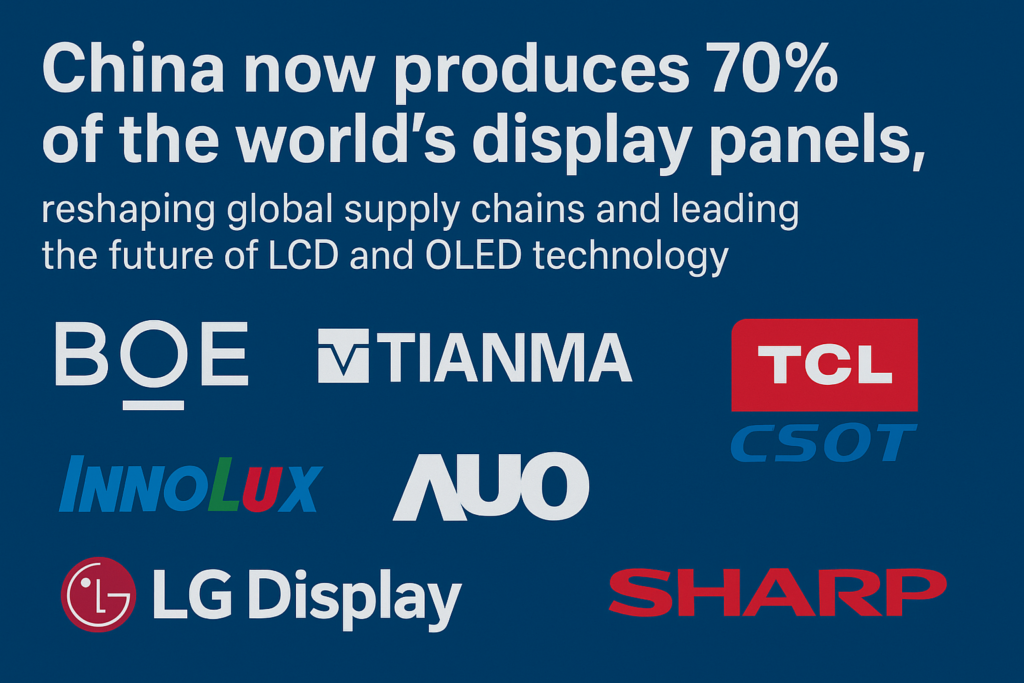
De hervorming van de mondiale display-industrie
In 2025, het mondiale displaylandschap is officieel opnieuw getekend. Voor het eerst in de geschiedenis, China houdt 70% van de wereldwijde productie van displaypanelen, volgens het laatste rapport van Omdia. Dit betekent dat zeven op de tien displaypanelen die wereldwijd worden gebruikt, zijn afkomstig uit Chinese fabrieken – een monumentale verschuiving die de positie van China als mondiale display-krachtcentrale versterkt.
Wat betekent ‘70% marktaandeel’ voor mondiale toeleveringsketens??
Deze dominantie gaat niet alleen over cijfers – het vertegenwoordigt een enorme herschikking in de mondiale productie- en technologische invloed. Van smartphones tot televisies, autoschermen tot gamingmonitors, De Chinese display-industrie vormt nu de ruggengraat van de wereldwijde toeleveringsketen voor visuele technologie.
Mondiaal landschap van de display-industrie 2025
Het enorme productievoordeel van China
De Chinese display-output in 2024 naar schatting bereikt ¥ 1,3 biljoen, voorbij vastleggen helft van de mondiale displaymarkt. Twee kerntechnologieën — LCD (56.25%) En OLED (14.51%) – domineren de productie, terwijl het aandeel van het exportgebied groter is 74% wereldwijd.
Dominantie op het gebied van smartphoneschermen
Volgens TrendForce, Chinese paneelmakers vastgelegd 68.8% van de markt voor smartphonedisplays in 2024, en dat wordt ook verwacht overtreffen 70% in 2025. BOE leidt het peloton met 610 miljoen verzendingen van smartphonepanelen dit jaar geprojecteerd.
Leiderschap van tv-panels en verzendstatistieken
In het segment LCD TV-panelen, De aanwezigheid van China is even sterk. In Q1 2025, wereldwijde leveringen van grote tv-panelen bereikt 63 miljoen eenheden, met BOE-holding 25.9%, CSOT 20.2%, en HKC 14.4%.
Marktomvang en exportsterkte
De enorme omvang van de Chinese productie maakt het mogelijk dat het land ook de export domineert en vasthoudt over 74% van 's werelds display-exportgebied, Daarmee wordt zijn greep op het mondiale aanbod opnieuw bevestigd.
De opkomst van Chinese displayfabrikanten
BOE – De marktleider
BOE Technology Group is een symbool geworden van de industriële kracht van China. In H1 2025, BOE gemeld ¥ 101,28 miljard aan inkomsten, een 8.45% stijging op jaarbasis, En ¥ 3,247 miljard aan nettowinst, omhoog 42.15% van vorig jaar.
Wereldwijd leiderschap op het gebied van verzending op verschillende apparaten
BOE behoudt mondiaal leiderschap op vijf belangrijke toepassingsgebieden: smartphones, tabletten, laptops, monitoren, en tv's — het beveiligen van de #1 positie wereldwijd in algemene displayzendingen.
De OLED-revolutie geleid door BOE
OLED is de nieuwe groeimotor voor BOE. In H1 2025, OLED-verzendingen overschreden 71 miljoen eenheden, groeien 7.5% jaar na jaar – beter dan het mondiale gemiddelde.
8.6-generatie AMOLED-productielijn
BOE's 8.6G AMOLED-productielijn werd in mei voor het eerst geïnstalleerd 2025 — vier maanden eerder dan gepland. Eenmaal operationeel tegen het einde van 2026, het zal BOE mogelijk maken concurreren frontaal met Samsung en LG in het high-end OLED-segment.
De groei van CSOT en Tianma
TCL CSOT en Tianma Microelectronics zijn ook in opkomst. Er wordt verwacht dat CSOT's smartphonepaneelverzendingen zullen bereiken 192 miljoen eenheden binnen 2025, terwijl Tianma blijft rondhangen 188 miljoen eenheden, ondersteund door de stijgende vraag naar AMOLED.
De tweesporenstrategie: LCD- en OLED-coëxistentie
Hoe China LCD levend houdt in een nieuw tijdperk
Terwijl OLED de toekomst is, LCD blijft de basis. Chinese bedrijven, gebruik te maken van schaalvoordelen en technologische verfijning, domineren de LCD-productie met a 64% deel erin 2024, verwacht te bereiken 69% in 2025.
voorzitter van BOE, Chen Yanshun, merkte op dat LCD een is binnengegaan “groeifase met lage volatiliteit”, zal de komende tien jaar een belangrijke pijler van de displaytechnologie blijven.
De OLED-sprint voor wereldwijde erkenning
In de tussentijd, Het Chinese OLED-momentum blijft stijgen. 2024 zag een 27% toename in verzendingen van AMOLED-smartphonepanelen, met een geprojecteerd 5.2% groei in 2025. BOE, Visiox, en Tianma zijn nu binnengekomen De toeleveringsketen van Apple, waaruit blijkt dat de Chinese OLED-technologie wereldwijd wordt gevalideerd.
Door 2024, Chinese OLED-fabrikanten hielden stand 46% van de markt, Zuid-Korea nadert 54%. In flexibele OLED, Het Chinese aandeel al overtroffen 57%, markeert een historische verschuiving in het leiderschap in de sector.
Opkomende toepassingen die nieuwe groeicurves stimuleren
Automobieldisplays: De volgende grens van China
Nu smartphones hun verzadiging naderen, Chinese paneelfabrikanten mikken op nieuwe groeicurves – en autodisplays staan bovenaan de lijst. In 2024, wereldwijde zendingen van autodisplays getroffen 232 miljoen eenheden, omhoog 6.3% jaar na jaar.
BOE leidt dit segment met 17.6% marktaandeel, het leveren van merken als Zeekr, Changan, Chery, en Dongfeng. Het mede-ontwikkelde ook een 30-inch dubbel scherm voor XPeng's G9-model en een 10.25-inch-instrumentendisplay voor de G6.
Tianma's automobieluitbreiding
Tianma staat op de tweede plaats met 36.9 miljoen zendingen, omhoog 25% jaar na jaar, leveren DOORD, BMW, Ford, en Honda over meerdere schermformaten.
Gaming- en esports-displays: Het volgende slagveld
Esports-displays zijn een andere bloeiende grens. 2024 zaag 32.4 miljoen LCD-gamingmonitoren wereldwijd verzonden, omhoog 12% van het jaar ervoor. Het succes van Zwarte mythe: Wukong laat 2024 heeft de Chinese binnenlandse vraag verder gestimuleerd.
En COMPUTEX 2025, ASUS en MSI onthuld 27-inch 500Hz QD-OLED-monitoren, wat een nieuwe hoge prestatienorm betekent. De vraag naar OLED-schermen van ASUS zal naar verwachting toenemen verdubbelen tot voorbij 500,000 eenheden binnen 2025.
De uitdagingen die voor ons liggen
Knelpunten in OLED-materialen en -apparatuur
Ondanks het succes, Er blijven uitdagingen bestaan, vooral bij OLED’s kernmaterialen en productieapparatuur. China is nog steeds sterk afhankelijk van import organische lichtgevende materialen En fijne metalen maskers (FMM), gedomineerd door Japan Idemitsu Kosan en die van de VS UDC.
Zwakke punten in de samenwerking stroomopwaarts en stroomafwaarts
Volgens CINNO-onderzoek, binnenlandse leveranciers dekken alleen 39% van OLED-apparatuurprocessen, met belangrijke gebieden zoals verdampings- en blootstellingsinstrumenten minder hebben dan 20% lokalisatie. Japans Tok, Canon, En Nikon domineren nog steeds deze cruciale stappen.
Dit resulteert in langzame adoptiecycli, soms nemend twee jaar van verificatie tot massaproductie – waardoor upstream-innovatie en rendement op R&D.
Het winstgevendheidsdilemma
Terwijl het marktaandeel groeit, De winstgevendheid blijft mager. OLED-productie vereist hoge R&D, lange cycli, en zware kapitaalinvesteringen, waardoor er aanhoudende financiële druk ontstaat.
Visiox, China's op één na grootste AMOLED-producent, is een voorbeeld van deze paradox: snelle marktexpansie maar aanhoudende verliezen. Van 2021 naar 2024, het heeft opgenomen vier opeenvolgende jaren van nettoverliezen, in totaal bijna ¥ 10 miljard.
De weg naar mondiaal leiderschap
Tien jaar geleden, De Chinese display-industrie was nog steeds bezig met een inhaalslag. Vandaag, zijn het mondiale tempo bepalen. Met BOE, TCL CSOT, en Tianma onder de 's werelds top vijf OLED-leveranciers, “Made in China” is voortgekomen uit volger tot vernieuwer.
De vroege ingebruikname van apparatuur voor 8,6G OLED-lijnen en de opkomst van op glas gebaseerde inkapseling laten zien hoe snel het ecosysteem vooruitgaat. De Chinese display-industrie concurreert niet alleen, maar is ook toonaangevend.
Conclusie: De dageraad van een nieuw tijdperk
Door vast te leggen 70% van de mondiale displayproductie, China heeft de spelregels herschreven. Van LCD tot OLED, van smartphones tot auto's, zijn technologie, schaal, en innovatie bepalen nu hoe de wereld haar digitale toekomst ziet.
Als nieuwe grenzen leuk vinden flexibele displays, microLED, en autopanelen tevoorschijnkomen, China is goed gepositioneerd om het voortouw te blijven nemen – niet alleen op het gebied van de productie, maar bij het definiëren van het volgende hoofdstuk van de mondiale display-innovatie.
FAQ's
1. Waarom produceert China? 70% van de displaypanelen ter wereld?
Vanwege zijn ongeëvenaarde schaal, krachtige steun van de overheid, geavanceerde productiemogelijkheden, en voortdurende investeringen in R&D- en OLED-technologie.
2. Wie zijn China's beste displayfabrikanten? 2025?
Tot de toonaangevende bedrijven behoren BOE Technologiegroep, TCL CSOT, Tianma Micro-elektronica, Visiox, En HKC.
3. Welke technologieën drijven de Chinese display-industrie aan??
In de eerste plaats LCD En OLED, met een snelle groei in AMOLED, Mini-LED, En flexibele OLED voor smartphones en autotoepassingen.
4. Met welke uitdagingen wordt China geconfronteerd bij de OLED-productie??
Afhankelijkheid van geïmporteerde materialen en apparatuur, lage lokalisatiepercentages, en een langzame innovatie-adoptiecyclus in de hele toeleveringsketen.
5. Hoe zal de mondiale displaymarkt daarna evolueren? 2025?
Verwacht sneller OLED-adoptie, microLED-doorbraken, en China verstevigt zijn leiderschap, terwijl de mondiale concurrentie zich richt op differentiatie in het hogere segment.



