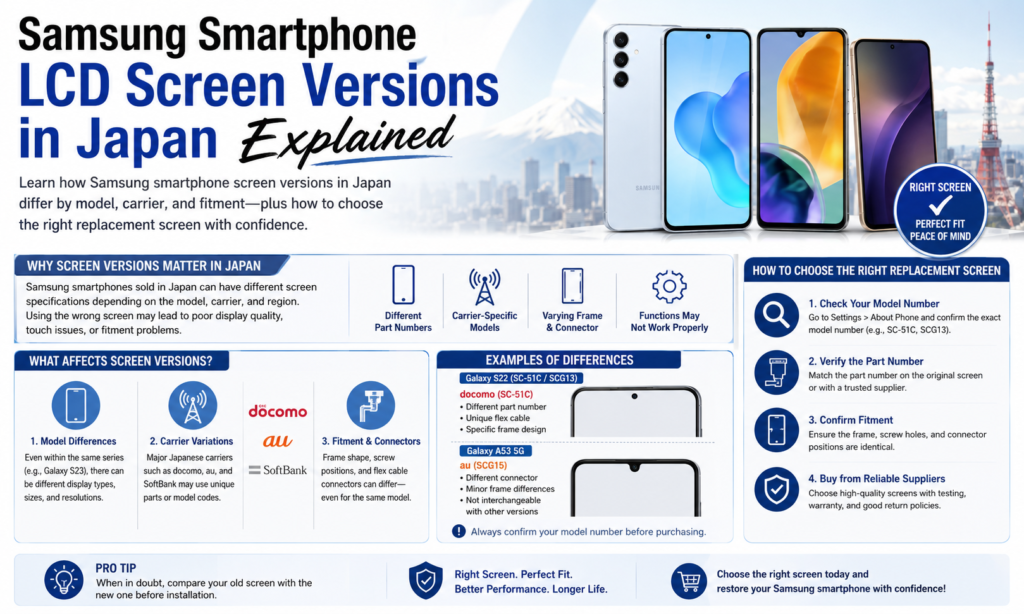
Waarom Samsung-schermversies in Japan anders zijn
Als u in mobiele reparatie werkt, telefoon renovatie, of schermgroothandel, Japanse markt Samsung-smartphoneschermen kan aanvoelen als een puzzeldoos. Op het eerste gezicht, een Galaxy S23 die in Japan wordt verkocht, ziet er bijna identiek uit als een Galaxy S23 die in Korea wordt verkocht, Europa, of de VS. Hetzelfde mooie scherm. Zelfde maat. Hetzelfde premium gevoel in de hand. Maar zodra u de telefoon opent of vervangende onderdelen gaat zoeken, worden de verschillen snel zichtbaar.
Dat is waar dingen interessant worden.
Japan heeft altijd een uniek smartphone-ecosysteem gehad. Vervoerders houden van NTT Docomo, au (KDDI), en af en toe heeft SoftBank in het verleden Samsung Galaxy-apparaten speciaal voor de lokale markt aangepast. Dit betekent modelnummers, firmware, merkvervoerder, en soms verschillen interne componenten van globale versies. Voor reparatiebedrijven, vooral schermleveranciers, dit doet er meer toe dan de meeste mensen zich realiseren.
De officiële Japanse ondersteuningspagina's van Samsung blijven reparatieprijzen vermelden op basis van het exacte Japanse marktmodel, met afzonderlijke afhandeling, afhankelijk van of de telefoon een providerversie of een SIM-vrije versie van de fabrikant is. Dat alleen al vertelt je iets belangrijks: Samsung behandelt veel Japanse Galaxy-varianten onafhankelijk binnen het service-ecosysteem.
Dus als u schermen bestelt die alleen zijn gebaseerd op het “Galaxy S23-display,'Misschien ben je al aan het gokken.
En niemand houdt van gokken met inventaris.
Japanse carrier-gedreven smartphonemarkt
In tegenstelling tot veel regio's waar ontgrendelde telefoons domineren, Japan ontwikkelde zich rond carrier-specifieke hardware. Jarenlang, het kopen van een Galaxy-telefoon betekende vaak direct kopen Docomo of au.
Die providerrelatie creëerde gelokaliseerde apparaatversies zoals:
- SC-51D
- SCG19
- SC-53B
- SCV42
Aan een consument, deze zien eruit als willekeurige letters.
Naar een reparateur, die letters bepalen of het scherm past – of dat het een dure, dode voorraad wordt.
Japanse carrierversies bevatten vaak:
- unieke firmware
- opstartschermen van carriers
- specifieke netwerktuning
- regionale certificeringsmarkeringen
- iets andere frameconstructies
Soms is het schermpaneel zelf identiek.
Soms is alleen de OLED identiek, maar verschilt het frame.
Soms verschuift de lay-out van de flexibele kabel net genoeg om installatieproblemen te veroorzaken.
Dat kleine detail kan van een reparatie van 30 minuten een hoofdpijn van drie uur maken.
Regionale modelnummers en hardwarevariaties
Het naamgevingssysteem van Samsung wordt veel eenvoudiger als je eenmaal weet hoe je het moet lezen.
Voorbeelden:
| Apparaat | Globaal model | Docomo Japan | in Japan |
|---|---|---|---|
| Melkwegstelsel S23 | SM-S911B | SC-51D | SCG19 |
| Melkwegstelsel S24 | SM-S921B | SC-51E | SCG25 |
| Galaxy Z Fold5 | SM-F946B | SC-55D | SCG22 |
| Melkwegstelsel S10 | SM-G973F | SC-03L | SCV41 |
Dezelfde telefoonfamilie.
Verschillende interne referentie.
Verschillende service-inventaris.
Dit is het belangrijkst bij het sourcen:
- weergavesamenstellen
- mid-frame bevestigde schermen
- touch-digitizers
- flex-connectoren weergeven
Alleen kopen op naam van de Galaxy-serie is niet genoeg.
Modelcode is belangrijk.
Altijd.
Samsung-displaytechnologie begrijpen
Mensen zoeken vaak naar ‘Samsung LCD-scherm vervangen,'Maar hier is het grappige gedeelte:
De meeste moderne Samsung-telefoons, vooral in Japan, gebruiken eigenlijk geen traditioneel LCD-scherm.
Ze gebruiken AMOLED.
En ja, dat onderscheid doet er veel toe.
AMOLED versus OLED versus LCD uitgelegd
Laten we het simpel houden.
Denk aan schermtechnologie zoals het verlichten van een kamer.
LCD is als het schijnen van een zaklamp door gekleurd glas.
Je hebt altijd achtergrondverlichting.
De pixels zelf creëren geen licht.
OLED werkt anders.
Elke pixel licht zichzelf afzonderlijk op.
Er zit geen zaklamp achter.
Slechts miljoenen kleine, onafhankelijke lampjes.
AMOLED is Samsung’s geavanceerde versie van OLED.
Het biedt:
- Dieper zwarten
- hoger contrast
- dunnere constructie
- lager stroomverbruik
- rijkere kleurweergave
Die kenmerkende Galaxy-look?
Dat superzwarte zwart als het scherm uit staat?
Dat is AMOLED.
Gemeenschapsdiscussies rond Samsung-reparaties wijzen er nog steeds op dat originele Samsung-vervangende beeldschermen AMOLED blijven in plaats van LCD, terwijl veel goedkopere vervangingen LCD-vervangers gebruiken met een lagere kwaliteit en verminderde prestaties.
Waarom Samsung voornamelijk AMOLED-panelen gebruikt
Samsung Display is een van de grootste OLED-fabrikanten ter wereld.
Zo natuurlijk, Samsung-telefoons laten die kracht zien.
De meeste Galaxy-apparaten op de Japanse markt, van het vlaggenschip uit de S-serie tot Fold and Flip-modellen, gebruiken dit:
- Dynamische AMOLED
- Dynamische AMOLED 2X
- Super AMOLED
Recente officiële Japanse reparatieprijzenpagina's geven een overzicht van de vervanging van schermen voor apparaten zoals Melkwegstelsel S24, S25, En S26 gezinnen, allemaal gebouwd rond Samsung AMOLED-displaytechnologie.
Voor reparatiewerkplaatsen, dit betekent dat originele schermvervangingen doorgaans duurder blijven in vergelijking met iPhone LCD-vervangingen.
Dat is normaal.
Het is de technologie.
Belangrijkste Samsung-telefoonversies verkocht in Japan
Laten we nu eens kijken naar de daadwerkelijke versies die u het vaakst tegenkomt in reparatie- en groothandelskanalen.
Docomo-versies
Docomo is van oudsher de sterkste carrierpartner van Samsung in Japan.
Deze zijn zeer gebruikelijk op de tweedehandsmarkt.
Voorbeelden zijn onder meer:
- SC-02H
- SC-03L
- SC-51A
- SC-51D
- SC-53E
Voorbeelden van algemene modelnaamgeving
Galaxy S7 Rand:
- Globaal: SM-G935
- Docomo Japan: SC-02H
Melkwegstelsel S23:
- Globaal: SM-S911
- Docomo Japan: SC-51D
Deze versies hebben mogelijk dezelfde weergavegrootte, maar verschillen in frame- of serviceassemblagecodering.
bij Versies
De au/KDDI-markt is ook groot.
Veelvoorkomende voorbeelden:
- SCV33
- SCV41
- SCG19
- SCG25
Reparatiecompatibiliteit ligt vaak dichtbij Docomo, maar neem nooit aan.
Verifieer altijd:
- positie van de beeldschermconnector
- montagegaten voor frame
- plaatsing van de sensor
- zelfklevende lay-out
Compatibiliteitsoverwegingen
Een scherm misschien:
- correct inschakelen
- afbeelding correct weergeven
…maar faal nog steeds omdat:
- nabijheidssensor is niet uitgelijnd
- vingerafdruksensor kalibreert niet
- frameclips komen niet overeen
- De positionering van de waterdichte afdichting verschilt
Dat is de reden dat professionele reparatieleveranciers hun inventaris doorgaans sorteren op de exacte Japanse modelcode, in plaats van alleen op ‘Galaxy S24’.
SIM-vrije Japanse versies
Samsung Japan verkoopt ook in de fabriek ontgrendelde apparaten.
Deze hebben meestal modelnummers zoals:
- SM-S918Q
- SM-S921Q
- SM-F946Q
Op de huidige Japanse ondersteuningspagina's van Samsung worden deze SIM-vrije modellen van het merk van de fabrikant afzonderlijk vermeld voor reparatieprijzen.
Deze worden steeds belangrijker omdat de markt voor ontgrendelde telefoons in Japan blijft groeien.
Verschillen tussen Japanse Samsung-schermen
Dit is de sectie waar reparatiewerkplaatsen het meest om geven.
Omdat dit is waar winst (of rendement) plaatsvindt.
Connectorflexverschillen
Flexverschillen kunnen omvatten:
- verschillende connectorlengte
- gevouwen kabelgeleiding
- verschillende plaatsing van de pads
- extra afscherming
Eén connector die niet past, maakt het hele samenstel onbruikbaar.
Zelfs als het paneel zelf prima is.
Dat is de reden waarom veel groothandelaren een lijst maken:
- Alleen OLED
- OLED + aanraken
- OLED met frame
- OLED volledige montage
als afzonderlijke SKU's.
Verschillen in framemontage
Dit is het grootste verborgen probleem.
De OLED zelf kan universeel zijn.
Het frame is dat misschien niet.
Veelvoorkomende verschillen zijn onder meer:
- locatie van het schroefgat
- uitsparingen voor antennebeugel
- plaatsing van de zijknoppen
- uitlijning van luidsprekergaas
- Plaatsing van NFC-componenten
Bij het kopen van ingelijste assemblages zonder de versiecode te controleren, gebeuren veel fouten.
Verschillen in helderheid en vernieuwingsfrequentie
Algemeen, beeldschermspecificaties blijven in alle regio's zeer vergelijkbaar.
Recente modellen uit de Japanse Galaxy S-serie worden bijvoorbeeld nog steeds geleverd:
- 120Hz vernieuwingspercentage
- HDR-ondersteuning
- hoge piekhelderheid
- QHD- of FHD+-resolutie, afhankelijk van het model
De lanceringsinformatie van de Galaxy S23 Japan bevestigde dezelfde 120Hz AMOLED-specificaties die wereldwijd worden aangetroffen.
De prestaties blijven dus meestal consistent.
Mechanische compatibiliteit is het grotere probleem.
Het juiste vervangingsscherm kiezen voor Samsung-telefoons op de Japanse markt
Bij het kopen van een Samsung-display voor apparaten op de Japanse markt draait het niet alleen om de prijs.
Het gaat over risicomanagement.
OEM versus getrokken versus gereviseerd versus aftermarket
Hier is de snelle vergelijking.
| Type | Kwaliteit | Prijs | Aanbevolen |
|---|---|---|---|
| OEM-origineel | Uitstekend | Hoog | Best |
| Scherm getrokken | Uitstekend | Middelhoog | Erg goed |
| Gerenoveerde OLED | Goed | Medium | Goed |
| Aftermarket-LCD | Lager | Laag | Alleen budget |
OEM: Gloednieuw origineel Samsung.
Getrokken: Verwijderd van originele telefoons.
Gerenoveerd: Originele OLED met vervangen glas.
Aftermarket: Kopieerscherm van derden.
Voor Galaxy-apparaten op de Japanse markt, getrokken en OEM blijven meestal de veiligste keuzes.
Veelvoorkomende fouten die reparatiewerkplaatsen moeten vermijden
De meest voorkomende fouten?
Alleen kopen op telefoonnummer.
Achtervoegselcodes negeren.
Ervan uitgaande dat alle schermen uit de S-serie identiek zijn.
Framemontages bestellen zonder controle.
Docomo mengen met wereldwijde voorraad zonder testen.
De veiligere workflow ziet er als volgt uit:
- Bevestig het modelnummer in Instellingen of achterlabel
- Bevestig de exacte providerversie
- Zorg ervoor dat de servicecode overeenkomt
- Match frame/no-frame versie
- Test vóór volledige installatie
Vijf extra minuten hier kunnen later weken aan retouren besparen.
Conclusie
De schermen van Samsung-smartphones op de Japanse markt lijken genoeg op elkaar om vertrouwen te wekken, en zijn verschillend genoeg om dure fouten te veroorzaken.
Dat maakt ze lastig.
Als u een mobiele reparatiewerkplaats bent, wederverkoper van onderdelen, opknapper, of groothandelkoper, de sleutel is eenvoudig:
Koop nooit alleen op basis van de naam Galaxy.
Verifieer altijd:
- volledig modelnummer
- dragerversie
- frameconfiguratie
- OLED-type
- connectorindeling
De Japanse markt van Samsung blijft groeien met zowel carrier- als SIM-vrije Galaxy-apparaten, wat betekent dat de vraag naar nauwkeurige vervanging van beeldschermen alleen maar zal blijven toenemen.
En in de reparatiebranche, nauwkeurigheid verslaat elke keer snelheid.
Een correct scherm levert winst op.
Het verkeerde scherm wordt inventaris die niemand wil.
Dat is het hele spel.
FAQ's
1. Verschillen de Japanse Samsung Galaxy-schermen van de wereldwijde versies??
Soms wel. Het OLED-paneel kan hetzelfde zijn, maar framemontage, flexibele kabelindeling, of vervoerderspecifieke componenten kunnen verschillen, afhankelijk van het exacte model.
2. Gebruiken Samsung-telefoons in Japan LCD of AMOLED??
De meeste moderne Samsung-telefoons die in Japan worden verkocht, gebruiken dit AMOLED, niet LCD-scherm.
3. Kunnen Docomo- en au Galaxy-schermen uitwisselbaar zijn??
Soms – maar niet altijd. Controleer altijd de exacte modelcode voordat u bestelt.
4. Wat is het veiligste vervangingsscherm voor Japanse Samsung-telefoons??
OEM originele of originele getrokken schermen zijn over het algemeen het veiligst en meest betrouwbaar.
5. Waarom zijn vervangende schermen van Samsung duur in Japan??
Omdat originele Samsung AMOLED-panelen premiumcomponenten zijn met geïntegreerde aanraak- en displayassemblages, vaak verkocht als complete modules.