Inleiding tot de import van LCD-schermen van smartphones
LCD-schermen van smartphones vormen het kloppende hart van moderne mobiele apparaten. Kraak er een, en de telefoon is vrijwel blind. Dat is de reden waarom de wereldwijde vraag naar vervangende en originele LCD-schermen voor smartphones jaar na jaar blijft groeien. Van reparatiewerkplaatsen tot grote distributeurs, Het importeren van LCD-schermen voor mobiele telefoons is eerder een dagelijkse bedrijfsvoering geworden dan een nichehandel.
Maar hier is het addertje onder het gras: Het importeren van LCD-schermen voor smartphones gaat niet alleen over het vinden van een leverancier en het verzenden van de goederen. Inklaringsprocedures bij de douane, documentatievereisten, tarieven, en belastingbeleid kan uw winstmarge maken of breken. Denk aan douane-inklaring zoals luchthavenbeveiliging voor goederen: mis één document, en alles wordt uitgesteld.
Laten we het allemaal in gewoon Engels opsplitsen.
Invoerinklaring begrijpen voor LCD-schermen van smartphones
Inklaring is het juridische proces waarbij goederen bij de douane worden aangegeven wanneer ze een land binnenkomen. Voor smartphone LCD-schermen, dit proces is vooral belangrijk omdat deze producten onder elektronische componenten vallen, die vaak onderworpen zijn aan strikte inspectie- en waarderingsregels.
Douaneautoriteiten concentreren zich op:
- Productclassificatie
- Aangegeven waarde
- Land van herkomst
- Beoogd commercieel gebruik
Begrijp een van deze dingen verkeerd, en u kunt te maken krijgen met vertragingen, boetes, of zelfs beslaglegging op zendingen.
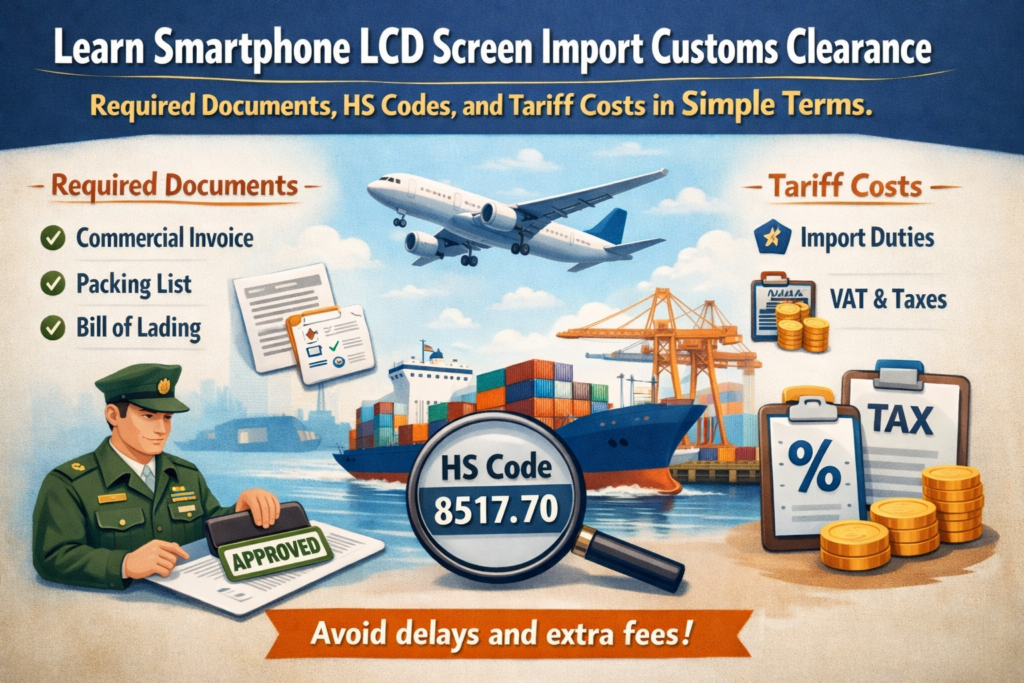
HS-codeclassificatie voor LCD-schermen van smartphones
De HS (Geharmoniseerd systeem) code is de ruggengraat van de douaneafhandeling. Hierin staat hoeveel accijns u betaalt en welke regels er gelden.
LCD-schermen van smartphones worden meestal geclassificeerd onder HS-codes die verband houden met:
- Weergavemodules met vloeibare kristallen
- Onderdelen en accessoires van mobiele telefoons
Het kiezen van de juiste HS-code is niet optioneel, maar verplicht. Een verkeerde code kan leiden tot hogere invoerrechten of douanecontroles. Zorg ervoor dat de HS-code altijd overeenkomt met de daadwerkelijke productfunctie, niet alleen wat de leverancier suggereert.
Vereiste importdocumenten voor LCD-schermen van smartphones
Papierwerk kan saai aanvoelen, maar bij de douaneafhandeling, documenten zijn koning.
Commerciële factuur
Dit document toont de transactiewaarde. Het moet omvatten:
- Gegevens van koper en verkoper
- Productbeschrijving (bijv., LCD-displaymodule voor smartphones)
- Eenheidsprijs en totale waarde
- Valuta en betalingsvoorwaarden
Nauwkeurigheid is hier van cruciaal belang omdat de douane dit gebruikt om invoerrechten en belastingen te berekenen.
Paklijst
Op de paklijst staat hoe de goederen zijn verpakt:
- Aantal dozen
- Bruto- en nettogewicht
- Aantal per verpakking
Customs uses this during inspections to verify physical goods against declared data.
Verkoopcontract
The contract proves that the trade is legitimate. It usually includes:
- Productspecificaties
- Delivery terms (Incotermen)
- Payment conditions
While not always inspected line by line, customs may request it during audits.
Certificaat van oorsprong
This document shows where the LCD screens were manufactured. It plays a key role in:
- Determining applicable tariff rates
- Applying free trade agreement benefits
Certificates of origin can be:
- Non-preferential
- Preferential (used for tariff reductions)
Bill of Lading or Air Waybill
This is the transport document issued by the carrier. It confirms shipment details and ownership of the goods.
Import Declaration Form
This is submitted electronically or manually to customs, summarizing all shipment information.
Special Compliance Requirements for LCD Screen Imports
De douane verlangt vaak gedetailleerde productbeschrijvingen voor LCD-schermen, inbegrepen:
- Schermtype (LCD, Tft, IPS)
- Grootte en resolutie
- Of het nu gemonteerd of halffabrikaat is
Voor merkschermen is in sommige landen mogelijk ook merkautorisatie of handelsmerkverklaringen vereist.
Importtarieven voor LCD-schermen van smartphones
Invoerrechten bestaan meestal uit:
- Basis invoerrecht
- Belasting over de toegevoegde waarde (VAT)
Het basistarief verschilt per land en HS-code, vaak variërend van 0% naar 10%. De BTW wordt doorgaans berekend over de CIF-waarde (Kosten + Verzekering + Vracht).
Formule voor belastbare waarde:
CIF-waarde + invoerrechten = BTW-grondslag
Als u deze formule begrijpt, kunt u de logistieke kosten nauwkeurig voorspellen.
Hoe importtarieftarieven te controleren
U kunt de tarieven raadplegen via:
- Officiële databases met douanetarieven
- Nationale douanewebsites
- Erkende douane-expediteurs
Voor een fooi: Controleer altijd de tarieven vóór verzending. Beleid verandert, en het tarief van gisteren is mogelijk niet van toepassing vandaag.
Importbelastingteruggave en kortingsbeleid
Als geïmporteerde LCD-schermen van smartphones later opnieuw worden geëxporteerd (wat gebruikelijk is in reparatie- en distributiecentra), komt u mogelijk in aanmerking voor belastingteruggave.
Belastingteruggave bij invoer
Sommige landen staan restitutie van invoer-btw toe als goederen binnen een bepaalde periode opnieuw worden geëxporteerd.
Btw-korting bij export
In productie- of wederexportscenario's, Er kunnen BTW-kortingen bij export van toepassing zijn. LCD-gerelateerde producten genieten vaak gematigde kortingen, afhankelijk van classificatie.
Controleer altijd of u in aanmerking komt voor kortingen voordat u grote importvolumes plant.
Kostenoptimalisatiestrategieën voor importeurs
Slimme importeurs regelen niet alleen de douane, ze optimaliseren deze ook.
- Kies verstandig voor gunstige Incoterms zoals FOB of CIF
- Maak indien van toepassing gebruik van vrijhandelsovereenkomsten
- Consolideer zendingen om de logistieke kosten per eenheid te verlagen
Beschouw de douanestrategie als een schaakspel, geen dobbelsteenworp.
Veelvoorkomende risico's bij inklaring en hoe u deze kunt vermijden
Typische valkuilen zijn onder meer:
- Inconsistente factuurwaarden
- Vage productbeschrijvingen
- Onjuiste HS-codes
De oplossing? Samenhang, transparantie, en voorbereiding.
Typisch douane-inklaringsproces, stap voor stap
- Bereid documenten voor voordat de verzending arriveert
- Douaneaangifte indienen
- Douane inspectie (indien nodig)
- Betaal invoerrechten en belastingen
- Goederen vrijgegeven
Een soepele ontruiming heeft alles te maken met voorbereiding, geen geluk.
Werken met douane-expediteurs en expediteurs
Als u regelmatig importeert, een professionele makelaar is elke cent waard. Zij:
- Declaraties afhandelen
- HS-geschillen oplossen
- Bespaar tijd en verminder risico's
Kies partners met ervaring in het importeren van elektronica, niet alleen stukgoed.
Casestudy: LCD-schermen voor smartphones importeren uit China
Een distributeur importeert 1,000 LCD-schermen:
- Aangegeven waarde: USD 30,000
- Invoerrechten: 5%
- VAT: 13%
Correcte documentatie en gebruik van de HS-code resulteren in een soepele afhandeling binnen twee werkdagen – zonder vertragingen, geen boetes.
Toekomstige trends in de import van LCD-schermen van smartphones
Digitale douanesystemen, vooraangifte, en AI-ondersteunde inspecties worden de norm. Transparantie en compliance zullen belangrijker zijn dan ooit.
Conclusie
Het importeren van LCD-schermen van smartphones is een winstgevende onderneming, maar alleen als u de douaneregels en tariefregels beheerst. Met de juiste documenten, juiste HS-codes, en een duidelijk begrip van invoerrechten en belastingkortingen, je verandert de douane van een wegversperring in een fast lane. Behandel compliance als onderdeel van uw bedrijfsstrategie, en uw import zal net zo soepel verlopen als een nieuwe swipe op het touchscreen.
FAQ's
Welke documenten zijn vereist om LCD-schermen van smartphones te importeren??
Normaal gesproken heeft u een handelsfactuur nodig, paklijst, contract, certificaat van oorsprong, en vervoersdocument.
Zijn LCD-schermen van smartphones onderworpen aan invoerrechten??
Ja, de meeste landen hanteren basisinvoerrechten en BTW, afhankelijk van de HS-codeclassificatie.
Hoe kan ik de invoerbelastingen legaal verlagen??
Gebruik de juiste HS-codes, vrijhandelsovereenkomsten, en verken het beleid inzake belastingteruggave bij wederuitvoer.
Is een certificaat van oorsprong verplicht?
Ja, vooral als u voorkeurstarieven wilt aanvragen.
Kan ik merk-LCD-schermen zonder toestemming importeren??
In sommige landen is merkautorisatie of handelsmerkregistratie vereist. Controleer altijd de lokale regelgeving.